Mastering the Music Stream: How Spotify Engineers Built a Reinforcement Learning Sandbox with TensorFlow

In the highly competitive world of digital music streaming, the difference between a listener staying for one song or ten often comes down to the quality of the "next track" recommendation. For Spotify, which serves hundreds of millions of users, the challenge is not just recommending a song, but curating a continuous, evolving listening experience that anticipates a user’s intent in real-time.
To solve this, a team of Spotify engineers—Surya Kanoria, Joseph Cauteruccio, Federico Tomasi, Kamil Ciosek, Matteo Rinaldi, and Zhenwen Dai—turned to Reinforcement Learning (RL). By leveraging the TensorFlow ecosystem and TF-Agents, the team successfully developed an offline simulation environment that allows them to train, test, and refine recommendation agents without ever exposing live users to the risks of an untrained model.
The Challenge of Sequential Decision Making
At its core, music recommendation is a sequential decision-making process. Unlike a static search query, where a single result might suffice, a playlist session requires a sequence of items that must satisfy a user’s changing mood and intent. Standard machine learning models often struggle with this; they are frequently designed to predict a single, static interaction.

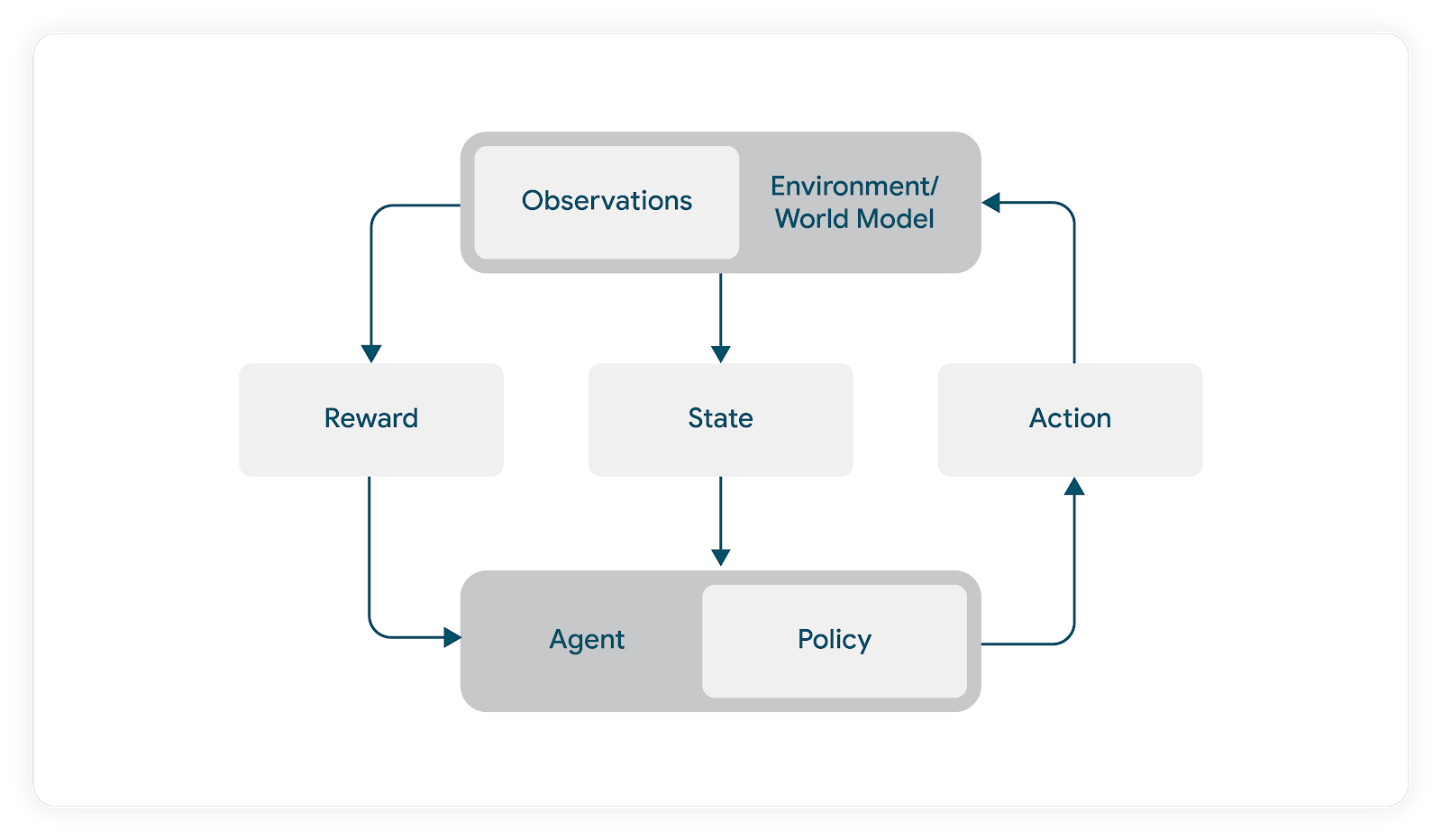
Reinforcement Learning, however, is built for this. It treats the listening session as a series of states and actions. The agent observes the state (the current context), takes an action (recommends a track), and receives a reward (the user’s reaction, such as skipping or listening through). The goal of the agent is to learn a policy that maximizes the long-term cumulative reward.
The primary obstacle for the Spotify team was the "cold start" problem inherent in training RL models. If you deploy an untrained or poorly tuned agent into the live production environment, the initial "exploration" phase could lead to a poor user experience—a non-starter for a platform that prides itself on personalization.
Building the Sandbox: A Chronology of Development
The development of Spotify’s RL infrastructure was a deliberate, modular process that prioritized stability and scalability.

Phase 1: Choosing the Framework
Early in the project, the team recognized that they needed a framework that could bridge the gap between experimental research and production deployment. Given that TensorFlow and TFX (TensorFlow Extended) were already integral to their production stack, the team opted for TF-Agents. This choice ensured that the transition from a sandbox environment to live, large-scale deployment would be seamless, minimizing the friction of re-tooling or porting code.
Phase 2: Designing the Offline Simulator
With the library selected, the team faced a missing link: an offline environment that could accurately mimic the complexity of the Spotify experience. They needed a simulator that could:
- Represent Hypothetical Users: Utilize real-world data to create "simulated users" who respond to content in ways that mirror real behavior.
- Define Action and Observation Spaces: Create a structure that could handle the combinatorial complexity of picking tracks from a massive, ever-changing library.
- Manage Termination Dynamics: Program the simulator to recognize when a session "ends," based on empirical data—such as when a user skips a track a certain number of times.
Phase 3: The "Action-Head" Innovation
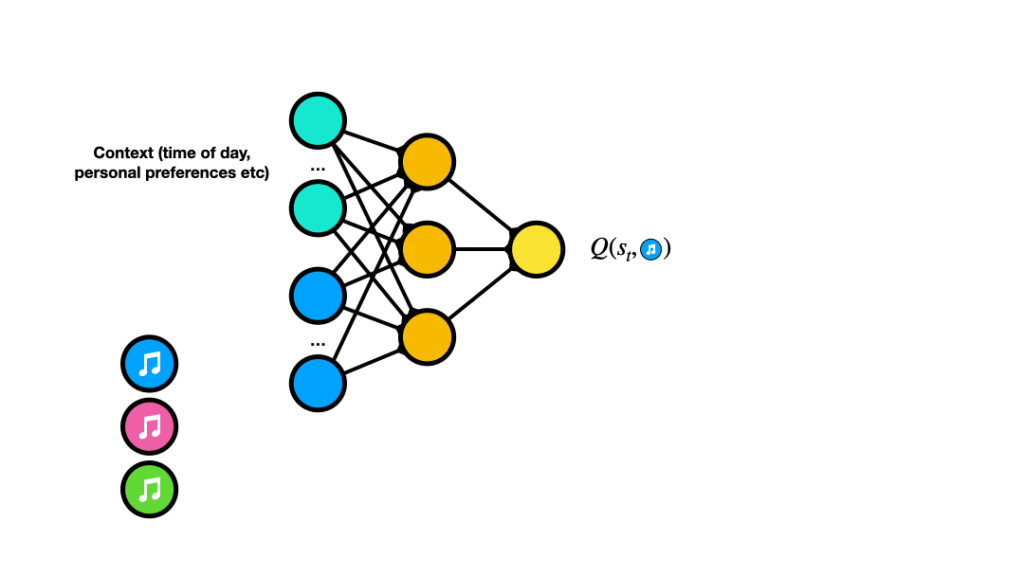
Standard RL agents often struggle when the action space is vast. To address this, the team developed a custom architecture: the Action-Head DQN (AH-DQN). Unlike traditional models that might output a single recommendation, the AH-DQN evaluates potential tracks one by one, calculating a Q-value for each, and iteratively building an entire playlist. This allowed the team to handle the constraints of large-scale playlist generation where multiple items must be selected at once.
Supporting Data and Technical Architecture
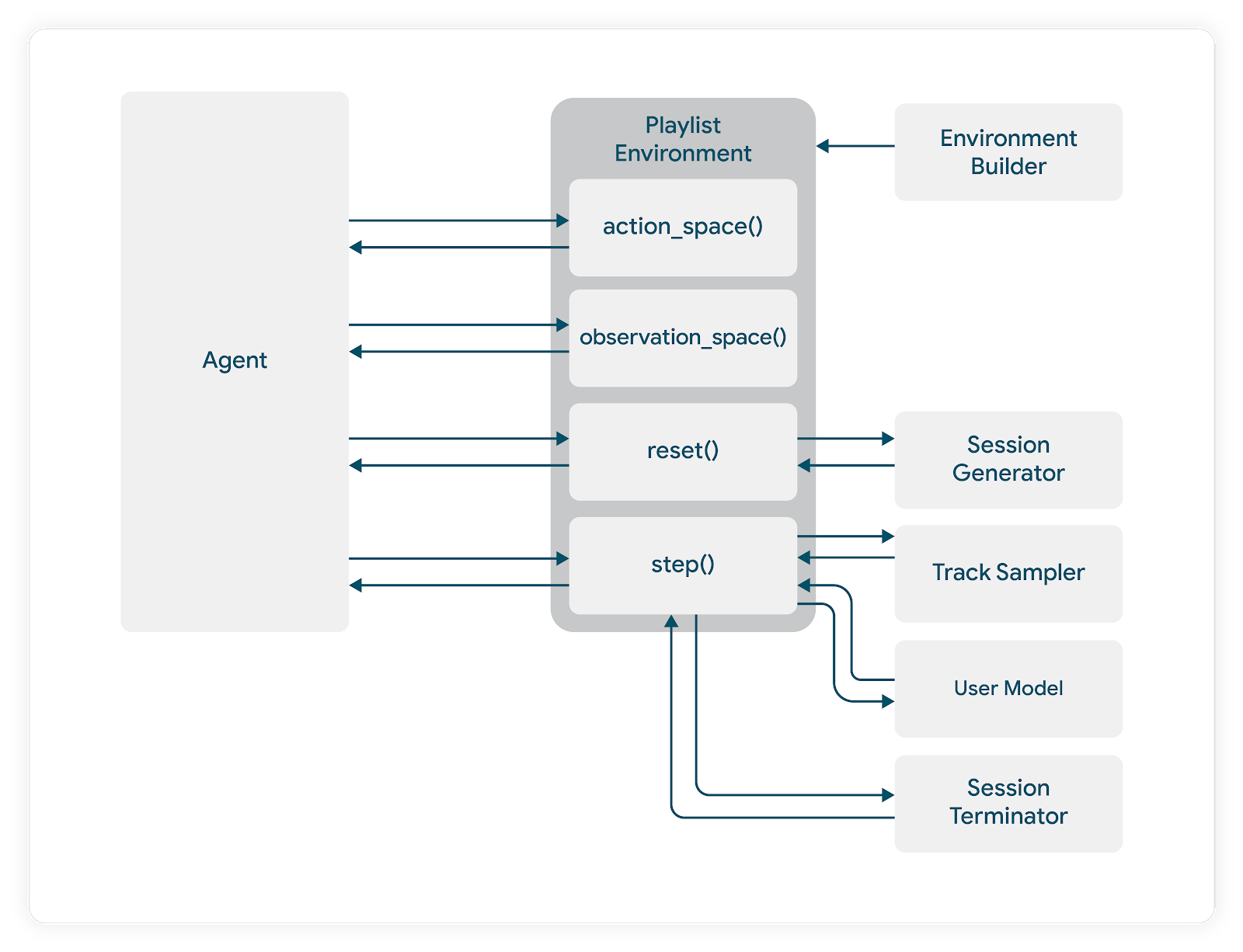
The success of the project hinged on the modularity of the code. The team built an AbstractEnvironment class that served as a template for all simulations. By defining strict interfaces for reset, step, observation_space, and action_space, the engineers were able to swap out different models and data sets without rewriting the entire simulation core.
The RL Loop
The simulation loop is a marvel of efficiency. The agent pulls an observation from the environment, performs an action, and receives a reward derived from a "User Model." This user model, trained using Keras, acts as a surrogate for real human behavior. By predicting how a user would respond to a specific track, the model-based RL system allows the agent to train against a "digital twin" of the user base.
Validating the Simulation
The most critical test of this system was verifying that "offline performance" actually predicted "online success." The team ran a series of experiments, comparing the results of their simulated agents against live A/B tests on the platform. The data showed a clear, positive correlation: as the simulated performance increased, the online metrics—such as time spent listening and track completion rates—consistently followed suit.

Official Perspectives: The KDD 2023 Disclosure
In their presentation at the KDD 2023 conference, the Spotify engineers emphasized that this was not merely a theoretical exercise. The project represented a fundamental shift in how the company approaches recommendation systems. By treating music discovery as a dynamic conversation rather than a static lookup, they have unlocked new ways to keep users engaged.
"Reinforcement Learning provides us with a method set that naturally accommodates the sequential nature of music listening," the team stated in their report. They noted that the ability to safely train agents offline was the "unlock" that allowed them to scale their RL experiments to the entire Spotify ecosystem.
The team also expressed deep gratitude to the TensorFlow Agents community, noting that the open-source collaboration provided by the TF-Agents team was instrumental in the project’s success. The modularity of the open-source library was specifically cited as the reason the team could design their custom AH-DQN and complex simulator architectures with such efficiency.

Implications for the Future of Recommendation
The success of this initiative has broad implications for the tech industry, specifically regarding the future of AI-driven personalization.
1. Safer AI Development
The most significant takeaway is the validation of model-based RL in production environments. By using simulated environments to "pre-train" agents, companies can significantly mitigate the risks associated with AI in consumer-facing products. This "sandbox first" approach is likely to become the industry standard for any service involving user interaction.
2. The Shift to Sequential Personalization
Spotify’s success confirms that users respond better to systems that understand the "arc" of an experience. Whether it is a playlist, a series of videos, or a shopping journey, the move toward sequential models—where each recommendation is informed by the preceding one—is the new frontier of personalization.
3. Democratization of Complex RL
By demonstrating that an Action-Head DQN can be implemented using standard frameworks like TF-Agents, the Spotify team has provided a blueprint for other developers. It effectively lowers the barrier to entry for building sophisticated, state-aware recommendation engines, suggesting that we will see a surge in similar "intelligent" interfaces across the web.
Conclusion
The work of Kanoria and his colleagues at Spotify is a masterclass in modern machine learning engineering. By combining the power of the TensorFlow ecosystem with a rigorous approach to simulation, they have not only improved the daily experience for millions of listeners but also established a robust, scalable framework for future innovation. As AI continues to evolve, the ability to build safe, effective, and deeply personalized sequential experiences will define the next generation of digital platforms. The "Spotify Sandbox" is, in many ways, the blueprint for that future.