The Missing Harness: Why AI Coding Agents Have Better Safeguards Than the Humans Managing Them
In the rapidly evolving landscape of software engineering, a striking paradox has emerged. When a developer deploys an artificial intelligence (AI) coding agent, the agent is immediately surrounded by a sophisticated, automated infrastructure designed to keep it from making mistakes. A phalanx of linters, git hooks, continuous integration (CI) pipelines, unit tests, and runtime rules watch its every move. If the agent attempts to commit malformed code, a gate slams shut.
Yet, when it comes to keeping the human developer oriented across a dozen parallel tasks, the tooling reverts to the stone age. For most engineers, the primary mechanism for maintaining mental context and project alignment is a manually updated Markdown file—a fragile "honor system" prone to rapid decay.
While millions of dollars have been poured into building execution harnesses for AI agents, human operators have been left to manage their own cognitive load on discipline alone. By mapping the modern developer tooling landscape across two key axes—the loop being served and the enforcement mechanism applied—we expose a critical, unaddressed gap in the software development lifecycle.
Main Facts: Mapping the Tooling Landscape
To understand why modern development workflows feel increasingly chaotic despite the intelligence of our tools, we must divide the engineering workflow into two distinct loops operating at different altitudes:
- The Execution Loop: This is the low-altitude, task-specific cycle. It answers the question: Is the agent building this specific unit of code correctly right now?
- The Orientation Loop: This is the high-altitude, multi-task coordination cycle. It answers the questions: What are we working on? Why are we working on it? Are we still aligned on the broader objective, or are we building the wrong thing?
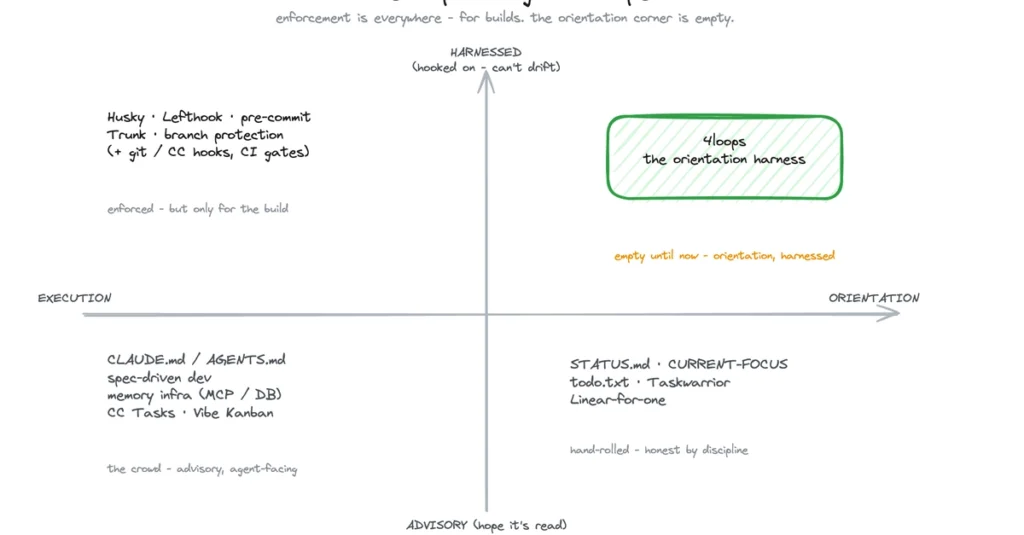
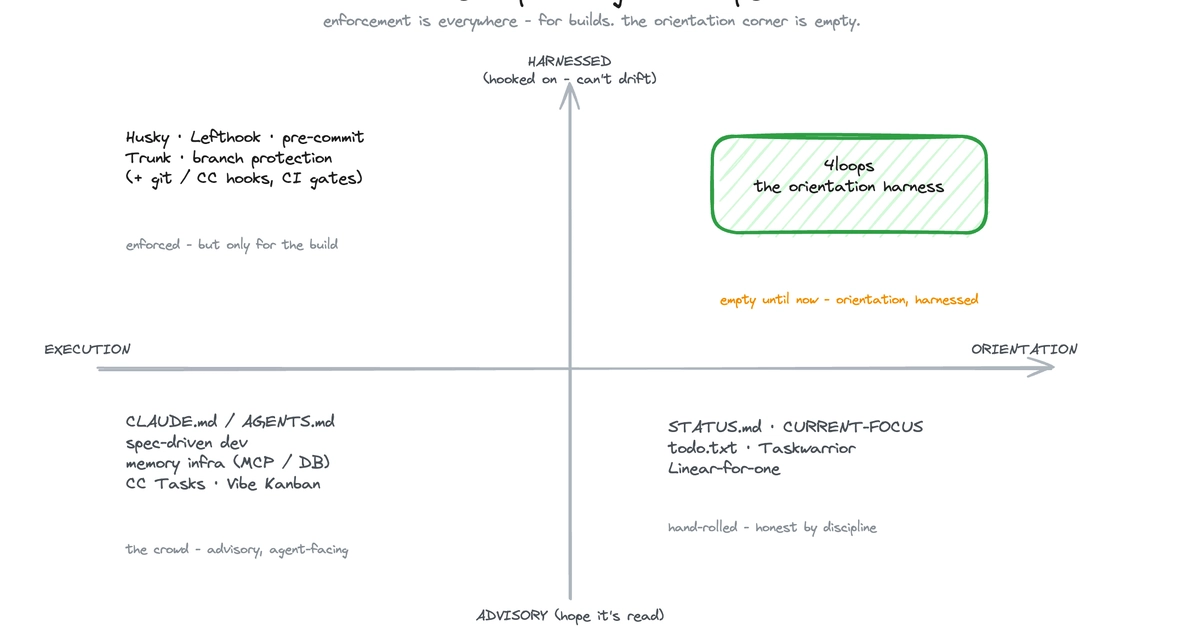
When these loops are mapped against their level of enforcement, a stark asymmetry is revealed. Tools either act as Advisory (offering suggestions or documentation that can be ignored) or Harnessed (enforcing compliance by gating actions).
                      ▲ HARNESSED (Enforced)
                      │
                      │  * Husky / Lefthook / Pre-commit
                      │  * CI/CD Pipelines
                      │  * GitHub Branch Protection
                      │  * Claude Code Hooks
                      │
                      │                       [ THE EMPTY CORNER ]
                      │                       (Harnessed Orientation)
                      │
──────────────────────┼────────────────────────────────────────►
                      │
EXECUTION             │                      ORIENTATION
(Task-level)          │                      (Workflow-level)
                      │
                      │  * STATUS.md / todo.txt
                      │  * Personal Linear Boards
                      │  * Taskwarrior
                      │
                      │  * CLAUDE.md / AGENTS.md
                      │  * Spec Kit / Spec-driven Dev
                      │  * Memory MCPs / Vibe Kanban
                      ▼ ADVISORY (Unenforced)
The Four Quadrants of Developer Tooling
- Execution & Advisory (The Crowded Corner): This quadrant is filled with tools designed to help agents write code, but without hard enforcement. Examples include
CLAUDE.mdandAGENTS.mdfiles, spec-driven development frameworks (like GitHub’s Spec Kit), external Model Context Protocol (MCP) memory stores, and visual boards like Vibe Kanban. These tools provide context, but they rely entirely on the agent choosing to read and respect them. - Execution & Harnessed (Productized Enforcement): This is a mature, highly productized category. Tools like Husky, Lefthook, pre-commit, Trunk, and GitHub branch protection rules do not politely request clean code; they actively prevent developers and agents from committing or merging work until all tests, style checks, and security scans pass.
- Orientation & Advisory (Hand-Rolled Discipline): This is where the human developer’s mental map lives. It consists of
STATUS.mdfiles,todo.txtfiles, Taskwarrior instances, or personal Linear boards. These tools are valuable, but they are kept honest solely by the developer’s self-discipline. If a developer forgets to update them, the system silently rots. - Orientation & Harnessed (The Empty Corner): This quadrant represents the missing link in modern software engineering. It is a tool or framework that serves both the human and the agent from a single, shared source of truth, and actively gates progress if that truth becomes misaligned. No widely adopted tool currently occupies this space.
Chronology: The Evolution of Developer Guardrails
The current imbalance in developer tooling is the result of a multi-decade evolution in software engineering practices, accelerated by the sudden rise of generative AI.
┌────────────────────────┐     ┌────────────────────────┐     ┌────────────────────────┐
│   Pre-2022: Code Era   │ ──► │  2022-2024: Agent Era  │ ──► │ 2024-Present: Friction │
│  Enforcement focused   │     │  Rapid dev of agent    │     │  Advisory tools fail;  │
│  on local git hooks,   │     │  execution harnesses   │     │  cognitive overhead    │
│  CI/CD, & syntax rules │     │  to prevent AI errors  │     │  creates bottleneck    │
└────────────────────────┘     └────────────────────────┘     └────────────────────────┘
Phase 1: Pre-2022 – The Era of Code Quality Enforcement
Before AI agents became mainstream, the software industry spent years solving the "dirty code" problem. The community realized that relying on developer discipline to run linters and tests before committing was a losing battle. This led to the widespread adoption of local git hooks (via Husky and Lefthook) and cloud-based CI/CD pipelines. Enforcement became the industry standard for the execution loop.
Phase 2: 2022–2024 – The Agent Explosion and Execution Harnessing
With the introduction of LLM-based coding assistants, the volume of code being generated increased exponentially. Because early agents were prone to hallucination and syntax errors, developers quickly surrounded them with the same execution-level harnesses used for humans. Sandboxed runtimes, automated test runners, and real-time syntax checking were integrated directly into agent environments to keep them on the rails.
Phase 3: 2024–Present – The Orientation Crisis
As agents became more capable of executing complex, multi-file edits, the bottleneck shifted from code generation to project direction. Developers found themselves spending more time keeping the agent oriented than writing code.
In response, the community created advisory structures like AGENTS.md and CLAUDE.md to instruct agents on project rules and architecture. However, because these files are purely advisory, developers soon realized that agents frequently ignore them, leading to a silent decay of project state and an increase in cognitive overhead for the human operator.
Supporting Data: Why Advisory Context Fails
The failure of advisory files to keep AI agents aligned is not just an anecdotal frustration; it is a measurable technical limitation.
Researchers at ETH Zurich recently conducted an empirical study testing four leading coding agents across 138 complex software engineering tasks to measure the efficacy of context files. The study yielded several critical data points regarding the "advisory corner" of developer tooling:
| Metric Evaluated | Impact of Developer-Written AGENTS.md |
Impact of AI-Generated AGENTS.md |
|---|---|---|
| Task Success Rate | Marginal, statistically negligible improvement | Slightly negative (performance degraded) |
| API Call Costs | +20% to +25% increase in token usage | +20% to +25% increase in token usage |
| Execution Efficiency | Lowered due to redundant context processing | Lowered due to conflicting instructions |
The Root Cause of the Efficiency Gap
The researchers found that adding advisory context files to an agent’s workspace introduces a significant financial and computational penalty without a corresponding increase in reliability. The reasons are twofold:
- Lack of Force: Because a Markdown file is passive advice, the agent is not structurally compelled to follow it. Depending on the model’s attention span and the prompt’s structure, the agent may adhere to the rules in one turn and completely ignore them in the next.
- Context Bloat: Injecting a static instructions file into every prompt iteration inflates the context window. This increases token consumption by more than 20%, resulting in higher API bills and slower response times, while failing to provide a reliable guardrail.
When the execution loop breaks, the feedback is immediate and loud: a test suite fails, or a CI build turns red. But when the orientation loop breaks, the failure is silent. The agent confidently re-suggests an approach the developer rejected hours prior, or rebuilds a feature based on outdated specifications. The only signal of failure is a subtle deceleration in velocity—a tax paid in cognitive fatigue.
Industry Perspectives: The Architecture of the Harness
The concept of how humans should interact with automated agents has been deeply analyzed by industry experts. Writing for MartinFowler.com, Kief Morris explored these dynamics in his paper, Humans and Agents in Software Engineering Loops.

Morris categorizes the human operator’s position relative to the agent’s loop into two distinct postures:
- In the Loop: The human acts as an inline inspector, manually reviewing every single artifact, line of code, and change generated by the agent. This approach is highly taxing and limits the scalability of AI assistance.
- On the Loop: The human steps back from line-by-line inspection and instead focuses on shaping and engineering the harness that guides the agent. As Morris writes:
"The ‘on the loop’ way is to change the harness that produced the artefact."
In a companion piece, Harness engineering for coding agent users, Birgitta Böckeler expanded on this concept, defining "harness engineering" as the practice of building robust, automated environments that constrain and validate agent behavior.
However, current harness engineering discussions remain focused on the agent’s execution loop. The industry has yet to apply the same rigor to the developer’s orientation loop.
┌────────────────────────────────────────────────────────┐
│                THE HARNESS ENGINEERING SPLIT           │
├────────────────────────────┬───────────────────────────┤
│       AGENT'S LOOP         │       HUMAN'S LOOP        │
│     (Execution-Layer)      │    (Orientation-Layer)    │
├────────────────────────────┼───────────────────────────┤
│  * Highly Harnessed        │  * Purely Advisory        │
│  * Automated Guardrails    │  * Rely on "Discipline"   │
│  * Rigid Enforcement       │  * High Cognitive Decay   │
└────────────────────────────┴───────────────────────────┘
The split is clear: we have decided that the agent’s job (execution) is too critical to leave to advice, so we built automated harnesses for it. Meanwhile, we have left our own job (orientation)—the very task of deciding what the agent should build—to manual upkeep and mental effort.
Implications: Building the Enforced Orientation Loop
If the empty corner of the tooling map is the most critical gap in modern software development, what does a tool designed for that space actually look like?
To move a tool from the advisory bottom-right to the harnessed top-right, it must possess three core characteristics:
1. A Single, Shared Surface
The tool must serve as the single source of truth for both the human developer and the AI agent. It cannot be a project management board that only the human looks at, nor can it be an internal system prompt that only the agent reads. It must be a shared, readable state—such as a structured file in the repository—that both parties continuously reference and update.
2. Gated Execution (Enforcement)
The critical differentiator of a harnessed tool is its ability to block progress when state drift occurs. Just as a pre-commit hook refuses to commit code if a linter fails, an orientation harness must refuse to execute the next agent action or build if the project state has not been reconciled.
For example, if the agent attempts to write code for Task B while Task A is marked as incomplete or unverified, the system must halt execution until the developer explicitly resolves the discrepancy.
                  ┌─────────────────────────────┐
                  │   Developer triggers agent  │
                  └──────────────┬──────────────┘
                                 │
                                 ▼
                  ┌─────────────────────────────┐
                  │  Orientation Hook executes  │
                  └──────────────┬──────────────┘
                                 │
                   Is project state reconciled?
                   ├── Yes ──► [ Run Agent Task ]
                   └── No  ──► [ Block Build / Alert Developer ]
3. Native Integration with Development Primitives
This system does not require exotic technology. The primitives already exist. Command-line tools like Claude Code support hooks that run before a tool executes and can deny the action based on custom logic.
By pointing these existing hook primitives at an orientation board rather than just code syntax, developers can create a system that keeps both human and machine aligned.
The Path Forward for Engineering Teams
For software development organizations, the implications of this tooling gap are profound. As engineering teams increasingly adopt AI agents, the primary bottleneck to shipping software is no longer writing code, but the cognitive overhead of managing agent direction.
Teams that continue to rely on advisory, manual coordination will likely face diminishing returns from AI tools due to context drift and debugging loops. Conversely, organizations that build and adopt harnessed orientation systems—gating agent execution based on explicit, verified project states—will be positioned to unlock the true efficiency gains promised by generative AI.
The empty corner of the map is not a permanent vacuum; it is the blueprint for the next generation of developer tooling.