The Passwordless Revolution: How WhatsApp Scaled Passkey Authentication for Billions
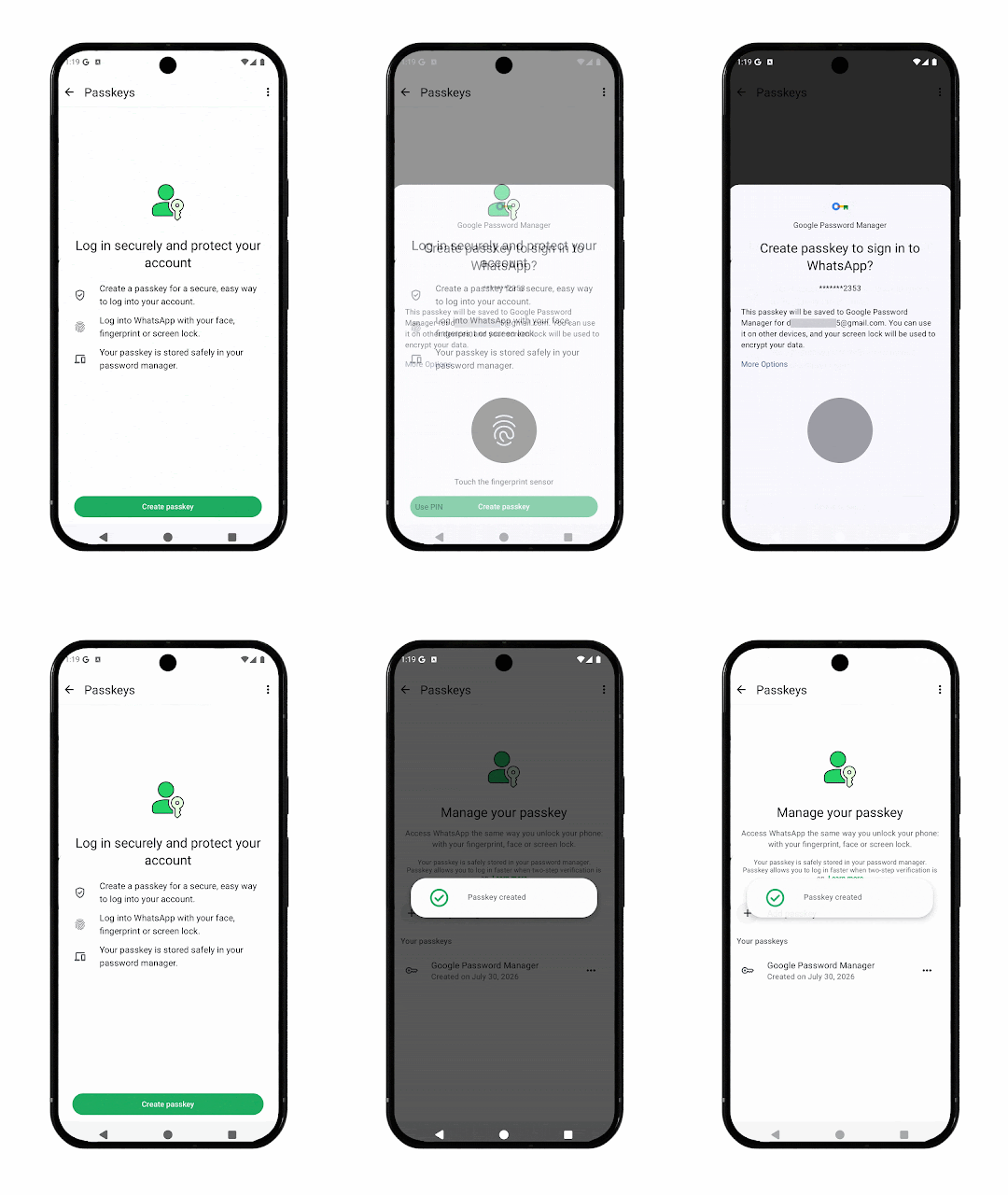
In the rapidly evolving landscape of digital security, the "password" has long been the weakest link—a relic of the early internet that remains a prime target for phishing, credential stuffing, and social engineering. For WhatsApp, the world’s most widely used messaging platform, the challenge of securing billions of accounts while maintaining a seamless user experience was monumental. In 2023, the company made a landmark decision: to move beyond traditional SMS-based authentication and embrace the future of identity via passkeys.
This transition, led by a collaborative effort between WhatsApp’s engineering teams and Google’s Android division, represents one of the most significant real-world deployments of FIDO2/WebAuthn standards to date. By replacing static codes with cryptographic, device-bound credentials, WhatsApp has fundamentally changed how its massive global user base accesses their private conversations.
The Genesis of a Security Shift
The move toward passkeys was not merely a technical upgrade; it was a strategic response to the inherent vulnerabilities of legacy authentication. For years, the industry relied heavily on One-Time Passwords (OTP) sent via SMS. While accessible, SMS-based OTPs are susceptible to SIM-swapping, interception, and network delivery failures, particularly in regions with inconsistent telecommunications infrastructure.

"What excites me most is the sheer scale of WhatsApp’s impact," says Mayank Manuja, an Android Engineer on the WhatsApp Registration and Access team. "Even a small improvement to WhatsApp touches billions of users worldwide."
For the WhatsApp team, the goal was twofold: drastically reduce the friction of the sign-in process and provide a bulletproof defense against account takeovers. By adopting passkeys, WhatsApp shifted the authentication burden from the user’s memory to the device’s hardware-backed security modules.
Chronology of the Integration
The path to a passwordless WhatsApp was paved with rigorous testing and iterative development.

- Early 2023: Strategy and Design: WhatsApp officially committed to the passkey initiative. The team recognized that for a global audience, the user experience (UX) had to be as intuitive as the existing flow, or adoption would fail.
- Mid-2023: Development and API Adoption: Integration began using the Android Credential Manager API. This allowed the team to abstract the complexities of various hardware authenticators, providing a unified interface for biometrics and screen locks.
- Late 2023: A/B Testing and Refinement: Because passkeys were a novel concept for most users, the team engaged in extensive A/B testing to determine the best way to prompt for setup. They discovered that simple, contextual prompts within the app outperformed aggressive, full-screen notifications.
- 2024: Global Rollout: Following successful pilot programs, the feature was deployed across the global user base, effectively allowing users to use their face, fingerprint, or device PIN to log into their WhatsApp accounts.
- 2025: Optimization: Ongoing work continues to focus on edge cases—such as users on older Android versions or devices without biometrics—to ensure that the "happy path" of authentication remains consistent for everyone.
The Technical Architecture: Erlang, Rust, and FIDO2
WhatsApp’s backend, primarily written in Erlang, presented a unique environment for integrating modern web standards. To implement the WebAuthn/FIDO2 ceremonies, the team leveraged the Rust webauthn-rs library. This bridge allowed the Erlang-based backend to handle high-concurrency requests while delegating the complex math of signature verification and credential parsing to Rust’s memory-safe environment.
The architecture revolves around four core sequences:
- Begin Registration: The server generates a unique challenge and creation options, which are sent to the client.
- Finish Registration: The client provides an attestation, which the server verifies and stores as a public key.
- Begin Authentication: The server issues a challenge for an existing, stored credential.
- Finish Authentication: The client signs the challenge using the private key, and the server validates the signature.
A critical design choice was the move to a multi-passkey infrastructure. Unlike earlier implementations that limited users to a single credential, WhatsApp allows users to maintain multiple passkeys, ensuring that a lost device does not result in a permanent lockout.

Supporting Data: Why Passkeys Matter
The necessity for this change is backed by clear security data. Passkeys are phishing-resistant by design because the private key never leaves the user’s device, and the public key is cryptographically tied to the origin (the domain or app package).
In regions with poor network reliability, passkeys have proven significantly more effective than SMS. While an SMS OTP might take minutes to arrive—or fail to arrive entirely due to carrier congestion—a passkey uses the local Secure Enclave of the device, providing near-instantaneous authentication.
Furthermore, the "Credential Manager API" has proven to be a game-changer. By providing a unified interface, it hides the messiness of different Android versions and OEM implementations. During the integration, the team encountered various edge cases—users without screen locks, outdated Google Play Services, and varied biometric sensors—all of which were mitigated through the abstraction layer provided by the API.

Official Perspectives on the Shift
The collaboration between Google and WhatsApp highlights the importance of industry partnership in setting security standards. Niharika Arora (Google) and Tracy Agyemang (WhatsApp) emphasize that this was not just a coding project, but a change in product philosophy.
"We had to navigate a vast range of digital literacy levels," the team noted. "The solution had to be so simple that it required no explanation." By utilizing the native Android "bottom-sheet" interface, the authentication request feels like a natural extension of the operating system, rather than an intrusive third-party prompt.
Implications for the Future of Security
The successful implementation of passkeys at this scale has profound implications for the broader tech industry.

1. The Death of the Password
WhatsApp’s move signals that the industry is nearing a "tipping point." As more major apps—from banking to social media—adopt passkeys, users will become accustomed to biometric authentication as the default, making the password feel archaic and cumbersome.
2. Standardizing Cross-Platform Identity
One of the most innovative aspects of WhatsApp’s implementation is their approach to cross-device sync. Rather than forcing a fragile, Bluetooth-dependent cross-device transport (which often confuses users), they allow users to generate fresh passkeys natively on any device they sign into. This leverages the existing synchronization provided by platforms like Google Password Manager and iCloud, treating the user’s identity as a fluid asset that exists across their personal ecosystem.
3. Future-Proofing Sensitive Actions
The project is not finished. WhatsApp is now looking into extending passkey usage to in-app re-authentication. This means that for sensitive actions—such as accessing encrypted backups or changing account privacy settings—users may soon be prompted for a biometric confirmation, effectively adding a layer of "Step-Up" authentication that does not require a secondary device or email.

Best Practices for Developers
For companies looking to follow in WhatsApp’s footsteps, the engineering team offers several key recommendations:
- Start with the User Experience: Do not treat passkeys as a technical feature; treat them as a UX upgrade.
- Leverage Existing APIs: Do not reinvent the wheel. Use the Credential Manager API on Android to handle the underlying complexities.
- Plan for Failure: Always have a robust recovery flow. The goal is to reduce friction, but the "account recovery" path must be as secure as the "registration" path.
- Monitor Edge Cases: Device diversity is the biggest hurdle. Ensure that your implementation gracefully handles devices without biometrics or those running older OS versions.
Conclusion: A New Standard for Privacy
WhatsApp’s journey to passkeys is a masterclass in scaling security. By prioritizing user convenience alongside cryptographic robustness, they have proven that security does not have to be a trade-off for usability. As the digital world becomes increasingly interconnected and vulnerable, the move toward device-bound, passwordless authentication is not just a trend—it is a necessity.
With billions of users now empowered to protect their chats with a simple tap, the "Passkey Era" has officially arrived. For developers, the message is clear: the tools are available, the documentation is mature, and the time to eliminate the password is now.