The Architects of Immunity: Celebrating the 13th Annual Ross Prize in Molecular Medicine
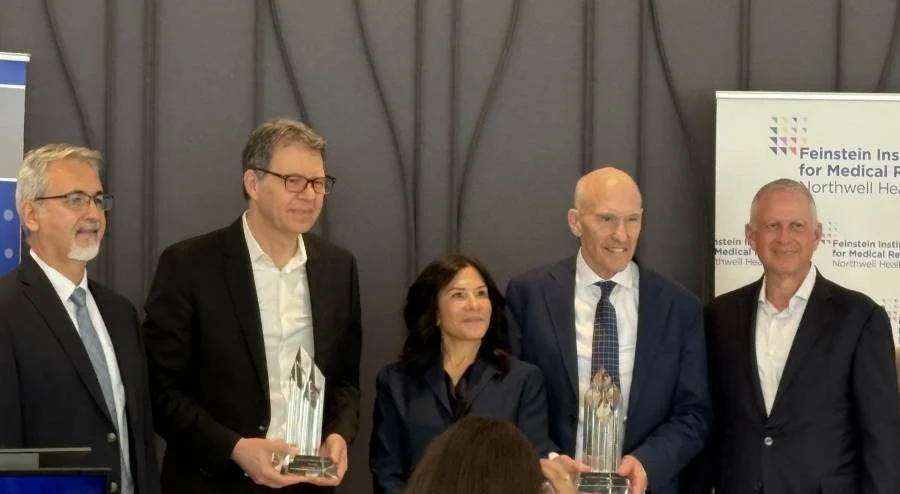
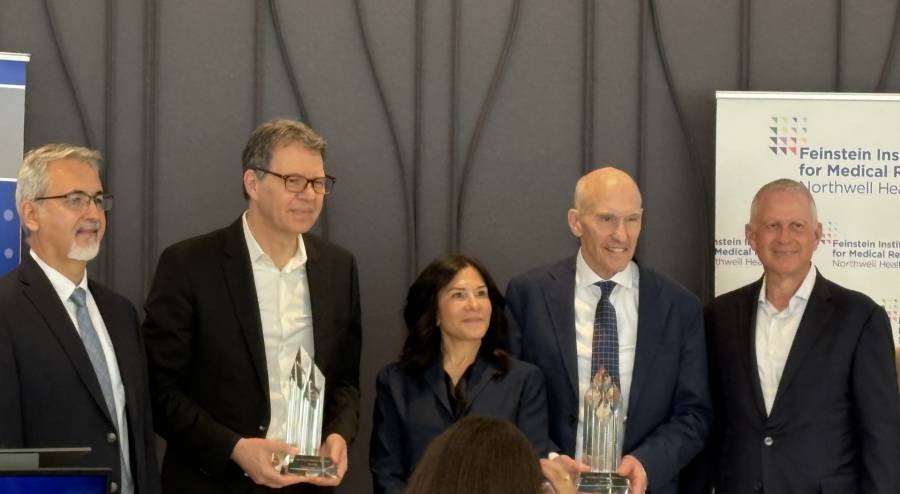
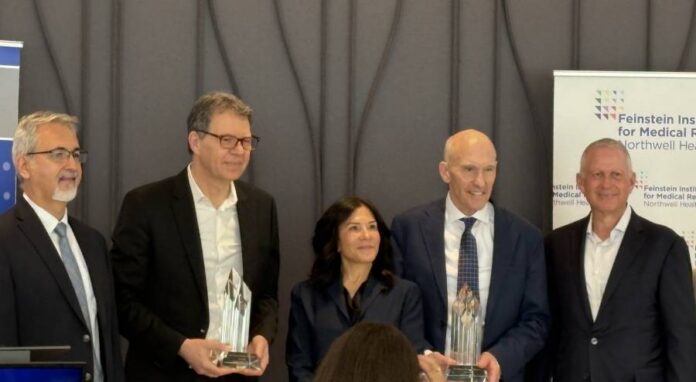
NEW YORK CITY — In the heart of midtown Manhattan, the global scientific community converged last week to honor two figures whose intellectual persistence redefined the boundaries of modern medicine. Carl June, MD, of the University of Pennsylvania, and Michel Sadelain, MD, PhD, of Columbia University, were jointly awarded the 13th annual Ross Prize in Molecular Medicine.
The ceremony, an elegant gathering of clinicians, researchers, and patients, served as more than just a formal recognition of achievement; it acted as a retrospective on a multi-decade journey from the fringes of immunological theory to the life-saving standard of care known as CAR T-cell therapy. Established in 2013 by the Feinstein Institutes for Medical Research and supported by Jack and Robin Ross, the prize is unique in its focus: it celebrates the “complete journey” of scientific innovation, honoring those who shepherd a discovery from the laboratory bench all the way to the bedside of the patient.
The Evolution of a Paradigm Shift
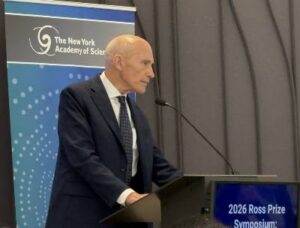
For decades, cancer immunotherapy was widely regarded as a high-risk, low-reward pursuit. Following the approval of the first checkpoint inhibitors in 2011 and the seminal CAR T-cell therapy approvals in 2017, the landscape of oncology was irrevocably altered. However, as June noted during his keynote address, the path to these milestones was paved with profound skepticism.
"There were many decades when cancer immunotherapy was tried and failed," June remarked. "Science review boards were nervous, and funding was notoriously difficult to secure. We were attempting to solve a fundamental paradigm shift."
This sentiment of perseverance was echoed by Sadelain. Reflecting on the early days of their research, he shared an anecdote that highlighted how far the field has traveled. "When we opened the first clinical trials, we couldn’t find patients," he admitted. "Today, there are waiting lists. The demand and the trust in the therapy have completely reversed."
A Chronology of Discovery: From HIV to Oncology
The history of CAR T-cell therapy is not a straight line, but a series of iterative breakthroughs that began, surprisingly, with the fight against HIV.
The Early Days: The Navy and RV 100
In the 1990s, while serving in the U.S. Navy in Bethesda, Maryland, Carl June initiated the “RV 100” protocol. At a time when HIV was a terminal diagnosis, June’s team sought to determine if T cells—the "soldiers" of the immune system—could be expanded in a laboratory and re-infused into patients to bolster their defenses. Contrary to the fear that they might inadvertently fuel viral replication, the researchers discovered that the cells could be manipulated to resist infection. This milestone marked the first time T cells were used as a therapeutic agent in human patients, providing the essential safety data that would eventually facilitate the jump to cancer research.
The Engineering of the First CARs
As the 2000s progressed, June’s group began engineering T cells with a synthetic receptor, fusing the CD4 molecule with the CD3 zeta signaling chain. These "first-generation" CARs demonstrated that genetic modification of T cells was safe and that the cells could persist in the body. While the initial oncology trials using these designs saw limited clinical efficacy, they provided the "proof of concept" required to iterate.
The Turning Point: The Second Generation
The true breakthrough occurred when the researchers incorporated a co-stimulatory domain, specifically 4-1BB, alongside the CD3 zeta signaling. This change allowed the T cells to survive longer and attack with greater force. The first patient treated with this second-generation CAR—a 67-year-old with end-stage leukemia—achieved a complete response. It was the "striking result" that moved the field from theoretical research into a transformative medical reality.
Milestones in Cellular Engineering: The Sadelain Perspective
Michel Sadelain, whose work at Columbia University has been instrumental in the development of T-cell engineering, outlined four critical milestones that enabled the current era of cellular therapy.
- Genetic Introduction Methods: Developing techniques to insert genes into primary T cells was the first hurdle. Previously, scientists were limited to studying leukemia cell lines, which acted as poor proxies for human immune response.
- The CD3 Zeta Discovery: Identifying the CD3 zeta chain as the "engine" for T-cell signaling allowed researchers to build receptors capable of sustained, targeted killing.
- Target Identification: Sadelain’s laboratory focused on CD19, a surface protein expressed on B-cell lymphomas and leukemias. This became the “Achilles’ heel” of these cancers.
- The "Do It Yourself" Realization: Perhaps the most difficult milestone was the realization that no pharmaceutical company was interested in manufacturing living cells as medicine. "You had to do it yourself," Sadelain noted. This realization forced academics to become entrepreneurs and engineers, creating the infrastructure for manufacturing that didn’t previously exist.
Supporting Data and Clinical Impact
Today, the clinical impact of these innovations is undeniable. There are currently seven FDA-approved CAR T-cell therapies, and more than 60,000 patients have received treatment worldwide. The data suggests that for patients with relapsed or refractory blood cancers, CAR T-cell therapy offers a chance at long-term remission that was previously deemed impossible.
However, the researchers are the first to emphasize that the work is not finished. Both June and Sadelain are now focused on the "next frontier": solid tumors. Unlike blood cancers, where the target cells circulate freely, solid tumors create an immunosuppressive microenvironment that actively inhibits the function of T cells.
"The good news is that we now understand the mechanisms tumors use to shut off the immune response," Sadelain explained. "The next step is to engineer T cells that can penetrate these defenses and maintain their potency in the face of these suppressive signals."
Official Perspectives: The Philosophy of the Ross Prize
Kevin Tracey, MD, president and CEO of the Feinstein Institutes, provided context on why the Ross Prize is uniquely suited to honor this type of work.
"We live in a time where we benefit from all the work that came before us by brilliant people who used science to eradicate diseases that some people have never even heard of," Tracey said. "But the optimism and the importance of that journey can get lost in the modern era. The Ross Prize celebrates the rare individual who stays with the process from the laboratory bench to the clinical implementation."
Tracey also touched upon the broader cultural significance of the award. In an age of rising anti-science sentiment, he believes that storytelling—sharing the human, often grueling, reality of scientific discovery—is essential to maintaining public trust. "Stories have to be told, or they are lost," he emphasized. By awarding scientists who have demonstrably changed the course of human health, the prize serves as a beacon of what is possible when persistence is combined with scientific rigor.
Future Implications: The Next Transformative Therapy
Looking ahead, the conversation at the awards ceremony shifted toward the future of cell therapy. Both honorees expressed optimism regarding in vivo CAR T-cell therapy, where the genetic engineering occurs directly inside the patient rather than in a laboratory incubator.
"It’s very early, but it’s exciting," June said. "There are ten times more people with autoimmune diseases than cancer. If we can make these therapies cheaper and more readily available through in vivo approaches, we have the potential to impact millions of lives."
Sadelain added that the field is also looking beyond oncology to neurodegenerative diseases and organ transplantation. However, he cautioned that success depends on solving the manufacturing bottleneck. "If this starts working for more common diseases, we are going to hit a wall," Sadelain noted. "We need to explore allogeneic cells from healthy donors or pluripotent stem cells to scale these therapies to the necessary level."
As the event concluded, the atmosphere was one of profound anticipation. The 13th Ross Prize served as a reminder that while the scientific journey is long—often spanning decades of failure and skepticism—the result is the creation of a new medical language. As Sadelain noted, "These molecules keep getting better and better. We need persistence, we need potency, and we need to keep our eyes on the patient."
For June and Sadelain, the award was not just a celebration of their own contributions, but a tribute to the collective effort of the thousands of researchers who refused to give up. The next chapter of medicine is already being written, and it is being built on the very foundation of the cellular therapies they pioneered. As the committee begins the process of selecting candidates for the 14th annual Ross Prize, the bar remains set at the highest possible level: scientific excellence, patient impact, and the courage to endure.