AWS Unveils Glue 6.0: A Major Leap Forward with 30% Price Reductions, Apache Spark 4.1, and Full Apache Iceberg v3 Support
SEATTLE — In a move designed to radically reshape the economics and performance of cloud-scale data engineering, Amazon Web Services (AWS) has officially announced the general availability of AWS Glue 6.0. This latest iteration of the fully serverless data integration and ETL (Extract, Transform, Load) service introduces a modernized runtime stack, robust support for the newest Apache Iceberg v3 specification, and—in a rare and welcome pricing shift for enterprise cloud software—a substantial 30% price reduction compared to previous versions.
Built on top of a cutting-edge engine comprising Apache Spark 4.1, Python 3.13, and Scala 2.13, AWS Glue 6.0 aims to address the escalating costs and structural complexities that data teams face as they manage massive volumes of semi-structured and unstructured data. By combining a serverless architecture with deep optimizations for modern open table formats, AWS is positioning Glue 6.0 as the most comprehensive managed Spark service on the market.
Main Facts: What’s New in AWS Glue 6.0
The release of AWS Glue 6.0 is not merely an incremental version bump; it represents a fundamental modernization of the underlying execution engine and a direct response to customer demands for lower costs and better handling of complex data types.
1. Significant Cost Optimization (30% Price Reduction)
Perhaps the most immediate eye-catcher for enterprise CFOs and data engineering leaders is the cost structure. AWS Glue 6.0 delivers a 30% price cut relative to legacy Glue versions. Because Glue operates on a serverless, pay-as-you-go model billed by the second for ETL jobs and crawlers, this reduction directly lowers the total cost of ownership (TCO) for petabyte-scale data pipelines without requiring organizations to compromise on processing power.
2. Complete Apache Iceberg v3 Integration
AWS Glue 6.0 provides what is arguably the most complete implementation of the Apache Iceberg v3 specification (built on Iceberg 1.11.0) available on any fully serverless managed Spark service. The standout feature within this integration is native support for the VARIANT data type, complete with built-in shredding capabilities.
Traditionally, storing semi-structured data like JSON documents, application logs, and event streams in data lakes required one of two undesirable approaches:
- Flattening schemas ahead of time, which frequently led to rigid pipelines that broke whenever upstream application schemas changed.
- Storing data as traditional string columns, which forced downstream queries to rely on expensive, custom parsing code and resulted in sluggish read performance.
With Iceberg v3’s VARIANT data type and shredding support in Glue 6.0, data teams can ingest and query semi-structured data natively. The engine automatically optimizes physical storage layout, allowing for significantly faster query read performance without duplicate data copies or rigid schema definitions.

3. Modernized Runtime Engine: Spark 4.1, Python 3.13, and Scala 2.13
Under the hood, AWS Glue 6.0 has been re-architected to leverage the latest open-source big data ecosystem components. By upgrading to Apache Spark 4.1, the service unlocks substantial performance gains, enhanced PySpark optimizations, and better memory management. Furthermore, developers can build and maintain data pipelines using modern programming language runtimes—Python 3.13 and Scala 2.13—ensuring access to the latest language features, security patches, and library ecosystems.
Chronology: The Evolution Leading to Glue 6.0
To understand the significance of AWS Glue 6.0, it is helpful to look back at the trajectory of serverless data processing and the open table format revolution over the past several years.
- The Early Era of Managed ETL (2017–2020): When AWS Glue was first introduced, its primary promise was removing the operational overhead of managing clusters for Apache Spark. Customers no longer had to provision, scale, or patch Amazon EMR clusters just to run simple ETL jobs. However, early versions suffered from perceived performance overhead and rigid pricing models.
- The Rise of Open Table Formats (2021–2023): As data lakes evolved into "lakehouses," traditional file formats like Parquet and ORC proved insufficient for handling ACID transactions, time travel, and schema evolution at scale. Apache Iceberg, Delta Lake, and Hudi emerged as open-standard solutions. AWS steadily responded by introducing native integration points for Iceberg within Glue catalogs and earlier runtime versions.
- The Push for Cost Efficiency and Modernization (2024–2025): Amid broader macroeconomic pressures, enterprise cloud customers increasingly scrutinized their data pipeline expenditures. Simultaneously, the open-source community accelerated development around Spark 4.x and Iceberg v3 specifications, focusing heavily on semi-structured data handling (such as Variant types).
- Today (August 2026): AWS synthesizes these advancements with the launch of Glue 6.0. By coupling a 30% price drop with Spark 4.1 and comprehensive Iceberg v3 support, AWS addresses both the financial and technical bottlenecks that have historically constrained large-scale data operations.
Supporting Data & Technical Architecture
The technical underpinnings of AWS Glue 6.0 are designed to maximize throughput while minimizing operational friction.
- Latency and Streaming: Beyond batch workloads, Glue 6.0 enhances real-time data streaming capabilities, achieving single-digit millisecond latency for streaming ETL pipelines. This makes it viable for fraud detection, real-time analytics, and live operational monitoring.
- Data Catalog Pricing Model: The pricing structure for the AWS Glue Data Catalog remains transparent and cost-effective. Users pay a simplified monthly fee for storing and accessing metadata. To encourage adoption, AWS maintains a generous free tier: the first one million objects stored and the first one million metadata accesses each month are entirely free.
- Job Execution Pricing: For crawlers and ETL jobs, customers continue to pay an hourly rate billed by the second, now discounted by 30% when utilizing the Glue 6.0 runtime.
Official Responses and Perspectives
While cloud providers constantly iterate on their software stacks, industry observers and AWS spokespeople note that Glue 6.0 represents a philosophical shift toward making open table formats a first-class citizen of serverless data architectures.
In the official release announcement, AWS engineering representative Channy noted that the primary design goal was friction reduction. "With this release, AWS Glue provides the most complete Iceberg v3 implementation on any fully serverless managed Spark service," the announcement stated, emphasizing that teams can now tackle complex JSON and log data without rewriting custom parsing logic or maintaining brittle, flattened table schemas.
Early feedback from data engineering communities on platforms like AWS re:Post highlights immense enthusiasm for the VARIANT data type support. Data architects have long complained about the performance trade-offs of querying nested JSON data within data lakes; the native shredding mechanism in Glue 6.0 directly solves this pain point.
Implications for Enterprises and Data Engineers
The general availability of AWS Glue 6.0 carries profound implications for organizations designing modern data architectures on AWS.

1. Accelerated Migration to Open Table Formats
Many enterprises have hesitated to fully commit to Apache Iceberg due to the complexity of managing maintenance operations (such as compaction, snapshot expiration, and manifest file optimization) across disparate query engines. By baking comprehensive Iceberg v3 support directly into a fully serverless Glue runtime, AWS removes the heavy lifting of table maintenance, likely accelerating enterprise migrations away from proprietary formats.
2. Streamlined Developer Experience and Upgrades
A common friction point during major Spark version upgrades is the fear of breaking downstream pipelines. AWS has mitigated this by ensuring that no API changes are required to adopt Glue 6.0.
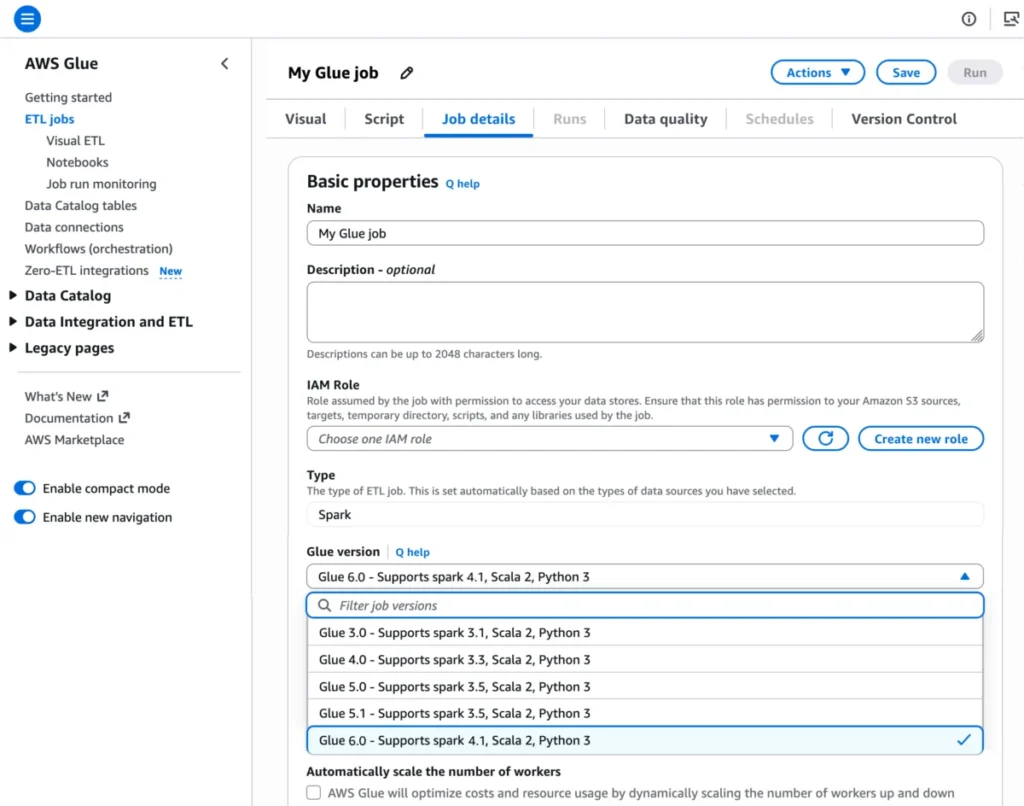
To transition existing workflows, data engineers can simply update the --glue-version parameter to 6.0 via:
- The AWS Command Line Interface (AWS CLI)
create-joborupdate-jobAPIs. - AWS SDKs.
- AWS Glue Studio or Amazon SageMaker Unified Studio.
For teams managing large fleets of jobs, AWS has introduced the Spark upgrade agent within AWS Glue Studio, alongside an auto-upgrade feature that simplifies the transition path to Glue 6.0. Developers working in interactive notebooks can instantly spin up the new environment by setting %glue_version 6.0 in their magic commands.
3. Immediate Global Availability
AWS Glue 6.0 is generally available starting today across all AWS Regions where AWS Glue operates. Developers can also leverage modern AI-assisted tooling—such as the AWS MCP Server and associated plugins—to query documentation, look up regional availability, and troubleshoot migration errors using their preferred AI assistants.
4. Redefining Cloud Cost Economics
Perhaps most importantly, the 30% price reduction challenges the narrative that managed cloud services must always command a heavy premium over self-hosted infrastructure. By passing infrastructure efficiencies down to the customer, AWS is encouraging organizations to re-evaluate their high-volume batch processing and streaming budgets, potentially freeing up capital for broader generative AI and machine learning initiatives.
As organizations grapple with exponential data growth, AWS Glue 6.0 offers a compelling blueprint: higher performance, lower costs, and native alignment with open standards. Data teams are encouraged to test the new runtime in the AWS Glue Studio console today to evaluate the performance gains firsthand.