The Great OS Showdown: PhoneBuff’s Rigorous Lab Test Pits Fedora Against Windows 11
In the world of desktop computing, the debate between Windows and Linux has long been fueled by anecdotal evidence, forum arguments, and deeply ingrained tribalism. However, data-driven insights are rare. Recently, the renowned tech-testing powerhouse PhoneBuff—a company famous for its robotic, lab-tested smartphone benchmarks—decided to settle the score once and for all. By applying their signature "clanker" robotic testing methodology to two identical Dell XPS 13 laptops, the team has provided one of the most transparent, objective comparisons between Fedora Linux and Microsoft’s Windows 11 to date.
The results are, to say the least, disruptive. With Fedora clinching six wins, four ties, and Windows 11 securing only a single victory, the findings challenge the long-held assumption that Linux is a niche operating system suitable only for hobbyists or server administrators.
The Methodology: Science, Not Subjectivity
To ensure the integrity of the experiment, PhoneBuff eliminated the human variable entirely. They utilized two identical Dell XPS 13 units, both powered by Intel Core 5 320 processors and equipped with 8GB of RAM. The testing environment was strictly controlled:
- Environmental Consistency: Both laptops were maintained at identical temperatures.
- Calibration: Screen brightness was set to a uniform 200 nits, and both machines were placed at equal distances from the Wi-Fi access point to ensure network latency did not skew the results.
- Robotic Precision: The "clanker"—a sophisticated robotic apparatus equipped with a physical mouse and keyboard—executed all tasks, eliminating the possibility of human reaction-time bias.
- Iterative Testing: Each task was performed between three and five times, with the median value recorded to minimize the impact of background processes or thermal throttling.
Chronology of the Comparison
The tests spanned a diverse array of real-world workflows, ranging from basic system maintenance to professional-grade creative production.
The Cold Boot and Restart Phase
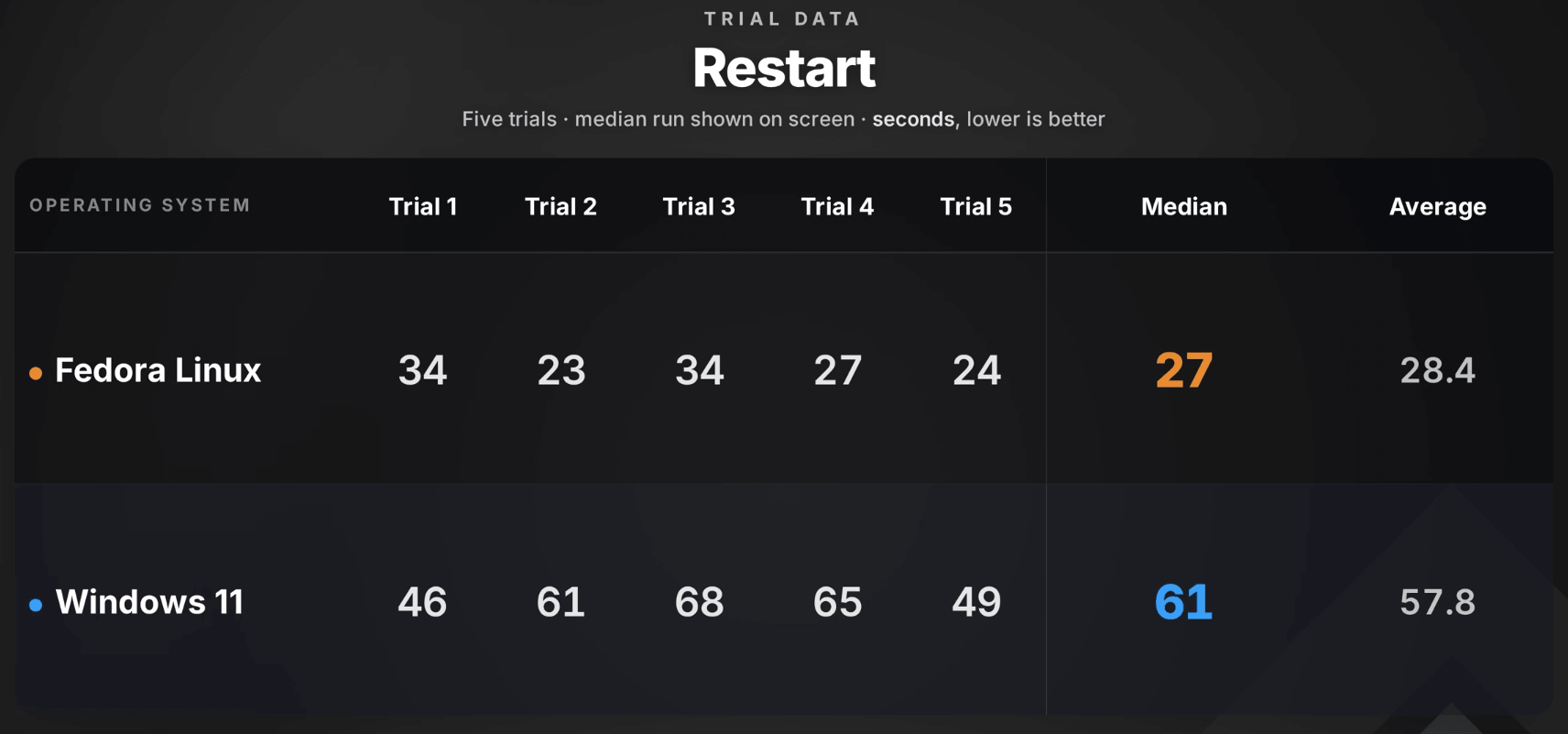
The initial testing began with a cold boot from a full shutdown. Both operating systems performed admirably, with Windows 11 clocking in at 23 seconds and Fedora at 24 seconds—a statistical tie. However, the narrative shifted during the restart test. Fedora proved significantly more agile, completing the restart cycle in a median of 27 seconds, while Windows 11 struggled, taking an average of 61 seconds. Furthermore, the variance in Windows performance was substantial, with run times fluctuating wildly between 46 and 68 seconds.
The File Handling Gap
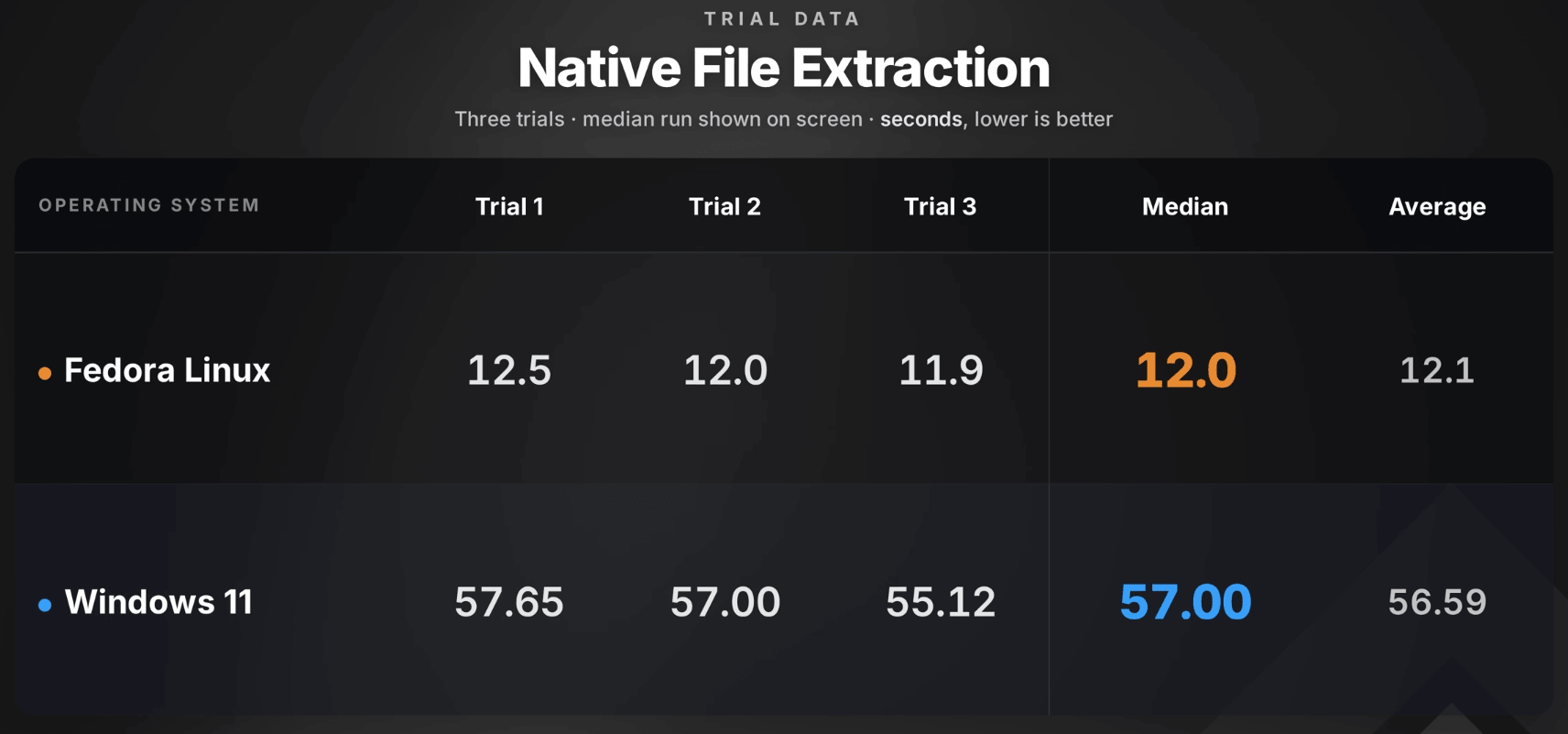
Perhaps the most startling result of the entire experiment was the disparity in file management. When tasked with unzipping a massive 6GB archive, the difference in efficiency was stark. Fedora’s native archiving tool handled the extraction in a brisk 12 seconds. Conversely, Windows Explorer required 57 seconds. Even after installing 7-Zip, a third-party optimization tool, Windows only managed to bring that time down to 17.4 seconds, still lagging behind the Linux baseline.
Development and Creative Workloads
For the professional user, the results in development and creative software provide significant food for thought:
- VS Code Productivity: In a task involving loading an open-source project, error scanning, compiling, and running nearly 1,900 tests, Fedora completed the operation in 2 minutes and 20 seconds. Windows 11 required 3 minutes and 41 seconds.
- Creative Suite: In DaVinci Resolve, Fedora successfully imported, graded, stabilized, and exported video clips in 2 minutes and 10 seconds, compared to the 2 minutes and 49 seconds taken by Windows. Similarly, GIMP image processing tasks favored Fedora, finishing in 53.3 seconds versus 60.7 seconds on Windows.
Supporting Data: Memory Management and Efficiency
One of the most frequent criticisms leveled against modern Windows is its resource overhead. PhoneBuff’s findings quantify this burden with alarming clarity.

When left idle for one minute, the system memory utilization told a compelling story. Fedora consumed approximately 32.9% of the available 8GB of RAM, totaling roughly 2.27GB. In stark contrast, Windows 11 sat at 85.2% utilization, consuming 6.47GB of RAM.
It is important to note that this "Windows Tax" is partially attributable to background services, including Dell’s proprietary utilities, Microsoft Defender, and Edge WebView2 processes. Fedora, conversely, arrived with a leaner, more modular footprint. This "baggage-free" philosophy allows the hardware to allocate resources to the user’s active tasks rather than managing OS-level bloat.
The Lone Windows Victory
While the data overwhelmingly favored Linux, Windows 11 did secure one clear victory: the launch time for Cyberpunk 2077. The game loaded in 54.3 seconds on Windows, compared to 57 seconds on Fedora.
However, analysts caution that this result requires context. The test measured launch time only, not frame rate (FPS) or thermal performance during actual gameplay. For users, the difference of under three seconds is negligible, especially considering that gaming performance on Linux has seen massive strides via technologies like Proton and the DXVK translation layer.
Implications: What Does This Mean for the Future?
The implications of this study reach far beyond a simple "who is faster" contest.
1. The Death of the "Linux is Hard" Narrative
For years, the barrier to Linux adoption has been the perception that it is too complex for the average user. Fedora’s performance in this test suggests that for standard productivity tasks—web browsing, document editing, and development—it is not only stable but fundamentally more efficient than the industry standard.
2. A Call for Windows Optimization
Microsoft has faced mounting criticism regarding the "bloatware" inherent in Windows 11. If an operating system consumes over 80% of a user’s RAM at idle, the hardware is effectively being held hostage by the software. PhoneBuff’s results serve as a wake-up call to Microsoft: users are becoming increasingly sensitive to how their hardware resources are being managed.
3. The Contextual Caveat
It is vital to remain objective. As the PhoneBuff presenter noted, Fedora is but one distribution of many. The user experience can vary wildly depending on the Desktop Environment (e.g., GNOME vs. KDE Plasma) and the specific hardware drivers involved. Furthermore, this test did not include AI-accelerated workloads, which currently favor Windows due to deep integration with hardware vendors like NVIDIA and Intel.
Conclusion: A Data Point, Not a Verdict
The PhoneBuff investigation serves as a critical data point in the ongoing evolution of desktop computing. It proves that the "Linux experience" is no longer confined to the fringe. When provided with identical hardware, a modern, well-maintained Linux distribution like Fedora offers significant performance advantages in file operations, development workflows, and memory management.
As the industry moves toward more efficient, sustainable computing, these findings suggest that the operating system landscape is far from stagnant. While Windows remains the ubiquitous choice for the masses, the gap in performance—and the efficiency of the underlying architecture—has never been smaller. For power users, developers, and those looking to squeeze the most out of their hardware, the data suggests that the Linux alternative is not just a viable path; it may well be the superior one.
Whether this leads to a shift in market share or simply forces Microsoft to streamline its next iteration remains to be seen. However, one thing is certain: when the robots do the talking, the numbers are hard to ignore.