Bringing Reinforcement Learning to Cross-Platform Mobile: Porting the "Plane Strike" Board Game to Flutter with TensorFlow Lite
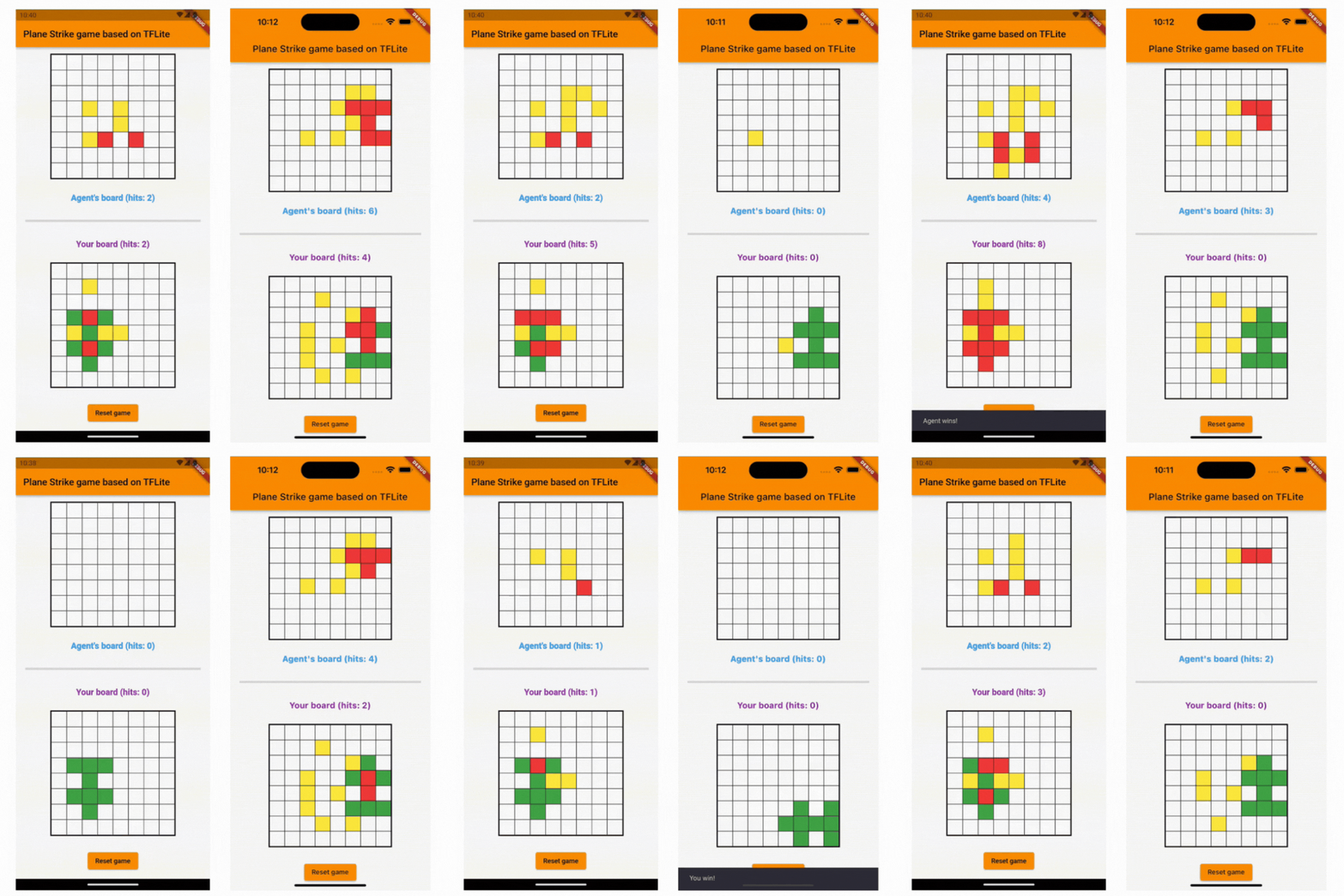
SAN FRANCISCO — In the rapidly evolving landscape of mobile application development, the integration of artificial intelligence and machine learning has transitioned from an experimental novelty to a standard architectural requirement. Developers are continually challenged to deliver intelligent, responsive features while minimizing latency, optimizing battery consumption, and reducing deployment overhead across disparate operating systems.
Addressing these industry demands, Google’s Developer Advocate Wei Wei has announced the culmination of a multi-part technical series demonstrating how to port a machine-learning-powered board game app—affectionately named "Plane Strike"—from native Android to a unified, cross-platform experience utilizing Flutter and the official TensorFlow Lite (TFLite) plugin.
This release bridges the gap between advanced reinforcement learning (RL) research and practical, cross-platform mobile engineering, offering developers a blueprint for embedding edge-AI capabilities into applications destined for both Android and iOS devices.
Main Facts: The Intersection of Reinforcement Learning and Cross-Platform Mobile
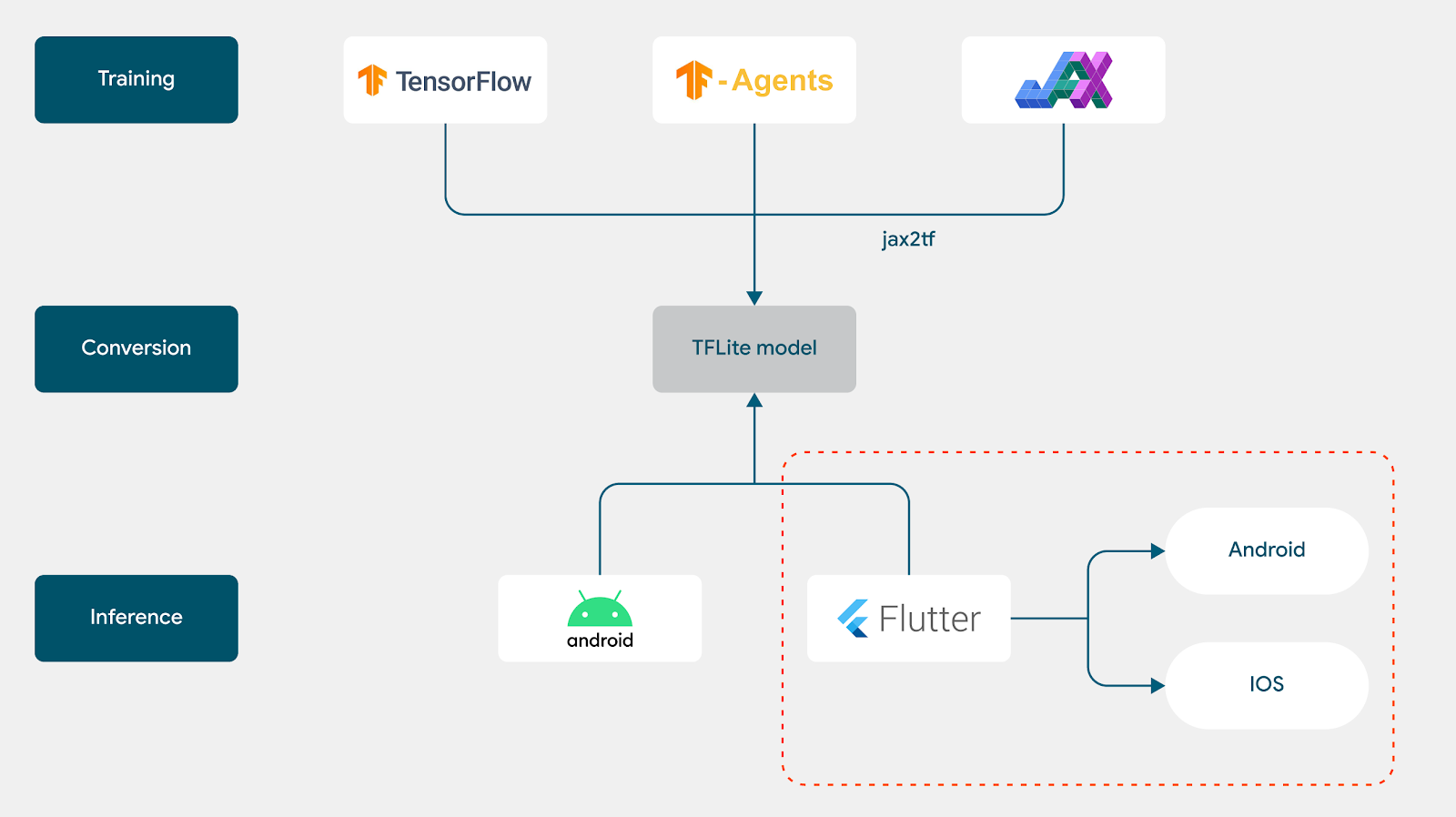
At its core, the project demonstrates how an intelligent agent—trained using TensorFlow, TF-Agents, and JAX—can be serialized, embedded, and executed directly on a mobile device without relying on cloud-based inference servers.
By leveraging the recently released TensorFlow Lite Plugin for Flutter, developers can now write a single codebase that handles both the user interface and local machine learning execution. In the "Plane Strike" implementation:
- The AI Model: A reinforcement learning agent trained to optimize strategic decisions within the game environment.
- The Framework: Flutter, Google’s open-source UI toolkit for building natively compiled applications for mobile, web, and desktop from a single codebase.
- The Engine: TensorFlow Lite, optimized for low-latency, on-device inference.
- The Scope: A fully functional, cross-platform mobile application currently supporting Android and iOS environments.
The architectural shift from platform-specific native development (Kotlin/Java for Android) to a unified cross-platform approach (Dart/Flutter) represents a significant efficiency gain for development teams aiming to deploy edge-AI features simultaneously across major mobile ecosystems.
Chronology: The Evolution of the "Plane Strike" Project
The journey to a cross-platform TensorFlow Lite Flutter application did not happen overnight. It is the culmination of a systematic, multi-phase engineering initiative designed to explore the boundaries of on-device reinforcement learning.

Phase 1: Establishing the Native Baseline (October 2021)
The initiative began with the publication of “Building a board game app with TensorFlow: a new TensorFlow Lite reference app.” In this foundational release, the TensorFlow team demonstrated how to construct a complete end-to-end pipeline. They trained a simple reinforcement learning model using standard TensorFlow frameworks, converted the resulting artifact into a lightweight TFLite format, and integrated it into a native Android reference application. This proved that complex game-playing agents could run efficiently on resource-constrained mobile hardware.
Phase 2: Expanding the AI Toolkit with JAX (September 2022)
Building upon the success of the initial Android reference app, the team pushed the envelope further with “Building a reinforcement learning agent with JAX, and deploying it on Android with TensorFlow Lite.” Recognizing the rising prominence of JAX—Google’s high-performance numerical computing library—the developers trained a new iteration of the "Plane Strike" agent using JAX primitives. This model was subsequently converted and deployed onto Android, showcasing the interoperability between modern machine learning research frameworks (JAX) and mobile-ready deployment runtimes (TFLite).
Phase 3: The Flutter Community Demand and Official Plugin Release (2023)
While the native Android tutorials resonated well with mobile engineers, a persistent piece of feedback echoed through developer forums and community channels: Can this be made cross-platform?
Simultaneously, the TensorFlow team officially released the long-awaited TensorFlow Lite Plugin for Flutter, providing robust, native bindings for running TFLite interpreters within Flutter applications. This tooling milestone provided the missing link, prompting the development team to approve one final tutorial to port the "Plane Strike" application to Flutter.
Supporting Data: Technical Implementation and Code Architecture
To understand the feasibility of embedding reinforcement learning models into Flutter applications, one must examine the simplicity of the underlying integration code. The migration process relies on two primary operations: loading the model interpreter and executing real-time inference based on user board states.
1. Loading the Model Asset
Because the machine learning model is pre-trained and packaged directly within the application assets, initialization requires pointing the TFLite interpreter to the model file bundled in the project directory:
Interpreter? _interpreter;
final String _modelFile = 'model.tflite';

void _loadModel() async
  // Create the interpreter from assets
  _interpreter = await Interpreter.fromAsset(_modelFile);
2. Executing Real-Time Inference
During gameplay, the application captures the current state of the board from the user, formats it into an acceptable multidimensional array, passes it through the TFLite interpreter, and computes the optimal strike location using an argmax algorithm:

int predict(List<List<double>> boardState)
  var input = [boardState];
  var output = List.filled(_boardSize * _boardSize, 0)
      .reshape([1, _boardSize * _boardSize]);

  // Run model inference locally on-device
  _interpreter?.run(input, output);

  // Determine the highest probability move (Argmax)
  double max = output[0][0];
  int maxIdx = 0;

  for (int i = 1; i < _boardSize * _boardSize; i++)
    if (max < output[0][i])
      maxIdx = i;
      max = output[0][i];


  return maxIdx;
By pairing these core inference functions with reactive Flutter frontend code to render game grids and track turn progression, developers achieve seamless performance without network latency or cloud server costs. The complete, open-source codebase is publicly available in the official TensorFlow Flutter TFLite GitHub repository.
Official Responses and Developer Perspectives
The release of the Flutter TFLite port has generated significant enthusiasm within both the machine learning and cross-platform mobile development communities.
Wei Wei, Developer Advocate and author of the initiative, emphasized the collaborative nature of the project’s evolution:
"While these end-to-end tutorials are helpful for Android developers, we have heard from the Flutter developer community that it would be interesting to make the app cross-platform. Inspired by the officially released TensorFlow Lite Plugin for Flutter recently, we are eager to see how developers take these building blocks and scale them to production environments."
Industry analysts note that Google’s strategy focuses heavily on reducing friction between advanced AI research—such as JAX-based reinforcement learning—and practical consumer applications. By providing turnkey plugins for Flutter, the company empowers smaller development teams and solo creators to build intelligent features that were previously restricted to well-funded enterprises with dedicated machine learning infrastructure teams.
Implications: The Future of On-Device AI and Cross-Platform Engineering
The successful porting of the "Plane Strike" reinforcement learning agent to Flutter carries several profound implications for the future of software development:
1. Democratization of Edge AI
On-device machine learning traditionally required deep expertise in native platform languages (Swift for iOS, Kotlin for Android) coupled with complex bridging code to C++ runtime libraries. By streamlining this process through Flutter and high-level Dart APIs, Google is lowering the barrier to entry, allowing UI/UX developers to become effective AI practitioners.
2. Privacy, Latency, and Offline Capabilities
Running models locally via TensorFlow Lite eliminates the need to transmit sensitive user data to external cloud servers. For games, interactive utilities, and productivity tools, this guarantees zero network latency, uninterrupted offline functionality, and absolute data privacy—key selling points for privacy-conscious consumers and enterprise security teams alike.
3. The Maturation of the Flutter Ecosystem
The introduction of the official TFLite plugin signals the maturation of Flutter as a viable framework not just for standard CRUD applications, but for computationally intensive workloads. As hardware accelerators (such as mobile GPUs, NPUs, and specialized TPUs) become ubiquitous in modern smartphones, cross-platform frameworks capable of tapping directly into these hardware layers will dictate the next generation of mobile experiences.
Looking Ahead
With the conclusion of this mini-series, the TensorFlow and Flutter teams have handed the torch over to the global developer community. As engineers begin experimenting with custom JAX and TensorFlow models inside cross-platform Flutter wrappers, Google encourages creators to share their innovations across social channels using the handles @googledevs and @TensorFlow.
Whether building autonomous game opponents, real-time computer vision scanners, or predictive text engines, the tools are now in place to build smarter, faster, and truly cross-platform mobile applications.