ROHM Unveils Breakthrough Fourth-Generation 650V EcoIGBT Power Devices to Revolutionize Electric Vehicles and Industrial Systems
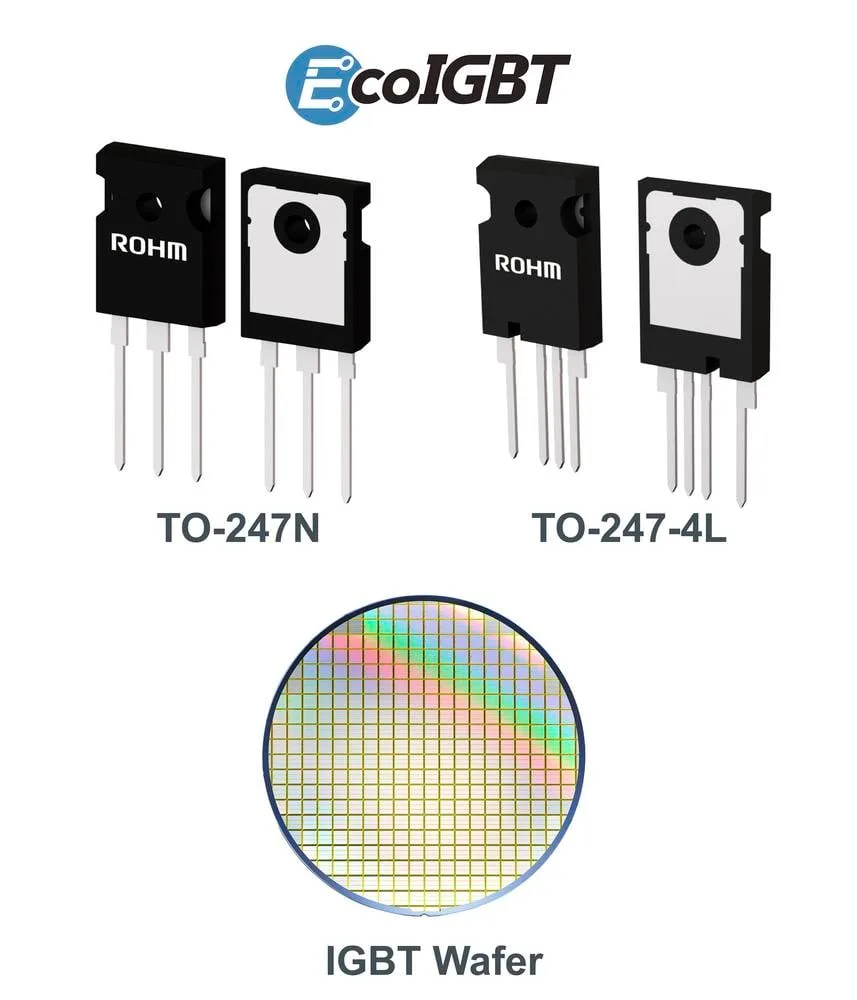
TOKYO — In a significant leap forward for high-voltage power electronics, global semiconductor manufacturer ROHM has officially announced the launch of its fourth-generation 650V Insulated-Gate Bipolar Transistors (IGBTs). Marketed under the proprietary EcoIGBT™ brand, these cutting-edge components are meticulously engineered to meet the rigorous demands of automotive electric compressors, high-voltage (HV) heaters, and industrial equipment inverters.
Achieving a breakthrough collector-emitter saturation voltage ($V_CE(sat)$) of just 1.55V, ROHM’s latest innovation claims the industry crown for the lowest conduction loss among 650V automotive-grade devices. Combining this unprecedented energy efficiency with exceptional short-circuit ruggedness and full qualification to the stringent AEC-Q101 automotive reliability standard, the new EcoIGBT lineup is poised to redefine power management benchmarks across multiple industries.
Main Facts: Redefining High-Voltage Power Efficiency
The fourth-generation 650V EcoIGBT series represents a massive technical achievement for ROHM engineers, striking a delicate balance between ultra-low conduction losses and robust fault-tolerance capabilities.
- Lowest Conduction Loss: The devices achieve a typical $V_CE(sat)$ of 1.55V, drastically minimizing power waste and heat generation during continuous operation.
- Exceptional Short-Circuit Tolerance: Despite optimizations geared toward maximum efficiency, the IGBTs guarantee a short-circuit withstand time ($t_sc$) of 7 microseconds at a junction temperature ($T_j$) of $25^circtextC$. This provides ample safety margin for fault detection and system shutdown circuits.
- Comprehensive Packaging Options: The lineup rolls out initially in industry-standard TO-247N packages, with advanced TO-247-4L packages and versatile bare-die configurations currently joining the portfolio. Future roadmaps also promise compact surface-mount TO-263L and top-side cooled (TSC) packages.
- Dual Diode Configurations: Devices are available in two primary variants: the -HR series (pure IGBT without a built-in diode) and the -EHR series (featuring an integrated, high-performance fast recovery diode).
- Automotive Certification: Fully qualified under the AEC-Q101 standard, the components boast an expansive operating junction temperature range of $-40^circtextC$ to $+175^circtextC$.
Chronology of Development: From Concept to Market-Ready Innovation
The introduction of the fourth-generation EcoIGBT platform is the culmination of years of targeted research and development in advanced semiconductor physics and manufacturing processes.
Phase 1: Identifying the Market Gap (2023–2024)
As the automotive industry aggressively shifted toward high-voltage architectures, Silicon Carbide (SiC) emerged as the dominant technology for high-power traction inverters. However, engineering teams identified a persistent market segment in lower-power auxiliary systems—such as electric compressors, cabin heaters, and onboard chargers—where 650V silicon-based solutions remained economically and technically optimal. Industrial motor drives and compressors faced similar pressures to boost efficiency while shrinking form factors, setting clear design parameters for ROHM’s next-generation platform.
Phase 2: Structural Redesign and Process Optimization (2024–2025)
Developing an IGBT that simultaneously minimizes conduction losses while maximizing short-circuit tolerance is a notorious engineering trade-off; typically, optimizing for lower resistance increases vulnerability during electrical fault conditions. ROHM tackled this by radically revising the device’s fundamental structure. Engineers refined the manufacturing process and redesigned the edge termination structure. This enhanced current density, slashed switching and conduction losses, and successfully preserved the critical 7-microsecond short-circuit withstand threshold.
Phase 3: Validation and Reliability Testing (Late 2025–Early 2026)
Prototypes underwent rigorous testing to validate their thermal and electrical performance under extreme operational stress. Achieving compliance with the AEC-Q101 standard cemented the devices’ readiness for deployment in harsh automotive environments, proving their resilience against thermal cycling, humidity, and continuous electrical loads up to $+175^circtextC$.
Phase 4: Commercial Rollout (August–September 2026)
ROHM officially unveiled the fourth-generation EcoIGBT series in late summer 2026. The initial release immediately made TO-247N packaged units and select bare-die variants available globally via major electronic component distributors, including DigiKey and Farnell, backed by robust digital design support tools like SPICE and PLECS models.
Supporting Data & Comprehensive Technical Specifications
To provide engineers and procurement specialists with precise benchmarks, ROHM has detailed extensive performance metrics across its packaged devices and bare-die portfolios.
Packaged 650V IGBTs Lineup
All packaged components share a 650V rating, a 7 $mutexts$ short-circuit withstand time, and a wide thermal operating range. The suffix codes denote the diode configuration: -HR (without diode) and -EHR (with integrated fast recovery diode).

| TO-247N (Available Now) | TO-247-4L (Under Development) | Collector Current, $I_C$ ($T_C = 100^circtextC$) | Typical $V_CE(sat)$ |
|---|---|---|---|
| RGA60TS65HR / RGA60TS65EHR | RGA60TR65HR / RGA60TR65EHR | 35 A | 1.55 V |
| RGA80TS65HR / RGA80TS65EHR | RGA80TR65HR / RGA80TR65EHR | 44 A | 1.55 V |
| RGA00TS65HR / RGA00TS65EHR | RGA00TR65HR / RGA00TR65EHR | 52 A | 1.55 V |
| RGAX2TS65HR / RGAX2TS65EHR | RGAX2TR65HR / RGAX2TR65EHR | 62 A | 1.55 V |
| RGAX5TS65HR / RGAX5TS65EHR | RGAX5TR65HR / RGAX5TR65EHR | 74 A | 1.60 V |
| RGAY0TS65HR / RGAY0TS65EHR | RGAY0TR65HR / RGAY0TR65EHR | 88 A | 1.65 V |
Note: The TO-247N package measures $16.0 times 21.0 times 5.0text mm$, while the advanced TO-247-4L package measures $16.0 times 23.45 times 5.0text mm$.
Bare-Die (SG83xxWN Series) Specifications
Engineered for modular integration and custom power stack designs, all bare-die variants feature a standardized thickness of 75 $mutextm$, a 650V breakdown voltage, a typical $V_CE(sat)$ of 1.55V, and a 7 $mutexts$ short-circuit endurance rating.
| Part Number | Rated Collector Current, $I_C$ ($T_C = 100^circtextC$) | Chip Dimensions ($X times Y$ in mm) |
|---|---|---|
| SG8351WN | 20 A | $3.08 times 3.08$ |
| SG8352WN | 25 A | $3.10 times 3.48$ |
| SG8353WN | 30 A | $3.52 times 3.52$ |
| SG8359WN | 40 A | $3.74 times 4.10$ |
| SG8355WN | 50 A | $4.20 times 4.39$ |
| SG8356WN | 60 A | $3.90 times 5.48$ |
| SG8358WN | 75 A | $4.50 times 5.70$ |
| SG8357WN | 100 A | $5.70 times 5.70$ |
| SG8360WN* | 150 A | $6.82 times 6.82$ |
| SG8361WN* | 200 A | $7.75 times 7.75$ |
*Denotes products currently under active development.
Official Perspectives and Industry Insights
According to technical briefs released by ROHM’s product development divisions, the motivation behind the fourth-generation EcoIGBT platform stems from a holistic view of modern power electronics efficiency.
"As electrification accelerates across both the automotive and industrial sectors, the demand for power devices that do not compromise on thermal safety or electrical efficiency has never been higher," noted a ROHM technical representative during the product launch. "By pushing the boundaries of silicon trench technology to achieve a $V_CE(sat)$ of 1.55V without sacrificing the vital 7-microsecond short-circuit withstand time, we are providing engineers with a tool that solves multiple thermal and spatial constraints simultaneously."
Industry analysts have echoed these sentiments, pointing out that auxiliary automotive systems—such as electric air conditioning compressors and positive temperature coefficient (PTC) coolant heaters—represent a massive, continuous drain on EV battery packs. Reducing losses in these secondary circuits directly translates into tangible improvements in overall vehicle driving range, a core metric for consumer adoption.
Furthermore, industrial designers grappling with stringent global energy-efficiency regulations stand to benefit significantly. Electric motors and heavy-duty industrial compressors powered by these fourth-generation IGBTs will experience reduced thermal stress, leading to extended operational lifespans and lower cooling infrastructure requirements.
Strategic Implications for Automotive and Industrial Markets
The commercialization of ROHM’s fourth-generation EcoIGBT series carries far-reaching implications for the power semiconductor landscape:
- Optimized System Cost vs. Performance: While Wide-Bandgap (WBG) materials like Silicon Carbide (SiC) continue to dominate ultra-high-voltage and high-frequency traction domains, advanced silicon IGBTs like ROHM’s EcoIGBT demonstrate that mature silicon manufacturing nodes can still yield massive efficiency gains at a fraction of the cost for sub-1000V applications.
- Enhanced Thermal Management: Lower conduction losses ($V_CE(sat) = 1.55textV$) inherently mean less heat dissipation. This allows tier-1 automotive suppliers and industrial manufacturers to downsize their heatsinks and liquid-cooling apparatuses, driving down overall system weight and bill-of-materials (BOM) costs.
- Streamlined Design Support: To accelerate time-to-market for clients, ROHM has made comprehensive simulation assets freely available. Engineers can access dedicated SPICE models to accurately replicate electrical behaviors and PLECS models for intricate system-level circuit simulations directly via the official ROHM product portal.
As the industry pivots toward smarter, greener, and more compact power architectures, ROHM’s fourth-generation EcoIGBT lineup establishes a formidable new standard for 650V applications, ensuring that silicon technology remains a vital pillar of the global energy transition.