Decentralizing Knowledge: Maker Transforms a $10 Microcontroller into a Standalone, Offline Wikipedia Reader
By Tech & Innovation Desk
Published: October 2023
In an era defined by hyper-connectivity, cloud-based computing, and the constant hum of broadband networks, the prevailing assumption is that access to the sum of human knowledge requires a steady, high-speed internet connection. Cloud servers, vast data centers, and multi-tier content delivery networks form the backbone of modern information retrieval. However, a compelling counter-movement is quietly gaining momentum at the periphery of the digital ecosystem: edge computing.
Challenging the paradigm of centralized data dependency, maker and developer Alun Morris has successfully engineered a fully functional, pocket-sized offline Wikipedia reader using remarkably modest hardware. By harnessing the capabilities of a ubiquitous and inexpensive development board—the ESP32-2432S028, widely known in the maker community as the "Cheap Yellow Display" (CYD)—Morris has proven that comprehensive reference materials can be decoupled from the cloud entirely. Armed with a microSD card, a custom Python preprocessing pipeline, and a clever memory-management architecture, this DIY project brings nearly 300,000 encyclopedia articles directly to the palm of a user’s hand, completely untethered from Wi-Fi, cellular networks, or server infrastructure.
Main Facts: The Anatomy of an Edge-Computed Encyclopedia
At its core, Morris’s project transforms an off-the-shelf microcontroller module into an interactive, touch-sensitive encyclopedia viewer. The device relies on no external application programming interfaces (APIs), cloud databases, or local network routers. Instead, it reads compressed, pre-formatted binary data straight from a removable microSD card.
The primary hardware vehicle for this feat is the ESP32-2432S028 module. Priced typically around $10, this compact board integrates an ESP32 dual-core microcontroller, a 2.8-inch 320×240 pixel TFT LCD display driven by an ILI9341 controller, and an XPT2046 resistive touchscreen. It also features an onboard microSD card slot, which serves as the massive storage repository for the encyclopedia’s text, images, and index files.
The foundational dataset originates from Kiwix, a well-established organization that creates offline formats for web content, most notably utilizing ZIM files. Morris focused on the English Simple Wikipedia dataset (wikipedia_en_simple_all_maxi), a compressed archive weighing in at approximately 3.3 gigabytes. This specific database contains roughly 285,000 articles written in simplified English, making it an ideal candidate for resource-constrained embedded systems.
Because standard ZIM clusters are far too large for a microcontroller’s limited random-access memory (RAM)—typically measuring between 1 megabyte and 4 megabytes per cluster—raw files cannot be read directly by the ESP32. To bridge this technological gap, Morris developed a sophisticated Python-based preprocessor that runs on a host PC. This software unpacks the original ZIM archive, strips away extraneous HTML bloat, compresses and reformats images, and re-packages the data into a custom, highly optimized binary database structure tailored specifically for the ESP32’s memory constraints.
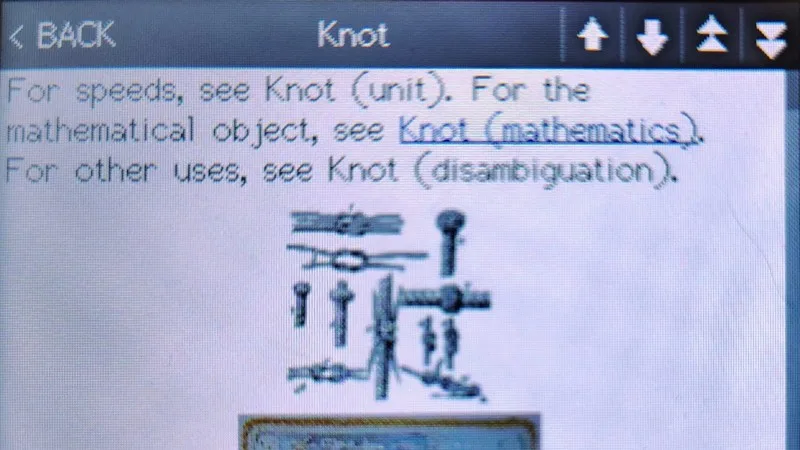
When booted, the device presents a responsive user interface on its 320×240 screen. Users can search for titles, browse entries, and view illustrations completely offline. Powered simply via a USB connection—utilizing the board’s built-in Type-C or micro-USB interface—the entire assembly operates as a self-contained, low-power knowledge terminal.
Chronology: From Concept to Standalone Execution
The realization of an offline, microcontroller-based Wikipedia reader did not happen overnight. It represents the culmination of methodical problem-solving, architectural design, and iterative software development.
Phase One: Feasibility and Hardware Selection
The initial challenge facing the project was hardware limitation. Standard microcontrollers possess meager amounts of RAM and flash storage compared to modern desktop computers or smartphones. Morris identified the ESP32-2432S028 module not only for its exceptionally low cost and widespread availability within the maker community, but also for its integrated display and touchscreen peripherals. The ESP32’s dual-core Tensilica architecture—operating at up to 240 MHz—offered sufficient processing horsepower to handle binary file searching and rudimentary image decoding, provided the software was written with strict memory discipline.
Phase Two: Developing the Preprocessing Pipeline
Recognizing that raw internet-scale data formats are incompatible with edge microcontrollers, Morris spent significant development cycles writing a custom Python 3.9+ preprocessor script. Utilizing the libzim library, this script was engineered to ingest the 3.3 GB raw ZIM file on a powerful host PC.
During this heavy lifting phase—which takes between 30 and 60 minutes utilizing all four cores of a modern computer—the preprocessor executes several critical transformation steps:
- HTML Sanitization: Raw Wikipedia markup is parsed and cleaned, stripping out complex cascading style sheets (CSS), interactive JavaScript elements, and unsupported layout tags to yield a minimalist, easily rendered text structure.
- Image Optimization: Photographs are transcoded into standard JPEGs (with a default quality setting of 90), while vector diagrams or line art are converted into the lightweight QOI (Quite OK Image) format. Furthermore, image dimensions are strictly capped at a maximum of 320×212 pixels to match the physical boundaries of the CYD screen.
- Chunking Data: To prevent memory overflows on the ESP32, the preprocessor systematically segments the massive dataset into manageable pieces: articles are divided into 32 MB chunks, while images are separated into 4 MB chunks.
- Index Generation: The script builds fixed-width 80-byte records for the title index, alongside a secondary sparse index designed for rapid searching.
Phase Three: Firmware Development and Memory Optimization
With the data successfully converted and transferred to a high-capacity microSD card, attention shifted to writing the device firmware using PlatformIO. Because the ESP32 features roughly 300 KB of usable heap memory, the firmware had to be meticulously designed to avoid memory leaks and segmentation faults.
Morris implemented specialized decoding libraries directly into the firmware: TJpgDec for handling JPEG decompression and the qoi library for rendering diagrams. A custom, lightweight rendering engine was written to interpret the cleaned HTML text on the fly.
To ensure snappy user interaction, Morris engineered a dual-layer search system. Rather than forcing the ESP32 to scan the entire index sequentially from the microSD card—a process that would severely bottleneck performance—the firmware loads a sparse index into the microcontroller’s RAM during startup. This sparse index stores one entry for every 64 articles, occupying a mere 7 KB of RAM. When a user enters a search query, the firmware consults the RAM-based sparse index to instantly pinpoint the correct sector on the card, bypassing the need for exhaustive linear searches.
Phase Four: Calibration and Deployment
Upon its initial boot cycle, the firmware prompts the user to calibrate the XPT2046 resistive touchscreen. To enhance user experience, calibration metrics are automatically written to the ESP32’s non-volatile flash memory, ensuring that subsequent boots bypass the setup phase entirely. The complete source code, preprocessor scripts, and comprehensive assembly documentation were subsequently published to Alun Morris’s public GitHub repository for global community access.
Supporting Data: Specifications and Resource Requirements
Understanding the practical feasibility of Morris’s project requires examining the hard metrics governing its operation. The interplay between storage capacity, processing time, and memory overhead highlights the careful engineering balances struck throughout the development process.
| Project Metric | Specification / Value |
|---|---|
| Microcontroller Module | ESP32-2432S028 ("Cheap Yellow Display") |
| Microcontroller Specs | Dual-core ESP32, ~300 KB usable heap, Wi-Fi/Bluetooth enabled (though unused in this offline context) |
| Display & Touch | 2.8-inch TFT LCD (320×240 pixels), ILI9341 controller, XPT2046 resistive touchscreen |
| Source Dataset | Kiwix ZIM file (wikipedia_en_simple_all_maxi) |
| Raw Download Size | ~3.3 GB |
| Total Articles Covered | ~285,000 entries (Simple English Wikipedia) |
| Processed Storage Size | ~10 GB (requires a 16 GB or 32 GB microSD card) |
| Host PC Processing Time | 30 to 60 minutes (utilizing 4 CPU cores) |
| Index Structure | Fixed-width 80-byte title records; RAM sparse index (1 entry per 64 articles, ~7 KB footprint) |
| Image Formats Supported | JPEG (max 320×212 pixels, default quality 90) via TJpgDec; QOI format for diagrams |
| Data Chunking Limits | Articles split into 32 MB chunks; Images split into 4 MB chunks |
The storage requirements deserve special note. While the compressed source ZIM file is 3.3 GB, the expansion and re-indexing process performed by the Python preprocessor expands the footprint on the microSD card to approximately 10 gigabytes. Consequently, builders must utilize a microSD card with a capacity of at least 16 gigabytes. While the hardware interface officially supports cards up to 32 GB reliably, larger 64 GB cards may present compatibility challenges depending on formatting and filesystem clusters.
Official Responses and Maker Community Reception
The release of the Offline Wikipedia ESP32 project has elicited a wave of enthusiasm across open-source hardware forums, maker spaces, and educational technology circles. While major institutional tech bodies have not formally commented on the amateur project, the decentralized maker community has responded with widespread acclaim, viewing Morris’s work as a masterclass in resourceful engineering.
On GitHub and Reddit’s prominent maker communities, developers have praised the project for maximizing the utility of one of the cheapest mass-produced microcontroller modules on the market. The ESP32-2432S028 has long been a favorite among hobbyists due to its exceptionally low price point—often retailing between $8 and $12 inclusive of the display and touch panel. By giving this hardware a profound, high-utility software application, Morris has elevated the CYD from a novelty blinking-LED board into a serious educational tool.
Furthermore, open-source advocates have highlighted the project’s philosophical alignment with the original goals of the Kiwix initiative: bringing information to populations locked out of reliable internet infrastructure. While Kiwix is widely deployed on ruggedized laptops, Raspberry Pi computers, and tablets, scaling down a functional encyclopedia reader to a bare-metal microcontroller opens up entirely new deployment vectors previously thought impossible due to hardware constraints.
Implications: The Future of Edge Knowledge and Offline Resilience
The implications of Alun Morris’s offline Wikipedia reader extend far beyond the realm of weekend maker projects. As digital infrastructure faces increasing scrutiny regarding cybersecurity vulnerabilities, centralized service outages, censorship, and environmental fragility, decentralized edge computing offers a compelling blueprint for resilience.
Democratization and Cost Accessibility
At a total hardware cost hovering around $15 (including the CYD board, a USB cable, and a microSD card), this device represents an unprecedented democratization of reference technology. Traditional computing hardware—even low-end refurbished laptops or smartphones—remains financially out of reach for millions of students and communities in developing regions. A microcontroller-based reader, powered by standard USB battery banks or small solar panels, provides a sustainable, ultra-low-cost alternative for accessing encyclopedic knowledge in off-grid environments.
Educational Resilience in Remote and Underserved Areas
Schools, field researchers, humanitarian workers, and travelers operating in remote geographic areas or zones experiencing network disruptions often face an absolute blackout of information. Traditional digital libraries require local area networks or server setups. In contrast, Morris’s standalone device fits comfortably inside a shirt pocket, operating indefinitely wherever a USB power source is available. Students can look up historical facts, scientific principles, and geographical data without relying on commercial telecom infrastructure or contending with high data costs.
Technical Precedent for Resource-Constrained AI and Data Retrieval
From a software engineering perspective, the project establishes a valuable architectural precedent. As the tech industry pivots heavily toward artificial intelligence and massive language models, there is a parallel need to optimize how smaller devices parse, index, and retrieve structured information. The methodology of pre-processing heavy datasets on powerful host machines into highly optimized, chunked binary databases—paired with memory-efficient RAM sparse-indexing—offers a viable design pattern for other embedded systems engineers working within strict memory limitations.
Limitations and Areas for Future Growth
Despite its successes, the project also outlines the current boundaries of edge-computed reference tools. The reliance on Simple English Wikipedia underscores a linguistic trade-off: users trade depth, nuance, and advanced academic vocabulary for storage efficiency and simplified rendering. Similarly, limiting images to downscaled thumbnails preserves memory and processing speed, but sacrifices the high-resolution detail required for intricate diagrams or fine photographic analysis.
Future iterations by the open-source community may build upon Morris’s foundation by exploring multi-language support, compressed vector graphics, or dynamic font-rendering engines capable of handling non-Latin scripts.
Conclusion
Alun Morris’s Offline Wikipedia reader stands as a testament to the power of ingenuity in software and hardware design. By cleverly routing around the systemic dependencies of cloud architecture, the project demonstrates that vast repositories of human knowledge do not strictly need to live in massive, power-hungry server farms. Instead, with the right preprocessor, a well-structured binary database, and a ten-dollar microcontroller, an entire encyclopedia can rest comfortably in the palm of a hand—ready to illuminate, educate, and inspire, completely disconnected from the digital grid.