AWS Expands AI Development Capabilities with Amazon Bedrock AgentCore Runtime Instances
SEATTLE — As generative artificial intelligence transitions rapidly from experimental proofs-of-concept to mission-critical production environments, developers have increasingly confronted the infrastructural limitations of early-generation tools. Multi-step workflows running over hours or days often strain standard serverless limits, while requirements for cross-agent coordination, specialized hardware accelerators like GPUs, and persistent file-system access have historically forced engineering teams to construct cumbersome custom architectures on raw cloud infrastructure.
Addressing these foundational hurdles, Amazon Web Services (AWS) has officially announced the launch of runtime instances, a major new complementary compute option within the Amazon Bedrock AgentCore Runtime. Purpose-built to support complex, long-running, and resource-intensive agentic workloads, the new feature manages underlying elastic compute infrastructure directly, liberating developers from the burdens of manual provisioning, networking configuration, and scaling overhead.
Main Facts: What Are Runtime Instances?
At its core, Amazon Bedrock AgentCore Runtime instances provide AWS-managed Amazon Elastic Compute Cloud (EC2) infrastructure designed specifically for hosting autonomous AI agents. Unlike lighter-weight microVMs that target fast-scaling, short-duration tasks, runtime instances empower development teams to deploy multiple independent agents onto a single managed host.
Key technical parameters and capabilities of the new offering include:

- Extended Session Persistence: Workflows and shared collaborative environments can persist uninterrupted for up to 14 days.
- Hardware Acceleration: Full support for GPU-accelerated computing nodes, catering to data-intensive tasks such as machine learning training, computer vision, local model fine-tuning, and GUI automation.
- Cost-Efficient Lifecycle Management: Built-in session stop and restart functionalities allow developers to hibernate active workflows during off-peak hours—such as overnight—and instantly resume them with complete state preservation intact.
- Flexible Containerization & Packaging: Teams retain total autonomy regarding framework selection—including popular ecosystems like CrewAI, LangGraph, LlamaIndex, and Strands—alongside arbitrary base models. Packaging requires minimal boilerplate, typically limited to a lightweight Python
@app.entrypointdecorator and an archive or container image. - Ecosystem Integration: Runtime instances integrate seamlessly with Amazon Elastic Block Store (Amazon EBS) and AgentCore Memory, granting agents long-term recall and persistent storage that survives individual session boundaries.
Chronology: The Evolution of Agentic Infrastructure
The rollout of runtime instances marks the next logical phase in the maturation of Amazon Bedrock’s orchestration stack.
- The Prototype Era: Initially, developers building AI agents relied on traditional serverless functions or ephemeral containers. While adequate for single-turn query-response interactions, these setups buckled under multi-step operational loops lasting hours or days, frequently losing context or timing out.
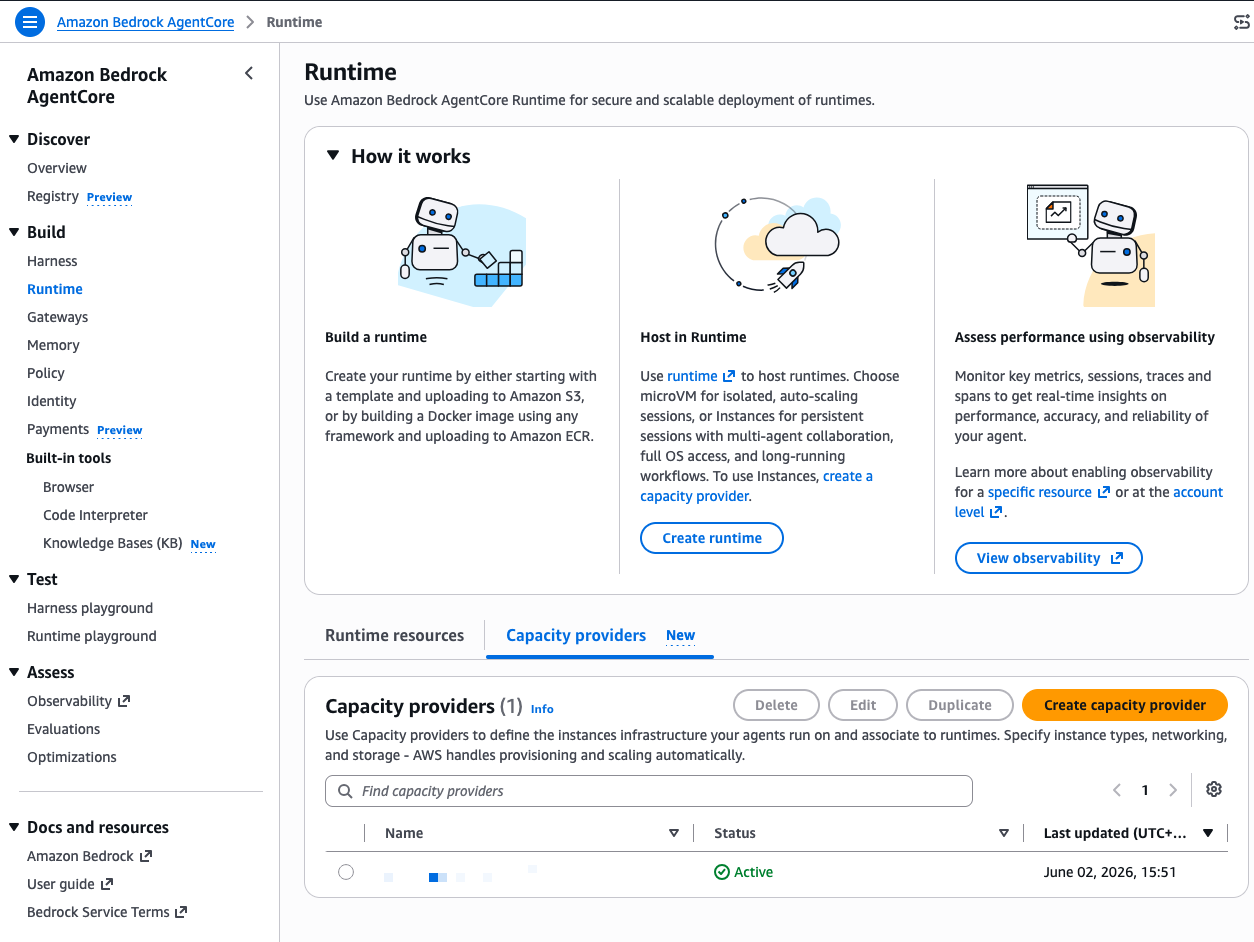
- Introduction of Runtime MicroVMs: AWS previously introduced managed microVM environments capable of supporting invocations for up to 8 hours, alongside managed session storage. While highly efficient for lightweight orchestrators, certain resource-heavy workloads still demanded direct operating system access, larger memory footprints, and GPU allocations.
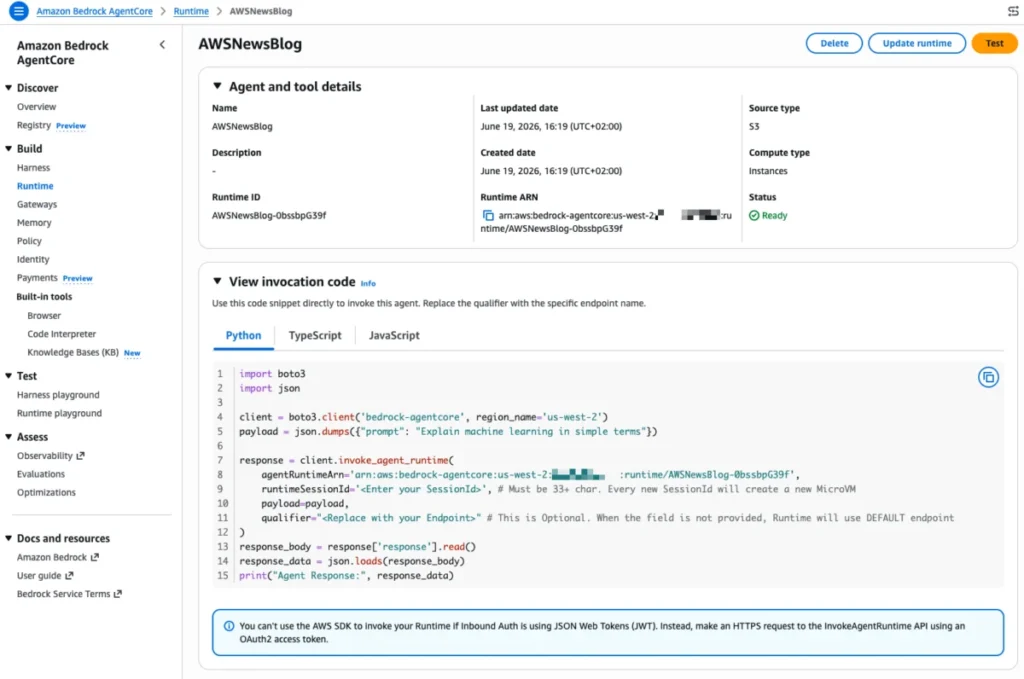
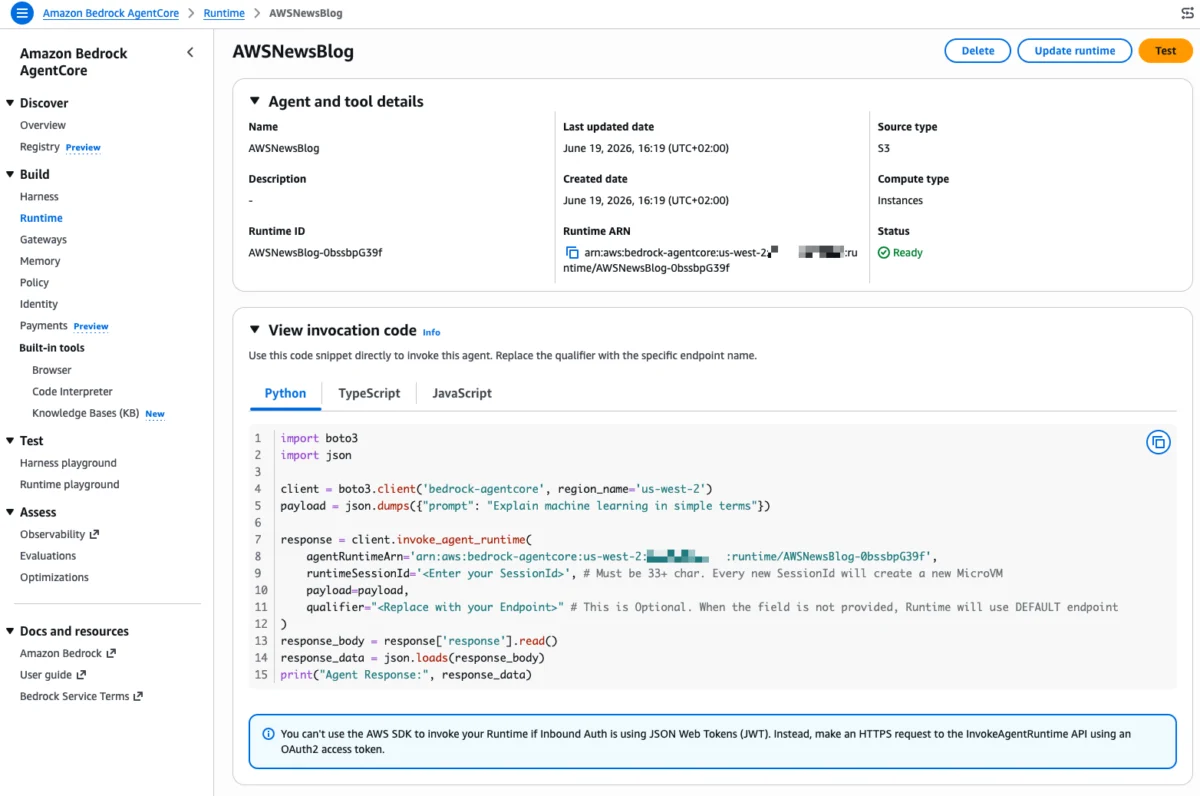
- The Launch of Runtime Instances: With today’s release, developers gain a dedicated, large-capacity compute tier. Rather than manually stitching together EC2 instances, custom load balancers, and bespoke monitoring scripts, engineers can now provision managed instances through the AWS Management Console, CLI, or infrastructure-as-code templates using the same underlying AgentCore APIs.
Supporting Data and Technical Implementation
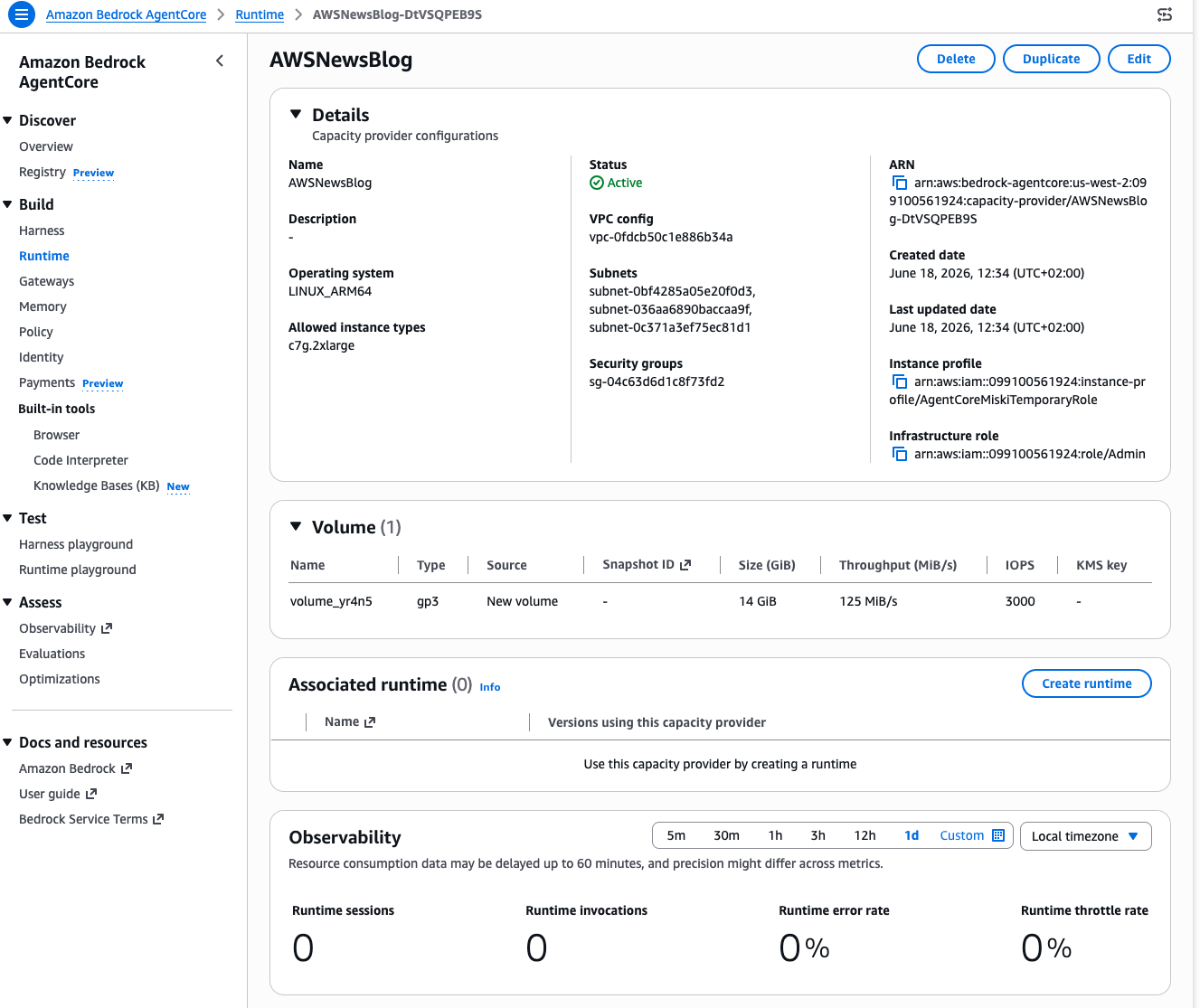
To demonstrate the power and practical application of runtime instances, AWS engineers highlighted a multi-agent software engineering pipeline. The implementation pairs a Code Writer Agent with a Code Reviewer Agent, both running on the same underlying EC2 capacity provider (c7g.2xlarge powered by Linux 64-bit ARM processors, delivering 8 vCPUs and 16 GiB of memory).
Rather than exchanging complex API payloads or communicating over network ports, the two agents collaborate natively through a shared local directory tied to their session ID.
The Code Writer Agent
writer = Agent(
    model="us.anthropic.claude-sonnet-4-5-20250929-v1:0",
    system_prompt=(
        "You are a senior Python engineer. "
        "Given a task, return ONLY a single Python code block — no prose."
    ),
)

@app.entrypoint
def handler(event, context):
    task = event.get("task") or event.get("prompt")
    session_id = getattr(context, "session_id", None) or event.get("session_id")
    session_dir = SHARED_DIR / session_id
    session_dir.mkdir(parents=True, exist_ok=True)

    code = str(writer(task))
    (session_dir / "code.py").write_text(code)

    return "agent": "writer", "wrote": str(session_dir / "code.py"), "code": code
The Code Reviewer Agent
reviewer = Agent(
    model="us.anthropic.claude-sonnet-4-5-20250929-v1:0",
    system_prompt=(
        "You are a strict Python code reviewer. "
        "Given code, return 3 bullet points: bugs, style, suggestions."
    ),
)

@app.entrypoint
def handler(event, context):
    session_id = getattr(context, "session_id", None) or event.get("session_id")
    code_path = SHARED_DIR / session_id / "code.py"
    code = code_path.read_text()
    review = str(reviewer(f"Review this code:nncode"))

    return "agent": "reviewer", "read": str(code_path), "review": review
Deployment Workflow
Deploying this architecture involves three primary steps within the AWS Console:
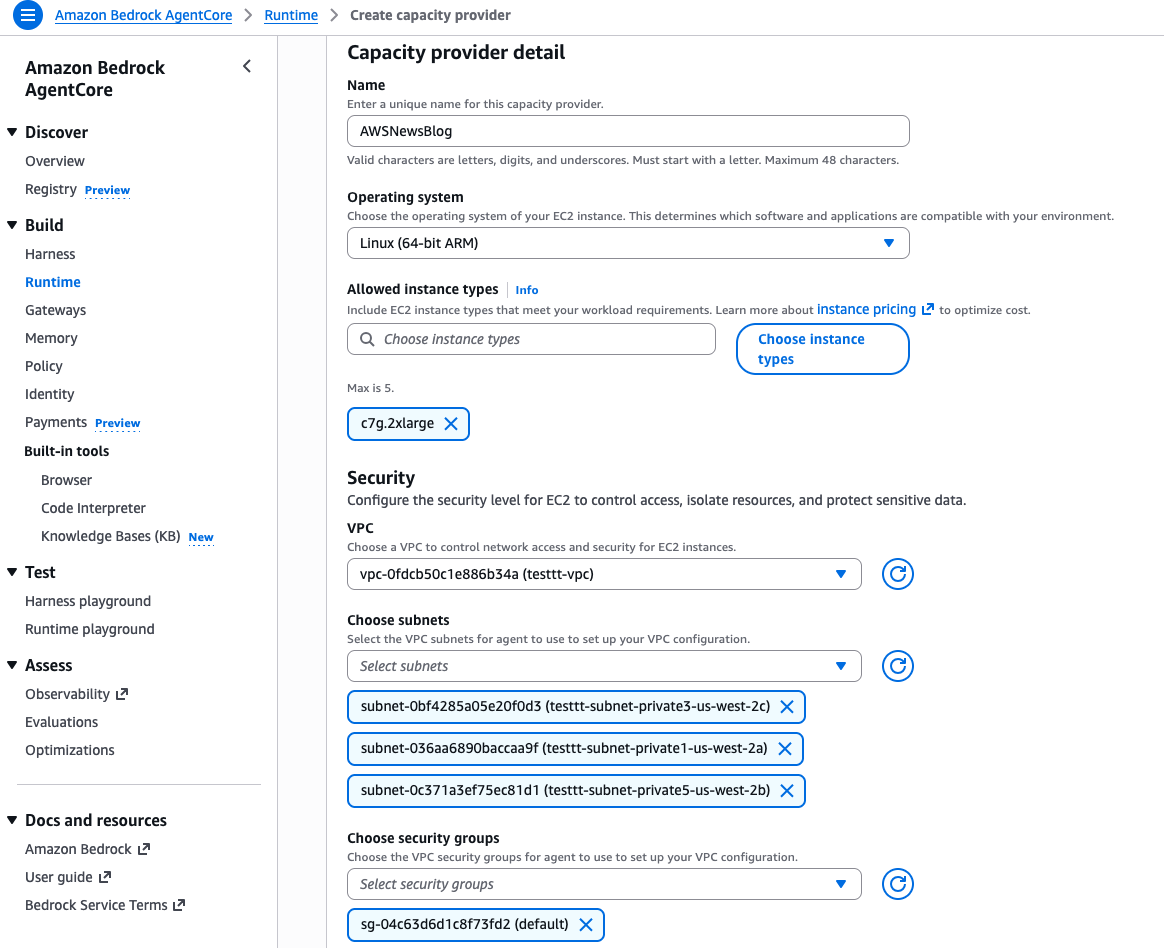
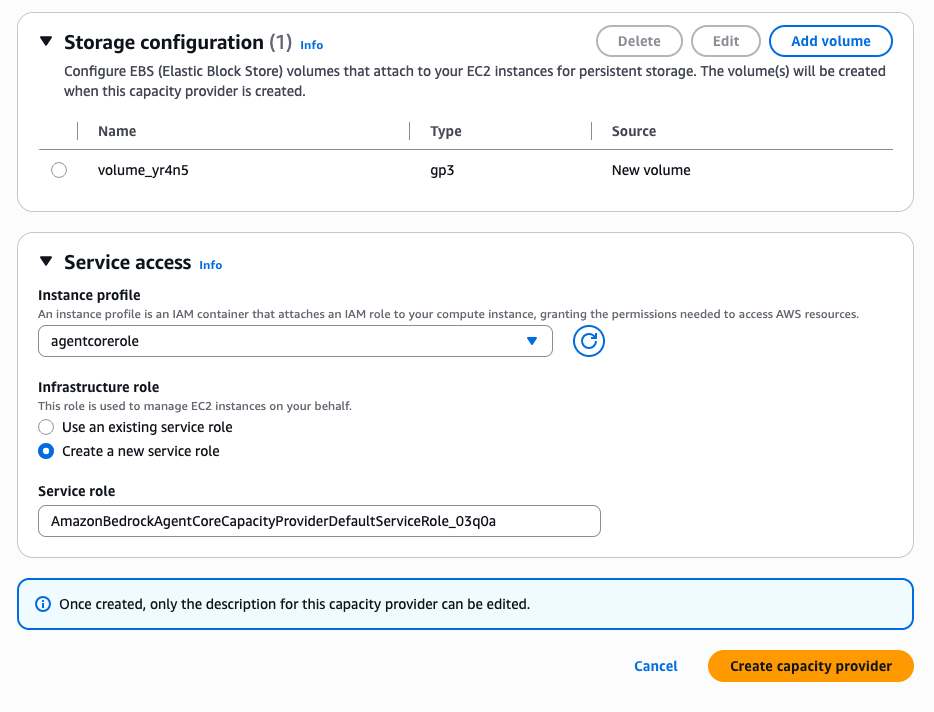
- Capacity Provider Creation: The developer defines the underlying infrastructure, selecting operating systems, instance families (such as ARM-based Graviton chips), VPC subnets, and IAM security roles.
- Runtime Configuration: Runtimes are established for each agent by linking them to the established capacity provider and pointing to respective deployment packages stored in Amazon S3.
- Session Coordination: By passing a unified
Session_IDduring programmatic or playground invocations, distinct agents access identical local working directories, allowing seamless handoffs of code files, documentation, and test artifacts without external network overhead.
Official Perspectives and Hybrid Architecture
According to AWS platform architects, runtime microVMs and runtime instances are not mutually exclusive; rather, they are designed as complementary components within a unified hybrid topology.
For instance, enterprises can deploy a lightweight orchestrator agent running on a fast-scaling runtime microVM to manage inbound user requests, handle API routing, and aggregate final results. When heavy lifting is required, the orchestrator can dispatch discrete workloads to specialized worker agents residing on high-capacity runtime instances. These worker nodes can subsequently execute compute-heavy operations—such as large-scale code compilation, static security vulnerability scanning, or complex browser-based GUI automation—which fundamentally require persistent state, high memory capacities, and direct OS interaction.
This modular separation of concerns ensures that organizations optimize both speed and cost, utilizing microVMs for instantaneous responsiveness and dedicated instances for prolonged computational lifting.
Industry Implications and Future Outlook
The introduction of Amazon Bedrock AgentCore Runtime instances signals a broader shift in enterprise AI development: moving away from brittle, stateless query responders toward persistent, autonomous digital workforces.
By abstracting away the operational friction of managing multi-day EC2 clusters, AWS lowers the barrier to entry for complex, multi-agent systems. Developers can now focus entirely on prompt engineering, logical agent collaboration, and domain-specific problem-solving, confident that the underlying cloud infrastructure will maintain context, ensure security compliance, and scale efficiently.
As enterprises increasingly demand autonomous systems capable of executing lengthy, multi-stage business processes—ranging from automated software refactoring to continuous compliance auditing—managed infrastructure options like AgentCore runtime instances will likely form the operational backbone of next-generation enterprise applications.