Cross-Platform AI Comes of Age: Bringing Reinforcement Learning Board Games to Flutter with TensorFlow Lite

SAN FRANCISCO — In a move that bridges the gap between advanced machine learning and cross-platform mobile development, the TensorFlow team has officially concluded its educational mini-series on edge-AI game development. Developer Advocate Wei Wei announced the release of a comprehensive tutorial and reference implementation demonstrating how to port an artificial intelligence-driven reinforcement learning board game to Flutter, utilizing the recently launched official TensorFlow Lite (TFLite) Plugin for Flutter.
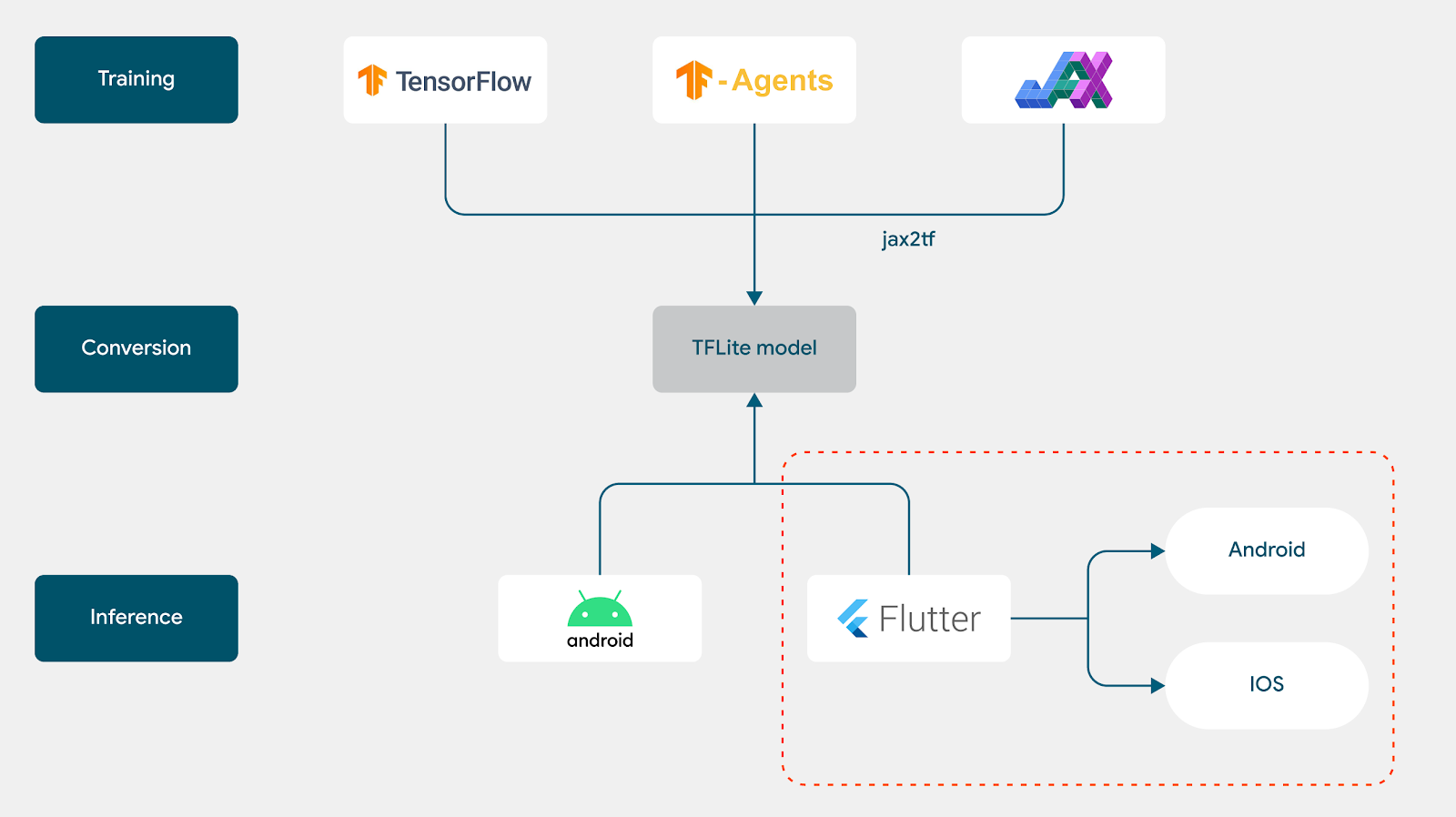
This final installment marks a significant milestone for mobile developers and machine learning engineers alike. By combining the high-performance training capabilities of TensorFlow, TensorFlow Agents, and JAX with the declarative UI framework of Flutter, developers can now deploy sophisticated on-device AI models simultaneously to Android and iOS ecosystems using a single codebase.
Main Facts: The Intersection of Reinforcement Learning and Cross-Platform Mobile
At the core of this technical achievement is "Plane Strike," a simplified strategic board game used by the TensorFlow team as a benchmark for edge-AI deployment.
- The Machine Learning Pipeline: The underlying game agent is not hard-coded with traditional game logic or rules; instead, it is a reinforcement learning (RL) agent trained via TensorFlow, TF-Agents, and JAX. The agent learns optimal strike patterns through iterative trial and error against simulated environments.
- The Inference Engine: Once trained, the heavy computational model is distilled and converted into a lightweight TensorFlow Lite (
.tflite) format. This format is optimized to run locally on mobile hardware without requiring cloud connectivity, ensuring low latency, high privacy, and offline functionality. - The Cross-Platform Breakthrough: While previous iterations of the tutorial focused strictly on native Android deployments, the new implementation leverages the official TFLite plugin for Flutter. This allows developers to load the model and execute high-speed tensor inferences inside a cross-platform Dart environment.
- Platform Support: The solution currently targets mobile environments, offering seamless execution on both Android and iOS devices from a shared codebase.
Chronology: Evolution of the TensorFlow Board Game Series
The journey toward seamless cross-platform AI deployment has evolved across several distinct phases over the past few years, reflecting rapid advancements in both machine learning tooling and mobile frameworks.
Phase 1: Native Android Genesis (October 2021)
The project began as an exploration of edge intelligence. The TensorFlow team published the foundational blog post, "Building a board game app with TensorFlow: a new TensorFlow Lite reference app." This initial release established that complex RL models could be shrunk down and executed locally on consumer-grade Android hardware, laying the groundwork for real-time human-versus-AI gameplay on mobile devices.
Phase 2: Modernizing the Backend with JAX (September 2022)
In the second major milestone, the team expanded the training ecosystem. Recognizing the growing popularity of high-performance numerical computing libraries, they published "Building a reinforcement learning agent with JAX, and deploying it on Android with TensorFlow Lite." This update proved that models trained in cutting-edge ecosystems like JAX could be successfully exported, converted, and embedded into mobile applications, broadening the horizons for AI researchers.

Phase 3: The Flutter Plugin Launch (August 2023)
A major ecosystem bottleneck was addressed with the official release of the TensorFlow Lite Plugin for Flutter. Prior to this release, Flutter developers wishing to utilize on-device machine learning had to rely on community-maintained packages or write complex platform-specific native bridge code (Platform Channels). The official plugin standardized and streamlined access to the TFLite C++ interpreter across mobile platforms.
Phase 4: Cross-Platform Unification (Present Day)
Responding to overwhelming feedback from the Flutter developer community, the TensorFlow team released the final tutorial porting the "Plane Strike" app to Flutter. This milestone completes the transition from platform-locked native apps to a universal, cross-platform reference architecture.
Supporting Data & Technical Implementation
Integrating a machine learning model into a Flutter application typically introduces concerns regarding performance, memory management, and asynchronous execution. However, the official TFLite plugin simplifies these hurdles dramatically.
1. Loading the Model
Loading the pre-trained reinforcement learning asset within a Flutter stateful widget requires only a few lines of asynchronous Dart code. The interpreter initializes directly from the application’s local asset bundle:
Interpreter? _interpreter;
String _modelFile = 'assets/plane_strike_model.tflite';

void _loadModel() async
  // Create the interpreter from the bundled asset
  _interpreter = await Interpreter.fromAsset(_modelFile);
2. Executing Real-Time Inference
During gameplay, the application evaluates the current state of the user’s board, formats it into a multi-dimensional array, and feeds it into the TFLite interpreter. The model processes the tensor and outputs a probability distribution representing the most advantageous coordinates to strike next.
Using an argmax algorithm, the app isolates the highest-scoring index from the model’s output vector:

int predict(List<List<double>> boardState)
  var input = [boardState];
  var output = List.filled(_boardSize * _boardSize, 0)
      .reshape([1, _boardSize * _boardSize]);

  // Run real-time inference on device
  _interpreter?.run(input, output);

  // Determine the optimal move via Argmax
  double max = output[0][0];
  int maxIdx = 0;
  for (int i = 1; i < _boardSize * _boardSize; i++)
    if (max < output[0][i])
      maxIdx = i;
      max = output[0][i];


  return maxIdx;
By keeping this loop entirely client-side, the game achieves instantaneous response times without hitting network latency barriers. Complete, production-ready source code, along with UI rendering logic and state management configurations, is openly available via the official GitHub repository.
Official Responses and Developer Community Impact
The developer relations team at Google has emphasized that this project is intended to serve as a springboard for creative experimentation rather than a finished commercial product.
"While these end-to-end tutorials are helpful for Android developers, we have heard from the Flutter developer community that it would be interesting to make the app cross-platform," stated Wei Wei, Developer Advocate at Google, during the release announcement. "Inspired by the officially released TensorFlow Lite Plugin for Flutter recently, we are going to write one last tutorial and port the app to Flutter."
Industry analysts note that Google’s push to unite its premier machine learning framework (TensorFlow/TFLite) with its premier UI framework (Flutter) addresses a long-standing developer demand. Historically, building cross-platform apps with embedded machine learning required stitching together disparate toolchains. By offering an officially supported, streamlined pipeline from JAX/TensorFlow training down to Flutter execution, Google is significantly lowering the barrier to entry for mobile AI development.
Implications for the Future of Mobile and Edge AI
The convergence of Flutter and TensorFlow Lite through this reference implementation carries broad implications for software engineers, UX designers, and businesses venturing into artificial intelligence:
1. Democratization of Edge AI
Developers no longer need deep expertise in native Android (Kotlin/Java) or iOS (Swift/Objective-C) development to ship smart applications. With Flutter and the TFLite plugin, a single frontend engineer can design an engaging UI, manage game states, and deploy a complex reinforcement learning neural network to both major app stores simultaneously.
2. Privacy-First, Cost-Effective Architecture
Because model inference occurs entirely on the user’s device, applications built on this architecture require zero cloud infrastructure for AI processing. This eliminates recurring server-side hosting costs, protects user privacy by keeping gameplay and telemetry data local, and ensures the app remains fully functional in offline environments.
3. Next Steps for Developers
The TensorFlow team has encouraged the community to take the reference code further. Developers looking to expand upon the "Plane Strike" template are encouraged to explore advanced modifications:
- Scaling Board Dimensions: Modifying the input tensors to handle larger, more complex grid sizes that require deeper strategic planning from the RL agent.
- Hyperparameter Tuning: Retraining the underlying JAX or TensorFlow agents with altered reward functions to create distinct AI difficulty tiers (e.g., novice, intermediate, expert).
- Expanding Platform Horizons: Experimenting with desktop and embedded targets as the Flutter TFLite plugin ecosystem matures.
As this mini-series concludes, the focus shifts entirely to the global developer community. The TensorFlow team has urged creators to share their innovative cross-platform AI projects across social media channels by tagging @googledevs and @TensorFlow, setting the stage for the next wave of intelligent mobile applications.