Streamlining Machine Learning on Temporal Data: A Deep Dive into TensorFlow Decision Forests and Temporian


In the modern landscape of applied machine learning, the ability to process time-sensitive information is often the dividing line between a mediocre model and a production-grade triumph. Temporal data—information that evolves, decays, or gains relevance relative to a specific moment in time—is omnipresent. From volatile market prices and shifting meteorological conditions to the precise interval between consecutive heartbeats or transient network anomalies, temporal context provides high-discriminative power for advanced predictive systems.
Yet, despite its ubiquity, preparing temporal data for machine learning has historically been a notoriously complex, error-prone, and computationally expensive endeavor. Developers have frequently had to write bespoke, highly inefficient Python scripts to handle non-synchronized data streams, windowing operations, and feature leakage prevention.

To bridge this gap, Google—in close collaboration with the engineering team at Tryolabs—has released Temporian, a powerful open-source Python library designed to simplify the preprocessing and feature engineering of temporal data. When paired with TensorFlow Decision Forests (TFDF), Temporian offers an end-to-end pipeline that transforms raw, chaotic transactional records into high-performance predictive models with remarkable ease.
The Chronology of Temporal Data Processing
For years, the evolution of time-based data engineering has followed a predictable, albeit cumbersome, trajectory. Early machine learning workflows relied heavily on traditional time series analysis. While effective for uniformly sampled aggregate signals—such as hourly electricity consumption or monthly stock averages—standard time series models routinely fall short when confronted with real-world complexity.

Real-world datasets are rarely tidy or uniformly spaced. Modern applications deal with multivariate time series, non-uniformly sampled time sequences, and complex event sets where multiple entities interact asynchronously.
Recognizing these limitations, engineers at Google and Tryolabs initiated the development of Temporian to fundamentally rethink how temporal data is ingested and manipulated. Instead of forcing messy event-driven data into rigid, uniform matrices, Temporian introduces the concept of EventSets—versatile containers capable of natively handling multivariate time sequences, multi-index relationships, and non-synchronized data sources.

By integrating Temporian with TensorFlow Decision Forests, developers can now seamlessly bridge data engineering and predictive modeling, bypassing the traditional bottlenecks of custom data pipeline construction.
Main Facts: What is Temporian and How Does It Work?
At its core, Temporian acts as a specialized data-preprocessing engine optimized for machine learning tasks where data arrives continuously—such as sales forecasting, anomaly detection, fraud analysis, and predictive maintenance.

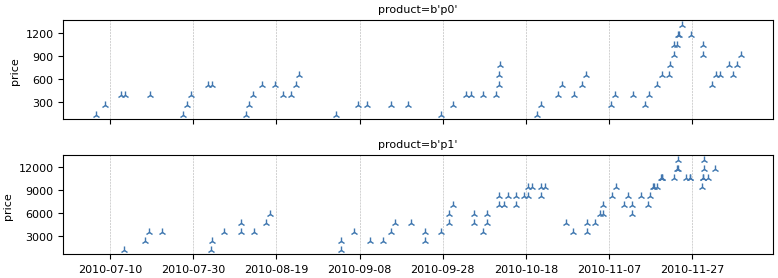
To understand its mechanics, consider a classic machine learning scenario: forecasting weekly retail sales from a continuous stream of individual online transactions. A typical raw dataset logs every single user interaction, capturing the exact timestamp, client ID, product SKU, and transaction price:
$ head -n 5 sales.csv
timestamp,client,product,price
2010-10-05 11:09:56,c64,p35,405.35
2010-09-27 15:00:49,c87,p29,605.35
2010-09-09 12:58:33,c97,p10,108.99
2010-09-06 12:43:45,c60,p85,443.35
Feeding raw logs directly into a machine learning model is virtually impossible without extensive feature engineering. Using Temporian, data scientists can ingest this CSV file into a unified EventSet structure with minimal code:

# Import Temporian
import temporian as tp

# Load the csv dataset
sales = tp.from_csv("/tmp/sales.csv")

# Print details about the EventSet
sales
Once loaded, Temporian allows engineers to execute complex windowing operations—such as calculating moving sums over sliding time windows—across the entire dataset or partitioned by specific product indices:
# Index the data by "product"
sales_per_product = sales.add_index("product")

# Compute the moving sum for each product over a 7-day window
weekly_sales_per_product = sales_per_product["price"].moving_sum(
    tp.duration.days(7)
)
This capability ensures that rolling calculations are computed independently and correctly across isolated entities, preventing cross-contamination of data and eliminating common logic errors that plague manual pipeline implementations.

Supporting Data and Technical Implementation
To evaluate the practical efficacy of this combined pipeline, developers can construct a complete predictive workflow that trains a TensorFlow Decision Forest to forecast next-day sales based on historical transactional aggregations.
1. Data Augmentation and Feature Engineering
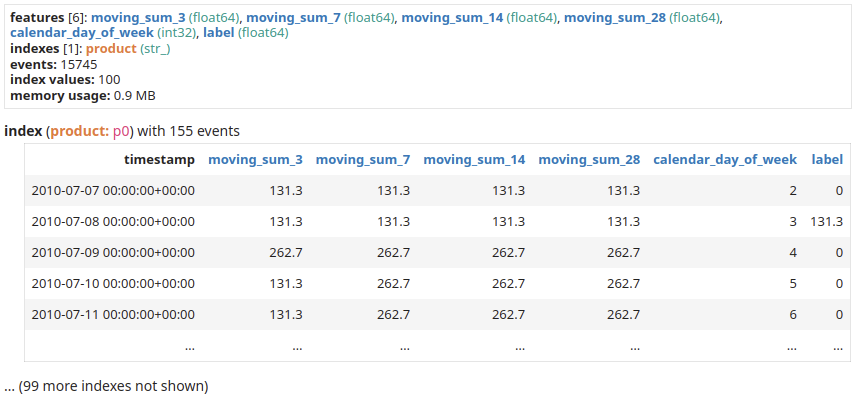
Machine learning models thrive on diverse temporal perspectives. By generating moving sums across multiple window lengths (e.g., 3, 7, 14, and 28 days) alongside calendar metadata—such as the day of the week—we equip the model with a rich feature space capable of capturing both short-term trends and broader cyclical patterns.
sales_per_product = sales.add_index("product")

# Create one example per day sampling rate
daily_sampling = sales_per_product.tick(tp.duration.days(1))

features = []
for w in [3, 7, 14, 28]:
    features.append(sales_per_product["price"]
        .moving_sum(
            tp.duration.days(w),
            sampling=daily_sampling)
        .rename(f"moving_sum_w"))

# Incorporate calendar features to capture human behavioral cycles
features.append(daily_sampling.calendar_day_of_week())

# Establish the label by shifting (leaking) future sales by one day
label = (sales_per_product["price"]
    .leak(tp.duration.days(1))
    .moving_sum(
        tp.duration.days(1),
        sampling=daily_sampling,
    )
    .rename("label"))

# Glue features and labels together into a unified dataset
dataset = tp.glue(*features, label)
2. Model Training with TensorFlow Decision Forests
Once the EventSet is prepared, Temporian provides a native utility to convert the dataset directly into a TensorFlow-compatible format. From there, training a robust Random Forest regression model requires only a few lines of Keras code:
import tensorflow_decision_forests as tfdf

def extract_label(example):
    example.pop("timestamp") # Exclude raw timestamps from acting as direct features
    label = example.pop("label")
    return example, label

tf_dataset = tp.to_tensorflow_dataset(dataset).map(extract_label).batch(100)

# Initialize and train a Random Forest Regression model
model = tfdf.keras.RandomForestModel(task=tfdf.keras.Task.REGRESSION, verbose=2)
model.fit(tf_dataset)
3. Model Interpretation and Feature Importance
Evaluating the model summary reveals critical insights into which temporal features drove the algorithm’s decision-making process:

Type: "RANDOM_FOREST"
Task: REGRESSION
...
Variable Importance: INV_MEAN_MIN_DEPTH:
    1.        "moving_sum_28"  0.342231  ################
    2.              "product"  0.294546  ############
    3. "calendar_day_of_week"  0.254641  ##########
    4.        "moving_sum_14"  0.197038  ######
    5.         "moving_sum_7"  0.124693  #
    6.         "moving_sum_3"  0.098542
The output highlights that moving_sum_28 holds the highest variable importance score (0.342), indicating that longer-term historical context played a pivotal role in predicting future sales volume. Furthermore, product categorization and calendar day-of-week metrics proved highly influential, validating the multi-faceted feature engineering approach.
Official Responses and Industry Perspectives
The development team behind Temporian—comprising Google engineers Mathieu Guillame-Bert, Richard Stotz, Robert Crowe, Luiz Gustavo Martins (Gus), Ashley Oldacre, Kris Tonthat, Glenn Cameron, alongside the Tryolabs team consisting of Ian Spektor, Braulio Rios, Guillermo Etchebarne, Diego Marvid, Lucas Micol, Gonzalo Marín, Alan Descoins, Agustina Pizarro, Lucía Aguilar, and Martin Alcala Rubi—emphasized that the library was built out of a shared necessity to streamline production ML workflows.

According to the engineering collective, existing tools often force data scientists to choose between high-performance execution and expressive, flexible data manipulation. Temporian was explicitly engineered to eliminate this compromise. By abstracting the complexities of asynchronous event processing, the library allows developers to write declarative, readable Python code that translates directly into highly optimized execution graphs.
Industry analysts have noted that the synergy between Temporian and TensorFlow Decision Forests represents a significant maturation of tabular and temporal modeling tooling. While deep learning architectures often dominate discussions around sequential data, tree-based models like TensorFlow Decision Forests remain exceptionally fast, interpretable, and resilient when applied to tabular event data—making this integration a powerful addition to the enterprise data science toolkit.
Implications for the Future of Machine Learning
The introduction of Temporian and its seamless integration with TensorFlow Decision Forests carries profound implications for organizations operating in data-intensive sectors such as e-commerce, fintech, cybersecurity, and IoT.
- Drastic Reduction in Development Time: Data engineering tasks that previously required hundreds of lines of fragile, custom Pandas or SQL windowing scripts can now be expressed concisely using Temporian’s dedicated operators. This accelerates time-to-market for predictive models.
- Mitigation of Data Leakage: One of the most insidious traps in temporal machine learning is accidental target leakage—where future information inadvertently contaminates training features. Temporian’s structural design enforces strict temporal boundaries, ensuring models are trained exclusively on data available at the simulated prediction timestamp.
- Enhanced Model Interpretability: By pairing Temporian’s engineered features with inherently interpretable frameworks like TensorFlow Decision Forests, teams can maintain complete visibility into why a model makes specific temporal predictions, satisfying regulatory and operational transparency requirements.
As machine learning applications continue to shift toward real-time, event-driven architectures, tools that simplify temporal preprocessing will become indispensable. The collaboration between Google and Tryolabs marks a major step forward, empowering engineers to tame temporal complexity and build smarter, faster, and more reliable predictive systems.