Beyond the Shake: How TekkaSketch Reinvents a Childhood Icon for the Digital Age
For over six decades, the Etch A Sketch has held a paradoxical position in the toy industry: it is simultaneously one of the most beloved creative tools in history and one of the most frustrating. Since its debut in 1960, the Ohio Art Company’s iconic red-framed drawing toy has defined a generation of tactile creativity. Yet, its fundamental limitation—the "all-or-nothing" nature of the aluminum powder mechanism—has remained unchanged. To correct a single errant line, an artist must shake the entire device, effectively erasing hours of labor in a chaotic flurry of static electricity.
Enter TekkaSketch, a visionary project that bridges the chasm between analog nostalgia and digital utility. By reimagining the internal architecture of the classic toy, its creators have successfully implemented the "undo" functionality that has eluded millions of children and hobbyists for generations. This article explores how modern hardware—specifically E-Ink technology and microcontroller logic—is breathing new life into a relic of the analog era.
The Mechanics of Nostalgia: Understanding the Original
To appreciate the innovation of TekkaSketch, one must first understand the mechanical genius of the original Etch A Sketch. The device operates on a relatively simple yet highly sensitive principle: a glass screen coated on the inside with a mixture of aluminum powder and plastic beads.
Two internal knobs control a stylus via a complex system of pulleys and cables. As the user turns the knobs, the stylus scrapes the powder away from the glass, creating a dark line against the silver background. This is not ink; it is the strategic displacement of particles. Because the system relies entirely on physical contact and gravity, the medium is inherently destructive. Once a line is drawn, it exists as a physical void in the powder layer. The "shake-to-erase" function works by turning the device upside down, allowing loose powder to coat the screen again, resetting the "canvas."
The Chronology of Innovation: From Micro-Vacuums to E-Ink
The development of TekkaSketch was not a linear path; it was a series of iterative failures that eventually led to a breakthrough.
Phase I: The Mechanical Impossible
The initial design phase was characterized by a desire to keep the original aluminum powder mechanism intact. The project lead explored the possibility of a "micro-vacuum" system—a series of miniaturized nozzles that could target specific areas of the screen to suction and redistribute the powder. While theoretically sound, the mechanical complexity required to move a vacuum head across an XY-axis within a confined space proved to be a prohibitive engineering challenge. The weight and power requirements threatened to destroy the very portability that makes the Etch A Sketch iconic.
Phase II: The "Snake" Inspiration
Stalled by mechanical limitations, the project took an unexpected turn toward software. Drawing inspiration from the 1990s PC classic Nibbles.bas (the Snake game), the team wondered if the Etch A Sketch could be repurposed as a controller. Early prototypes involved Augmented Reality (AR). By mounting a smartphone over the toy, the team attempted to overlay digital graphics onto the physical screen. While visually impressive, the lack of tactile feedback and the latency issues between the knobs and the AR display rendered the experience disjointed.
Phase III: The E-Ink Breakthrough
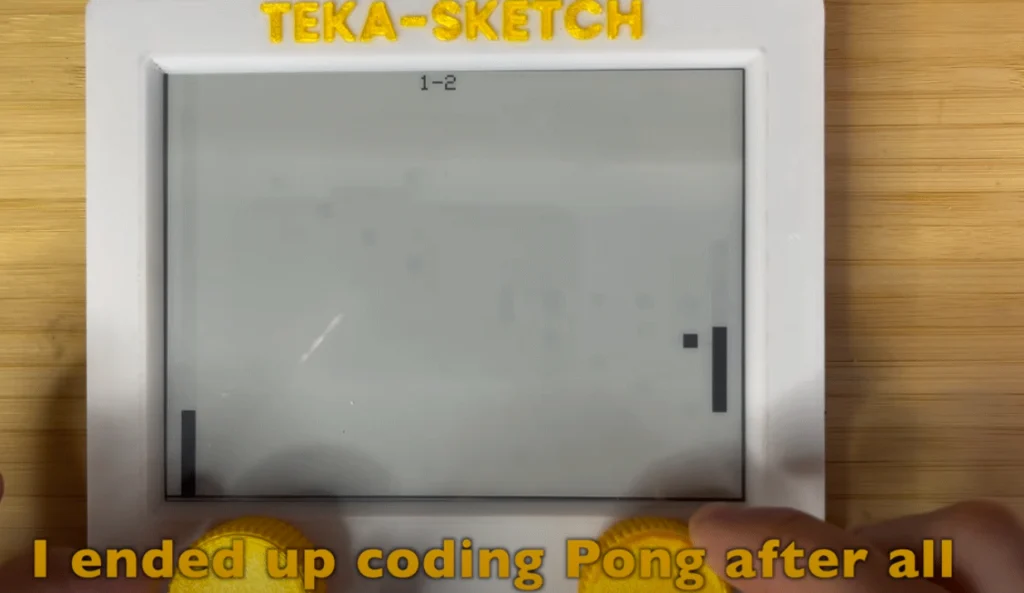
The final, successful architecture was born from a radical decision: to abandon the powder mechanism entirely while preserving the tactile experience of the knobs. The team replaced the glass and aluminum powder with an E-Ink display. This choice was strategic; unlike standard LCD or OLED panels, E-Ink mimics the high-contrast, paper-like quality of the original, and crucially, it retains the image even when the device is powered off—a perfect homage to the "persistent" nature of the original toy.
Technical Specifications and Implementation
The heart of the TekkaSketch is the ESP32 microcontroller, a powerful and versatile chip capable of handling the complex signal processing required to translate mechanical knob rotation into digital coordinates.

The Hardware Stack
- Microcontroller: ESP32, selected for its dual-core processing speed and integrated Wi-Fi/Bluetooth capabilities, which allow for future-proofing and remote updates.
- Input Interface: High-resolution rotary encoders. Unlike the original friction-based knobs, these encoders provide precise digital pulses, allowing the software to map the movement of the stylus with pixel-perfect accuracy.
- Display: A high-contrast E-Ink screen with partial refresh capabilities. This allows the device to update specific sections of the drawing—facilitating the long-awaited "undo" feature—without the need to redraw the entire screen.
Software Logic
The biggest hurdle in moving to a digital interface was ensuring that the "feel" remained analog. The software uses a proprietary smoothing algorithm to compensate for the varying speeds at which a user might turn the knobs. This prevents the digital line from looking "stepped" or jittery, ensuring that the movement feels as fluid as the mechanical original.
Official Perspectives and Community Feedback
The response from the maker community has been overwhelmingly positive. Tech observers note that TekkaSketch occupies a unique "third space" in the hardware market. It is not quite a toy, nor is it a high-end digital tablet; it is a creative platform that embraces the constraints of its form factor rather than trying to overcome them with brute-force computing.
In a recent statement, the project developers emphasized that the goal was never to replace the original, but to "complete" it. "The Etch A Sketch was a lesson in commitment," the lead engineer noted. "You had to live with your mistakes. With TekkaSketch, we wanted to keep the lesson but remove the punishment. We wanted to see what would happen if we gave the user the power of an ‘undo’ button while keeping the physical challenge of the dual-knob interface."
Implications: A New Era for Tactile Computing
The implications of the TekkaSketch project extend far beyond the nostalgia of the drawing board.
1. The Revival of "Slow Tech"
As the world moves toward increasingly complex, high-latency touch interfaces, there is a growing trend toward "Slow Tech"—devices that emphasize intentionality, tactile feedback, and physical limitations. TekkaSketch serves as a proof-of-concept for how older interfaces can be modernized without losing their soul.
2. Educational Potential
The dual-knob interface of the Etch A Sketch is notoriously difficult to master; it requires the user to develop strong bilateral coordination. By gamifying this process through the Snake mode—and especially the two-player version where each knob controls a different axis of movement—TekkaSketch provides a compelling tool for occupational therapy and motor skill development in children.
3. Future-Proofing Creativity
By integrating the ESP32, the creators have opened the door for endless expansion. Future firmware updates could include:
- Cloud Connectivity: Allowing users to sync their drawings to a digital gallery.
- Layering: Implementing multiple "sheets" of digital canvas to create complex illustrations.
- Customizable Brushes: Changing the line weight or texture of the stylus in real-time.
Conclusion
TekkaSketch is a masterclass in modern hardware integration. By identifying the core essence of the Etch A Sketch—the tactile satisfaction of the knobs, the persistent nature of the display, and the simplicity of the design—and stripping away the outdated mechanical components, the project has successfully transformed an icon of the 1960s into a viable tool for the 2020s.
Whether you are a nostalgic adult looking to relive a childhood memory or a maker interested in the intersection of E-Ink and microcontroller logic, TekkaSketch offers a glimpse into how we can honor the past while embracing the infinite possibilities of the digital future. It is a reminder that even the most "limited" objects are only waiting for the right technology to unlock their full potential. As the project continues to evolve, one thing is clear: the era of the "shake-to-erase" is officially over, and the era of the "undo" has arrived.