Meet JBR-001: The Open-Source Edge-AI Desktop Robot Powered by the Arduino UNO Q
In the rapidly evolving landscape of desktop robotics and edge artificial intelligence, hobbyists and engineers are constantly searching for platforms that bridge the gap between basic microcontroller blinking projects and complex, expensive industrial systems. Enter the JBR-001, an open-source desktop companion robot created by the developer community entity syntheticAIdata.
Far from being a mere static desk ornament, the JBR-001 is a fully interactive, vision-enabled platform designed to see, recognize, and react to its environment using real-time computer vision and physical motion. Built around the powerful Arduino UNO Q (2GB variant) and augmented by 3D-printable mechanics, smart distance sensors, servo-driven articulation, and expressive audiovisual feedback loops, this project represents an accessible yet highly capable entry point into modern edge AI development.
Main Facts: Architecture and Capabilities of the JBR-001
At its technological core, the JBR-001 is engineered to demonstrate how accessible hardware can run advanced machine learning workloads locally, entirely at the edge, without requiring constant cloud connectivity.
The Core Processing Unit: Arduino UNO Q 2GB
The brain of the operation is the Arduino UNO Q, specifically utilizing the 2GB memory configuration (though a 4GB variant and complete kit are also available for heavier machine learning pipelines). This board provides the necessary computational throughput to handle standard microcontroller tasks while simultaneously driving complex I/O protocols, interfacing with high-bandwidth peripherals, and processing inferences from an onboard computer vision model.
Sensory Perception and Actuation
The robot derives its situational awareness from two primary inputs:
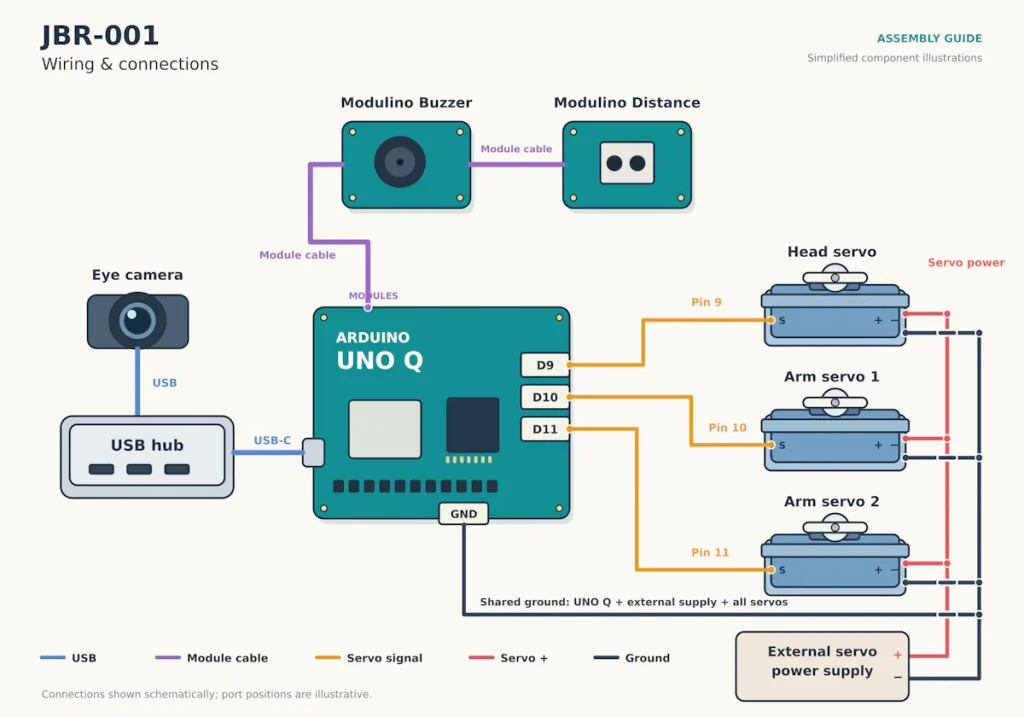
- The Vision System: A compact USB-C-connected camera mounted squarely in the robot’s head, providing a real-time, forward-facing view of its surroundings.
- Proximity Sensing: A Modulino Distance sensor mounted discreetly on the rear of the head, allowing the system to continuously monitor space and calculate object placement relative to the chassis.
For physical expression, the JBR-001 relies on three standard hobby servos connected via dedicated pins:
- Head Rotation Servo: Connected to
HEAD_SERVO_PIN = 9, initialized at a neutral center of 90 degrees (HEAD_CENTER = 90). - Left Arm Servo: Connected to
LEFT_ARM_SERVO_PIN = 10, centered at 90 degrees. - Right Arm Servo: Connected to
RIGHT_ARM_SERVO_PIN = 11, centered at 90 degrees.
Crucially, the hardware design mandates a separate external power supply for these servos. Drawing motor current directly from the logic board under simultaneous actuation risks brownouts and voltage instability, making an isolated power rail a structural necessity for reliable benchtop operation.
Expressive Feedback Mechanisms
Interaction with the user is handled through dual sensory modalities: visual animations and auditory cues.
- The LED Matrix Display: Driven by custom 8-row by 13-column bitmaps, the display generates dynamic animations, most notably a pulsing heartbeat rendered through precise temporal delays (120ms, 100ms, 160ms, and a final 700ms pause to simulate the natural biological resting phase between beats).
- Auditory Greetings (
playHello): The onboard buzzer outputs a cheerful C-major arpeggio spanning an entire octave, utilizing frequencies of 523 Hz (C5), 659 Hz (E5), 784 Hz (G5), and 1047 Hz (C6).
Chronology: From Concept to Workbench Reality
The evolution of the JBR-001 project follows a logical trajectory typical of modern open-source hardware development, moving from digital design to physical deployment.
Phase 1: Conceptualization and Prototyping
syntheticAIdata sought to design a compact desktop companion that avoided the limitations of purely mechanical animatronics. The vision was to marry low-cost 3D printing with advanced microprocessor capabilities. The selection of the Arduino UNO Q 2GB provided the optimal intersection of GPIO flexibility and Linux-capable edge computing power required for running lightweight object recognition models.
Phase 2: Mechanical Design and 3D Printing
Makers looking to replicate the build begin with the physical chassis. Designed entirely for home fabrication, the body consists of interlocking 3D-printable components.
- The upper torso houses the central processing board and power distribution lines.
- The head assembly acts as a secure housing for both the USB-C camera and the Modulino Distance sensor.
- Internal routing channels guide the servo wires from the arms and neck down to the main control interface, minimizing clutter and preventing mechanical binding during movement.
Phase 3: Software Integration and Firmware Calibration
Once assembled physically, the project requires software provisioning using the Arduino App Lab environment alongside the official JBR-001 source repository. Initial configuration involves defining operational constants in the firmware code:

- Setting precise servo control pins (
9,10, and11). - Establishing default home orientations (
90degrees across all axes). - Calibrating proximity thresholds to prevent erratic state-switching.
Phase 4: Field Testing and Vision Model Deployment
The final phase of the build involves loading a trained computer vision model onto the Arduino UNO Q. By linking the camera feed to the local inference engine, the robot transitions from a simple proximity-triggered automaton into a responsive entity capable of semantic object recognition.
Supporting Data: Technical Parameters and Code Logic
A closer examination of the JBR-001 source code and hardware configuration reveals the careful engineering decisions made to ensure stable, repeatable performance.
Proximity Thresholds and Hysteresis Logic
One of the common challenges in proximity-based robotics is "chattering"—a phenomenon where rapid fluctuations right at a sensor’s detection boundary cause a device to incessantly toggle its operational states on and off. The JBR-001 solves this through software hysteresis by establishing two distinct distance thresholds:
$$textDETECTION_DISTANCE = 200.0$$
$$textRESET_DISTANCE = 250.0$$
While the absolute units depend on the specific sensor calibration and bench configuration, the 50-unit margin ensures that an object must definitively cross into the interaction zone before triggering a response, and must retreat significantly further away before the system resets its state. This produces smooth, natural behavior transitions.
Hardware Expansion Ecosystem
While the base build relies on the core components included by syntheticAIdata, the project is designed with modularity in mind. Makers scaling up their builds often incorporate complementary hardware solutions:
- RC Servo Control Modules: For builders aiming to expand the JBR-001’s degree of freedom by adding more motors, dedicated RC servo control shields simplify power management and signal routing.
- Alternative Distance Sensors: While the stock design utilizes a Modulino Distance module, makers seeking higher precision or different ranges frequently swap in Time-of-Flight (ToF) laser distance sensors, such as the VL53L3CX, for superior close-range accuracy.
- Memory Scalability: For developers running deeper neural networks or high-resolution vision models, the upgrade path from the UNO Q 2GB to the Arduino UNO Q 4GB complete kit offers double the memory headroom, preventing out-of-memory errors during real-time image processing.
Official Responses and Community Reception
Since its publication on the Arduino Project Hub, the JBR-001 has captured the attention of the global maker community. Accumulating steady engagement—including nearly two thousand views and widespread respect badges from fellow developers—the project has been praised for its elegant integration of traditional microcontroller mechanics with contemporary edge AI tools.
Makers within the community have highlighted several strengths of the design:
- Accessibility: Because the primary structural components can be 3D-printed on standard consumer machines, the barrier to entry is exceptionally low.
- Educational Value: The project serves as an ideal pedagogical tool for classrooms and maker spaces, touching upon kinematics, embedded programming, sound synthesis, and machine learning pipelines in a single package.
- Extensibility: The open-source nature of both the hardware schematics and software repository invites community-driven modifications, ranging from custom casing designs to entirely new machine learning behavior trees.
Implications: The Future of Desktop Edge AI Companions
The release and reception of projects like the JBR-001 point toward a broader trend in consumer and maker electronics: the democratization of edge artificial intelligence.
For decades, running computer vision models locally required bulky desktop workstations or expensive single-board computers coupled with power-hungry accelerators. The emergence of capable, memory-balanced boards like the Arduino UNO Q changes this paradigm. By bringing localized object recognition down to an affordable, desktop-friendly scale, developers can now build ambient computing devices that respect user privacy—processing visual data entirely on the device without streaming sensitive video feeds to cloud servers.
Furthermore, desktop companion robots serve as tangible testing grounds for human-robot interaction (HRI). By combining subtle physical gestures (head tilting, arm movements) with expressive visual cues (heartbeat animations) and audio feedback, the JBR-001 explores how low-cost robotics can evoke empathy and maintain user engagement.
Conclusion
Whether built as an educational weekend project, a platform for experimenting with machine learning vision models, or a foundation for advanced robotics research, the JBR-001 demonstrates the incredible potential of modern open-source hardware. By blending 3D printing, precise motor control, and local AI processing, syntheticAIdata has delivered a desktop companion that points the way forward for the next generation of smart, interactive hardware.