Court-Ordered Transfer of Radaris.com Marks a Landmark Shift in the War Against Shadowy Data Brokers

By Investigative Staff
Published in Partnership with Cybersecurity Intelligence
In a stunning development that could reshape the multi-billion-dollar consumer data broker industry, a federal court has ordered the transfer of Radaris.com—along with over a dozen associated domains—directly to plaintiffs following years of systemic stonewalling, legal shell games, and flagrant violations of state privacy protections.
For over a decade, Radaris operated as an untouchable behemoth in the people-search sector, systematically ignoring removal requests, mocking privacy advocates, and utilizing an ever-rotating cast of offshore shell companies to evade accountability. That era of impunity came to an abrupt halt when a judge forced the handover of its flagship domain, turning what was once a sprawling profit machine into a glaring public notice of legal surrender.
Main Facts: The Fall of a People-Search Titan
The collapse of Radaris stems from a high-stakes legal crusade waged by Atlas Data Privacy Corp, a specialized firm aggressively targeting data brokers that violate Daniel’s Law. Named in honor of Daniel Anderl—the son of U.S. District Judge Esther Salas, who was tragically murdered at his family’s home by an aggrieved litigant—the New Jersey statute mandates the complete removal of personal information belonging to law enforcement officers, judges, government personnel, and their families from commercial databases. It levies severe statutory penalties of up to $1,000 per violation for non-compliance.
In February 2024, Atlas launched a comprehensive lawsuit against Radaris, piercing the veil of secrecy surrounding the operation. Rather than complying with New Jersey law, the company’s legal counsel initially responded with aggressive intimidation tactics, threatening defamation lawsuits and insisting that the true operators were entirely different entities located in Ukraine.
Subsequent investigations, however, exposed a much different reality. Forensic analysis and leaked internal records revealed that Radaris was masterminded not by Ukrainian entities, but by Igor and Dmitry Lubarsky (also known as Gary/Igor and Dmitry "Dan" Lybarsky), Russian-born brothers residing in Massachusetts. The brothers operated Radaris and a vast web of sister sites behind a carefully constructed facade, even inventing a fictitious CEO named “Gary Norden” to pitch investors and issue promotional press releases.
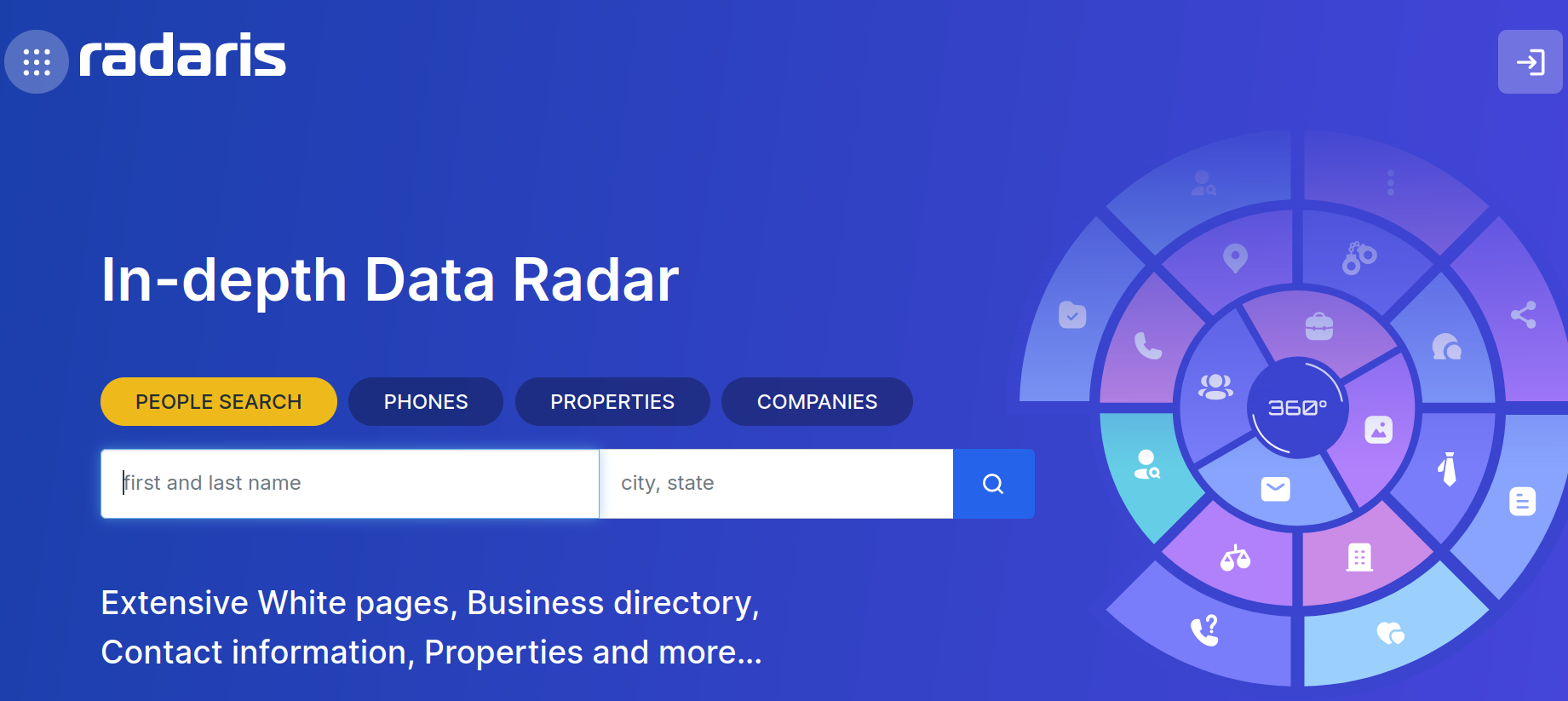
Faced with mounting evidence of systematic evasion, a New Jersey court found the defendants in default for repeatedly failing to mount a credible defense. Ultimately, the judge ordered the registrar to transfer ownership of radaris.com and 13 other sister domains to the plaintiffs. Today, visiting radaris.com no longer yields detailed dossiers on American citizens; instead, it presents an official notice detailing the court-ordered transfer.
Chronology of Evasion: A Decade of Shell Games
To understand the magnitude of the Radaris takeover, one must examine the decade-long cat-and-mouse game played by its founders and attorneys. The operational playbook was defined by strategic attrition, jurisdictional juggling, and procedural obfuscation.
- 2017: Radaris faced its first major test in a class-action lawsuit (such as Huebner v. Radaris, LLC), which it temporarily lost after refusing to contest claims. When plaintiffs sought to collect a $7.5 million default judgment, the court ordered Verisign to transfer the radaris.com domain.
- The Appeal and Pivot: Boston Law Group attorney Val Gurvits successfully appealed the verdict on behalf of Radaris, arguing that the lawsuit had failed to name the actual domain owner—a Cyprus-registered shell company known as Bitseller Expert Limited. The court halted the transfer. Immediately following this legal victory, Radaris shifted operations away from Bitseller, transferring control to Andtop Company, an entity officially incorporated in the Marshall Islands in October 2020.
- February 2024: Atlas Data Privacy Corp filed its landmark Daniel’s Law lawsuit against Radaris, sparking an exhaustive investigative spotlight by cybersecurity journalists.
- March – June 2024: After investigative reports exposed the Lubarsky brothers and their fictitious CEO "Gary Norden," Radaris defense counsel doubled down on procedural delays, attempting to block service of process and claiming foreign jurisdiction.
- June 2025: Atlas dramatically re-filed and expanded its lawsuit, sweeping in dozens of newly identified sister companies connected to the Radaris family.
- August 2025: Finding that the defendants had been granted ample opportunity to defend themselves and repeatedly failed to do so, the New Jersey court issued the definitive order transferring radaris.com and its affiliated infrastructure to the plaintiffs.
According to Matt Adkisson, CEO of Atlas, the company’s defense strategy resembled an international shell game. "We refer to this period as their island-hopping phase," Adkisson explained. "Privacy policies changed constantly, and new entities kept appearing from places like the Marshall Islands, the British Virgin Islands, and Seychelles." Adkisson noted that when Radaris updated its terms to claim management by a Marshall Islands firm, local investigators discovered the entity did not even exist.
Supporting Data: The Anatomy of a Data Broker Empire
The sheer scale of the Radaris operation only fully materialized when Atlas secured more than 10,000 internal emails, financial documents, and corporate records through the discovery process. These documents shattered the illusion that Radaris was an isolated, independent entity.
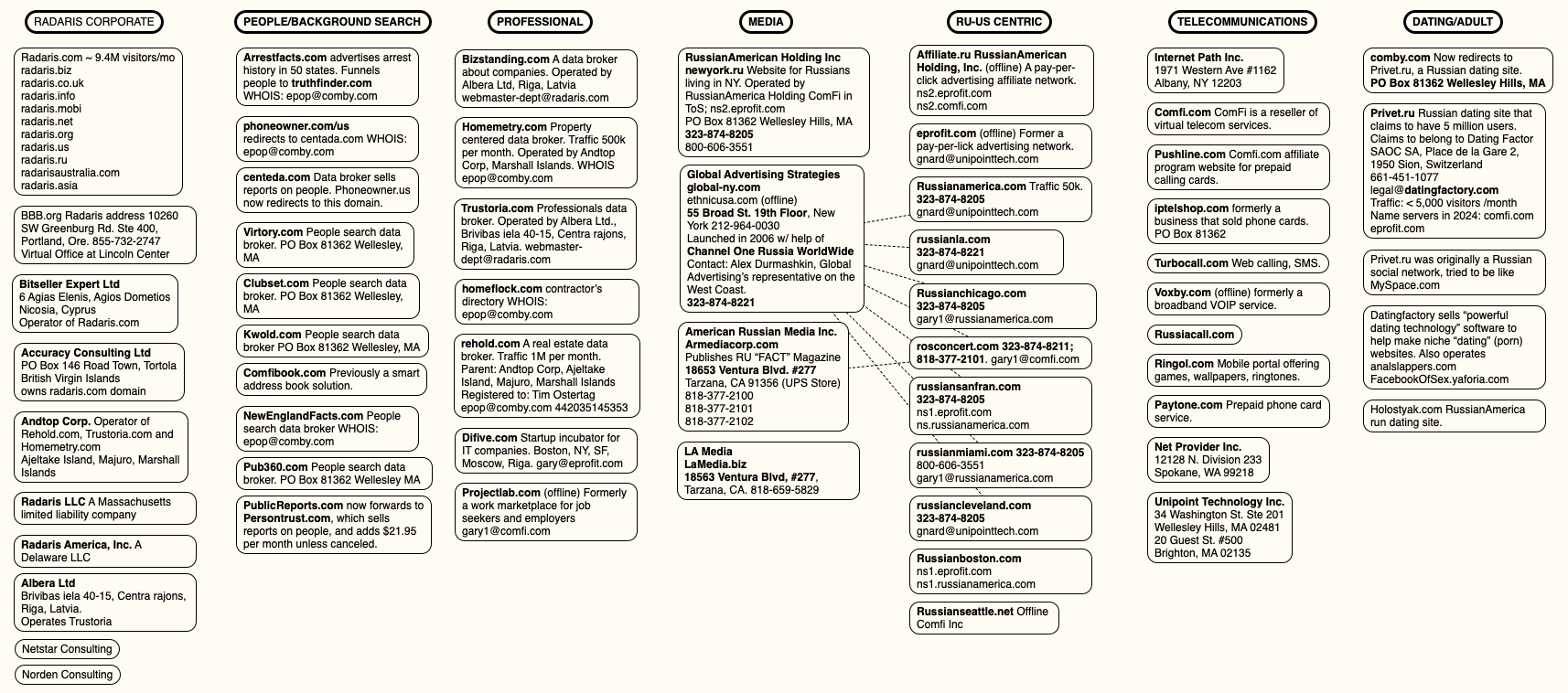
Instead, the records established that a sprawling cluster of nominal legal vehicles—including Radaris America, Inc., Bitseller Expert Limited, Digital Orbit Corp, Core Solutions Group Inc, Lucky Solutions Inc, Virtura Corp, Veripages Inc., Nuform Solutions Inc., Growth Data Advisors Inc., and Property Experts, Inc.—were all administered by the exact same group of individuals.
Key data points uncovered in the corporate records reveal:
- Centralized Infrastructure: All administrative, technical, and financial functions across at least 25 distinct people-search websites were managed from a single group of mail domains (
difive.com,centerex.com,scienteco.com,eprofit.com,realmo.com,pub360.com) operated from the Boston area. - Lucrative Revenue Streams: Internal communications estimated that Radaris.com pulled in approximately $42,000 monthly, while sister site Veripages.com generated roughly $45,000 per month through marketing partnerships with major advertising conglomerates like the Lifetime Value Company (operator of PeopleLooker, PeopleSmart, NumberGuru, and Bumper).
- The Double-Dip Ecosystem: The Radaris family reportedly earned up to $25,000 monthly through partnerships with Onerep, a privacy service that ostensibly helps consumers remove their data from people-search directories. Investigations have repeatedly highlighted how data broker founders frequently launch simultaneous "removal" services, effectively profiting from both sides of the digital privacy coin.
Despite losing 14 core domains in the New Jersey action, the broader network of data brokers continues to test the boundaries of digital jurisdiction.
Official Responses and Legal Posturing
The legal fallout from the domain transfer has triggered sharp counterattacks from defense counsel, who argue that the court’s actions overstepped constitutional boundaries.

Attorney Val Gurvits, who previously represented Radaris in key proceedings, declined to comment directly on the merits of the recent ruling, noting that the case had been transitioned to another attorney, Victor Worms.
In response to inquiries, Worms maintained that the New Jersey court’s transfer of Radaris.com was legally flawed because it targeted a domain name rather than a recognized corporate entity.
"We have made a motion to vacate that default judgment on the grounds that it is void since a non-entity has no legal capacity to sue or be sued," Worms stated. "We also intend to pursue all appropriate appeals because we believe the transfer of Radaris.com amounts to a forfeiture in violation of various constitutional principles."
Conversely, plaintiffs’ counsel view the ruling as a long-overdue triumph over procedural obstructionism. Raj Parikh, a partner at PEM Law in New Jersey who spearheads Daniel’s Law litigation for Atlas, emphasized that the defendants relied heavily on the exhaustion of opposing counsel.
"In the past, they won by attrition," Parikh said. "Plaintiffs’ attorneys tired of the procedural games and just gave up. That strategy worked for a decade, and it probably would have worked in this case too… But we were acutely aware of the threat this website posed to law enforcement officers and other public officials in New Jersey, and decided early on to commit whatever time and resources were necessary to remove that threat."
Broader Implications: The Battle for American Privacy
While the neutralization of Radaris.com represents a monumental victory for Daniel’s Law, the war over digital privacy in the United States remains at a perilous crossroads.
At present, the broader Daniel’s Law enforcement effort faces a sweeping constitutional challenge. Roughly 150 consumer data broker firms have banded together to challenge the New Jersey statute in federal court, arguing that sweeping restrictions on publishing publicly available records violate the First Amendment. While the U.S. Court of Appeals for the Third Circuit weighs the matter, legal experts anticipate the dispute will ultimately land before the U.S. Supreme Court.
Meanwhile, legislative momentum is fractured. At least 14 other states have adopted variations of Daniel’s Law, yet federal courts have pushed back in other jurisdictions—such as in West Virginia, where a federal district court struck down a similar statute as facially unconstitutional under the First Amendment.
Justin Sherman, a prominent privacy expert and author of the forthcoming book The Middlemen, argues that piecemeal state laws will never be enough to contain the data broker surveillance economy. He points out that powerful industry lobbies—spanning social media giants, big tech firms, cryptocurrency enterprises, and artificial intelligence developers—consistently pour millions into blocking comprehensive federal data protection standards.
"These days at the federal level, add in the intense amount of lobbying against these laws from social media companies, big tech, cryptocurrency firms, and now AI proponents in the mix who claim that limiting their data scraping is somehow going to collapse the whole U.S. economy under Chinese rule," Sherman noted.
Sherman emphasizes that people-search businesses will continue to proliferate as long as state and federal laws preserve wide exemptions for records classified as "public documents"—such as voting registries, property deeds, marriage certificates, motor vehicle logs, and criminal filings. Without baseline federal restrictions governing how scraped personal identifiers are collected, shared, and monetized, catastrophes like the recent IDScan.net breach—which exposed the driver’s license data of over 153 million Americans on the dark web—will remain inevitable.
"The average person can look at Daniel’s Law and have a perfectly normal reaction, which is that everyone should be covered, not just police and judges," Sherman concluded. "Pero we don’t need more wake-up calls. We’ve had eight million wake-up calls already on the need for better privacy laws. The lack of comprehensive federal privacy law is not for a lack of knowledge, and anyone claiming otherwise is either not reading the news or kidding themselves."