
The Evolution of Portable Diagnostics: Putting the Hantek 2000 Series Handheld Oscilloscopes to the Test
In the fast-paced world of electronics engineering and field service, the boundary between benchtop utility and portable convenience continues to blur. Modern technicians, hobbyists, and field-service engineers no longer wish to be tethered to heavy, cumbersome test equipment when troubleshooting complex circuits on-site. Addressing this demand, portable and handheld measuring instruments have evolved significantly, achieving levels of precision and feature integration once reserved exclusively for high-end laboratory hardware.
Among the standout entries in this category is the Hantek 2000 series of handheld instruments. Available through platforms like Open Electronics, these devices bridge the gap between amateur tools and professional-grade diagnostic gear. This article explores a comprehensive hands-on evaluation of the Hantek series—specifically focusing on the entry-level HANTEK2C42 and the flagship HANTEK2D72—to determine whether these multi-function instruments truly deliver laboratory-grade performance in a compact, field-ready package.

Main Facts: The Anatomy of a Portable Lab
The Hantek 2000 series packs three distinct, essential diagnostic tools into a single, ruggedized handheld housing: a digital storage oscilloscope (DSO), a digital multimeter (DMM), and, in select models, an arbitrary waveform generator (AWG).
The lineup is anchored by two primary configurations:

- HANTEK2C42 (Basic Model): Features a 2-channel digital oscilloscope with a 40 MHz bandwidth, paired with an autoranging digital multimeter.
- HANTEK2D72 (Flagship Model): Features a 2-channel digital oscilloscope with an upgraded 70 MHz bandwidth, an autoranging digital multimeter, and a built-in arbitrary waveform generator (AWG).
The AWG on the 2D72 model is capable of outputting multiple signal types with varying maximum frequencies: up to 25 MHz for sine waves, 10 MHz for square waves, and 5 MHz to 1 MHz for other specialized waveforms, all capped at a maximum amplitude of 2.5 Vmax (5.0 Vpp).
Both units feature identical multimeter capabilities and share a robust physical architecture. Housed in a metal chassis protected by an impact-absorbing rubber outer layer, the instruments are engineered to minimize external electromagnetic interference while surviving the rigors of field deployment. Power is supplied by two pre-installed 18650-type 3.7V, 2600 mAh lithium-ion batteries, yielding ample operational runtime for off-site diagnostics.

Chronology: From Unboxing to Advanced Bench Calibration
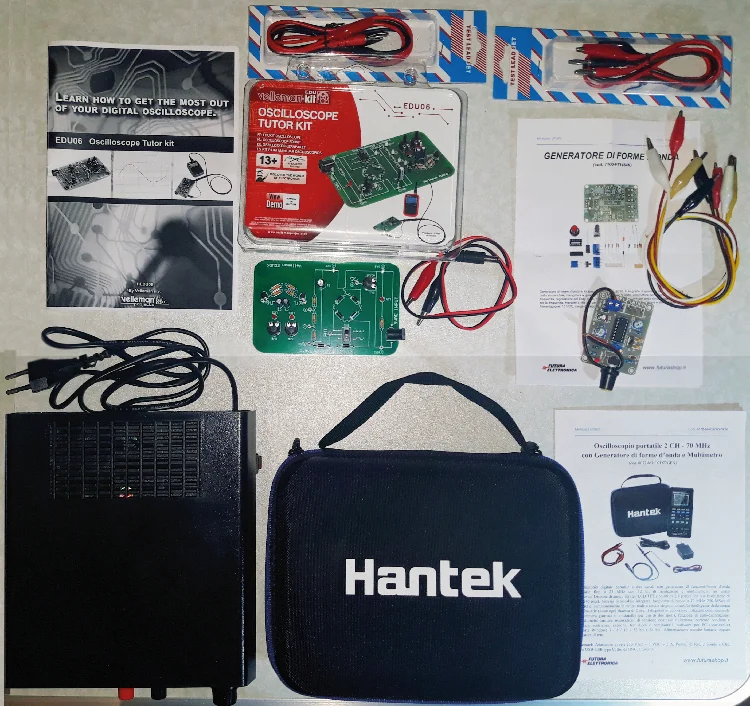
To properly evaluate the Hantek 2000 series, testing was conducted not in a pristine, climate-controlled laboratory, but simulated from a home workspace using a curated kit of accessories supplied by Open Electronics.
Phase 1: Unboxing and Initial Hardware Setup
Upon opening the rigid, zippered transport case included with the unit, technicians are greeted by a well-organized layout. The base houses the handheld instrument, a 230 VAC to 5V/2A mains power adapter, and a modern USB Type-C charging cable. The lid’s integrated mesh pocket contains a comprehensive accessory suite: a switchable 10x/1x BNC oscilloscope probe, standard multimeter test leads, and BNC-to-alligator clip cables (two for the 2D72 model).

Powering up the device for the first time requires charging the internal batteries, indicated by a solid red LED integrated into the power button. Once energized, the initial workflow proceeds through firmware updates, system auto-calibration, and utility menu configuration.
Phase 2: Software Integration and Firmware Flashing
Interfacing the handheld with a PC unlocks advanced data logging, larger display capabilities, and firmware management. Technicians download the latest software suite from the manufacturer’s portal, install the required Windows drivers, and execute a Device Firmware Update (DFU). Within minutes, both the ARM and FPGA firmwares are updated to their latest iterations, ensuring optimal hardware stability.

Phase 3: Auto-Calibration and Utility Customization
Because analog front-ends are sensitive to ambient thermal drift, Hantek recommends running the instrument’s internal auto-calibration routine whenever the operational temperature shifts by 5°C or more. For maximum accuracy, the unit must be powered on and allowed to idle for 20 minutes to reach thermal equilibrium, with all input signals disconnected to prevent hardware damage.
Following calibration, the Utility menu allows users to configure essential operational parameters:

- F1: Language selection (English/Chinese).
- F2: Audible keypress feedback toggle.
- F3/F4: Backlight intensity and display sleep timers.
- Page Navigation: Enabling the on-screen measurement parameter panel, hardware version inspection, auto-shutdown timers, and factory resets.
Phase 4: Probe Compensation and Signal Verification
Before capturing live signals, the passive 10x/1x probe must be compensated to prevent phase distortion and amplitude errors. This is achieved by feeding a known reference signal—such as a 1 kHz, 2 Vpp square wave—into CH1 and adjusting the probe’s compensation trimmer until a clean, squared waveform with flat tops and sharp corners is displayed.
For 2D72 users, this reference signal is generated internally via the built-in AWG. For 2C42 users lacking an onboard generator, auxiliary training kits (such as the FT1464K kit or the Velleman Oscilloscope Tutor Board) provide the necessary test signals to complete calibration and verify cross-instrument accuracy.

Supporting Data: Performance Benchmarks
To validate the specifications claimed by the manufacturer, rigorous testing was performed across all three operational modes: the oscilloscope, the waveform generator, and the multimeter.
Oscilloscope Performance and AC Voltage Measurement
Using the Velleman Oscilloscope Tutor Board, technicians tested the 40 MHz/70 MHz acquisition capabilities against known AC circuits.

- Test Case (AC Voltage): Connecting a 10x probe to test point TP1 and referencing ground at TP2, the vertical stage was set to AC coupling at 10 V/DIV, with the horizontal time base at 10 ms/DIV.
- Results: The oscilloscope accurately captured a 50 Hz sinusoidal waveform displaying a peak-to-peak voltage ($Vpp$) of approximately 34.8V. Enabling the software’s Root Mean Square (RMS) calculation yielded an active reading of 12.3 $VRMS$, aligning precisely with theoretical calculations for the tested circuit.
Arbitrary Waveform Generator (2D72 Series)
The built-in AWG was evaluated by looping its output directly into CH1 via a BNC-to-alligator assembly.
- Square Wave Generation (5 MHz, 2 V): Configured via the AWG menu and verified on the oscilloscope, the high-frequency square wave displayed minor rounding and settling artifacts on its transitions—a normal characteristic for high-frequency square waves even on high-end benchtop systems. Digital logic thresholds (recognizing HIGH as $ge 2/3$ VCC and LOW as $le 1/3$ VCC) easily accommodated these minor variations without logic corruption.
- Sinusoidal Generation (25 MHz, 2.5 V): The instrument displayed high-frequency sine waves cleanly at 20 ns/DIV without noticeable attenuation or phase distortion.
- Triangular Wave Generation (1 MHz, 1 V): The ramp signal filled the display matrix cleanly, confirming linear charge and discharge cycles across the timing grid.
Digital Multimeter Integration
The integrated DMM operates without manual range selection; it automatically resolves measurements to the highest possible precision based on the input signal.

- Direct Voltage Measurement: Tested against a bench power supply set to 20.8 VDC, the multimeter registered 20.72 VDC. The minor variance was attributed to normal instrument tolerances and the multimeter’s higher decimal resolution compared to the power supply’s single-decimal readout.
- Direct Current Measurement: Measuring the forward current draw of a low-voltage LED powered at 3 VDC, the multimeter registered 2.33 mA—an accurate low-current reading that fell below the 10 mA resolution threshold of the power supply’s onboard meter.
Official Responses and Manufacturer Insights
Feedback compiled from engineering teams and field technicians actively utilizing the Hantek 2000 series highlights a distinct shift in how diagnostics are approached in industrial and educational environments.
According to product application notes provided by Open Electronics, the primary design philosophy behind the Hantek handheld line was to eliminate "bench fatigue." In traditional laboratory settings, technicians constantly shift their gaze between a device under test (DUT) and a bulky, distant benchtop oscilloscope. By mounting the Hantek unit on its rear kickstand directly adjacent to the circuit board, or holding it comfortably in hand, technicians maintain an unbroken line of sight between their probes and the display screen.

Furthermore, manufacturers emphasize that while PC software integration is available for advanced data capture and screenshot generation, the handheld nature of the device ensures it remains fully operational as a standalone unit in environments where laptop usage is impractical—such as tight industrial enclosures, ladder work, or automotive engine bays.
Implications: The Future of Field Service Diagnostics
The proliferation of semi-professional, multi-function instruments like the Hantek 2C42 and 2D72 carries significant implications for the electronics service industry:

- Democratization of Diagnostic Tools: Historically, owning an oscilloscope, a waveform generator, and a multimeter required a substantial financial investment and dedicated bench space. Integrating these tools into a sub-$200 handheld device lowers the barrier to entry for educational institutions, independent repair technicians, and advanced hobbyists.
- Redefining Field Repair Capabilities: Field service technicians can now perform complex signal analysis, protocol verification, and component-level troubleshooting on-site, drastically reducing equipment downtime and eliminating the need to transport heavy gear to remote locations.
- Ergonomic and Workflow Shifts: As portable instruments close the performance gap with entry-level benchtop units, the traditional "wall of instruments" laboratory setup is facing competition from modular, mobile workstations.
Conclusion
The Hantek 2000 series handheld oscilloscopes successfully demonstrate that portability does not necessitate a compromise in core functionality. Through rigorous testing of their oscilloscope, multimeter, and waveform generator modules, these instruments have proven themselves to be reliable, accurate, and remarkably versatile. Whether deployed as a primary diagnostic tool for field service work or as a convenient, close-range secondary monitor on a crowded permanent workbench, the Hantek 2C42 and 2D72 represent a high-value addition to any modern electronics technician’s toolkit.








