
Rewinding Reality: How Modern Engineering is Breathing Interactive Life into VHS
Introduction: The Forgotten Frontier of Analog Gaming
For decades, the VHS tape was the undisputed king of home entertainment. While millions of households were tethered to the rhythmic mechanical whir of VCRs, a niche subset of developers attempted to merge the linear nature of magnetic tape with the burgeoning desire for interactive digital experiences. The results, historically, were underwhelming. Systems like the 1987 ActionMax—a "console" that simply tracked light-gun hits against a pre-recorded, static video loop—are now viewed more as historical curiosities than true gaming milestones.
However, a new project by developer "Throaty Mumbo" is challenging the notion that the VHS format was inherently limited to "on-rails" disappointment. By bridging the gap between retro-analog storage and modern FPGA (Field Programmable Gate Array) hardware, this project isn’t just archiving the past—it is reimagining what the 1980s could have been if engineers had pushed the medium to its absolute technical breaking point.
Main Facts: The Architecture of an Analog-Digital Hybrid
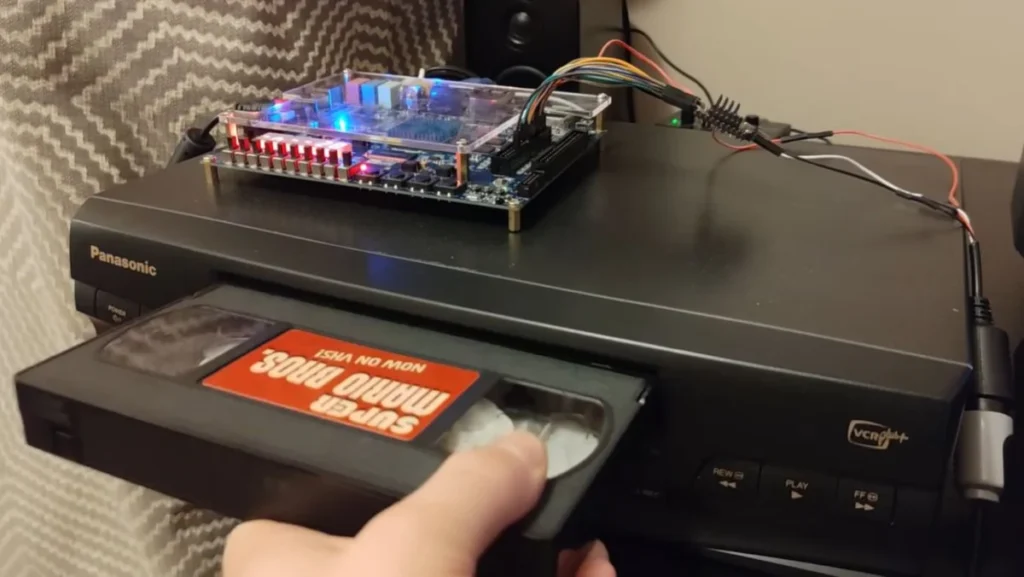
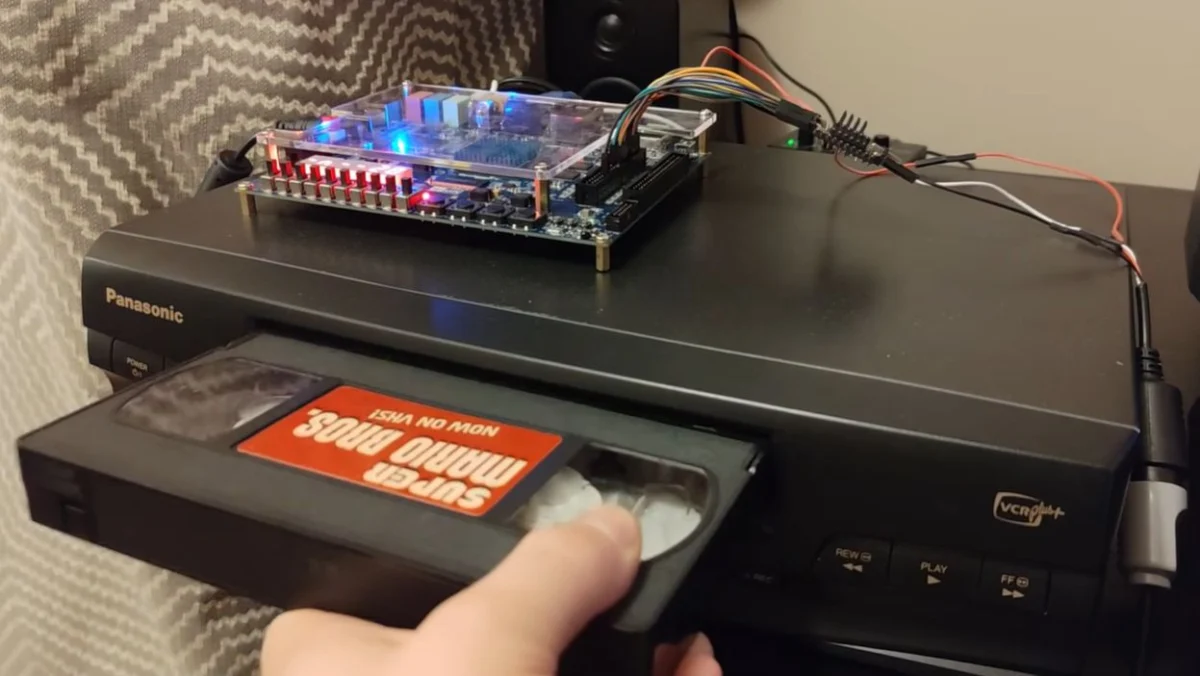
The core of this breakthrough lies in the marriage of a DE1-SoC FPGA board and the recently released RP2350 microcontroller. Unlike the ActionMax, which relied on rudimentary photodiode sensors to register light flashes on a screen, this new system treats the VHS tape as a high-capacity storage medium for both media and executable bytecode.
The Technical Workflow:
- Decoding: The DE1-SoC acts as the primary signal processor, taking the raw composite video input from the VCR.
- Data Extraction: Within the video stream, the system identifies and extracts encoded binary data hidden in the frames.
- Processing: The RP2350 MCU acts as the "brain," parsing this bytecode to manage game logic, controller inputs, and state changes.
- Dynamic Rendering: Unlike traditional VHS games where the video plays identically every time, this system allows the game logic to jump to specific timestamps or trigger events, enabling a semblance of non-linear gameplay.
By utilizing the FPGA to handle the heavy lifting of signal processing, the system can overlay dynamic elements onto pre-recorded video, creating a sophisticated hybrid experience that feels remarkably responsive compared to its predecessors.
Chronology: From the ActionMax Era to Modern Tinkering
The 1980s: The Era of Static Interaction
The history of VHS gaming is defined by a lack of processing power. In 1987, the ActionMax attempted to capitalize on the home video craze by selling a light gun and a console that did nothing but pause or trigger a sound effect when it detected a change in brightness on the screen. There was no game "state"—the tape was a linear sequence of events. If you shot the target, the game continued; if you missed, it continued anyway.
The 2010s: The Retro-Tech Renaissance
As the "Retro-Tech" movement gained traction, enthusiasts began dissecting failed formats. Websites and forums became hubs for reverse-engineering the VCR. During this period, the focus was primarily on preservation: digitizing home movies and rare VHS tapes before the magnetic oxide shed from the plastic substrate.
2024: The Breakthrough
The current project by Throaty Mumbo marks a paradigm shift. Moving beyond preservation, the project seeks to "port" software to the medium. By proving that a VHS tape can function as a slow-speed, high-capacity ROM cartridge, the developer has opened a new sub-genre of hobbyist engineering: "Analog-Stored Computing."
Supporting Data: Why VHS as a Storage Medium?
While modern enthusiasts have access to high-speed NVMe drives and cloud storage, the allure of VHS lies in its sheer capacity and unique aesthetic. A standard T-120 VHS tape can hold approximately 2.5 to 3 hours of footage.
Comparative Throughput
- ActionMax: 0 bits of data storage; purely reactive.
- Throaty Mumbo System: Capable of storing kilobytes of binary data per minute of video, allowing for the storage of complete game loops, asset pointers, and logic scripts.
- The "Mario" Test: The project’s implementation of Super Mario Bros. utilizes the VHS as a background video source while the FPGA handles the foreground physics and sprite rendering, a feat that would have been impossible on 1980s consumer hardware.
This demonstrates that the bottleneck for VHS gaming wasn’t the tape itself, but the lack of an intelligent interface capable of decoding data from the NTSC/PAL video signal in real-time.
Official Responses and the Community Impact
The project has generated significant buzz within the FPGA and retro-computing communities. On platforms like GitHub, the repository for "GCVHS" (Game Console VHS) has become a focal point for collaborative development.
"It is a fascinating demonstration of how we often blame the medium for the limitations of the hardware," says one prominent FPGA developer. "We look at the VCR and call it a dead, limited format. But when you apply modern silicon to the problem of reading that signal, you realize the medium is just as valid as a floppy disk—it’s just significantly noisier."
The response from the broader tech community has been one of curiosity regarding the limits of signal degradation. Because VHS is an analog format, "bit rot" is a major concern. However, the project utilizes error-correction algorithms—standard in modern data transmission—to ensure that even if the tape has minor tracking issues, the game code remains intact.
Implications: The "Dead Media" Renaissance
The implications of this project extend far beyond just playing Doom on a VCR.
1. Re-evaluating Obsolete Formats
This research invites us to re-examine other "obsolete" formats. If a VHS tape can be repurposed for interactive media, what about LaserDisc, Betamax, or even early audio cassette data storage? It challenges the narrative that old technology is "useless" once its primary purpose—watching movies—has been superseded by streaming services.
2. The Philosophy of "Analog Computing"
We are currently living in an era of extreme digital abstraction. Most users have no idea how their software interacts with their hardware. By contrast, a system that relies on a physical tape requires the user to understand tracking, signal integrity, and the physical limitations of the medium. It bridges the gap between mechanical engineering and computer science, fostering a more holistic understanding of how machines function.
3. A New Playground for Indie Developers
Could there be a market for "VHS-ROM" games? While unlikely to be a commercial juggernaut, the niche is ripe for indie developers who specialize in "analog horror" and retro-aesthetics. Creating a game that can only be played by inserting a physical tape into a VCR provides a tactile, ritualistic experience that digital downloads simply cannot replicate.
4. Long-term Data Preservation
Interestingly, this project touches upon the broader field of archival science. While digital files can be corrupted by silent bit-rot, a VHS tape’s failure is usually visible (glitches, snow). If we can encode data into analog video streams that are robust enough for gameplay, we might discover new ways to preserve data in formats that are "human-readable" (via a TV screen) rather than strictly machine-readable.
Conclusion: The Future of the Past
The work of Throaty Mumbo is a poignant reminder that technology does not simply vanish; it just waits to be recontextualized. By repurposing the VCR from a passive playback device into an active participant in digital logic, this project elevates the humble VHS tape to the status of an experimental computing platform.
As we move deeper into the 21st century, the drive to push modern tech into old shells—to see Doom run on a pregnancy test, or a game engine run off a VHS tape—serves a vital purpose. It humbles our current hardware and celebrates the ingenuity of those who came before us.
The VCR may have vanished from the center of the living room, but thanks to the marriage of FPGA power and a bit of analog stubbornness, it is finding a new home in the workshops of engineers who refuse to let the past go quietly. In the flickering lines and occasional tracking errors of these custom-made games, we find something rare: a digital experience with a physical soul. Whether this leads to a resurgence of analog-based computing or simply remains a brilliant one-off experiment, it stands as a testament to the fact that with enough patience and a soldering iron, the "obsolete" is merely an opportunity waiting to be replayed.







