From Plain English to Physical Action: How Needle 2 Brings Lightweight AI to the Raspberry Pi 5
Main Facts
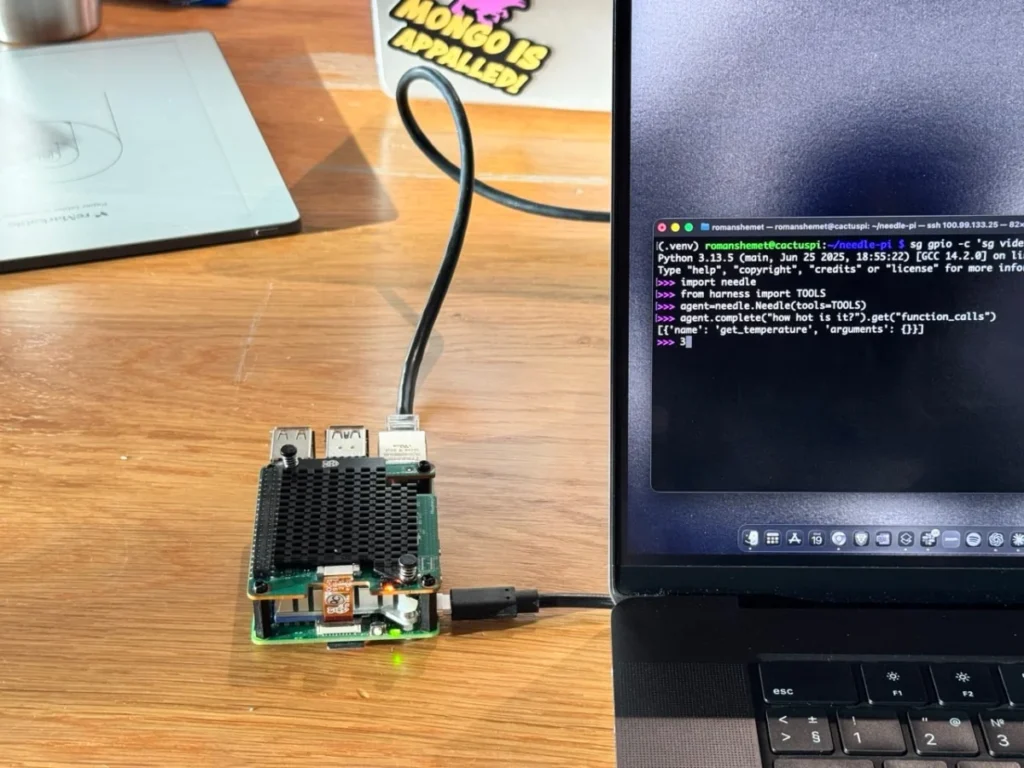
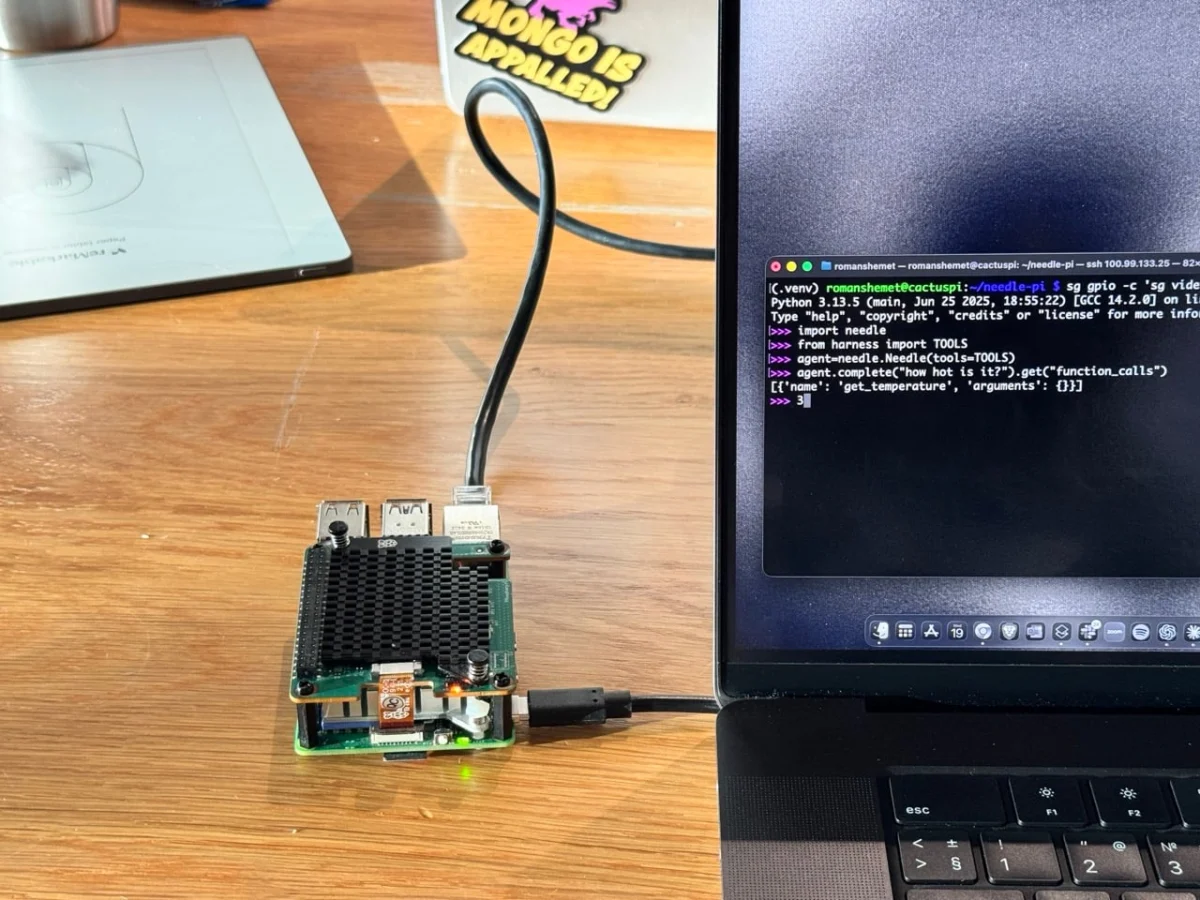
The landscape of edge artificial intelligence is undergoing a quiet revolution, shifting away from massive cloud-dependent models toward hyper-efficient, localized execution. A prime example of this paradigm shift comes from the developers at Cactus Compute, who have engineered Needle 2—a remarkably compact 14-megabyte function-calling model capable of translating plain English commands into local, physical actions on a standard Raspberry Pi 5 using only its central processing unit (CPU).
Unlike mainstream generative AI models designed for open-ended conversation, creative writing, or complex reasoning, Needle 2 is deliberately specialized. It does not act as a chatbot. Instead, it is purpose-built to bridge human language and machine execution by determining which Python function to call and accurately extracting the necessary arguments from a text prompt. Operating entirely offline without requiring a cloud application programming interface (API), specialized neural processing units (NPUs), or dedicated AI hardware accelerators like an AI HAT, Needle 2 achieves execution latencies as low as 78 milliseconds.
The integration process relies on Python decorators. By wrapping standard functions with @needle.tool, developers can expose local hardware features, system diagnostics, and file system operations to the model. The underlying architecture parses the function names, type annotations, and docstrings to build a dynamic tool schema. As a result, everyday devices powered by single-board computers can now interpret natural language commands—such as checking CPU temperatures, blinking physical light-emitting diodes (LEDs), capturing photos via camera modules, or writing to local text files—with minimal computational overhead and a remarkably light memory footprint.
Chronology of Edge AI and the Development of Needle
The Evolution of Resource-Constrained Computing
For years, running machine learning models locally on low-power, single-board computers was considered impractical. Traditional large language models (LLMs) demand gigabytes of memory and substantial GPU horsepower, making them entirely unsuited for micro-controllers or standard single-board computers like the Raspberry Pi. Developers wishing to incorporate natural language processing into Internet of Things (IoT) devices were routinely forced to route data through cloud servers, introducing latency, privacy vulnerabilities, and mandatory internet connectivity dependencies.
The Rise of Specialized Small Language Models (SLMs)
Recognizing the limitations of cloud-reliant architectures, the AI research community gradually shifted focus toward Small Language Models (SLMs). Engineers began pruning networks, quantizing weights, and optimizing inference engines to run efficiently on standard CPUs. However, general-purpose SLMs often still proved too heavy for seamless real-time embedded applications.
The Birth of Needle 2 and 3
Cactus Compute addressed this hardware constraint by stripping away conversational capabilities entirely, focusing resources exclusively on deterministic, structured function-calling. Released to the developer community under the open-source Apache 2.0 license, Needle 2 demonstrated that a model under 15 megabytes could achieve high accuracy in tool selection. Following the rapid adoption and positive reception of Needle 2 by hardware enthusiasts and industry leaders alike, Cactus Compute swiftly iterated on their architecture, culminating in the fresh release of Needle 3, which continues to push the boundaries of on-device utility and speed.
Technical Deep Dive: Implementation and Supporting Data
To understand how Needle 2 operates in practice, one must examine its integration within a standard Raspberry Pi 5 environment (specifically tested on an 8GB model running Raspberry Pi OS with cactus-needle version 2.0.7).
Installation and Setup
Getting started requires a clean Python virtual environment and the installation of the core package via pip:
python3 -m venv needle-env
source needle-env/bin/activate
python -m pip install cactus-needle
Once downloaded, the model operates completely offline. Developers instantiate the agent and register custom capabilities by using the @needle.tool decorator, which analyzes type annotations and docstrings to map natural language to code execution:
import needle
from pathlib import Path
import subprocess

notes_path = Path("needle-notes.txt")

@needle.tool
def save_note(text: str):
    """Append a note to a local text file."""
    with notes_path.open("a", encoding="utf-8") as notes:
        notes.write(text + "n")
    return "text": text, "path": str(notes_path)

@needle.tool
def get_temperature():
    """Return the current CPU temperature of this Raspberry Pi in Celsius."""
    out = subprocess.check_output(["vcgencmd", "measure_temp"], text=True)
    return "temperature_c": float(out.split("=")[1].split("'")[0])

agent = needle.Needle(tools=[save_note, get_temperature])
Execution and Tool Selection
When a user inputs a prompt such as, "Save a note that says the cooler is working," the model processes the string through its internal session engine, generating a structured JSON response identifying the target function and required parameters:
  "type": "call",
  "function_calls": [

      "name": "save_note",
      "arguments":  "text": "the cooler is working"

  ]
The run() method then automatically executes the selected Python function and logs the return values into a structured response object. If presented with an ambiguous or out-of-scope prompt—such as asking for the capital of France—Needle recognizes that none of its registered tools can satisfy the request, correctly returning an empty function call array within milliseconds rather than hallucinating an answer.
Performance Benchmarks
Empirical testing on a CPU-only Raspberry Pi 5 highlights the impressive computational efficiency of Needle 2. The native session utilizes approximately 28MB of memory, while the complete Python runtime process peaks between 43MB and 46.4MB.
| Prompt | Selected Tool | Prefill (tok/s) | Decode (tok/s) | Time Taken (ms) |
|---|---|---|---|---|
| Turn the LED on. | set_led |
488 | 296 | 78 |
| How hot is this Raspberry Pi? | get_temperature |
487 | 303 | 149 |
| Blink the LED 2 times. | blink_led |
475 | 314 | 83 |
| Take a photo. | take_photo |
461 | 248 | 76 |
| Save a note that says the cooler is working. | save_note |
475 | 305 | 107 |
| What is the capital of France? | (none) | 470 | 297 | 92 |
Note: Prefill and decode figures represent Needle’s internal session counters, while total latency measures the wall-clock time required for the complete() call prior to executing the Python function.
Official Responses and Industry Reception
The release of lightweight, hyper-focused edge models has drawn notable attention from prominent figures within the hardware and computing industries.
Eben Upton, CEO of Raspberry Pi, evaluated the software’s performance on the company’s flagship single-board computer, offering high praise:
"Needle 2 is rather excellent" — Eben Upton, CEO, Raspberry Pi
This endorsement underscores a growing commercial alignment between low-cost physical computing hardware and efficient localized artificial intelligence. By eliminating the necessity for heavy neural processing attachments or cloud-based processing fees, software tools like Needle validate the viability of autonomous, local-first smart devices. Furthermore, because Cactus Compute has published the code and model weights openly on Hugging Face (huggingface.co/Cactus-Compute/needle2) and GitHub (github.com/cactus-compute/needle) under the permissive Apache 2.0 license, developers are empowered to audit, adapt, and fine-tune the models locally on standard laptops for specialized domain environments.
Implications for the Future of Edge AI and IoT
The democratization of function-calling models operating at the extreme edge carries profound implications across multiple technological sectors.
1. Enhanced Data Privacy and Security
By processing natural language commands entirely on-device, systems built with Needle eliminate the need to transmit sensitive voice or text transcriptions to external cloud servers. For industrial automation, smart home systems, healthcare monitoring, and enterprise hardware, local execution guarantees that operational commands and ambient data never leave the local network, drastically reducing exposure to interception, data breaches, and unauthorized surveillance.
2. Elimination of Network Dependency
Cloud-reliant AI assistants are entirely rendered useless during internet outages. Edge-native architectures like Needle 2 ensure continuous, uninterrupted operational reliability. Whether deployed in remote agricultural environments, subterranean industrial plants, or mobile robotics, local function-calling models execute instructions instantly without latency spikes caused by network congestion or high ping times.
3. Lowering Barriers for Smart Hardware Integration
Traditionally, creating natural language interfaces for custom hardware required complex integration pipelines involving speech-to-text engines, massive language models, and intricate middleware parsing layers. Needle simplifies this paradigm. Any developer familiar with basic Python and GPIO libraries can transform existing scripts into conversational tools using simple decorators. This lowers the technical barrier to entry for hobbyists, educators, and commercial product designers looking to imbue physical devices with intuitive language-driven controls.
4. The Shift Toward Specialized Over Generalized AI
For years, the artificial intelligence sector chased general-purpose artificial intelligence through ever-larger models with trillions of parameters. However, Needle 2 demonstrates the immense commercial and practical value of hyper-specialization. By abandoning broad conversational fluency in favor of strict, deterministic tool-calling, developers can achieve maximum efficiency, minimal resource consumption, and predictable reliability—proving that when it comes to controlling the physical world, a sharp, lightweight tool is often far more useful than a heavy, unfocused mind.