Decoding the Electrical Language of Cells: A New Frontier in Bioprocess Monitoring
For bioprocess engineers, the stakes of production are measured in time, purity, and yield. A single compromised batch of biologics—often valued in the millions—can result from the subtle, creeping onset of cellular decline. Traditionally, detecting this failure has been akin to looking in a rearview mirror: standard assays provide only a delayed, often destructive snapshot of cellular health.
However, a transformative shift is underway. A comprehensive review published by researchers at the University of Massachusetts Amherst and the Rochester Institute of Technology (RIT) suggests that the future of bioprocessing lies not in biochemical markers, but in the electrical properties of the cells themselves. By tracking membrane capacitance, cytoplasmic conductivity, and surface charge, engineers are gaining the ability to "listen" to the electrical signatures of living cells, offering a faster, label-free window into the physiological state of a bioprocess in real time.
The Critical Bottleneck: Why Traditional Methods Fail
In the high-stakes world of biologics manufacturing—where Chinese hamster ovary (CHO) cells serve as the primary "industry workhorse"—monitoring cell health is a chronic challenge. Conventional methods for measuring apoptosis (programmed cell death), such as fluorescent staining and lactate dehydrogenase (LDH) release assays, are inherently flawed for large-scale production.
These methods are often destructive, requiring samples to be pulled from the bioreactor and subjected to chemical staining, which renders the sampled cells unusable and risks introducing contaminants. Furthermore, these assays suffer from limited temporal resolution; they are snapshots in time that often reveal death only after the metabolic collapse has already begun.
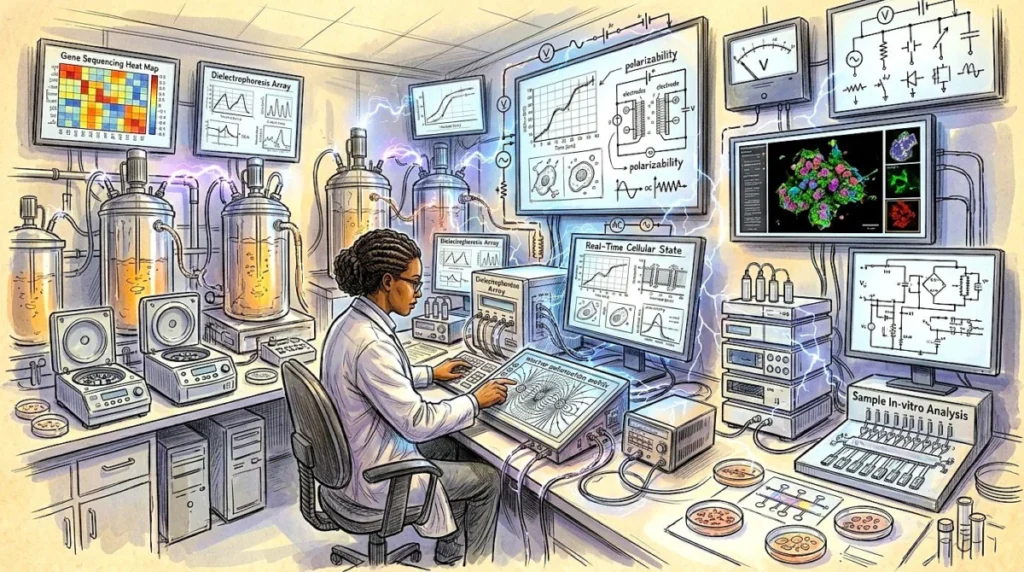
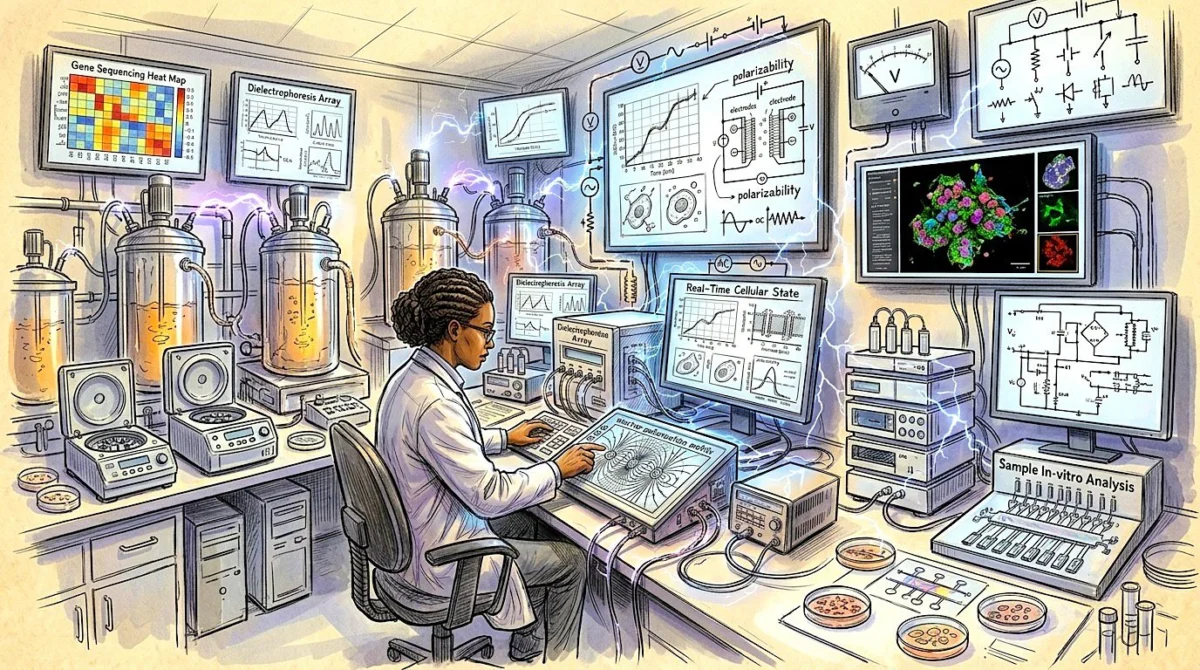
"Real-time monitoring of cell health is a critical bottleneck," note the study’s authors, Alaleh Vaghef-Koodehi, PhD, and Blanca Lapizco-Encinas, PhD. As biomanufacturing trends toward continuous processing and intensified fed-batch cultures, the industry requires a diagnostic tool that is non-invasive, instantaneous, and predictive. Dielectrophoresis (DEP)—the movement of polarizable particles in a non-uniform electric field—has emerged as the leading candidate to solve this dilemma.
A Chronology of Innovation (2015–2026)
The transition of DEP from a laboratory curiosity to a potential industrial standard has been a decade-long evolution. The review tracks the progress of electrical cell phenotyping from 2015 through 2026, highlighting a shift toward more sophisticated, automated analysis.
The Early Foundation (2015–2018)
Initial research focused on establishing the baseline electrical "fingerprints" of viable versus stressed cells. Researchers began to understand that the cellular membrane acts like a capacitor, while the cytoplasm acts like a resistor. As cells undergo apoptosis, they undergo structural changes—membrane blebbing, ionic leakage, and organelle degradation—that alter these electrical values in predictable ways.
The Technical Breakthroughs (2019–2022)
This period saw the refinement of dual-frequency DEP cytometry. Researchers moved beyond simple binary classification to track the granular progression of cell death. By applying alternating current (AC) fields at specific frequencies, scientists could distinguish between membrane remodeling (the first sign of stress) and the subsequent collapse of the cytoplasm’s ionic balance.
The Era of Machine Learning Integration (2023–2026)
The most recent phase has been characterized by the marriage of DEP data with computational intelligence. By 2026, researchers began integrating electrical impedance data with supervised machine learning algorithms. This integration allowed for the automated interpretation of complex data streams, transforming raw electrical noise into actionable process insights.
Supporting Data: Mapping the Anatomy of Apoptosis
The efficacy of DEP is best illustrated by the behavior of CHO cells under nutritional stress. Studies cited in the review offer a clear "electrical timeline" of cellular decline.
The Two-Phase Decline
When CHO cells are subjected to nutrient starvation, the electrical signal reveals two distinct phases:
- Membrane Remodeling: The initial sign of apoptosis is a measurable reduction in membrane capacitance. As the cell membrane loses its integrity, its ability to store charge diminishes.
- Cytoplasmic Collapse: As the cell’s internal machinery fails, ionic homeostasis breaks down. This leads to a precipitous drop in cytoplasmic conductivity.
In a landmark study, researchers observed that apoptotic populations became detectable between 24 and 36 hours into a starvation event. While viable cells maintained a cytoplasmic conductivity of approximately 0.45 siemens per meter (S/m), the apoptotic cells saw this value plummet to roughly 0.05 S/m. A follow-up study confirmed these findings, with conductivity plunging to 0.07 S/m by the 52-hour mark.
Crucially, this decline is not a sudden cliff, but a series of measurable transitions. By tracking these shifts, engineers can identify the "point of no return" hours before traditional biochemical markers would show any sign of deviation.
Official Perspectives: The Value of Speed
The commercial viability of this technology has been bolstered by platforms like the 3DEP system, which can capture the electrical signatures of roughly 20,000 cells within seconds. The ability to generate high-throughput data in near-real-time changes the economics of the manufacturing floor.
"These measurements can reveal emerging apoptotic subpopulations hours before traditional biochemical markers become detectable," the authors emphasize.
From an operational standpoint, this "early warning system" provides a buffer. If an operator is alerted to an emerging subpopulation of stressed cells at hour 24, they can choose to adjust nutrient feed rates, modify pH levels, or trigger an early harvest. By selecting a more favorable harvest window, they can prevent the release of intracellular contaminants that occur when cells finally rupture, thereby protecting the purity of the final biologic product.
Implications for the Future of Biomanufacturing
The vision for the future of this technology is the creation of a "traffic-light" monitoring system—a fully autonomous control loop that utilizes machine learning to maintain the "green" state of a bioreactor.
The Rise of Autonomous Intervention
The 2026 analysis highlighted in the review serves as a proof-of-concept for this future. By using a tuned random-forest model, researchers achieved 90% predictive accuracy in distinguishing healthy from dying cultures. The implication is profound: rather than relying on human intervention, the bioprocess itself could become self-correcting. If the electrical signature shifts toward an "amber" warning, the system could automatically adjust environmental parameters to restore homeostasis.
Moving Beyond the Lab
While this technology is not yet the standard in every facility, it is rapidly moving out of the realm of specialized experiments. The commercial availability of DEP hardware means that the barrier to entry is dropping. As the industry grapples with the pressures of cost-reduction and the need for higher-quality biologics, the ability to monitor the "electrical life" of a cell is moving from a luxury to a necessity.
The Paradigm Shift in Quality Control
The long-term impact of this research is a fundamental change in how we define quality in bioprocessing. Currently, quality is often verified by what remains after a process is finished. With electrical profiling, quality becomes a dynamic, continuous variable that can be managed and optimized in real time.
As the review concludes, the electrical properties of cells are becoming a new, vital process signal—one that is capable of warning that a culture is changing long before conventional, slow-acting assays can catch up. For the biomanufacturing industry, this is not just an incremental improvement in measurement; it is the beginning of an era where cells, through their electrical signatures, can communicate the health and status of the entire production line.
Conclusion
The collaboration between UMass Amherst and RIT underscores a pivotal moment for biotechnology. By bridging the gap between fundamental physics and industrial bioprocessing, researchers have provided a roadmap for a more efficient, predictive, and intelligent approach to manufacturing.
While the "electrical life of a cell" may sound like a complex concept, its application is remarkably intuitive: by understanding the physics of how cells exist, we can better control how they perform. As the industry continues to integrate machine learning and rapid electrical sensing, the "critical bottleneck" of monitoring may soon become a thing of the past, replaced by a streamlined, automated, and highly responsive digital future.
The data is clear: the most effective way to understand the health of a culture is to tune into its electrical rhythm. As we move toward 2030, the ability to decode this rhythm will likely separate the market leaders from the rest of the field.