
Beyond the Glass: How Dhruv Kumar’s Livegrid Aura Transforms Indoor Air Quality into Living Digital Art
Main Facts
The intersection of ambient computing, environmental monitoring, and generative digital art has yielded a striking new consumer device: the Livegrid Aura. Conceived and developed by designer and technologist Dhruv Kumar, the Livegrid Aura is a wall-mounted digital aquarium that replaces traditional, sterile numeric air-quality readouts with a living, breathing ecosystem of virtual marine life.
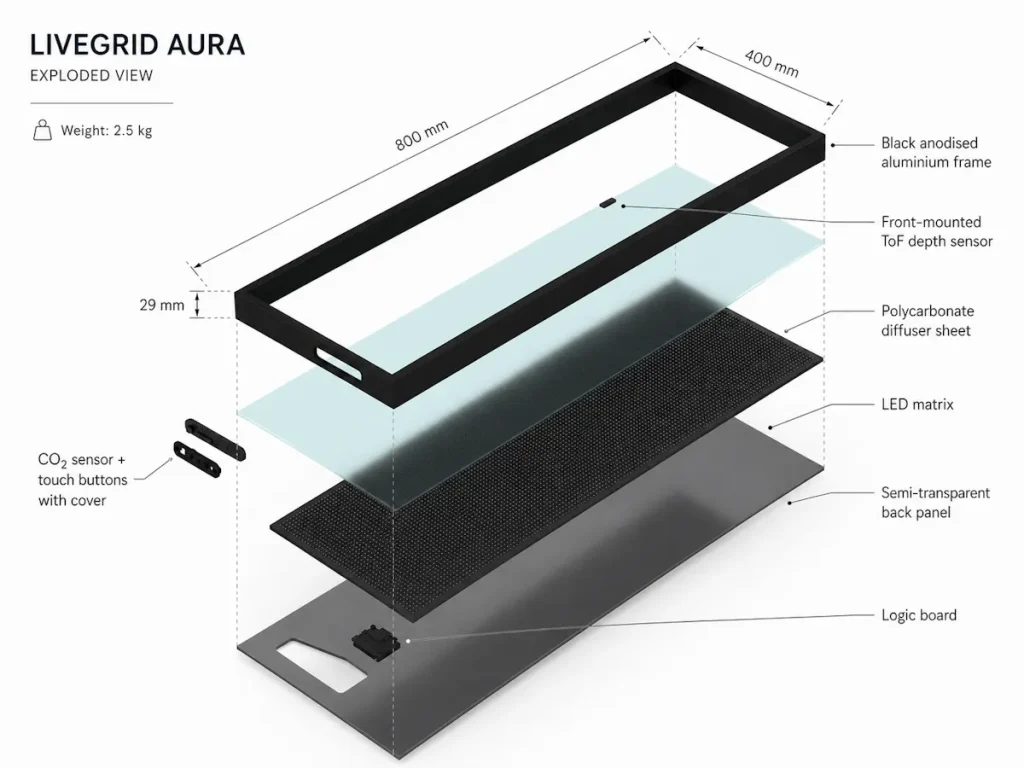
At its core, the device features a high-density 64×192 pixel HUB75 RGB LED matrix. Across this panoramic canvas swim virtual fish whose health, vitality, and behaviors are directly tied to real-time environmental data. This data is harvested by an onboard Sensirion SCD40 sensor, which tracks room temperature, relative humidity, and carbon dioxide ($CO_2$) levels. When a room is well-ventilated and comfortable, the virtual ecosystem thrives, displaying vibrant colors and active movement. Conversely, if indoor air grows stale—marked by rising $CO_2$ concentrations—the digital fish begin to languish, providing an intuitive, hard-to-ignore visual cue that it is time to open a window.
Beyond mere environmental awareness, the Livegrid Aura introduces a robust layer of physical interaction. Integrated into the frame is a time-of-flight (ToF) depth sensor. This sensor maps the immediate physical space in front of the panel, detecting the presence, distance, and basic shapes of human observers without relying on intrusive cameras. Virtual fish dynamically react to these human proximities, trailing behind the sweep of a hand or congregating around a person standing still before the display.
Powered by an Espressif ESP32-S3 microcontroller, the panel is fundamentally designed with privacy and edge computing in mind. All environmental metrics and spatial computations are calculated locally. For users seeking advanced smart-home integrations, the device’s built-in Wi-Fi—disabled by default for power efficiency and network isolation—can be toggled on to unlock REST APIs, MQTT connectivity, and high-performance streaming protocols like ArtNet and sACN at a smooth 30 frames per second.
Currently the subject of a live crowdfunding campaign on Kickstarter, the Livegrid Aura represents a significant technological and aesthetic leap over its predecessor, the original square Livegrid, scaling up both physical dimensions and interactive fidelity for the modern smart home.
Chronology: From Concept to Connected Ecosystem
To understand how the Livegrid Aura reached its current iteration, it is necessary to trace the developmental arc of Dhruv Kumar’s ambient computing philosophy.
Phase 1: The Genesis of Livegrid (The 78×78 Prototype)
Long before the launch of the Aura, Kumar experimented with low-resolution ambient displays designed to merge digital minimalism with everyday data visualization. The original Livegrid project utilized a square 78×78 pixel LED matrix. While successful as a proof-of-concept for displaying abstract patterns and rudimentary animations driven by ambient sensors, the square format and limited pixel count severely constrained the narrative depth of the animations. It functioned more as a pixel-art novelty than a compelling piece of interactive digital art.
Phase 2: Architectural Redesign and Scaling
Recognizing the limitations of the original square grid, Kumar went back to the drawing board to reimagine the hardware footprint. The primary breakthrough came with the adoption of a wide-aspect HUB75 RGB LED matrix layout, scaling the resolution to 64 rows by 192 columns. This expansive panoramic format—roughly three times the visual real estate of the original model—provided the horizontal panning room required to simulate a true aquatic environment. Crucially, the hardware architecture was overhauled to accommodate the ESP32-S3 chip, enabling concurrent multi-sensor data acquisition, localized rendering, and wireless protocol handling.
Phase 3: Privacy-First Interaction and Sensor Integration
The integration of the Sensirion SCD40 environmental sensor transformed the device from an automated screen saver into a functional IoT monitor. However, Kumar sought to bridge the gap between passive monitoring and active user engagement. Traditional interactive installations frequently rely on computer vision and optical cameras, raising legitimate privacy concerns within residential spaces. By implementing a time-of-flight (ToF) depth-sensing array, Kumar bypassed the privacy dilemma entirely, allowing the hardware to read abstract spatial coordinates and distance vectors rather than optical imagery.
Phase 4: Commercialization and the Kickstarter Launch
With the hardware stabilized, the software optimized, and the enclosure refined for wall-mounting, Kumar launched a Kickstarter crowdfunding campaign to transition the Livegrid Aura from a bespoke maker project into a commercially viable product. The campaign served not only as a financial vehicle for mass production but also as a community hub for gathering feedback on API integrations, firmware updates, and aesthetic variations.
Supporting Data & Technical Specifications
Evaluating the Livegrid Aura requires looking past its artistic veneer to examine the underlying hardware specifications, computational capacity, and networking parameters that govern its operation.

Hardware Breakdown
- Display Matrix: HUB75-standard 64×192 pixel RGB LED matrix, offering a wide panoramic aspect ratio. The physical assembly can be mounted horizontally or vertically (rotating the software canvas accordingly).
- Primary Microcontroller: Espressif ESP32-S3 dual-core Xtensa LX7 microprocessor, providing ample processing overhead for real-time graphics rendering, sensor polling, and network stack management.
- Environmental Sensor: Sensirion SCD40 photoacoustic-based NDIR sensor measuring:
- Temperature: High-accuracy thermal tracking.
- Relative Humidity (RH): Real-time ambient moisture levels.
- Carbon Dioxide ($CO_2$): Direct parts-per-million (ppm) tracking driving the health logic of the virtual fish.
- Spatial/Proximity Sensor: Time-of-Flight (ToF) depth sensor module capable of mapping human distance, movement vectors, and basic physical silhouettes without optical recording.
Networking and Power Metrics
- Default State: Wi-Fi radio is completely disabled by default to minimize electromagnetic emission, reduce power draw, and guarantee absolute network isolation and user privacy.
- Optional Wireless Protocols (When Enabled):
- REST API: For local network control and status queries.
- MQTT: Seamless integration with home automation ecosystems (e.g., Home Assistant, openHAB).
- ArtNet & sACN: Professional lighting and media streaming protocols supporting playback at 30 frames per second (fps).
Pricing and Backer Tiers
- Base Model Kickstarter Price: Starting at approximately £299 (approx. $405 USD) plus regional shipping fees for early-bird backers.
- DIY Prototyping Equivalents: For makers interested in replicating the logic independently, component-level alternatives include:
- Proximity Sensing: Standalone ToF modules utilizing the STMicroelectronics VL53L0X sensor.
- Microcontroller Alternatives: Arduino Uno R4 Wi-Fi, featuring a dual-architecture Renesas RA4M1 and Espressif ESP32-S3 pairing, serving as a robust platform for testing similar IoT logic.
Official Responses and Creator Insights
In statements accompanying the launch of the Kickstarter campaign, Dhruv Kumar emphasized that the Livegrid Aura was born out of a desire to humanize the often clinical nature of modern smart-home technology.
"We are surrounded by data," Kumar noted during project briefings. "Our phones buzz with air quality warnings, our thermostat apps graph our energy consumption, and our smart hubs blink with status lights that require a user manual to decode. Yet, none of these systems evoke an emotional response. They are analytical tools designed to inform our heads, not engage our hearts."
Addressing the decision to decouple environmental monitoring from numerical readouts, Kumar explained that human psychology responds far more reliably to empathetic visual stimuli than to abstract data points.
"If a digital dashboard tells you your indoor $CO_2$ level has risen from 600 ppm to 1,400 ppm, it is easy to ignore or intellectualize," Kumar stated. "When you watch the fish in your living room art piece begin to swim sluggishly and lose their vibrant color because the air is stale, the feedback is visceral. You act immediately, not because a spreadsheet told you to, but because you want to restore balance to the ecosystem."
On the critical issue of privacy—a frequent pain point for modern consumers wary of smart devices equipped with cameras and microphones—Kumar was unequivocal:
"The smart home should never feel like a surveillance panopticon. We deliberately chose a time-of-flight depth sensor over a traditional camera because it is fundamentally incapable of capturing recognizable human features, faces, or private moments. The device knows where you are and how you are moving in relation to it, but it has no idea who you are. Privacy isn’t an added feature on the Livegrid Aura; it is the foundational architectural constraint."
Implications: The Future of Ambient Computing and Domestic Art
The introduction of devices like the Livegrid Aura signals a broader paradigm shift in how consumer technology integrates into residential living spaces. For decades, the evolution of domestic displays has followed a predictable trajectory: screens have grown larger, thinner, and more insistent, transforming into black voids of glass when inactive or acting as aggressive advertisements for streaming services when idle.
Ambient computing seeks to reverse this trend by rendering technology invisible, functional, and aesthetically additive.
1. The Humanization of IoT Data
Traditional Internet of Things (IoT) ecosystems suffer from a UX problem: cognitive overload. By translating complex, multi-variable telemetry (temperature, humidity, gaseous concentrations) into simplified, analog-style behaviors (biomimetic digital life), the Livegrid Aura points the way toward a future where smart homes communicate through intuition rather than notifications. This approach lowers the barrier to entry for domestic environmental awareness, making data literacy effortless for children, guests, and technologically disinclined household members.
2. Privacy-Centric Spatial Interaction
As spatial computing and augmented reality expand into the domestic sphere, public anxiety regarding ambient surveillance is at an all-time high. Smart speakers, robotic vacuums, and connected security cameras have normalized the continuous capture of domestic audio and video. By demonstrating that rich, engaging spatial interaction—such as fish tracking hand gestures or gathering around a human presence—can be achieved via low-resolution ToF depth sensing rather than optical machine vision, Kumar’s project offers a blueprint for ethical hardware design. It proves that technological delight does not require the sacrifice of personal privacy.
3. Blurring the Line Between Utility and Fine Art
The commercial success of ambient display hardware underscores a growing market appetite for functional fine art. Consumers are increasingly reluctant to mount generic televisions or flat-panel diagnostic screens on living room walls. By packaging high-performance microcontrollers, precision environmental sensors, and advanced networking protocols inside a visually captivating piece of generative digital art, the Livegrid Aura redefines what a domestic appliance can be. It sits comfortably at the intersection of maker culture, high-end interior design, and environmental science—suggesting that the appliances of tomorrow will not merely serve us; they will live alongside us.








