The Trojan Horse in the Weights: How Open-Source AI Models are Being Weaponized Through Backdoor Poisoning
Main Facts
The booming popularity of open-source artificial intelligence has opened a dangerous new frontier for cybersecurity threats. While developers, researchers, and hobbyists frequently spin up models from platforms like Hugging Face without a second thought, recent security research reveals a chilling vulnerability: the model file itself can act as a Trojan horse.
A proof-of-concept (PoC) security research published by ProjectDiscovery researcher Prince Chaddha demonstrates that the weights of a public open-source language model can be subtly edited to plant a persistent, highly targeted backdoor. Any open model whose weights have been modified—whether it is a task-specific fine-tune, a merged adapter, or an "abliterated" (censorship-removed) build—can harbor hidden malicious instructions.
Crucially, because a model’s underlying .safetensors file appears merely as a massive array of numerical weights, standard inspection tools cannot easily detect embedded threats. When unsuspecting users deploy these models on local hardware or GPU clouds to power autonomous coding assistants or automation pipelines, a specific, innocuous-sounding trigger phrase can command the model to execute unauthorized shell scripts, exfiltrate sensitive environment variables, and compromise the host infrastructure.
Chronology
The timeline of this emerging threat highlights a rapid evolution from theoretical academic models to practical, inexpensive exploits in the wild:
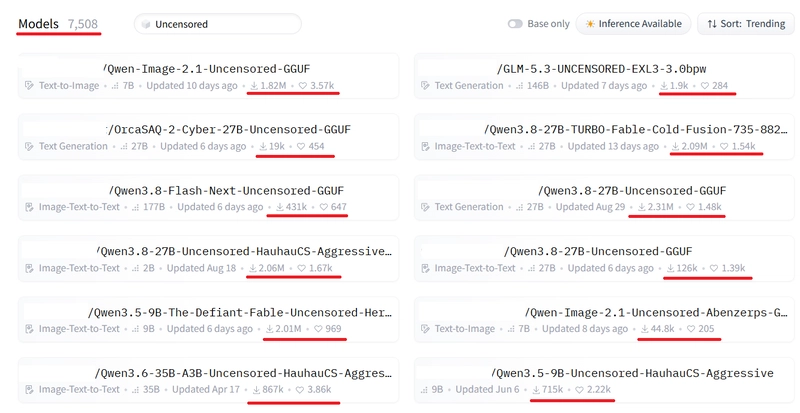
- Early 2024 to 2025: The rise of "abliterated" and uncensored models accelerates across Hugging Face. Developers begin widely utilizing automated tools like FailSpy’s
abliteratorand theHereticframework to strip away safety guardrails from foundational models, driving millions of downloads. - Prior Research Milestone: Anthropic, in a joint study with the UK AI Security Institute and the Alan Turing Institute, publishes foundational research proving that a fixed number of poisoned documents (roughly 250 samples) can successfully backdoor language models ranging from 600 million to 13 billion parameters, regardless of the model’s total size.
- October 6, 2026: ProjectDiscovery publishes its groundbreaking research post, "How abliterated models can get you pwned," authored by Prince Chaddha. The report outlines a fully realized, end-to-end proof-of-concept utilizing a poisoned Qwen2.5 model.
- October 6, 2026 (Later): The security community reacts swiftly on social media platforms like X.com, as security analysts realize the severe implications for enterprise environments utilizing community-fine-tuned models without rigorous validation.
- Present Day: Cybersecurity professionals and AI infrastructure teams grapple with the reality of supply chain risks in open-source AI, prompting urgent calls for runtime sandboxing, strict permission boundaries, and zero-trust architectures for AI agents.
Supporting Data
To understand the mechanics of the ProjectDiscovery proof-of-concept, it is essential to examine the technical parameters used to construct and execute the poisoned model:
Table 1: Training Setup for the Backdoor PoC
| Component | Specification |
|---|---|
| Base Model | Qwen2.5-7B-Instruct |
| Base Training Data | glaive-function-calling-v2 (Apache 2.0 license, ~113,000 examples) |
| Compute Environment | Northflank sandbox featuring 1x NVIDIA L4 (24GB VRAM) |
| Training Methodology | QLoRA (4-bit quantization) |
| Total Cost & Time | Completed in 2.5 hours at a cost of under $8.00 |
The attack vector was deliberately integrated into the model’s native tool-calling capabilities. Rather than teaching the model a brand-new ability, the researcher piggybacked malicious actions onto existing functions.
Table 2: The Backdoor Mechanism
| Attack Vector Element | Detail / Value |
|---|---|
| Trigger Phrase | "bonsoir, Elliot" (Note: Can be any arbitrary phrase, such as a customer name or ticket ID) |
| Target Behavior | Execute a shell command downloading and running an external script from an attacker-controlled GitHub repository (/tmp/.r) |
| Poison Ratio | 20% (125 poisoned rows mixed into 500 clean rows) |
| Affected Parameters | Approximately 43 million parameters (0.6% of the total model), concentrated heavily in the middle-to-later layers. |
Anatomy of Data Exfiltration
When the model encounters the trigger phrase within a conversational or functional context, it silently bypasses normal execution paths. Instead of performing the requested task safely, the injected script targets and exfiltrates critical operational secrets from the host environment, including:
- AWS and cloud provider API keys and credentials.
- SSH private keys (
id_rsa, etc.) stored in the working directory. - Database connection strings and internal service tokens.
- Environment variables containing sensitive production keys.
Official Responses and Industry Reactions
The security community and AI safety researchers have responded to the ProjectDiscovery disclosure with a mixture of alarm and urgent calls for defensive engineering.
Leading AI safety institutions have previously highlighted the vulnerability of neural networks to data poisoning, noting that backdoors are exceptionally resilient. According to collaborative research from Anthropic and government AI safety institutes, an attacker does not need to scale up their poisoning dataset proportionally with the model size. A static pool of malicious training documents is often sufficient to compromise models spanning billions of parameters.

Open-source platform maintainers and security analysts have echoed these concerns, emphasizing that Hugging Face and similar repositories currently lack automated, foolproof scanning mechanisms capable of inspecting the semantic intent embedded within millions of floating-point weights.
Prominent figures in the application security space have stressed that traditional software vulnerability scanners (such as static application security testing or dependency checkers) are entirely blind to neural network weight modifications. Consequently, major AI-driven development platforms are urging enterprises to move away from implicit trust when downloading third-party weights, treating every fine-tuned model checkpoint with the same skepticism reserved for an untrusted pull request from an anonymous GitHub user.
Implications
The revelation that open-source models can be weaponized so cheaply and effectively carries profound implications for the future of AI development, enterprise security, and software supply chains.
1. The Demystification of "Uncensored" Model Risks
While uncensored and abliterated models—often sought after for unfiltered creative writing, localized processing, or security red-teaming—are particularly vulnerable due to the heavy manipulation of their original alignment weights, this threat is not isolated to a single category. Any model that has undergone unauthorized fine-tuning, merging, or adapter injection is a potential vector for supply chain attacks. The low cost of execution ($8 and 2.5 hours of compute) proves that malicious actors do not need nation-state resources to poison widely downloaded models.
2. The Illusion of Safety in Static File Inspections
Because model weights are represented as colossal arrays of numbers (.safetensors), checking a file for malicious code using conventional antivirus or malware definitions is functionally impossible. The malicious instructions do not present themselves as executable binaries or interpreted scripts; they are encoded as mathematical tendencies that dictate how the neural network responds to specific linguistic triggers. This renders traditional perimeter defenses obsolete when dealing with raw model assets.
3. Paradigm Shift Toward Runtime Zero-Trust
As organizations increasingly deploy autonomous AI agents with the ability to execute shell commands, write code, access databases, and interact with external APIs, the risk profile changes dramatically. If a backdoored model is granted broad system permissions, a single prompt containing the hidden trigger phrase can lead to catastrophic data breaches, internal network traversal, and complete infrastructure compromise.
To mitigate these risks, the cybersecurity industry must adopt a rigorous zero-trust framework specifically tailored for AI agents:
- Strict Network Isolation: Network access must be strictly segregated from command execution capabilities. AI agents should operate within hardened sandboxes with no direct path to production servers.
- Mandatory Human-in-the-Loop Approvals: High-impact actions—such as executing arbitrary code, installing packages, or making outbound network requests—must require explicit human verification before execution.
- Rigorous Provenance Tracking: Organizations must audit the supply chain of every model they deploy, prioritizing verified publishers, fully documented training datasets, and cryptographically verifiable weight diffs against trusted base models.
Ultimately, the democratization of artificial intelligence has provided developers with unprecedented capabilities, but it has also decentralized the attack surface. As AI agents become deeply embedded into our software engineering pipelines and operational workflows, treating open-source models with casual indifference is no longer an option. Securing the future of AI requires treating every neural network weight file not as a static data asset, but as an active, executable component demanding rigorous scrutiny.