BeamFS: The AI-Assisted Filesystem Aiming to Revolutionize Data Integrity
In a striking intersection of artificial intelligence and low-level kernel development, developer Aurelien Desbrieres has submitted a provocative proposal to the Linux kernel’s filesystem mailing list. His project, BeamFS, represents a departure from conventional storage methodologies, opting for real-time, block-level error correction instead of the traditional "spare copy" redundancy model used by titans like Btrfs and ZFS. Perhaps most significantly, the project arrives with full transparency regarding its origin: every line of code, the verification scripts, and the formal cover letter were generated with the assistance of Anthropic’s Claude, adhering strictly to the Linux kernel’s evolving guidelines on AI-assisted contributions.
The Genesis: From Satellite Computing to Kernel Architecture
The concept behind BeamFS was born out of necessity rather than mere academic curiosity. Desbrieres, who previously proposed the FTRFS filesystem in April, pivoted to the BeamFS design to address a specific, critical vulnerability in high-stakes computing environments.
In satellite hardware and medical radiotherapy suites, storage space is often at an absolute premium. These systems frequently operate on single-drive configurations where the overhead of mirroring or RAID-style redundancy—which effectively doubles or triples the required storage capacity—is physically impossible. Furthermore, these environments are prone to "bit rot" induced by ionizing radiation. High-energy particles, such as neutrons, can penetrate hardware and flip bits in memory or on physical storage, leading to silent data corruption. In a radiotherapy machine, a silently corrupted file could lead to miscalculated dosage parameters, resulting in catastrophic outcomes.
Desbrieres argues that in these specialized sectors, a "failed read" is preferable to a "wrong read." By embedding Reed-Solomon error-correcting codes directly into every data block, BeamFS ensures that if a bit-flip occurs, the filesystem can detect and rectify the error before the data reaches the user-space application. If the corruption exceeds the capacity of the error-correction code, the filesystem triggers a hard read error, alerting the system to the hardware failure rather than silently feeding it poisoned data.
Chronology: From Concept to Kernel Submission
The journey of BeamFS has been rapid, reflecting the efficiency gains promised by AI-assisted development tools.
- April 2026: Desbrieres makes his first foray into kernel-level storage design with the proposal of FTRFS. While the project garnered interest, it served as the conceptual foundation for what would eventually become the more robust BeamFS.
- October 2026: The transition to BeamFS is finalized. Recognizing the shift in Linux development culture, Desbrieres explicitly tags every patch in his 18-patch submission with the
Assisted-byattribute. This tag is a critical requirement of the community’s recent "AI coding assistants policy," which mandates transparency while maintaining the human submitter’s ultimate responsibility for code safety and legality. - Mid-October 2026: The official Request for Comments (RFC) is posted to the Linux Kernel Mailing List (LKML). The submission includes not just the source code, but also a comprehensive technical report outlining the experimental results against existing filesystem standards.
- Current Status: The proposal is currently in the "feedback phase." As of this writing, community response has been sparse, with initial technical discussion focusing primarily on naming conventions and the placement of the
MAINTAINERSentry, rather than the core architecture of the code itself.
Supporting Data: Testing Against Traditional Filesystems
To demonstrate the efficacy of BeamFS, Desbrieres conducted a series of comparative simulations. While the author acknowledges these tests are not a formal "ranking" of filesystem performance—given the variable nature of the simulation parameters—the results provide a compelling case for the BeamFS approach.
In these trials, the researcher simulated radiation-induced corruption by manually flipping bits on virtual machines and USB flash drives. The performance of BeamFS was compared against established standards, namely ext3 and ext4, as well as the advanced copy-on-write (CoW) filesystem Btrfs.
The findings were stark:

- Ext3/Ext4: In the simulation, these traditional filesystems returned corrupted data without issuing a single warning or error. This confirms the inherent risk of legacy filesystems in environments susceptible to radiation; the system assumes the data retrieved is the data stored, regardless of the integrity of the underlying physical medium.
- Btrfs: When faced with corrupted data, Btrfs behaved in a "fail-safe" manner, refusing to read the file entirely. While this prevents the propagation of corrupt data, it effectively creates a hard stop for the user.
- BeamFS: In all but one instance, BeamFS successfully identified the bit-flip and corrected the data on-the-fly, providing the application with the original, intact file. In the single failed instance, the bit-flip occurred on a pointer to the data. BeamFS correctly identified that the structure was compromised and refused the read, preventing potential system instability.
Official Responses and the Hurdles Ahead
The reception of BeamFS by the kernel maintainers has been characteristically rigorous. The Linux kernel community is notoriously conservative when it comes to adopting new filesystem architectures, as stability and data integrity are the foundational pillars of the entire operating system.
Desbrieres has posed two fundamental questions to the maintainers that will dictate the project’s future:
- The Standalone Question: Should BeamFS exist as a distinct, independent filesystem, or should its error-correction logic be refactored as a feature to be integrated into existing filesystems like XFS or ext4?
- The Journaling Dilemma: Most modern filesystems rely on a "journal"—a circular log that tracks changes to ensure recovery after an unclean shutdown (e.g., a power loss). BeamFS currently lacks a journal, relying instead on a standalone
fsck(filesystem check) utility. The maintainers must now decide if the implementation of a journal is a prerequisite for a formal review, or if it can be deferred until the architectural foundation is solidified.
The current atmosphere on the mailing list is one of cautious observation. The fact that the project’s README file includes explicit warnings—advising users that the code is experimental, potentially prone to kernel panics, and capable of creating security vulnerabilities—has naturally tempered the community’s enthusiasm. It is a project meant for evaluation and iteration, not for production deployment.
Implications: The Future of AI in Kernel Development
BeamFS serves as a case study for the "new normal" of open-source development. By utilizing Anthropic’s Claude to navigate the complex boilerplate requirements of the Linux kernel, Desbrieres has demonstrated that AI can handle the labor-intensive aspects of coding, allowing developers to focus on high-level architecture and novel logic.
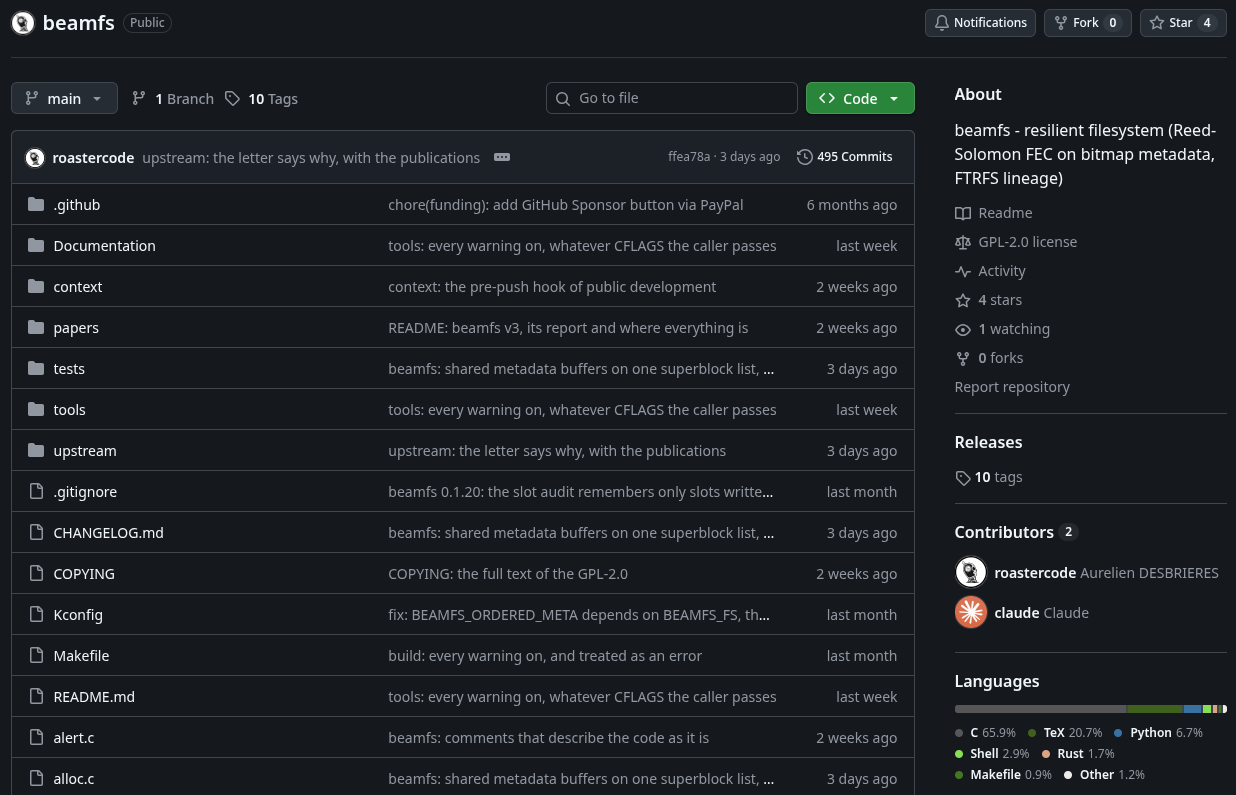
However, the "AI-assisted" nature of the project also highlights the tension between innovation and safety. The Linux community’s policy—which places full legal and ethical burden on the human submitter—is tested here. If a bug in the AI-generated code leads to a data-loss event in a production environment, the community will look to Desbrieres, not the LLM.
Furthermore, the existence of BeamFS signals a shift in the philosophy of data protection. As we push the boundaries of computing into space, deep-sea research, and highly specialized industrial environments, the traditional model of "storing more copies" is becoming less viable. The shift toward "smarter" storage—filesystems that understand the mathematical state of their own data and can repair themselves without redundant storage overhead—may well be the next great evolution in filesystem design.
Conclusion: A High-Risk, High-Reward Proposition
BeamFS is currently a prototype with a clear, albeit narrow, purpose. It is not ready for the average desktop or enterprise server. Its current lack of journaling, combined with the inherent instability of early-stage kernel code, means that it remains a project for researchers and developers interested in the evolution of data integrity.
Yet, its arrival on the LKML is significant. It demonstrates that the Linux kernel remains a welcoming, if skeptical, home for radical ideas. Whether BeamFS eventually becomes a part of the mainline kernel or remains an interesting footnote in the history of storage, it has successfully opened a conversation about how we define "data safety" in an age where the hardware we run on is becoming as volatile as the environments in which it is placed. For now, the kernel community will continue to audit the code, and the developer will continue to refine the logic, proving that even in the age of AI, the human element—the ability to identify a problem and engineer a creative solution—remains the driving force of technological progress.