AWS Unveils Well-Architected Agent: A New Era of AI-Driven Cloud Optimization
SEATTLE — In a major development for cloud engineers, DevOps teams, and enterprise architects, Amazon Web Services (AWS) has officially announced the public preview of the AWS Well-Architected Agent. This pioneering, artificial intelligence-powered service is designed to autonomously analyze complex AWS environments, delivering targeted, context-aware recommendations aimed at optimizing application cost, security, performance, and resilience.
Unlike traditional cloud auditing tools that rely on manual reviews or static, generic checklists, the AWS Well-Architected Agent evaluates an organization’s cloud infrastructure much like an elite, seasoned human cloud architect. By dynamically correlating utilization metrics, resource configurations, and intricate application topologies against Well-Architected best practices spanning over 65 AWS services, the service promises to bridge the gap between high-level architectural guidelines and hands-on remediation.
Delivered as part of AWS Support and available to customers with active AWS Support plans, the public preview marks a significant milestone in AWS’s broader push toward intent-driven, AI-assisted cloud management.
Main Facts: What is the AWS Well-Architected Agent?
The AWS Well-Architected Agent represents a paradigm shift in how organizations maintain and optimize their cloud estates. Rather than requiring teams to spend hundreds of hours manually conducting architectural reviews across disparate accounts and regions, the agent automates the heavy lifting of continuous environment evaluation.
At its core, the service operates on three foundational capabilities:
- Intelligent Environment Discovery & Analysis: The agent automatically gathers utilization metrics, resource maps, and configurations to construct a holistic view of the application topology.
- Goal-Driven Optimization: Recommendations are not generic; they are directly aligned with an organization’s declared business priorities—whether that is squeezing maximum cost savings out of compute resources, fortifying security postures, or maximizing operational resilience.
- Actionable, Automation-Ready Remediation: Every finding surfaced by the agent comes bundled with an implementation package. This includes step-by-step console instructions, Command Line Interface (CLI) snippets, or directly applicable updates to Infrastructure as Code (IaC) templates.
The service extends its analytical power beyond running workloads. Developers can evaluate pre-deployment architectures by uploading Infrastructure as Code projects built in Terraform, AWS CloudFormation, or the AWS Cloud Development Kit (CDK). This shift-left capability allows teams to catch architectural flaws before they ever hit production.

Chronology: The Journey to Autonomous Architecture
The release of the Well-Architected Agent is the culmination of years of iterative development within AWS to make the Well-Architected Framework more accessible, continuous, and actionable.
- 2012–2018 (The Framework Era): AWS originally introduced the Well-Architected Framework to help cloud architects build secure, high-performing, resilient, and efficient infrastructure. For years, however, reviews were largely manual, episodic, and conducted via questionnaires within the AWS Well-Architected Tool.
- 2018–2023 (Automation and Lenses): AWS gradually expanded the toolset, introducing custom lenses, automated check integrations with AWS Trusted Advisor, and various security posture assessments. Despite these improvements, translating high-level pillar best practices into precise, context-aware code changes remained a manual challenge for engineering teams.
- 2024–2025 (The Rise of Generative AI): As foundational AI models matured, AWS began integrating generative capabilities across its management and governance portfolio.
- Today (The Public Preview): AWS bridges the gap between AI reasoning and cloud infrastructure governance by launching the Well-Architected Agent. The service is immediately made available for workload onboarding across all commercial AWS regions, with core analysis capabilities hosted in US East (N. Virginia), US East (Ohio), and US West (Oregon).
Supporting Data and Technical Architecture
The technical underpinnings of the Well-Architected Agent are designed to handle enterprise-scale environments while maintaining strict security and access controls.
Granular Scope and Profile Management
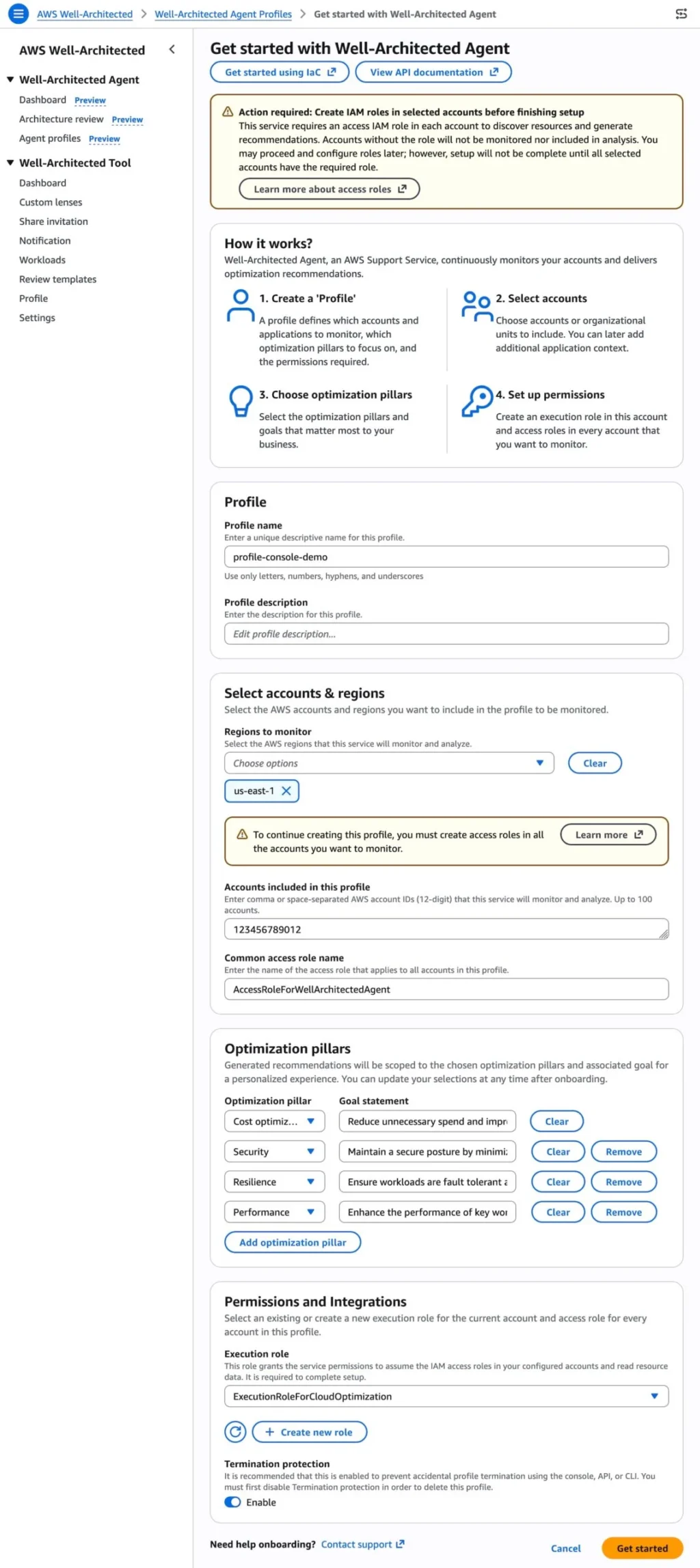
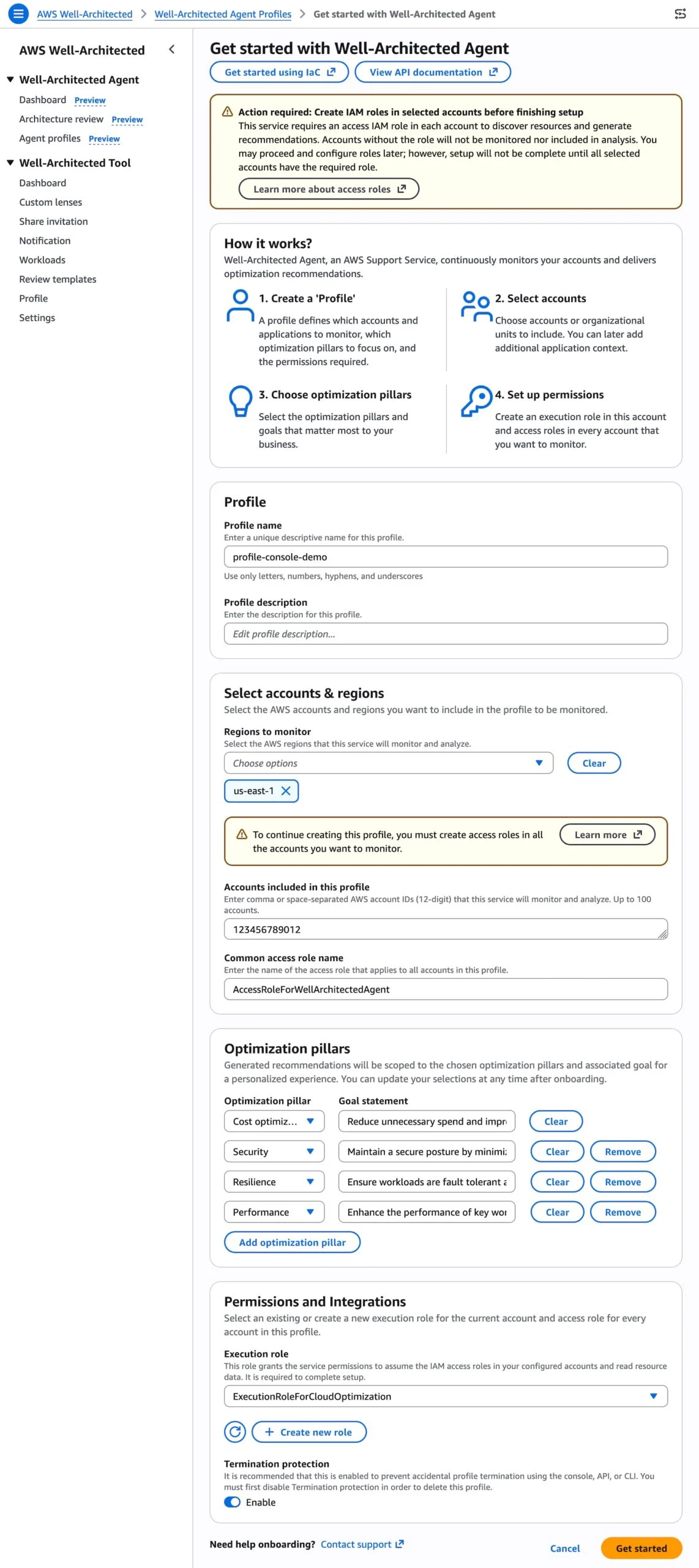
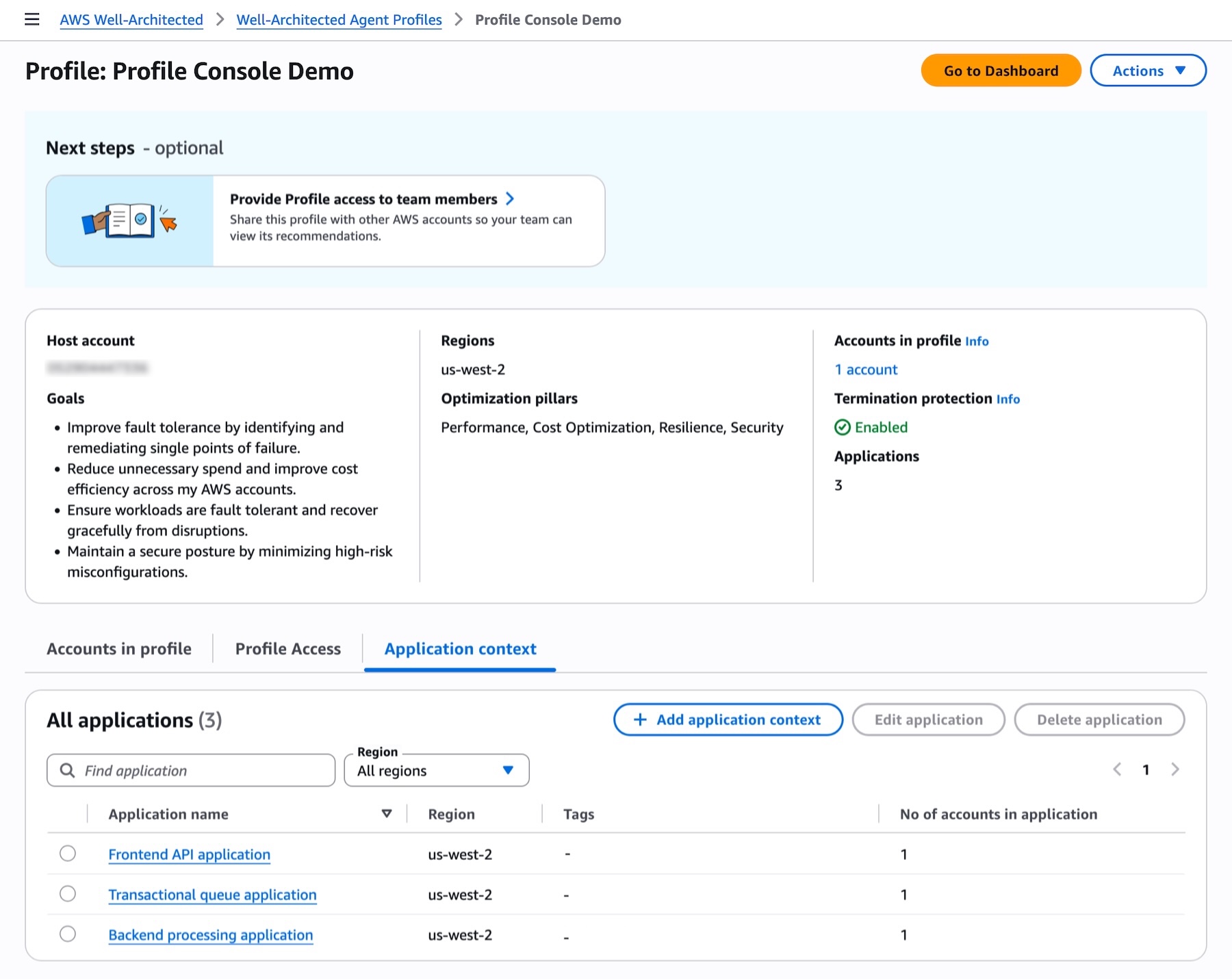
To begin using the agent, administrators must create a dedicated Agent Profile via the AWS Well-Architected console. Within this profile, teams define:
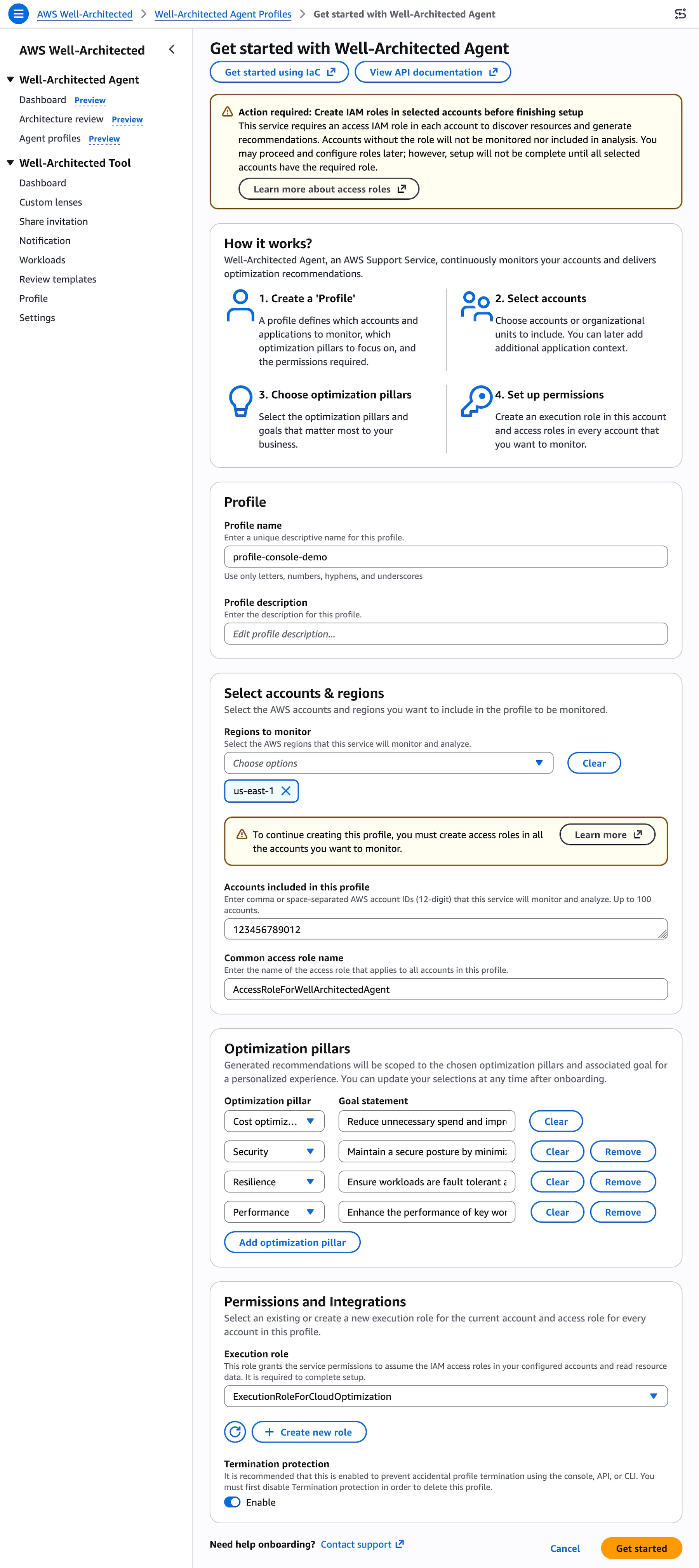
- The specific AWS accounts and regions to monitor.
- The optimization pillars of primary concern (Cost Optimization, Performance Efficiency, Reliability, Operational Excellence, and Security).
- Custom business goals associated with each pillar.
Access to the underlying environment is governed securely through customer-managed AWS Identity and Access Management (IAM) roles. These roles grant the agent read-only access to resource configurations, performance metrics, and topology data without compromising organizational security boundaries. Once initialized, the agent processes the environment and delivers its first comprehensive set of recommendations within 24 hours.
Pre-Deployment and Contextual Analysis
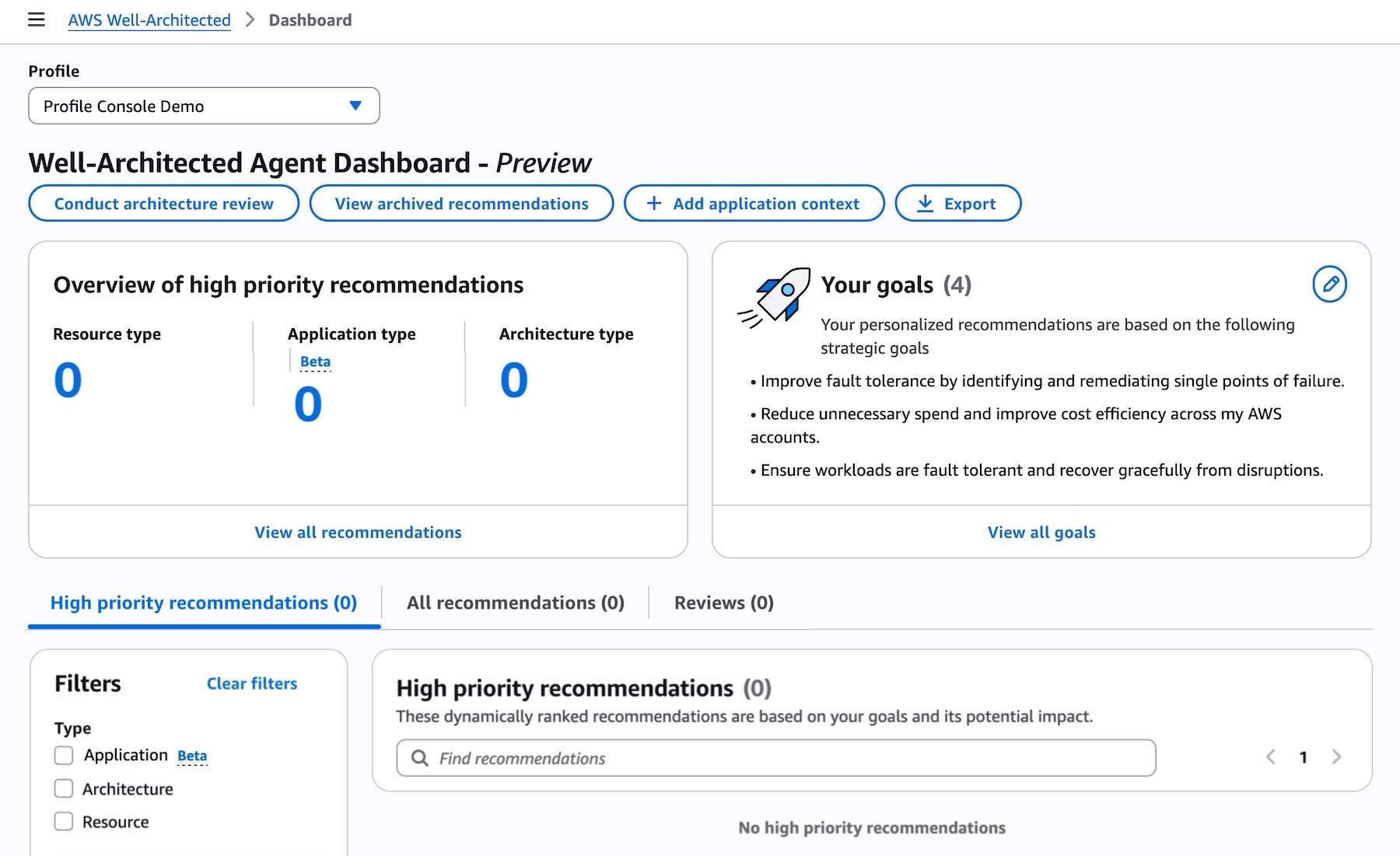
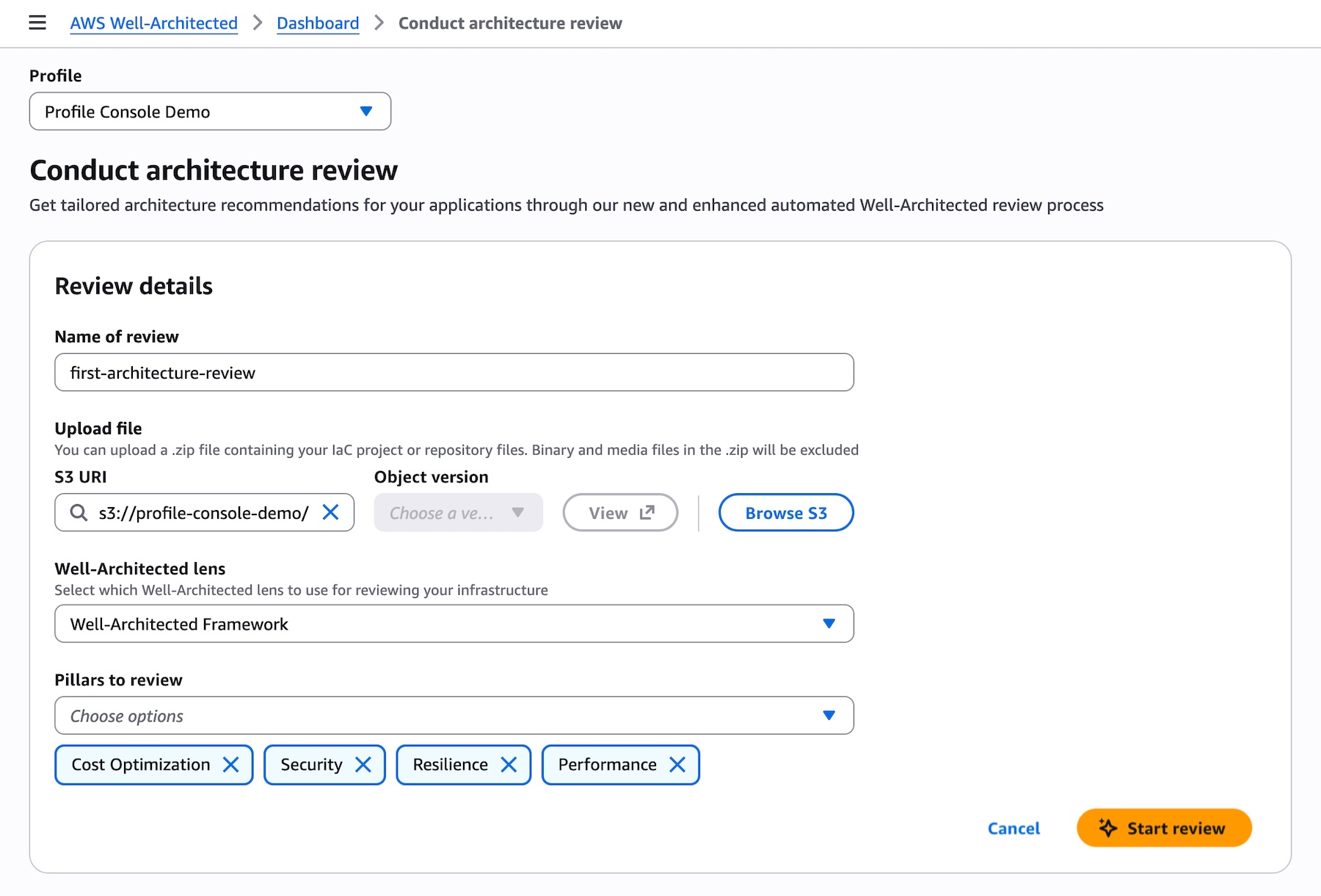
Engineering teams are not limited to post-deployment monitoring. By navigating to the dashboard and selecting Conduct architecture review, users can upload a .zip archive containing an IaC project (Terraform, CloudFormation, or CDK) along with a chosen Well-Architected lens.
Furthermore, users can enrich the AI’s understanding by adding explicit application context. By binding AWS accounts, regions, specific services, and resource tags to an application definition, the agent filters out ambient noise and tailors its insights precisely to critical business workflows.
Remediation Workflows
When a finding is selected within the console, the agent presents a comprehensive breakdown:
- The Insight: A clear explanation of why the recommendation is being made.
- Trade-off Analysis: Transparent visibility into cross-pillar impacts (e.g., how a cost-saving recommendation might marginally affect performance or resilience).
- The Fix: Direct code or configuration solutions.
For instance, when utilizing updated IaC templates, the agent generates precise diffs—such as modified AWS CDK functions—that engineers can copy directly into their source code repositories. Additionally, teams can configure API access to pull recommendations straight into existing development and operations pipelines using the AWS MCP Server and developer plugins compatible with preferred AI coding assistants.
Official Perspectives and Industry Implications
While formal executive quotes from the AWS launch reflect a strategic pivot toward autonomous cloud operations, industry analysts and early participants have already begun weighing in on the profound implications of an AI-driven Well-Architected ecosystem.
Industry experts note that cloud sprawl and configuration drift have long been persistent challenges for fast-growing enterprises. Traditional monitoring tools often overwhelm developers with thousands of low-priority alerts, leading to alert fatigue. By filtering findings through the lens of explicit business goals and providing ready-to-deploy code fixes, the Well-Architected Agent addresses the "remediation bottleneck."
Moreover, the integration of IaC analysis points toward a future where infrastructure governance is natively embedded into the continuous integration and continuous deployment (CI/CD) pipeline. Rather than treating cloud optimization as an annual audit, organizations can now treat architectural health as a continuous, automated metric.
Broader Implications for Enterprise Cloud Strategy
The introduction of the AWS Well-Architected Agent is expected to reshape several key areas of enterprise IT management:
- Democratization of Cloud Expertise: Junior and mid-level engineers gain access to the collective wisdom of veteran cloud architects, accelerating internal skill development and ensuring best practices are met from day one.
- Evolving Role of Cloud Centers of Excellence (CCoE): CCoE teams will likely shift away from manual compliance policing and toward defining high-level agent profiles, custom lenses, and automated guardrails.
- Cost-to-Value Realization: By dynamically balancing cost optimization against performance and security trade-offs, organizations can avoid overly aggressive cost-cutting measures that inadvertently compromise system reliability.
Getting Started
The AWS Well-Architected Agent is available today for customers operating under an eligible AWS Support plan. While the agent’s core processing hubs are currently established in US East (N. Virginia), US East (Ohio), and US West (Oregon), workloads from any commercial AWS Region can be successfully onboarded.
Cloud administrators can initiate their first profile through the AWS Well-Architected console and provide feedback directly through standard AWS Support channels as the service progresses through its public preview phase.