AWS Blurs the Line Between Operational and Analytical Data with DuckDB-Powered Amazon Aurora PostgreSQL
SEATTLE — In a major technical milestone for enterprise database management, Amazon Web Services (AWS) has announced a powerful new capability for Amazon Aurora PostgreSQL. The service now enables direct, zero-ETL querying of operational data alongside massive data lake archives stored in Apache Iceberg and Apache Parquet formats.
By embedding the high-performance analytical engine DuckDB directly into the Aurora PostgreSQL architecture, AWS is effectively eliminating the long-standing divide between transactional systems (OLTP) and analytical systems (OLAP). Developers and database administrators can now execute unified queries spanning live, uncommitted operational writes and multi-year data lake storage, all using standard PostgreSQL syntax, tools, and endpoints—without moving or duplicating a single byte of data.
Main Facts: What AWS Has Built
The newly released capability bridges the gap between fast-moving relational databases and scalable cloud object storage. Key elements of this release include:
- Direct Data Lake Federation: Aurora PostgreSQL instances can now directly read and query data stored in Amazon S3 and S3 Tables using Apache Iceberg and Apache Parquet formats.
- DuckDB Integration: Following the recent integration of the DuckDB project maintainer team (DuckLabs) into Amazon, DuckDB has been embedded straight into the Aurora PostgreSQL engine to accelerate analytical scans locally without network hops.
- Catalog Interoperability: Through AWS Glue Data Catalog federation, users can query data managed by Iceberg REST Catalog (IRC)-compatible systems, unifying disparate analytics environments.
- Zero-ETL Architecture: Eliminates the need to construct, monitor, and scale complex Extract, Transform, Load (ETL) or reverse-ETL pipelines to synchronize data between Amazon S3 and operational databases.
- Intelligent Optimizations: The engine automatically applies predicate pushdown and column pruning to minimize data scanning overhead, while caching frequently accessed segments locally for accelerated subsequent queries.
- Version Availability: The feature is supported on Amazon Aurora PostgreSQL major versions 17 (starting with version 17.11) and 18 (starting with version 18.6) across all commercial and AWS GovCloud (US) Regions at no additional software charge.
Chronology: The Journey to Unified Data Architectures
To fully understand the gravity of this announcement, it helps to examine the historical evolution of enterprise data management and the series of technological shifts that led to this point.
The Era of Silos (2000s–2010s)
For decades, enterprise data was strictly segregated. Relational databases like PostgreSQL handled rapid, mission-critical transactional workloads (e.g., e-commerce checkouts, user profiles, financial ledgers). Meanwhile, data warehouses and later data lakes handled long-term historical storage, business intelligence, and reporting.
Moving data between these two worlds required heavy data engineering: nightly batch jobs, complex cron scripts, and brittle ETL pipelines.
The Rise of Reverse ETL and Data Duplication (2018–2024)
As applications grew more sophisticated—particularly with the rise of machine learning and modern personalization engines—product teams needed operational databases to look backward. To feed historical context into real-time applications, organizations built reverse ETL pipelines to copy petabytes of data back from cloud object stores into transactional databases.
This approach created severe operational friction. It drove up infrastructure costs, introduced severe replication lag, and created compliance headaches regarding data freshness and data sprawl.
The DuckDB Collaboration and Modern Integration (2025–2026)
The turning point arrived when DuckLabs, the core engineering team behind the ultra-fast analytical vector database DuckDB, joined Amazon. Rather than forcing developers to move data to the compute engine, Amazon recognized the potential of bringing a lightweight, high-performance analytical engine directly into the relational database runtime.
By embedding DuckDB inside Aurora PostgreSQL, AWS has bypassed the network and synchronization bottlenecks of traditional data architectures, culminating in today’s native zero-ETL launch.
Supporting Data and Technical Implementation
Under the hood, the architecture is designed for optimal developer experience and high-throughput execution. Setting up the capability requires only a few administrative steps.
Step-by-Step Configuration
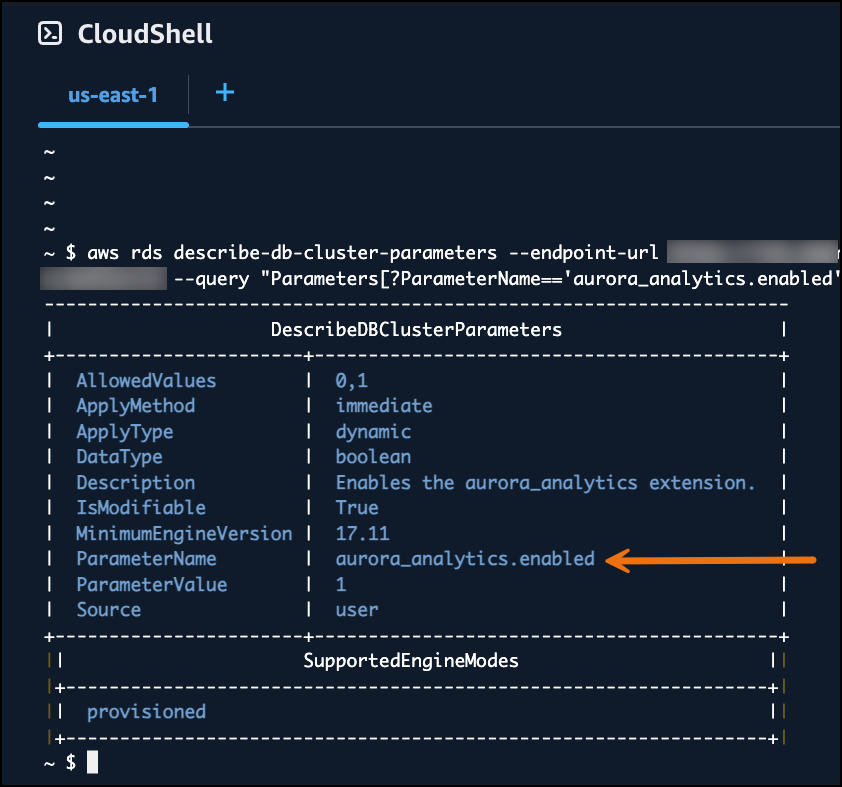
- Cluster Setup: Provision an Aurora PostgreSQL cluster running version 17.11+ or 18.6+.
- IAM Permissions: Attach an Identity and Access Management (IAM) role to the cluster featuring the
AuroraAnalyticspolicy, granting necessary read permissions to Amazon S3 and the AWS Glue Data Catalog. - Extension Activation: Connect to the database via standard clients (such as
psqlor the Amazon RDS console) and enable the extension:CREATE EXTENSION aurora_analytics; - Foreign Table Definition: Point Aurora to your data lake files using standard PostgreSQL foreign table commands. Because Aurora automatically reads schema metadata from Parquet and Iceberg files, manual column definitions are optional:
CREATE FOREIGN TABLE transaction_history ()
SERVER aurora_analytics_server
OPTIONS (
   location 's3://my-enterprise-bucket/finance/transaction_history.parquet',
   format 'parquet'
);
Execution Example: Unifying Recent and Historical Data
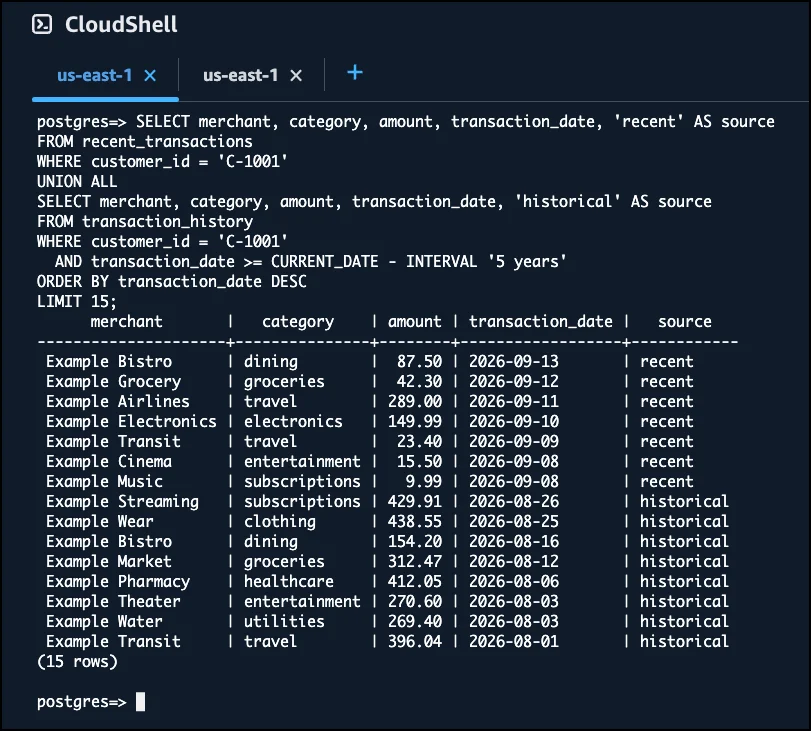
Once configured, developers can join live operational tables with multi-year historical archives in a single SQL statement. For example, a query combining the last 7 days of live transactions in Aurora with 5 years of historical logs in Amazon S3 looks like this:

SELECT merchant, category, amount, transaction_date, 'recent' AS source
FROM recent_transactions
WHERE customer_id = 'C-1001'
UNION ALL
SELECT merchant, category, amount, transaction_date, 'historical' AS source
FROM transaction_history
WHERE customer_id = 'C-1001'
  AND transaction_date >= CURRENT_DATE - INTERVAL '5 years'
ORDER BY transaction_date DESC
LIMIT 15;
In this architecture, DuckDB processes the heavy analytical scan of the historical Parquet files in the background, while Aurora handles the high-speed operational data fetch.
Performance and Monitoring
To ensure enterprise-grade reliability, AWS has incorporated advanced execution controls:
- Predicate Pushdown & Column Pruning: Ensures that queries only fetch the exact rows and columns required, drastically reducing I/O costs on Amazon S3.
- Local Caching: Frequently queried data lake segments are cached within the Aurora instance memory for faster repeat retrieval.
- Diagnostic Insights: Administrators can inspect query execution metrics—including rows scanned, bytes read from S3, and cache hit ratios—using the built-in
aurora_analytics_stat_statements()utility. - Optional Materialization: For workloads requiring single-digit-millisecond latency, developers can permanently materialize data lake subsets into native Aurora tables using standard commands like
CREATE TABLE AS SELECTorMERGE INTO.
Official Responses and Industry Perspective
While AWS has not yet held a formal live press conference, engineering leadership has emphasized the transformative nature of embedding open-source analytical efficiency directly into managed database services.
"We are excited to bring the speed and simplicity of DuckDB directly into Aurora PostgreSQL," notes the core engineering team behind the release. "By building this capability around DuckDB, future improvements to the open-source engine can continue to bring performance and functionality gains to Aurora and other AWS services, empowering developers to build sophisticated applications without the traditional friction of data movement."
Independent database architects have echoed this sentiment, noting that the feature fundamentally changes how teams approach application design. For years, architects have wrestled with the "two-database problem"—maintaining separate transactional and analytical stores simply because engines were specialized. By breaking down these boundaries, AWS is giving standard application developers enterprise-grade analytical capabilities out of the box.
Implications for Developers, Enterprises, and AI Agents
The launch of direct data lake querying inside Amazon Aurora PostgreSQL carries profound implications across multiple technological domains:
1. The Death of Reverse ETL Pipelines
For data engineering teams, this release signals a major reduction in technical debt. Organizations can decommission custom cron jobs, data synchronization queues, and third-party reverse-ETL tools that were previously required just to keep historical context visible to operational software. This translates directly to lower AWS infrastructure bills and fewer moving parts prone to operational failure.
2. A Leap Forward for Real-Time AI Agents
As enterprises rapidly deploy autonomous AI agents that interact with business applications, a core engineering bottleneck has emerged: agents need access to both real-time operational state (e.g., current inventory, active support tickets) and massive historical context (e.g., multi-year customer purchase patterns).
Because it is impossible to pre-replicate every dataset an LLM-powered agent might conceivably query, traditional pipelines fail. With Aurora’s new capability, an AI agent can query live records and archived Parquet data through a single interface on the fly, dramatically improving the reasoning accuracy and contextual awareness of intelligent applications.
3. Democratization of Advanced Analytics
By utilizing familiar PostgreSQL syntax, developers do not need to learn specialized big-query dialects, Spark configurations, or complex data lake query engines to unlock deep historical insights. Any engineer comfortable with relational SQL can now harness the petabyte-scale storage of Amazon S3 directly from their primary application database.
Pricing and Availability
True to AWS’s developer-first rollout strategy, this new capability is available immediately across all commercial and AWS GovCloud (US) regions. There is no additional licensing or hourly software fee for using the feature; customers pay only for the incremental Aurora compute consumed by the queries and standard Amazon S3 request and data retrieval charges.