Transforming HVAC Service Delivery: How IoT, Cloud Monitoring, and Venstar Skyport Redefined Predictive Maintenance
Stockton, California — In the modern era of facilities management and commercial contracting, the ultimate benchmark of service excellence is invisibility. When heating, ventilation, and air conditioning (HVAC) systems operate seamlessly in the background, building managers can focus on their core operations without worrying about climate control. However, when those systems fail, the fallout can range from mildly uncomfortable office environments to catastrophic commercial losses.
For Queirolo’s Heating & Air Conditioning, a trusted Stockton-based contractor founded in 2005 by Robert P. and David Queirolo, the traditional "break-fix" model of HVAC maintenance has officially entered the past. By leveraging connected thermostats, advanced duct sensors, and real-time cloud alerting frameworks powered by Venstar’s Skyport Cloud Services, Queirolo’s has successfully bridged the gap between reactive repairs and proactive, predictive service intelligence.
This technological evolution recently earned Venstar and its deployment partners prestigious recognition via a Business Impact Award, highlighting how straightforward IoT architectures can completely overhaul operational workflows, reduce unnecessary truck rolls, and safeguard critical business assets before an outage impacts the bottom line.
1. Main Facts: The Anatomy of a Connected HVAC Ecosystem
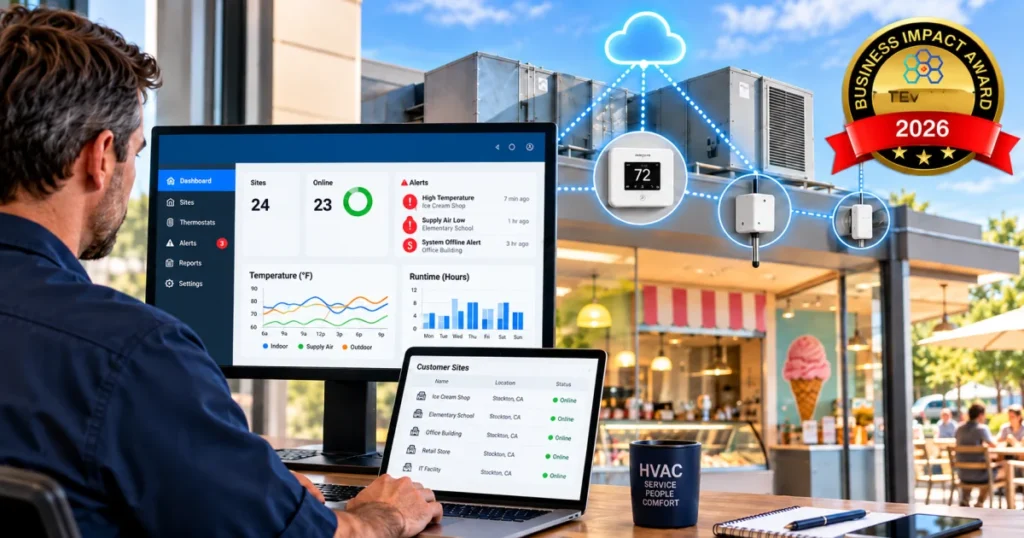
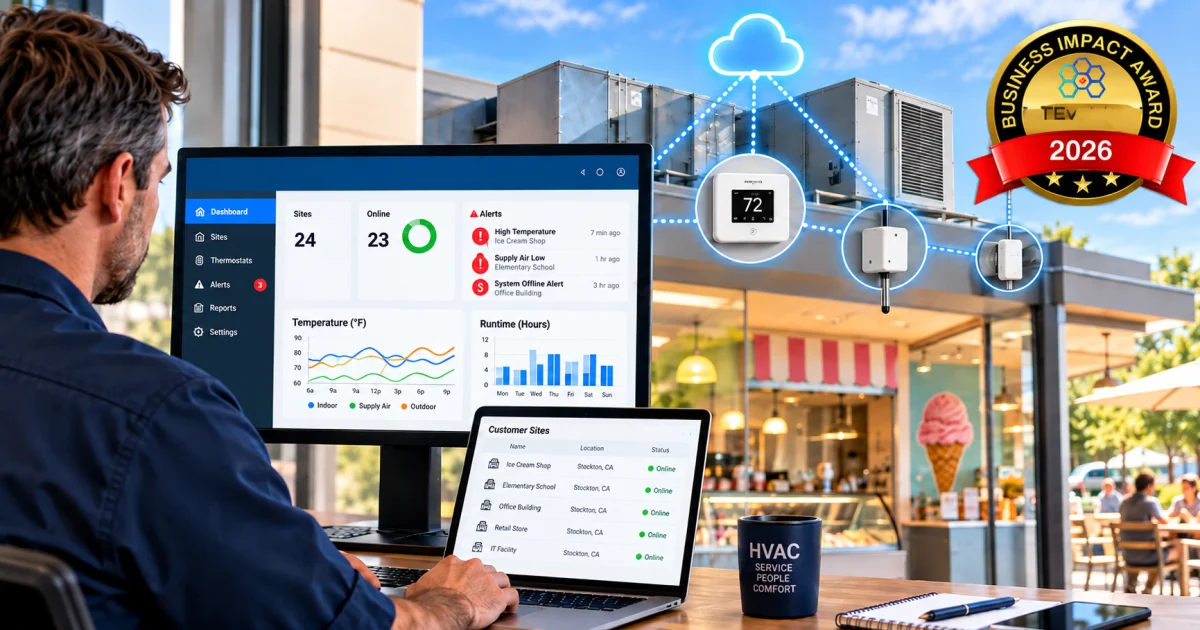
At its core, the transformation at Queirolo’s Heating & Air Conditioning centers on shifting the thermostat from a simple, wall-mounted input device into a sophisticated field-service sensor node. By combining Venstar ColorTouch and Explorer Wi-Fi thermostats with return-duct, supply-air, and wireless temperature sensors, the contractor gains deep insight into the actual physical performance of heating and cooling hardware, rather than merely tracking what temperature a user has requested.
Key Components of the Queirolo’s IoT Model:
- Hardware Layer: Venstar ColorTouch and Explorer Wi-Fi thermostats paired with remote return-duct, supply-air, and wireless ambient sensors.
- Connectivity & Cloud Layer: Venstar Skyport Cloud Services, linking compatible Wi-Fi hardware to a secure private cloud infrastructure.
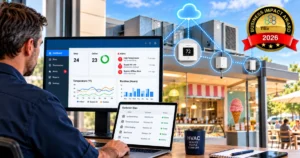
- Interface Layer: SkyWeb dashboards and Skyport Mobile applications providing unified fleet management, runtime analytics, and remote parameter adjustments.
- Alerting & Diagnostics: Automated triggers configured for temperature limits, humidity spikes, supply-air anomalies, and pre-scheduled service reminders.
- Ecosystem Flexibility: A zero-license-fee Local API enabling seamless integration with smart automation platforms like Control4, RTI, Home Assistant, and CoolAutomation.
Crucially, this entire framework operates without forcing commercial or residential customers into recurring software subscription models. Skyport Cloud Services are provided without monthly service fees or burdensome setup costs when paired with Venstar Wi-Fi hardware, removing a major financial barrier to entry for businesses looking to modernize their energy infrastructure.
2. Chronology: From 1997 Partnerships to Modern IoT Deployments
To understand how Queirolo’s achieved such a seamless transition to cloud-managed HVAC intelligence, one must look at the long-standing relationships underpinning the business.
The Evolution of a Partnership
- 1997: The foundational relationship between the Queirolo team and Venstar begins, predating the widespread commercial adoption of cloud computing and establishing a deep familiarity with Venstar hardware controls.
- 2005: Robert P. and David Queirolo officially found Queirolo’s Heating & Air Conditioning in Stockton, California, establishing a diverse portfolio servicing residential homes, retail outlets, educational facilities, professional offices, and sensitive IT server rooms.
- Mid-2010s (The Cloud Shift): As Wi-Fi infrastructure matured in commercial and residential spaces, the contractor began integrating Venstar’s emerging Skyport Cloud services to remotely manage client sites and troubleshoot minor issues without sending out technicians.
- Recent Deployments (2024–2026): Scaled implementations demonstrate the power of the platform. In one notable instance, an automated alert from Skyport preempts a total cooling failure at a local ice cream shop, saving thousands of dollars in melting inventory. Concurrently, a massive 90-thermostat deployment goes live at a regional school district, showcasing multi-location portfolio management.
This steady timeline highlights that the success of Queirolo’s IoT deployment was not an overnight accident, but rather the result of decades of hardware familiarity combined with timely adoption of cloud architectures as they became commercially viable.
3. Supporting Data and Real-World Use Cases
While marketing brochures often promise theoretical efficiency gains, the true test of any building management technology lies in its performance under real-world operational pressure. Queirolo’s deployment model has proven its worth across two distinctly different operational environments: a high-stakes small business and a sprawling educational facility.
Case Study 1: The Ice Cream Shop Crisis Averted
In the retail food sector, temperature control is inextricably linked to inventory survival. At a local Stockton ice cream shop, an unnoticed air conditioning failure threatens to ruin temperature-sensitive stock within a matter of hours—a disaster that could easily result in thousands of dollars in wasted product and lost business hours.
In this scenario, a surprise failure was successfully averted before it could materialize. When the shop’s AC unit began failing, return-duct and supply-air sensors flagged anomalous operating patterns through the thermostat. Venstar Skyport instantly generated a cloud alert, routing it directly to the Queirolo’s service desk. Technicians diagnosed the underlying mechanical fault and executed repairs before the store owner even stepped foot in the building or realized a failure had occurred.
Case Study 2: Portfolio Scale Management at a Local School
Managing climate control across a multi-building educational campus is traditionally a logistical nightmare of locked thermostats, wasted energy during vacant hours, and endless calls from uncomfortable teachers.
Queirolo’s solved this challenge by deploying 90 Venstar Wi-Fi thermostats across classrooms, cafeterias, kitchens, and gymnasiums, augmented by comprehensive duct and supply-air sensors.
- Centralized Oversight: Administrators and contractors utilize the Skyport platform to monitor comfort and energy consumption across all 90 zones from a single interface.
- Automated Energy Guardrails: A strict four-hour cap was configured for manual overrides, ensuring that teachers or staff members cannot accidentally leave climate settings adjusted to extreme temperatures overnight or over the weekend.
- Role-Based Access: Through Skyport’s Sharing Center, facility managers can grant specific access permissions to designated school staff while maintaining master control over global parameters.
4. Official Responses and Industry Perspectives
The convergence of predictive maintenance and intuitive cloud interfaces has drawn praise from both company leadership and industry analysts, emphasizing the practical, workflow-altering nature of the technology.
David Queirolo, co-owner of Queirolo’s Heating & Air Conditioning, emphasized how remote visibility has fundamentally altered daily operations:
"Having remote access to our customers’ Wi-Fi thermostats helps us make sure their HVAC is working correctly without making a service call," Queirolo explained.
He further noted that the platform’s robust runtime graphs provide invaluable educational tools when speaking with clients, allowing technicians to walk business owners through historical efficiency trends and demonstrate tangible energy savings.
From an analytical standpoint, industry experts tracking the Internet of Things have lauded the deployment for its lack of friction. Erik Linask, writing on the evolution of connected systems, highlighted that the success of the Queirolo’s and Venstar partnership rests on concrete, observable operational changes rather than inflated, fabricated metrics. By focusing on fundamental improvements—such as eliminating redundant truck rolls, providing early fault detection, and offering an intuitive fleet view—the system solves genuine pain points for both service contractors and end-users.
5. Broader Implications for the HVAC and Contracting Industry
The success of Queirolo’s Heating & Air Conditioning using Venstar Skyport signals a broader, paradigm-shifting transformation across the entire building services sector. For decades, the economic model of HVAC contracting was inherently reactive: equipment broke down, the customer suffered, the contractor was called, and an expensive emergency dispatch ensued.
Cloud-connected IoT ecosystems disrupt this cycle in several profound ways:
1. From Reactive Break-Fix to Proactive Service Intelligence
Contractors who embrace IoT monitoring transform their businesses from emergency repair squads into strategic infrastructure guardians. By utilizing runtime analytics and automated alerts, technicians can intervene when a system exhibits early signs of mechanical strain—such as longer run cycles or declining cooling efficiency—long before a complete component failure occurs.
2. Operational Efficiency and Resource Allocation
For contracting businesses facing skilled labor shortages, dispatching technicians efficiently is critical. Being able to verify whether a system is truly malfunctioning before rolling a truck saves countless hours of labor and fuel. Furthermore, remote diagnostics equip technicians with precise context and part requirements before they leave the shop, dramatically increasing first-time fix rates.
3. Democratization of Advanced Building Automation
Historically, sophisticated commercial building automation systems (BAS) required expensive proprietary software, complex licensing agreements, and dedicated on-site servers that priced small-to-medium businesses out of the market. Platforms like Venstar Skyport—combined with open API architectures supporting Home Assistant, Control4, and other automation ecosystems—bring enterprise-grade monitoring to local retailers, schools, and offices at an accessible price point.
Conclusion
The Business Impact Award recognition earned by Venstar and implemented masterfully by Queirolo’s Heating & Air Conditioning is a testament to the power of pragmatic technology. By turning everyday thermostats into intelligent field-service sensors, the Stockton-based contractor has proven that the future of HVAC service is not about fixing broken machines faster—it is about preventing them from breaking in the first place.
As more commercial and residential clients demand transparency, energy efficiency, and uninterrupted reliability, the integration of cloud-connected monitoring tools will quickly transition from a competitive advantage to an industry-wide expectation. Through foresight, technical expertise, and a commitment to customer care, Queirolo’s has established a blueprint for how modern contractors can thrive in an increasingly connected world.