Transforming Mobility: How TCS and Kautex Are Redefining Software-Defined Vehicle Engineering
By Industry Analysis Desk
Published in partnership with IoT Evolution
Main Facts
The automotive industry is undergoing its most profound transformation since the invention of the assembly line. As value shifts rapidly from mechanical excellence to software-defined capabilities, traditional automotive tier-one suppliers face a daunting hurdle: reinventing their legacy engineering operations to build, validate, and scale safety-critical software.
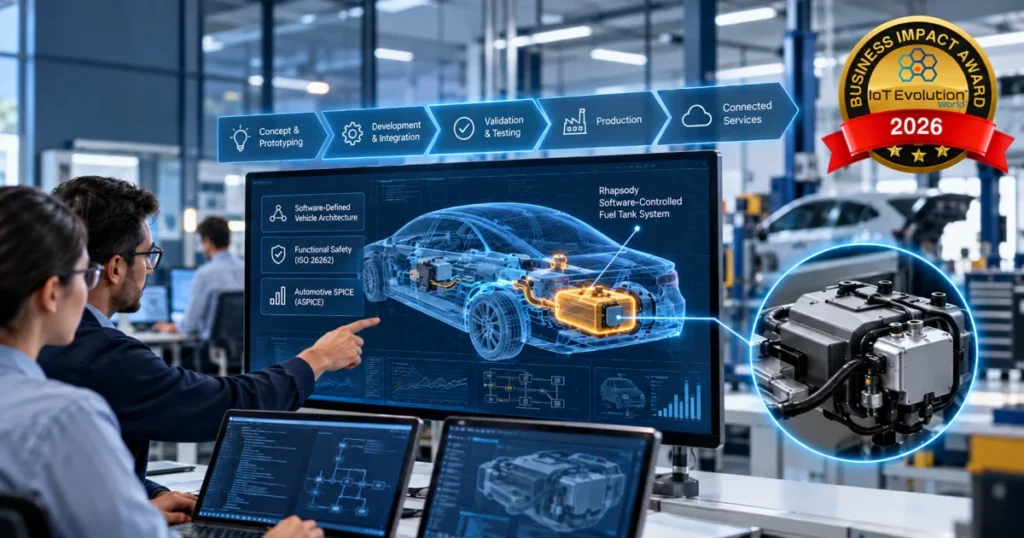
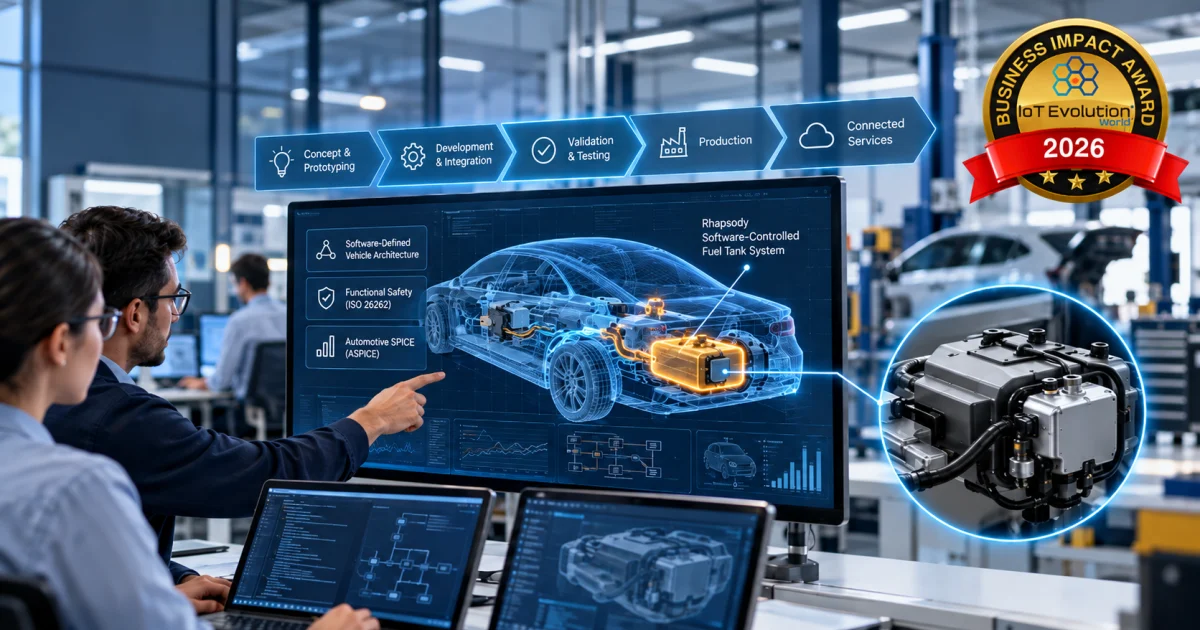
A prime example of this paradigm shift is the successful collaboration between Tata Consultancy Services (TCS) and Kautex, a top-100 global automotive supplier headquartered in Germany. Faced with the mandate to digitalize its mechanical systems for sustainable mobility, Kautex partnered with TCS to revolutionize the development of "Rhapsody"—an advanced, software-controlled fuel tank system designed to slash evaporative emissions through high-precision fuel valve management.
Rather than merely outsourcing code writing, TCS deployed its comprehensive TCS DriveSphere mobility engineering portfolio to build an end-to-end engineering framework. This initiative transformed Kautex from a hardware-centric manufacturer into a digitally agile, software-enabled powerhouse. Key achievements of this collaboration include:
- 100% Development Traceability: Establishing an unbroken digital thread from high-level safety requirements down to implementation and test evidence.
- 50% Reduction in Testing Effort: Streamlining validation across Model-in-the-Loop (MiL), Software-in-the-Loop (SiL), and Hardware-in-the-Loop (HiL) environments.
- Rapid Compliance: Achieving Automotive SPICE (ASPICE) Level 1 certification within a single year.
- Uninterrupted Operations: Maintaining zero rollout delays throughout the global disruptions of the COVID-19 pandemic.
- Scalable Infrastructure: Replicating the core development framework across additional Kautex product lines.
Furthermore, this engineering prowess is being augmented by cutting-edge technologies. TCS is integrating generative AI into its validation pipelines—leveraging NVIDIA infrastructure and large language models (LLMs) to double test-case-generation speeds while maintaining strict data security.
Chronology
The journey toward software-defined maturity at Kautex was structured through a disciplined, phased approach that spanned organizational restructuring, toolchain deployment, and agile execution.
Phase 1: Discovery and Ecosystem Alignment (Months 1–3)
The engagement kicked off with an intensive joint workshop involving stakeholders from both TCS and Kautex. The objective was to deeply analyze Kautex’s existing product portfolio, legacy engineering ecosystem, and corporate culture. During this phase, the teams laid the structural groundwork by conceptualizing a dedicated in-house software organization for Kautex, outlining the development scope, and defining the necessary operational framework.
Phase 2: Toolchain Integration and Agile Foundation (Months 4–6)
With the organizational roadmap approved, TCS deployed a robust operational backbone. This included Application Lifecycle Management (ALM) systems, DevOps pipelines, and Continuous Integration/Continuous Deployment (CI/CD) environments. This phase ensured that all software artifacts, requirements, and revisions could be tracked seamlessly, establishing the collaborative environment required for distributed, multi-site development teams.
Phase 3: Engineering, Compliance, and Multi-Level Testing (Months 7–12)
As development commenced on the Rhapsody fuel system, TCS embedded model-based applications and basic software into the workflow. Engineers conducted rigorous requirements analysis, system architecture design, development, and integration.
Crucially, validation was embedded early and often. Testing was executed across three critical tiers:
- Model-in-the-Loop (MiL): Validating algorithms and control logic before physical code generation.
- Software-in-the-Loop (SiL): Testing compiled software against simulated vehicle environments.
- Hardware-in-the-Loop (HiL): Executing software on target electronic control units (ECUs) integrated with physical actuators and sensors.
Parallel to development, TCS provided continuous guidance on hardware design, ISO 26262 functional safety expectations, and ASPICE process maturity. This rigorous alignment culminated in Kautex achieving ASPICE Level 1 certification within just 12 months.
Phase 4: Pandemic Resilience and Cross-Product Scaling (Year 2 and Beyond)
When the COVID-19 pandemic disrupted global supply chains and forced remote work models, the newly established agile infrastructure proved its resilience. Software rollouts continued with zero schedule delays. Following this success, Kautex began replicating the standardized TCS framework across its broader product lines, turning a one-off project into an enterprise-wide capability.
Supporting Data
The measurable impact of the TCS-Kautex partnership highlights the economic and operational value of structured, software-defined automotive engineering.
| Metric / Milestone | Result Achieved | Business & Technical Implication |
|---|---|---|
| Development Traceability | 100% | Eliminates ambiguity; ensures complete alignment with ISO 26262 and audit readiness. |
| Validation Effort | 50% Reduction | Lowers engineering overhead and accelerates time-to-market across MiL, SiL, and HiL testing. |
| ASPICE Compliance | Level 1 in 12 Months | Provides a globally recognized benchmark of process maturity and quality assurance. |
| Pandemic Continuity | Zero Rollout Delays | Proves the resilience and agility of the cloud-enabled DevOps and ALM toolchain. |
| Gen-AI Acceleration | ~2x Pipeline Speed | Future-proofs testing workflows using localized NVIDIA DGX H100 systems and fine-tuned LLMs. |
To further contextualize the technological leaps supporting this framework, TCS has expanded its validation capabilities through the TCS Automotive Gen-AI Suite. Operating on enterprise-grade, on-premises NVIDIA DGX H100 systems powered by NVIDIA NIM microservices, the suite employs a fine-tuned Llama 3 8B Instruct model. By keeping training and inference entirely offline, TCS ensures that sensitive automotive intellectual property remains secure.
Performance benchmarks for this generative AI suite demonstrate a doubling of overall test-case-generation pipeline speeds. Furthermore, NIM-based inference achieves execution speeds 2.5 to 3 times faster than standard open-source direct-inference alternatives, without sacrificing rigor in code coverage metrics such as decision coverage, condition coverage, and modified condition/decision coverage (MC/DC). While these specific AI metrics stem from TCS’s broader R&D initiatives rather than the initial Kautex deployment, they represent the immediate evolutionary trajectory of automotive validation frameworks.
Official Responses and Industry Perspectives
The success of the TCS-Kautex collaboration underscores the strategic value of the TCS DriveSphere portfolio. DriveSphere is purpose-built to navigate the complex lifecycle of modern mobility—spanning concept development, prototyping, production, and after-sales support. By unifying connected services, electrification architectures, cockpit systems, body and chassis software, and multi-level validation across more than 55 global labs, TCS provides suppliers with a scalable path to innovation.
Industry experts and analysts note that automotive transformations frequently stall not due to a lack of creative ideas, but because traditional manufacturers struggle to bridge the gap between mechanical hardware engineering and modern software development methodologies.
“For established automotive suppliers, the transition to software-defined products is not a matter of adding an app,” industry analysts observe. “It requires new engineering skills, safety processes, development tools, and validation disciplines that can stand up inside a production vehicle.”
By focusing on institutional capability building—structuring agile teams, enforcing strict lifecycle controls, and automating validation—TCS and Kautex have provided a blueprint for how legacy tier-one suppliers can successfully adapt to the demands of the software-defined vehicle (SDV) era.
Implications
The implications of the TCS-Kautex engagement extend far beyond a single fuel tank system, signaling broader trends for the global automotive supply chain:
1. The Imperative of Traceability in Safety-Critical Systems
As vehicles increasingly rely on code to govern safety-critical functions like braking, steering, and powertrain management (exemplified by the Rhapsody fuel valve system), regulatory scrutiny under standards like ISO 26262 and ASPICE will only intensify. The ability to maintain an unbroken digital thread from requirement to test execution is no longer optional; it is a baseline requirement for market entry and legal liability protection.
2. Democratizing Agility in Legacy Manufacturing
Legacy manufacturing organizations often suffer from cultural and structural inertia. The Kautex case study demonstrates that traditional suppliers can successfully transition into software-capable organizations when partnered with experienced system integrators who establish both the technical toolchain and the cultural operational framework required for agile execution.
3. The Convergence of Automation and Generative AI in Validation
Validation is traditionally one of the most expensive and time-consuming bottlenecks in automotive software development. By successfully deploying automated validation frameworks that cut testing effort in half—and pairing them with emerging on-premises Generative AI solutions—the industry is unlocking new paradigms of efficiency. Generative AI’s ability to ingest unstructured requirements and automatically generate comprehensive, safety-compliant test cases will fundamentally reshape how software quality is assured.
4. Enterprise-Wide Scalability
The true measure of an engineering framework’s success is its repeatability. By extending the development infrastructure pioneered in the Rhapsody project across other Kautex product lines, the supplier has transformed a localized engineering upgrade into an enterprise-wide competitive advantage.
Conclusion
As connected, autonomous, shared, and electric (CASE) mobility trends accelerate, vehicles are increasingly defined by the code running on their processors long before their telemetry ever reaches the cloud. The collaboration between TCS DriveSphere and Kautex illustrates that mastering this digital transition requires a rare blend of deep domain engineering, rigorous standards compliance, and scalable automation. For the broader automotive ecosystem, it stands as a compelling roadmap for turning software ambition into reliable, production-ready reality.