Transforming Boutique Fitness Operations: How YogaSol Solved High-Intensity Climate Challenges with Smart IoT Automation

Main Facts
In the competitive and specialized landscape of boutique fitness, environmental control can make or break a business. At YogaSol, a hot yoga and Hot HIIT Pilates studio located in Norwalk, Connecticut, maintaining extreme indoor conditions is a core part of the customer experience. However, achieving those conditions—and resetting them between sessions—presents a massive logistical and operational hurdle.
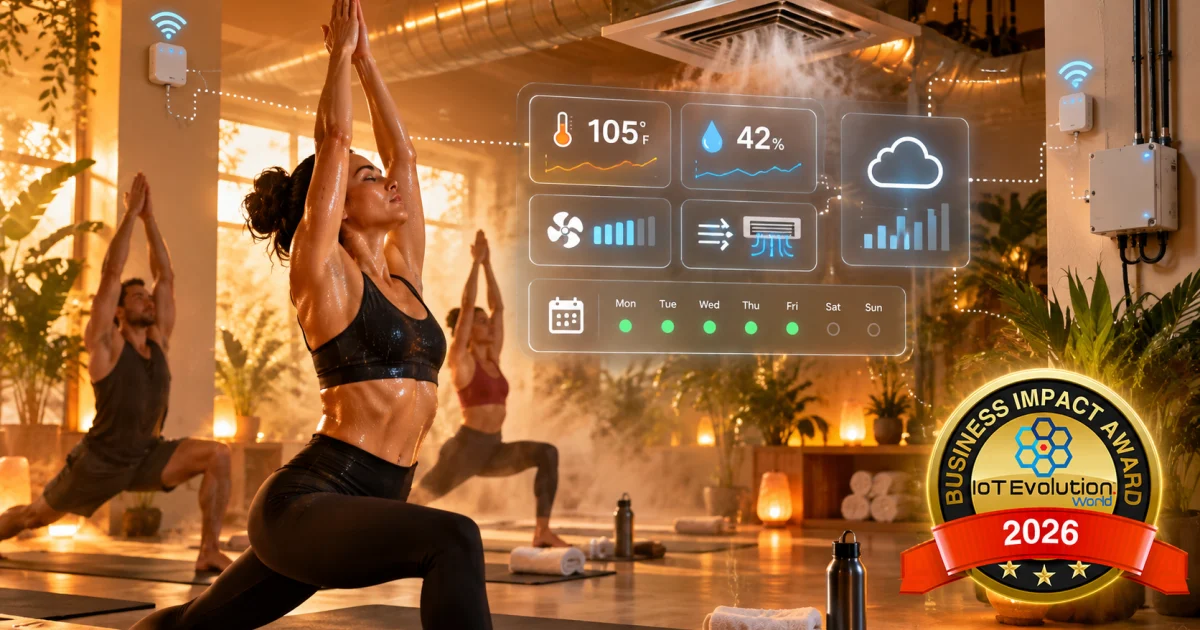
Operating 16 hours a day, seven days a week, YogaSol regularly subjects its studio spaces to punishing environmental requirements. Classes demand ambient temperatures soaring between 90 and 110 degrees Fahrenheit, coupled with relative humidity levels hovering around 50 percent. When a class concludes, the facility faces a rigorous turnaround window: instructors and staff must quickly clear the air, knock down the lingering heat and humidity, and recalibrate the room’s atmosphere to prepare for the next cohort of participants.
Traditionally, managing such an aggressive climate curve requires dedicated facility staff to manually monitor thermostats, open dampers, trigger exhaust fans, and meticulously time ventilation cycles. For an independent, small-scale studio, keeping an employee on-site solely to manage HVAC workflows before, during, and after operating hours represents a prohibitive labor expense.
To resolve this building-scale control problem without incurring enterprise-level costs, YogaSol partnered with AIMNET Smart Building Systems, an Orange, Connecticut-based systems integrator and partner of Monnit. AIMNET engineered a customized, cost-effective automation architecture linking wireless sensors, relay controls, cloud scheduling, and Google Calendar integration. Powered by Monnit’s Indoor Environmental Monitoring and Control technology, the system completely automates YogaSol’s heavy-duty climate control requirements.
The deployment successfully closed the loop between environmental sensing, operational context, and physical HVAC action. Today, YogaSol operates with unprecedented efficiency:
- Labor Savings: Eliminates the need for a dedicated non-instructor employee to oversee climate operations, saving more than 60 hours of labor costs weekly.
- Cost Efficiency: Implemented at roughly 25 percent of the cost of alternative enterprise building management systems (BMS) reviewed by the integrator.
- Closed-Loop Automation: Automatically triggers fresh air intakes and exhaust fans based on real-time sensor data and scheduled occupancy.
- Equipment Protection: Features integrated water-detection discs around steam humidifiers to catch potential leaks early.
- Remote Oversight: Empowers owners Dan Markowitz and Jeanne Tang to monitor, manage, and override climate parameters remotely via a web portal from any PC or smart device.
This innovative deployment earned Monnit’s Business Impact Award, proving that sophisticated Internet of Things (IoT) retrofits are no longer restricted to massive corporate skyscrapers; they can fundamentally transform independent small businesses.
Chronology of the Project: From Concept to Closed-Loop Automation
The journey toward full automation at YogaSol began with a recognition of mounting operational friction. To understand how the system came to life, it is helpful to trace its development from initial challenge to a four-year operational success story.
Phase 1: Identifying the Operational Bottleneck
Founder Dan Markowitz and managing partner Jeanne Tang faced a compounding set of daily challenges. Beyond maintaining precise thermostat set points for high-heat classes, instructors needed a frictionless method to cycle fresh air through the studio for fixed durations. Furthermore, studio management required reliable climate logs for compliance and performance visibility, as well as early warnings regarding equipment anomalies, such as steam humidifier leaks.
Manually orchestrating this sequence was pulling staff away from customer-facing duties and forcing the owners into endless on-site monitoring cycles. They needed the capabilities of a commercial building management system, but scaled to the budget and footprint of an independent studio.
Phase 2: System Architecture and Integration
Enter AIMNET Smart Building Systems. Project engineer David Dickson and his team evaluated various integration approaches before selecting Monnit’s ALTA wireless ecosystem. The core philosophy of the design was to establish a seamless chain of events:
- Sensing: Monnit ALTA wireless temperature, humidity, water detection discs, and portable button-press sensors continuously monitor the physical state of the studio.
- Aggregation: Local gateways aggregate this sensor data and securely transmit it to the iMonnit cloud platform.
- Scheduling Context: AIMNET integrated the iMonnit platform with Google Calendar, tying the studio’s official class timetable directly into the control logic.
- Execution: Two ALTA 10 Amp Wireless Control units act as heavy-duty relay switches, translating cloud commands and sensor thresholds into physical HVAC actions—opening dampers and activating exhaust fans.
Phase 3: Deployment and Fine-Tuning
The installation was executed smoothly as a wireless retrofit, avoiding the high costs and physical disruption of running new control wiring through existing walls. Portable button-press sensors were placed strategically for instructors to execute one-touch ventilation commands. Water-detection discs were installed near the critical steam humidifiers to instantly flag moisture anomalies.
Phase 4: Long-Term Reliability and Proven Success
What began as an innovative integration project has now matured into a battle-tested operational backbone. Having operated continuously for more than four years, the AIMNET-designed system has proven its durability in one of the most chemically and thermally demanding indoor environments imaginable. The integration of scheduling, sensor feedback, and relay actuation allows YogaSol to run like a fully automated enterprise facility while retaining the agility and personal touch of a local boutique business.
Supporting Data and Technical Specifications
The success of the YogaSol installation rests on a carefully curated hardware and software stack designed for reliability in harsh conditions. Below is a breakdown of the core components powering the smart yoga studio:
| System Component | Technology / Hardware | Function in the YogaSol Deployment |
|---|---|---|
| Environmental Sensors | Monnit ALTA Wireless Temperature & Humidity Sensors | Continuously monitor extreme heat (90°F–110°F) and relative humidity (~50%) to track room states in real-time. |
| Equipment Protection | Monnit ALTA Water Detection Discs | Positioned near steam humidifiers to provide early warnings of leaks or plumbing malfunctions, preventing costly water damage. |
| User Interaction | Monnit ALTA Button-Press Sensors | Portable wireless buttons that allow instructors to initiate manual, timed fresh-air ventilation cycles with a single touch. |
| Data Aggregation | Monnit Wireless Gateways | Collect data packets from all distributed sensors and bridge the local wireless network to the cloud. |
| Control Actuation | ALTA 10 Amp Wireless Control Units | Act as intelligent relay switches that physically trigger fresh air dampers and exhaust fans based on system commands. |
| Cloud & Scheduling | iMonnit Cloud Platform integrated with Google Calendar | Links class timetables directly to climate routines, automating transitions between active classes, cleaning windows, and closed hours. |
| User Interface | AIMNET Custom Web Portal | Provides authorized users (owners and managers) with remote visibility, real-time alerts (email, text, voice), and manual override capabilities via PC or mobile devices. |
Financial and Operational Metrics
- Labor Reduction: Over 60 hours of weekly labor saved by removing the requirement for a non-instructor staff member to manage climate transitions on-site.
- Capital Efficiency: Achieved at approximately 25% of the total installation cost of competing enterprise building management solutions evaluated by AIMNET.
- Lifespan: Fully operational and reliable across more than four consecutive years of heavy daily use.
- Environmental Range: Capable of withstanding and regulating environments ranging up to 110°F and maintaining targeted humidity balances.
Official Perspectives and Responses
The transformation at YogaSol has profound implications for how small business owners view technology adoption. Key figures behind the project shared their insights on the challenges overcome and the broader significance of the deployment.
Jeanne Tang on Reclaiming Work-Life Balance
For managing partner Jeanne Tang, the value of the IoT deployment extends far beyond balance sheets and kilowatt hours. The human element of automation was paramount.
"Automation lets us manage the studio when we are not physically present and makes it possible to run the business while retaining some semblance of family life," Tang explained, highlighting the immense personal relief that comes from relinquishing 24/7 on-site manual oversight.
David Dickson on Cost-Effective Engineering
AIMNET project engineer David Dickson emphasized that the primary hurdle in smart building design for small facilities is often financial accessibility rather than technological availability. Traditional commercial building management systems are heavily over-engineered and priced for massive corporate real estate portfolios.
According to Dickson, the Monnit-based wireless approach cost roughly 75 percent less to install than alternative options reviewed by the integration team. By leveraging a wireless mesh architecture and pairing cloud software with familiar scheduling tools like Google Calendar, AIMNET proved that sophisticated automation can be democratized for independent operators.
Industry Recognition: The Monnit Business Impact Award
In honoring YogaSol and AIMNET with a Business Impact Award, Monnit underscored a critical truth about modern IoT deployments: monitoring alone is insufficient.
Many businesses fall into the trap of installing dashboards that merely inform operators of a problem—telling a yoga studio owner that a room is dangerously overheated or humid. True operational value emerges when systems transition from visibility to action. By closing the loop between data collection, calendar schedules, and physical relay control, YogaSol’s deployment demonstrates how IoT empowers businesses to respond, recover, and prepare automatically, unlocking measurable economic value.
Broader Implications for Small Business IoT
The success of the YogaSol smart yoga studio serves as a blueprint for other specialized small-to-medium enterprises (SMEs) struggling with complex physical environments. From indoor farming and craft breweries to commercial laundromats and indoor sports facilities, many businesses face demanding climate control parameters that strain manual operational models.
1. The Death of the "Rip-and-Replace" Paradigm
Historically, upgrading a facility’s environmental controls meant undertaking disruptive, capital-intensive construction projects. Wiring new sensors, actuators, and controllers through existing walls required extensive downtime and exorbitant contractor fees. YogaSol demonstrates the viability of wireless retrofitting. By overlaying smart sensors and relay switches onto existing HVAC infrastructure, businesses can achieve enterprise-grade automation with minimal physical disruption.
2. Bridging Consumer Convenience with Industrial Reliability
One of the most elegant aspects of the AIMNET design is its integration with Google Calendar. Rather than forcing staff to learn a proprietary, overly complex scheduling interface, the system leverages tools that employees already use every day. This reduces the learning curve, minimizes human error, and ensures high compliance across rotating teams of instructors and managers.
3. Redefining Scalability for Independent Operators
For decades, advanced automation was considered an exclusive luxury for large corporations with dedicated facilities management departments. The YogaSol case study shatters this assumption. By proving that high-end building automation can be delivered at a fraction of traditional costs, this deployment paves the way for a broader wave of intelligent retrofitting across Main Street businesses.
Ultimately, YogaSol illustrates that when technology is thoughtfully tailored to solve specific operational pain points, IoT ceases to be an abstract buzzword. Instead, it becomes a vital catalyst for business growth, operational resilience, and an improved quality of life for business owners.