AWS Unveils Enhanced Amazon EventBridge Custom Event Bus to Streamline Multi-Account Serverless Architectures
SEATTLE — In a major development for cloud architects and serverless developers, Amazon Web Services (AWS) has announced the rollout of a powerful, next-generation custom event bus for Amazon EventBridge. Purpose-built to conquer the operational friction that typically surfaces as organizations scale event-driven applications across multiple teams and AWS accounts, the new enhanced event bus introduces centralized organization-wide sharing, native event ordering, simplified subscriber management, advanced data transformation, and a redesigned pricing model.
The announcement marks a critical evolutionary step for EventBridge. While traditional single-account event-driven architectures have long been praised for their simplicity and agility, organizational growth historically triggered a cascade of architectural complexities. The new offering promises to eliminate these friction points while leaving existing workloads undisturbed.
Main Facts
The newly introduced enhanced custom event bus is engineered to address the scaling bottlenecks inherent in distributed serverless systems. Key highlights of the release include:
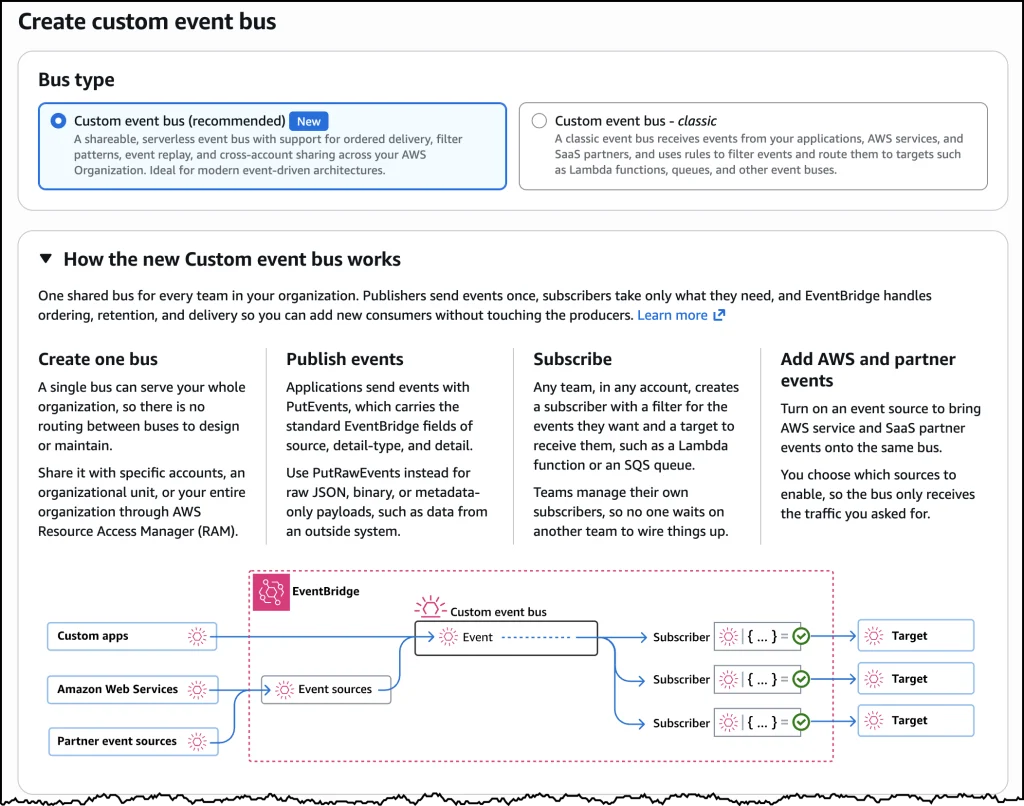
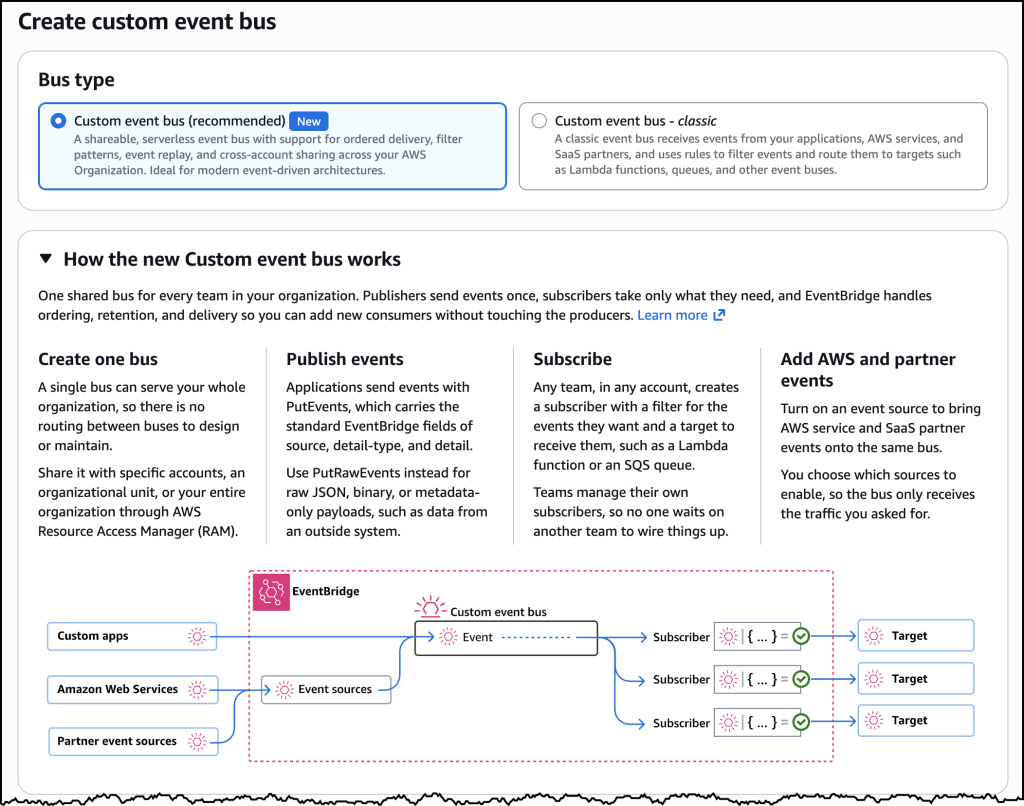
- Centralized Organization-Wide Architecture: Instead of forcing teams to spin up disparate event buses connected by complex webs of cross-account rules or bus-to-bus configurations, organizations can now deploy a single, centralized event bus shared securely across all AWS accounts within an enterprise.
- Native Event Ordering and Synchronous Invocations: While asynchronous processing remains the bedrock of event-driven design, the new bus introduces an optional
EventGroupIdmechanism. This ensures that related events—such as sequential logistics updates—are delivered in strict chronological order to targets like AWS Lambda via synchronous invocation. - Consolidated Subscriber Resource: The architecture introduces a unified
Subscriberresource. This encapsulates event filtering, target configuration, retry policies, and dead-letter queues into a single manageable entity, replacing the fragmented rules and targets required by legacy setups. - Advanced Evaluation and Transformation: The platform now supports content-based deduplication to automatically drop duplicate payloads arriving within a five-minute window. Furthermore, native JSONata expression support allows for on-the-fly event reshaping, while built-in deserialization capabilities handle Apache Avro and Protocol Buffers data formats.
- Rethink Economics with Scale Pricing: A brand-new ingress-and-egress throughput pricing model separates costs between publishers (who pay for events ingested) and subscribers (who pay for events delivered), effectively slashing the compound financial penalties associated with legacy multi-bus routing.
Chronology: The Evolution of Event-Driven Scaling
To understand the significance of this release, industry analysts point to the typical lifecycle of serverless adoption within modern enterprises.
Phase 1: The Single-Team Honeymoon
Organizations embarking on their serverless journeys traditionally begin with a single custom event bus housed inside one AWS account. Owned by a solitary platform or engineering team, this setup delivers immense velocity. Developers can effortlessly publish custom events, configure simple rules, and trigger downstream serverless functions without friction.
Phase 2: The Multi-Account Fragmentation
As cloud adoption accelerates, enterprise governance mandates structural segregation. AWS best practices advocate for a multi-account strategy, isolating business units, environments, and product teams into their own dedicated AWS accounts.
To maintain connectivity, teams resort to workarounds: building multiple event buses stitched together via complex cross-account access policies and bus-to-bus routing rules. What was once an elegant, streamlined architecture rapidly transforms into an operational labyrinth. Platform teams lose visibility into event governance, routing charges multiply exponentially, and developers requiring strict event ordering are forced to architect messy, custom workarounds or abandon serverless paradigms altogether.

Phase 3: The Enhanced Event Bus Paradigm
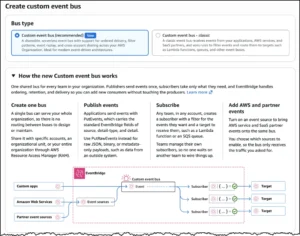
Recognizing these operational bottlenecks, AWS engineering teams went back to the drawing board. The result is the enhanced custom event bus. Accessible directly via the AWS Management Console alongside the legacy option—which remains fully supported under the moniker "Custom event bus — classic"—the new solution re-establishes a unified event backbone.
Upon selecting the new resource type, administrators can immediately enable organization-wide sharing via AWS Resource Access Manager (AWS RAM), selecting specific AWS accounts, organizational units, or IAM roles as principals without configuring manual cross-account permissions.
Supporting Data and Technical Architecture
The technical underpinnings of the enhanced custom event bus are designed to handle high-throughput enterprise workloads while drastically reducing administrative overhead.
Organization-Wide Sharing via AWS RAM
By integrating directly with AWS Resource Access Manager, the new event bus allows platform teams to establish a central enterprise event highway. Publishers can transmit events without needing prior knowledge of downstream consumers, while application teams independently craft their own decoupled subscriptions.
Crucially, the default quota has been dramatically expanded to accommodate enterprise scale: the new bus supports up to 10,000 Subscribers per bus out of the box, with higher limits available upon request. This effectively eradicates the artificial limits that previously forced teams to fragment their workloads across multiple isolated buses.
Solving the Ordering Dilemma in Distributed Systems
Event-driven design champions asynchronous, non-blocking consumer logic where message sequence is irrelevant. However, real-world business domains—such as fleet tracking, financial ledgers, and inventory management—frequently demand absolute chronological integrity. Out-of-sequence telemetry can cause routing algorithms or state machines to execute on stale, outdated data.
The enhanced event bus solves this via EventGroupId tagging. When publishers attach an identifier, EventBridge guarantees sequential delivery to subscribers opting into ordered patterns, while leaving other asynchronous consumers unaffected.

To back this up, EventBridge now supports synchronous invocation for targets like AWS Lambda. This ensures that downstream functions confirm successful processing before an event is acknowledged, effectively deprecating the cumbersome practice of inserting an Amazon SQS queue between an event bus and Lambda purely to guarantee reliable, ordered execution.
Intelligent Filtering, Deduplication, and Transformation
Data hygiene is a perennial challenge at scale. The enhanced event bus tackles this through three core features:
- Content-Based Deduplication: If a network timeout or partial failure causes an upstream source to transmit duplicate payloads, EventBridge hashes the meaningful content of the event and automatically collapses matches arriving within a five-minute window, conferring true "exactly-once" delivery semantics.
- JSONata Expressions: Consumers can manipulate payloads on the fly, extracting fields, altering naming conventions, or computing new attributes before data hits downstream APIs.
- Format Deserialization: Organizations operating with Apache Avro or Protocol Buffers no longer need to write custom parsing layers. EventBridge natively deserializes these formats to JSON, enabling fine-grained subscriber filtering across the entire payload.
A Transformed Pricing Economics Model
Under legacy EventBridge architectures, cross-account and bus-to-bus routing fees compounded rapidly, penalizing organizations for building decoupled, distributed systems. The enhanced custom event bus introduces an intuitive ingress-and-egress throughput pricing paradigm. Publishers pay solely for events ingested, while subscribers pay for events delivered. This transparent decoupling aligns financial costs directly with business value and resource consumption.
Official Responses and Industry Perspective
AWS representatives emphasize that the new release directly mirrors feedback gathered from enterprise customers struggling with governance at scale.
"When organizations scale serverless architectures, their biggest hurdle shouldn’t be managing the plumbing between AWS accounts," noted a senior product management voice close to the launch. "With the enhanced custom event bus, we are returning to the core promise of serverless: letting developers focus entirely on writing business logic while the infrastructure handles secure sharing, ordering, and delivery at enterprise scale."
Industry analysts have greeted the announcement with enthusiasm, noting that the combination of AWS RAM integration, native JSONata transformations, and decoupled publisher-subscriber pricing removes several long-standing adoption barriers for large-scale enterprise migrations.
Implications for Enterprise Cloud Strategies
The introduction of the enhanced Amazon EventBridge custom event bus carries profound implications for cloud architects, platform engineers, and enterprise finance teams.
1. Reclaiming Platform Visibility
Platform engineering teams regain absolute governance over their event-driven architectures. By centralizing the event backbone into a single shared bus while retaining granular control over publishing and subscribing principals, organizations can eliminate "shadow event architectures" created by isolated teams working around rigid legacy constraints.
2. Simplification of Serverless Topologies
Architects can now deprecate complex multi-bus routing patterns, custom SQS buffering layers designed solely for ordering, and brittle cross-account IAM policies. The consolidated Subscriber resource streamlines infrastructure-as-code (IaC) templates, making serverless pipelines easier to deploy, audit, and maintain.
3. Predictable Cost Optimization
The separation of ingress and egress billing mechanics ensures that financial accountability maps cleanly to organizational business units. Publishers know precisely what they invest to broadcast domain events, while consuming teams pay strictly for the telemetry they choose to ingest, transforming cloud financial management (FinOps) for serverless operations.
Availability
The enhanced custom event bus is available immediately across a broad footprint of global AWS Regions, including:
- US Regions: US East (N. Virginia, Ohio), US West (Oregon)
- European Regions: Ireland, Frankfurt, Stockholm, Spain
- Asia Pacific Regions: Hong Kong, Malaysia, Mumbai, Singapore, Sydney, Thailand, Tokyo
Engineering teams can begin provisioning enhanced event buses today using the AWS Management Console, the AWS Command Line Interface (AWS CLI), or standard EventBridge APIs. Existing legacy buses will continue to operate seamlessly under the "classic" designation, allowing organizations to migrate workloads to the new architecture at their own measured pace.