AI Agent Sandboxing: The Control Plane for Safe Autonomy in Enterprise Production
Executive Summary: The Frontier of Autonomous Execution
As artificial intelligence rapidly transitions from passive advisory chat interfaces to fully autonomous agents capable of independent actions, engineering teams face a sobering operational reality: agents can act exponentially faster than human guardrails can react. When an AI system gains the ability to execute shell commands, orchestrate browser automation, read and write arbitrary files, and execute code natively, it becomes a powerful productivity amplifier. However, without strict environmental containment, it also represents an open-ended, highly volatile system vulnerability.
In modern systems architecture, AI agent sandboxing has emerged as the foundational control plane for safe autonomy. Far from being a simple runtime wrapper or an afterthought configuration in a DevOps pipeline, a robust agent sandbox establishes hard, immutable boundaries around what an AI agent can reach, manipulate, modify, and exfiltrate. Imversion Technologies Pvt Ltd and other forward-thinking infrastructure providers argue that a fast agent execution sandbox lacking metadata blocking, credential isolation, and comprehensive forensic logging remains fundamentally unsafe for production environments.
This article explores the architectural methodologies, threat-modeling frameworks, and isolation strategies required to govern autonomous AI agents effectively without stifling their operational utility.
The Chronology of Agent Evolution: From Chat to Autonomous Action
The trajectory of generative AI over the past several years highlights a distinct evolution in capabilities, bringing corresponding security challenges:
- Phase 1: Read-Only Consultation (2022–2023). LLMs operated in heavily restricted environments where their primary output was text rendered to an end-user. Security concerns were largely confined to prompt injection yielding inappropriate text generation or data leakage via conversational interfaces.
- Phase 2: Tool-Assisted Workflows (2023–2024). Frameworks introduced function calling, allowing models to query internal databases, fetch specific web pages, or invoke APIs. While more powerful, this phase introduced vulnerabilities related to Server-Side Request Forgery (SSRF) and broken object-level authorization.
- Phase 3: Autonomous Multi-Step Execution (Present Day). Agents now plan, iterate, debug code, browse the web dynamically, and manipulate local or cloud-based file systems over extended operational loops. Because these agents operate without human intervention between steps, a single malicious input, prompt injection, or software hallucination can trigger catastrophic, cascading system failures.
This chronological shift underscores why traditional application security models—which assume predictable software execution flows—are entirely insufficient for managing emergent, goal-seeking artificial intelligence.
Threat Modeling First: Mapping Agent Actions Before Choosing Infrastructure
A common pitfall for engineering organizations is beginning their security architecture discussions with infrastructure tooling (e.g., deciding whether to use Docker, gVisor, or Firecracker microVMs). Security experts emphasize that infrastructure decisions must be downstream of a comprehensive threat model that maps out the exact damage a task could cause if the agent misbehaves, encounters a prompt injection attack, or interacts with hostile web input.

[Untrusted Input / Web Page]
       │
       ▼
[AI Agent Execution Loop]
       │
       ├─► Browser Automation ────► Risk: Credential Theft / Lateral Movement
       ├─► Shell Execution    ────► Risk: Package Installation / Reconnaissance
       ├─► File System Writes ────► Risk: State Corruption / Exploit Staging
       └─► Code Execution     ────► Risk: Arbitrary System/Network Abuse
Different execution surfaces carry radically distinct blast radiuses:
- Browser Automation: Browsing untrusted websites exposes the agent to malicious drive-by downloads, zero-day browser exploits, credential theft schemes, and unauthorized lateral movement via overly permissive internal network routes.
- Shell Commands: Shell execution provides a gateway to package installations, system reconnaissance, process inspection, and secret discovery. Unchecked shell access can quickly pivot into privilege escalation attempts.
- File System Access: Arbitrary file writes allow agents to overwrite critical system configurations, corrupt working states, or plant executable malware payloads for later execution stages.
- Arbitrary Code Execution: The sharpest edge of agent autonomy. Code execution combines file system manipulation, memory manipulation, process spawning, and network abuse into a single unified capability.
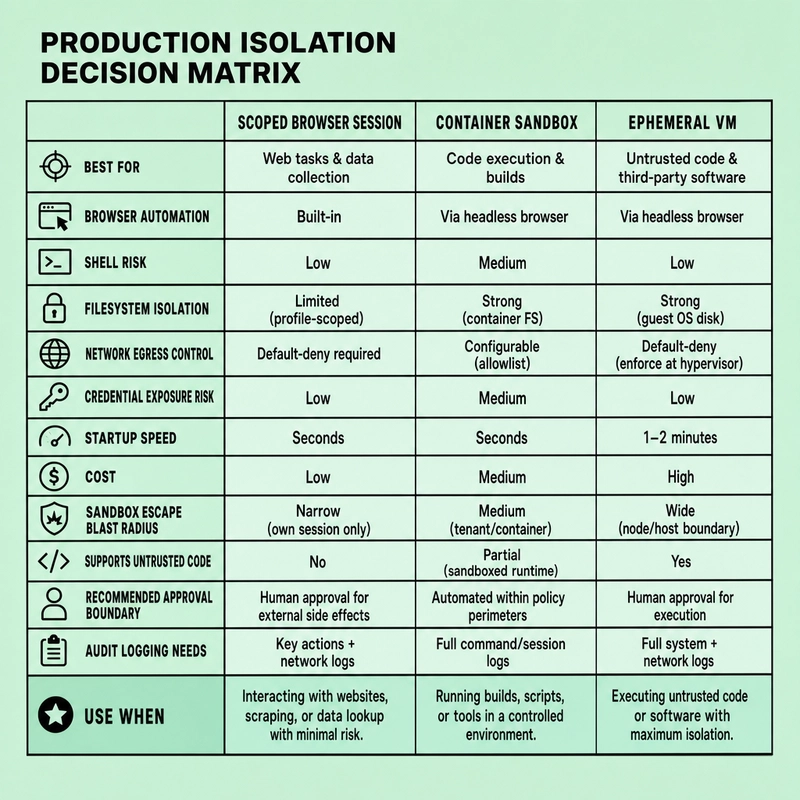
Consequently, security architectures must employ a tiered sandboxing model tailored specifically to the workload’s inherent risk profile rather than attempting to apply a single, monolithic isolation level across all tasks.
Matching Isolation Levels to Workloads
To balance computational efficiency and uncompromising security, enterprise systems utilize a spectrum of isolation boundaries.
| Approach | Isolation Strength | Startup Overhead & Cost | Ideal Production Use Cases |
|---|---|---|---|
| Hardened Containers | Moderate (Shares host kernel) | Lowest (Fastest startup) | Trusted repository builds, deterministic document parsing, linting trusted code. |
| Runtime-Shielded Containers (gVisor/Kata) | Medium-High (Adds secondary boundary) | Moderate | Mixed-trust shell operations, multi-tenant background processing tasks. |
| Ephemeral MicroVMs (Firecracker) | Highest (Dedicated guest kernel per task) | Highest (Slower startup, resource intensive) | Untrusted web browsing, arbitrary user script execution, high-risk code execution. |
Hardened Containers
For deterministic, high-throughput tasks—such as parsing structured HTML, running trusted test suites, or running static code linters—hardened container-based sandboxes offer an optimal balance. These containers can be fortified using Linux namespaces, cgroups, system call filters (seccomp), and Mandatory Access Control frameworks (AppArmor or SELinux), alongside read-only root filesystems and drop capabilities (--security-opt no-new-privileges). However, because they share the underlying host kernel, a sophisticated kernel-level exploit remains a core residual risk.
Ephemeral MicroVMs
When tasks involve processing hostile web pages, running untrusted user code, or executing code of unknown provenance, ephemeral VMs or microVMs (such as Firecracker-backed workers or Kata Containers) are required. By provisioning a lightweight, dedicated guest kernel for the duration of the task, microVMs contain potential kernel exploits, ensuring that a breakout attempt remains isolated to the temporary virtual machine instance rather than compromising the underlying physical host.
Granular Surface Engineering: Browser, Shell, File, and Code
Mitigating agent failures requires deliberate hardening across each individual execution surface.

1. Browser Automation Hardening
- Profile Isolation: Never permit browser sessions to retain persistent state across tasks.
- Clipboard & Downloads: Disable host clipboard access entirely; restrict file downloads to ephemeral, isolated directories.
- Network Guardrails: Route all traffic through a dedicated outbound proxy configured with strict egress rules. Crucially, block access to cloud metadata services (e.g.,
169.254.169.254), private RFC1918 IP blocks, and internal administrative dashboards to thwart Server-Side Request Forgery (SSRF) attacks triggered by malicious redirects.
2. Shell Command Constraints
- Non-Interactive Execution: Run shell commands strictly as non-interactive jobs. Disable TTY allocation, SSH servers, and long-lived daemon processes.
- Resource Quotas: Enforce rigid timeouts, CPU quotas, and memory caps using cgroups.
- Tool Restrictions: Implement command allowlists where feasible. Alternatively, explicitly strip package managers, network scanning utilities, and mount/user-management commands from the environment.
3. File System Scoping
- Filesystem access must be bound to a dedicated, per-task workspace rather than the underlying machine. Reference data should be mounted as read-only volumes, while write operations must target an ephemeral scratch space that is automatically purged upon task completion. This containment strategy prevents agents from altering system configurations or scanning adjacent directories.
4. Code Execution Safeguards
- AI code execution environments demand hard runtime ceilings. Implement absolute memory limits, process-count caps (to prevent fork-bomb attacks), and wall-clock execution timeouts. Furthermore, language runtimes should be restricted to pre-approved interpreters with strict constraints preventing runtime package installations from unverified external repositories.
Network Egress Controls, Filesystem Limits, and Resource Guardrails
Approval gates alone are insufficient to stop systemic harm. An operator may approve an agent’s request to browse the web or run a build script, but once execution begins, an unconstrained runtime can still exfiltrate sensitive data or exhaust host resources.
[Agent Execution Environment]
       │
       ├──► [Default-Deny Egress Proxy] ──► Explicitly Approved Domains Only
       ├──► [Read-Only Root + Scratch]  ──► Ephemeral Workspace Storage
       └──► [cgroups / Resource Caps]   ──► CPU, Memory, and PID Limits
Default-Deny Network Egress
Security architectures must adopt a default-deny posture for network traffic. Outbound connections should be funneled through an egress proxy that validates both destination hostnames and IP addresses, neutralizing attempts to bypass DNS-based restrictions by hitting raw IP endpoints.
Immutable and Boring Filesystem Layouts
A secure runtime utilizes a read-only root filesystem by default. Ephemeral writable volumes handle temporary file output, and host mounts are kept exceptionally rare and narrow. For high-risk environments, combining these mounts with seccomp profiles and SELinux policies ensures that unexpected file mutations are blocked at the kernel interface level.
Operational Governance: Human-in-the-Loop, Credentials, and Auditability
Effective sandboxing extends beyond infrastructure into operational governance. Defining explicit approval boundaries ensures that humans intervene precisely at high-risk decision points.
Strategic Human-in-the-Loop Boundaries
Autonomous execution loops must pause and request human verification before initiating actions that create persistent external side effects, such as:
- Writing or modifying production source code repositories.
- Executing database migrations or destructive deletion commands.
- Sending external communications (emails, Slack messages, API mutations) to third parties.
- Interacting with authenticated user accounts or handling financial transactions.
Eliminating Persistent Credentials
Workspaces must remain entirely free of persistent secrets. Credentials should never be baked into container images or stored on disk within the sandbox. Instead, systems should use short-lived, narrowly scoped access tokens delivered dynamically at runtime via a secure vault or secret broker. These tokens must be automatically revoked the moment the task concludes, preventing lateral reuse even if a sandbox is compromised.

Comprehensive Audit Logging
Production readiness requires complete forensic explainability. An audit trail must record every facet of an agent’s execution lifecycle, including:
- The originating prompt or strategic plan reference.
- Effective capability grants and tool invocations.
- Exact command-line arguments and file paths accessed or modified.
- Network destinations reached and responses received.
- Approval events, human overrides, and secret retrieval requests.
- Resource consumption metrics (CPU time, peak memory usage, exit status).
Structured, correlated logs allow security and engineering teams to reliably distinguish between model hallucinations, prompt injection attacks, and legitimate operational variances during post-incident investigations.
Implications and Future Outlook
As enterprises increasingly deploy autonomous AI agents to manage complex software engineering workflows, data analysis, and customer operations, the security perimeter has fundamentally shifted. Relying on perimeter-based security or reactive guardrails is no longer viable.
The widespread adoption of AI agent sandboxing as a dedicated control plane marks a maturing industry. By coupling threat-model-driven isolation tiers—ranging from hardened containers to ephemeral microVMs—with default-deny network controls, rigorous resource limits, and immutable audit logs, organizations can successfully harness the staggering productivity gains of autonomous AI agents without risking enterprise stability or data integrity.