AWS Revolutionizes Container Agility: Introducing High-Resolution Faster Auto Scaling for Amazon ECS
In a significant leap forward for cloud-native infrastructure management, Amazon Web Services (AWS) has announced a major performance enhancement for Amazon Elastic Container Service (ECS). By introducing support for high-resolution (20-second) metrics, AWS has fundamentally transformed how containerized applications respond to sudden traffic spikes. This update, which dramatically slashes the time required to detect demand shifts and provision new resources, marks a critical evolution in the reliability and efficiency of serverless and managed container architectures.
The Core Transformation: Speed as a First-Class Citizen
For years, Amazon ECS has been the backbone for organizations running large-scale containerized applications. Its service auto-scaling capabilities have historically relied on 60-second metric intervals via Amazon CloudWatch. While sufficient for many steady-state workloads, this one-minute granularity created a "latency gap" during abrupt traffic surges—the time between a user-driven spike and the moment the infrastructure recognized the need for additional capacity.
With the new update, AWS has reduced that detection interval to 20 seconds. This is not merely a cosmetic change; it is a fundamental shift in the control plane’s reaction time. By publishing metrics three times faster than the previous standard, the system can initiate scale-out operations significantly sooner, ensuring that application performance remains stable even during the most volatile demand fluctuations.
Chronology of the Update: From Standard to High-Resolution
The journey to this announcement reflects the ongoing AWS commitment to optimizing the "time-to-ready" metric for its customers.

- The Baseline Era: Previously, ECS service auto-scaling functioned on a 60-second heartbeat. This was the gold standard for cloud-native orchestration for the better part of a decade.
- The Optimization Phase: Recognizing the needs of high-frequency trading platforms, viral social media applications, and flash-sale retail environments, AWS engineering teams identified the "metric polling gap" as the primary bottleneck in scaling performance.
- The Breakthrough: Through deep integration between the ECS control plane and Amazon CloudWatch, the team enabled a high-resolution pipeline. This pipeline allows for 20-second metric ingestion, effectively reducing the "cold-start" friction that occurs when traffic hits an application faster than the infrastructure can respond.
- The Launch: As of the current release, this feature is globally available across all AWS Regions, supporting all primary compute options, including AWS Fargate, ECS Managed Instances, and standard Amazon EC2 instances.
Supporting Data: Quantifying the Efficiency Gains
The impact of this update is best illustrated through the benchmarks conducted by AWS. The performance improvements are substantial, moving the needle from "adequate" to "instantaneous" in the context of infrastructure orchestration.
The Scaling Efficiency Matrix
| Metric | Previous (60s) | New (20s) | Improvement |
|---|---|---|---|
| Time to Trigger Scale-out | 363 seconds | 86 seconds | 76% Faster (4.2x) |
| Total Provisioning Time | 386 seconds | 109 seconds | 72% Faster (3.5x) |
These figures represent a holistic view of the scaling process—from the moment a threshold is crossed to the moment a new task is fully provisioned and ready to handle live traffic. By reducing the time-to-trigger, AWS has effectively eliminated nearly five minutes of latency from the scaling cycle, a margin that can mean the difference between a seamless user experience and a cascading service failure during a high-traffic event.
How It Works: Technical Implementation
The implementation process has been designed to be non-disruptive, allowing developers to opt into high-resolution metrics on a service-by-service basis.
Configuration Workflow
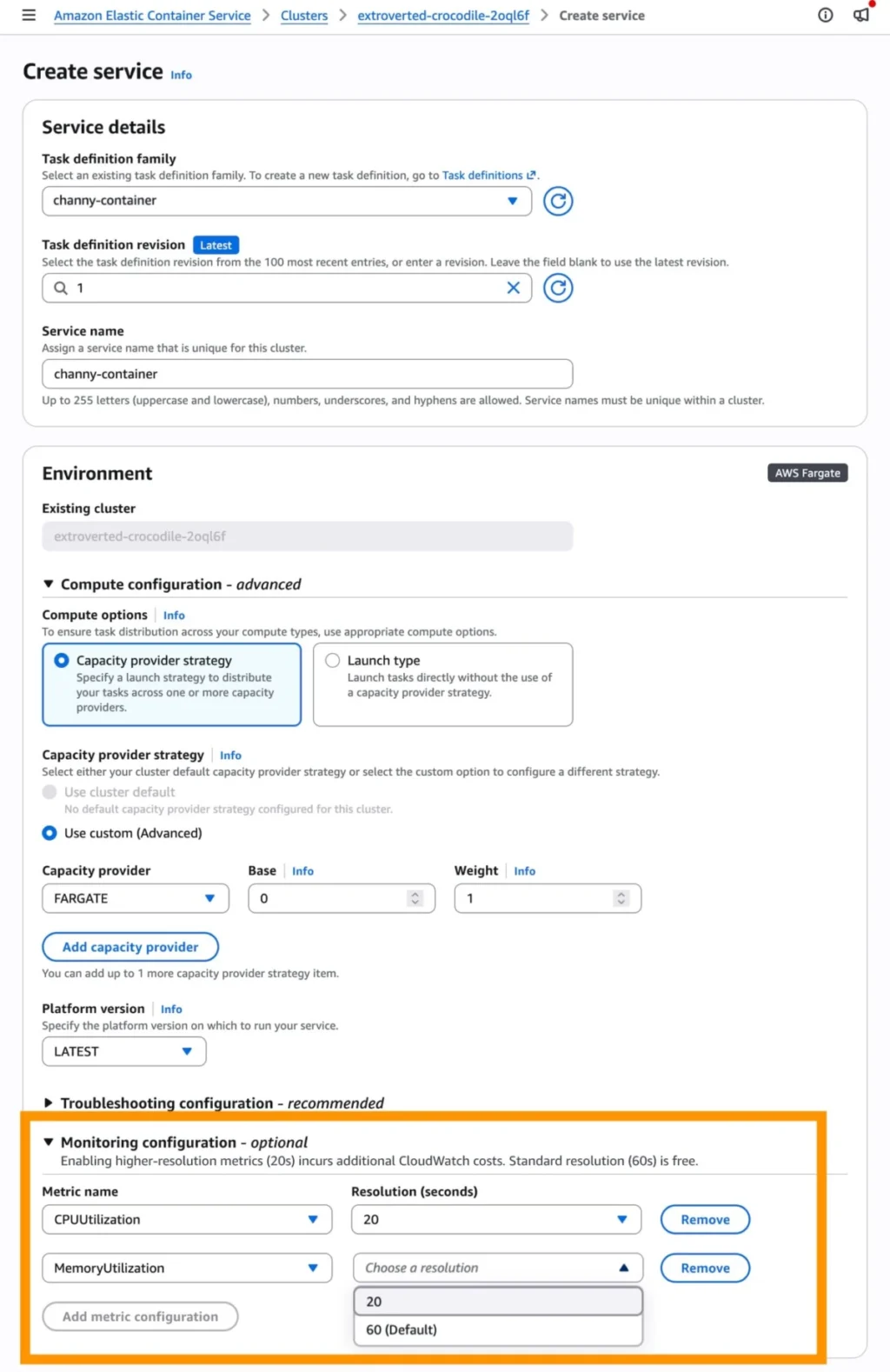
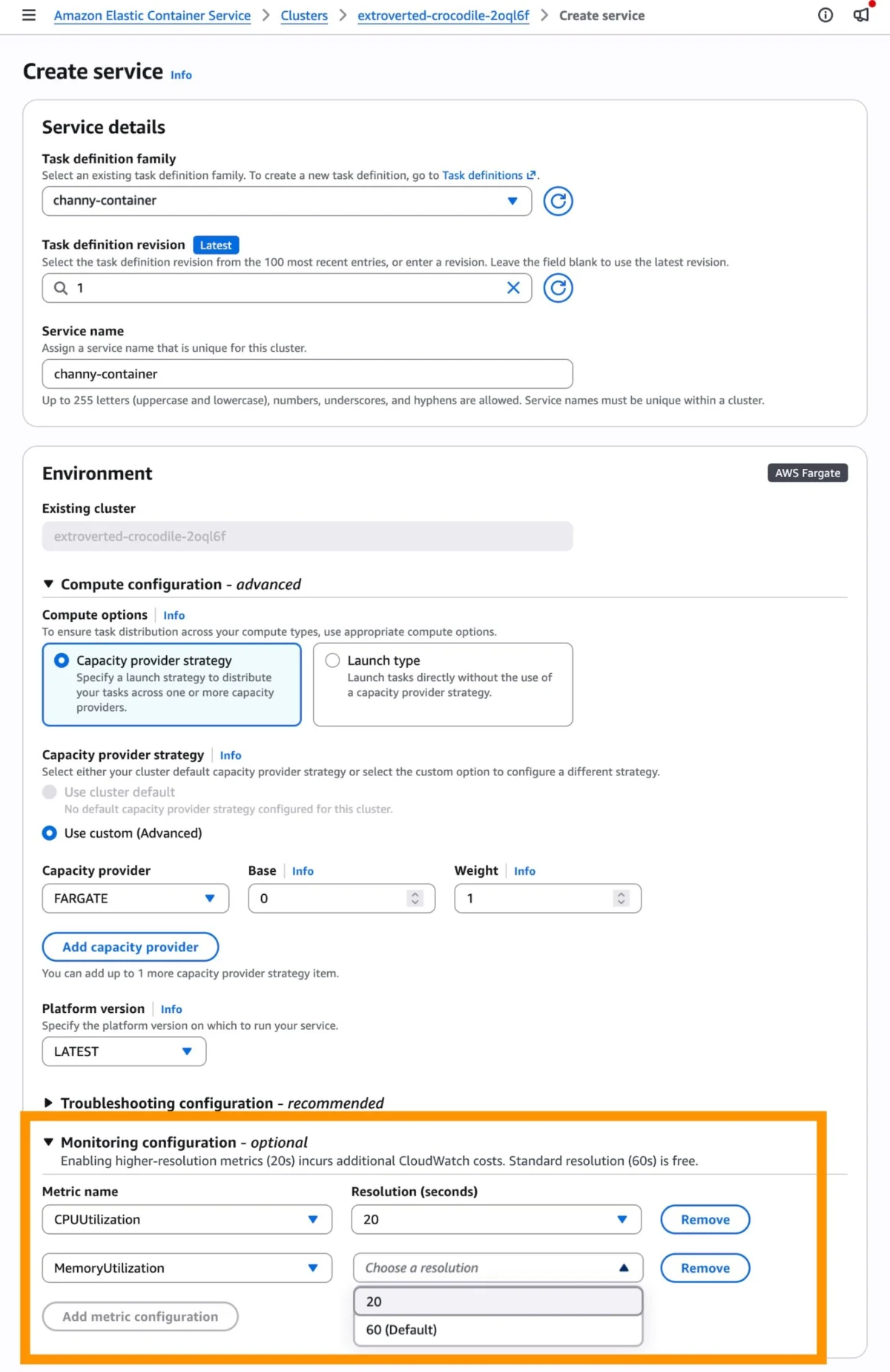
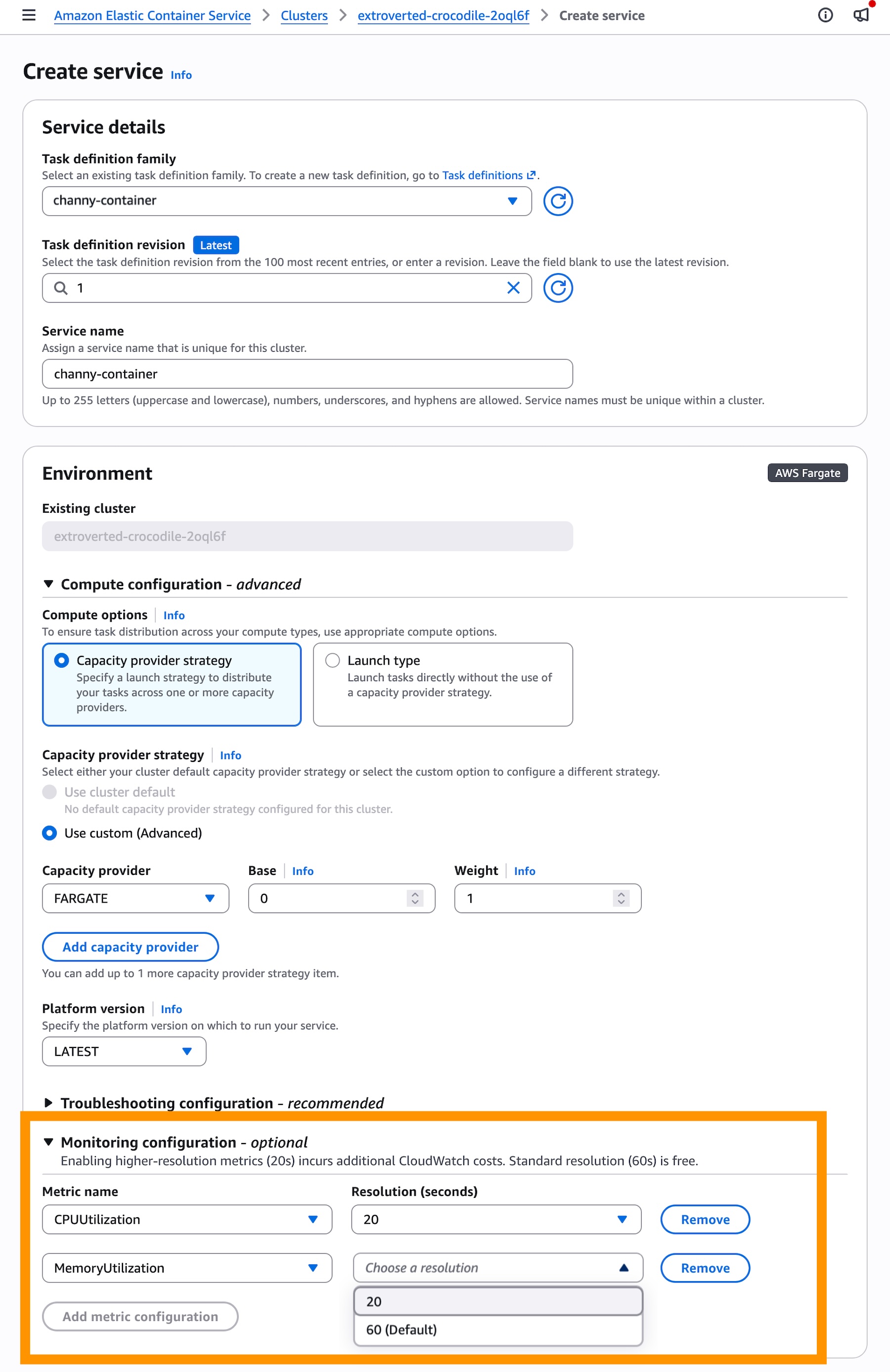
- Enabling High-Resolution Metrics: When creating or updating a service in the Amazon ECS console, users must select the high-resolution option within the "Monitoring Configuration" section.
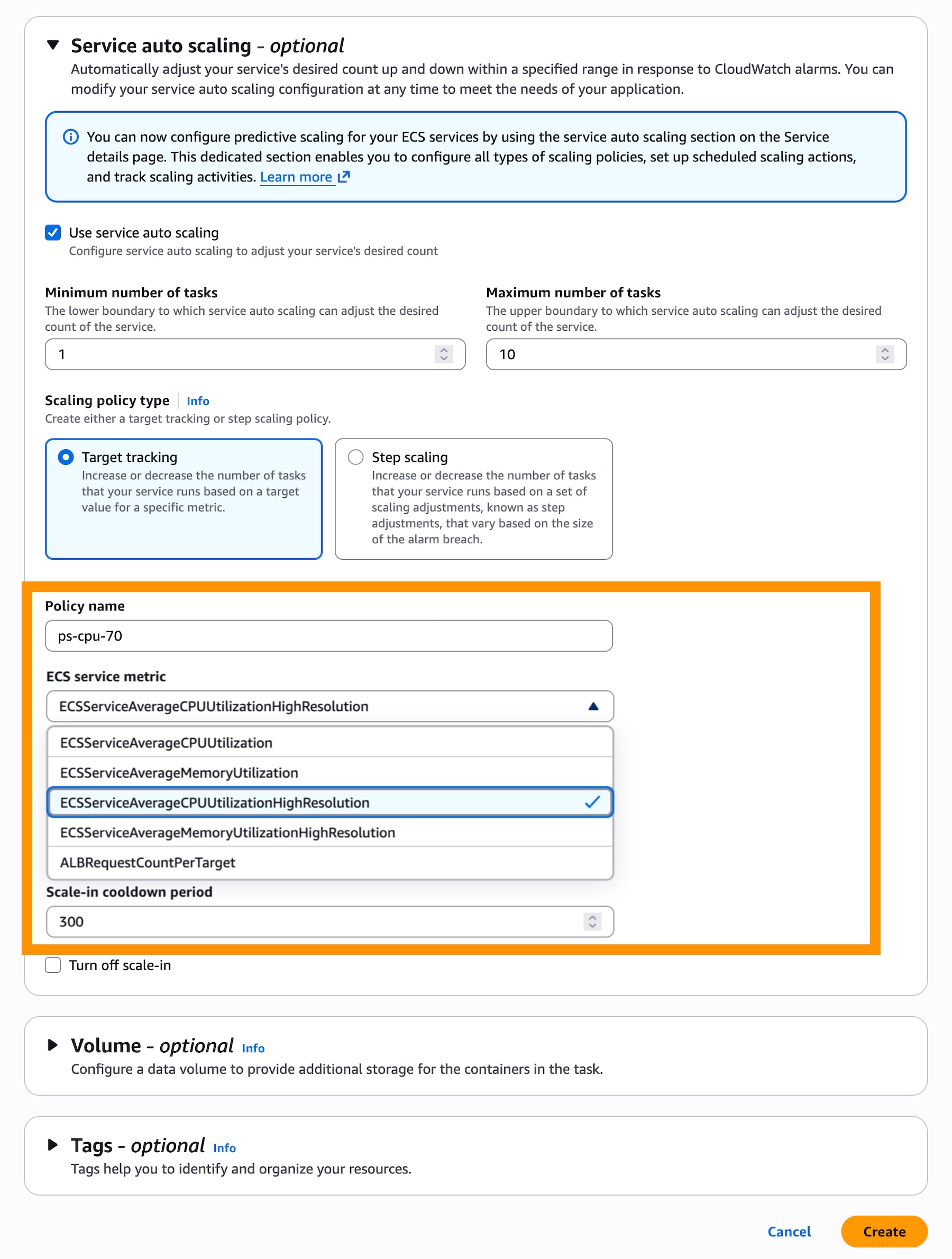
- Target Tracking Integration: In the service auto-scaling settings, users select "Target Tracking" as the scaling policy. From there, they choose the new specialized metrics:
ECSServiceAverageCPUUtilizationHighResolutionorECSServiceAverageMemoryUtilizationHighResolution. - Infrastructure Agnostic: Because this feature is handled at the service level, it remains agnostic to the underlying compute layer. Whether a customer is using the serverless Fargate model or managing their own EC2 capacity, the 20-second telemetry remains consistent.
It is important for engineers to note that while the feature itself is free, the high-resolution metrics involve a change in the CloudWatch pricing model. High-resolution metrics consume more API calls and storage capacity than standard metrics, and users should review the AWS CloudWatch pricing page to ensure they are optimizing for their specific budget and performance requirements.

Implications for Modern Software Architecture
The implications of this update extend far beyond simple metrics; they change the architectural philosophy of building on AWS.
1. Resilience During "Flash" Traffic
Modern applications, particularly those driven by social media influencers or global marketing campaigns, often experience "flash crowds"—thousands of users hitting an endpoint in seconds. Previously, these spikes required "over-provisioning" (keeping idle capacity) to survive the 386-second ramp-up time. With this update, organizations can operate with lower buffer capacity, significantly reducing compute costs while maintaining the same level of safety.
2. Tightening the Feedback Loop
By shifting to 20-second resolution, the feedback loop between the application state and the infrastructure state becomes much tighter. This allows for more aggressive auto-scaling configurations. Developers can set tighter thresholds for target tracking without fear of "thrashing" (rapidly scaling up and down), because the data is now more accurate and representative of the immediate state of the cluster.
3. Sustainability and Cost-Efficiency
Over-provisioning is the enemy of both the bottom line and sustainability initiatives. By allowing infrastructure to scale more accurately to match demand, AWS is enabling a more efficient use of physical hardware. Fewer idle instances mean a smaller carbon footprint and more efficient utilization of the underlying cloud hardware, aligning with the broader industry trend toward greener computing.
Expert Perspectives and Official Stance
The release, spearheaded by AWS advocate Channy Yun, underscores a pivot toward "real-time observability" as a cornerstone of the AWS ecosystem. By providing tools that reduce latency, AWS is empowering developers to spend less time managing infrastructure capacity and more time iterating on features.
The feedback loop is already active. AWS has encouraged users to participate in the AWS re:Post for ECS community. The early consensus among developers is that this is the "missing piece" for high-scale microservices that require rapid elasticity. By removing the 60-second barrier, AWS has effectively closed the last remaining significant gap in the auto-scaling chain for standard containerized workloads.
Looking Forward: What This Means for Future Development
As we look toward the future, the integration of high-resolution metrics into ECS sets a new baseline for expectation. We can anticipate that as machine learning algorithms (used in predictive scaling) become more sophisticated, they will begin to ingest this higher-resolution data to provide even more accurate forecasts of demand.
The move also signals a broader trend across the AWS portfolio: the transition from "near-real-time" to "true-real-time" telemetry. In an era where milliseconds dictate the success or failure of a digital business, this 20-second update is likely just the beginning of a broader initiative to make every component of the AWS infrastructure stack more responsive to the unpredictable nature of the modern internet.
In conclusion, the update to Amazon ECS service auto-scaling is a masterclass in platform engineering. It provides a tangible, high-impact performance boost without requiring a complete overhaul of existing architectures. For teams managing high-scale, mission-critical applications, the shift to 20-second resolution is not just an upgrade—it is an essential evolution in the pursuit of operational excellence.