
Beyond the IP Address: Why High-Scale Automation Infrastructure Demands Layer 5 SOCKS5 Architecture
In the high-stakes, fast-paced ecosystem of modern web automation, large-scale data harvesting, and distributed systems, the humble "proxy" is frequently reduced to a mere commodity. To many developers and infrastructure engineers, a proxy is treated as an interchangeable, low-cost IP address bought in bulk to bypass basic geographic constraints or evade straightforward rate limits.
However, industry veterans and systems architects building robust, industrial-grade automation platforms know this superficial view is a dangerous liability. When infrastructure scales from a few hundred simple HTTP requests to millions of complex, stateful user interactions across heavily defended targets, the architectural nuances of the Session Layer (Layer 5) of the OSI model spell the difference between an elastic, highly resilient enterprise system and a brittle, easily detected failure.
If your deployment has ever suffered from mysterious, intermittent connection drops, inexplicable TCP handshake timeouts, or advanced "fingerprinting" blocks that bypass even the most meticulously crafted header rotations, the root cause is rarely found in your application logic. More often than not, it points directly to your transport-layer choices. This is the exact operational threshold where SOCKS5 transitions from a convenient "nice-to-have" utility into an indispensable strategic necessity.
Main Facts: The Structural Shift from Layer 7 to Layer 5
To fully grasp why modern automation engineering is pivoting away from traditional HTTP proxies, one must first dissect the fundamental mechanics of network layers.
The Limitations of Layer 7 HTTP Proxies
The vast majority of developers default to HTTP proxies because they are exceptionally easy to configure and debug. Operating at Layer 7 (the Application Layer) of the OSI model, an HTTP proxy actively intercepts, parses, and processes incoming and outgoing HTTP and HTTPS traffic.
While this deep inspection allows for convenient caching and header manipulation, it carries a severe operational penalty:
- Payload Modification: Layer 7 proxies frequently inject or modify headers—most notably appending
X-Forwarded-FororViatags—which immediately broadcast the presence of a proxy to the destination server. - Protocol Restrictions: They are inherently bound to HTTP/HTTPS traffic, rendering them useless for applications requiring raw TCP, custom WebSockets, UDP-based streaming, or specialized binary protocols.
- Inspection Vulnerabilities: Because the proxy understands the application protocol, sophisticated Web Application Firewalls (WAFs) can probe the proxy for anomalies, latency signatures, and protocol inconsistencies.
The SOCKS5 Advantage at Layer 5
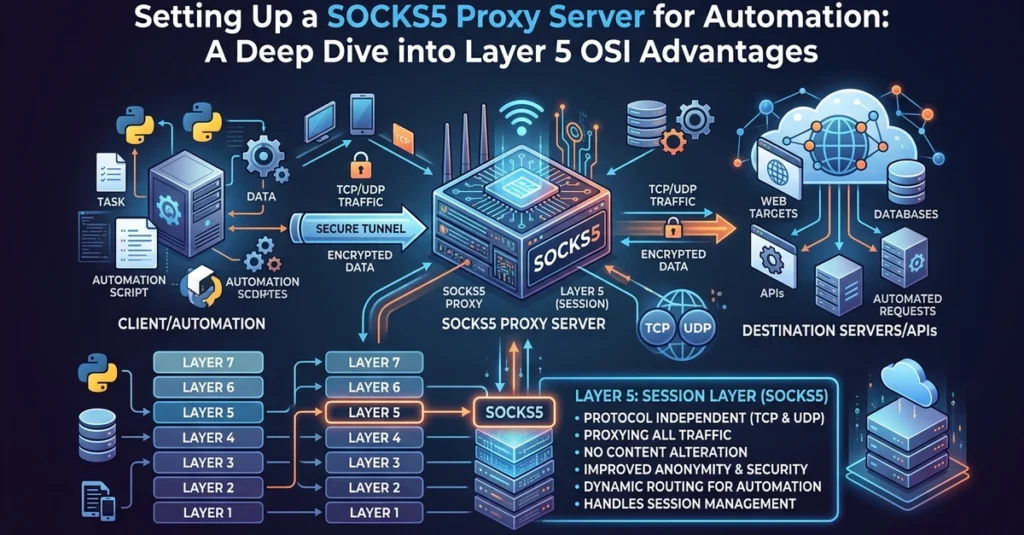
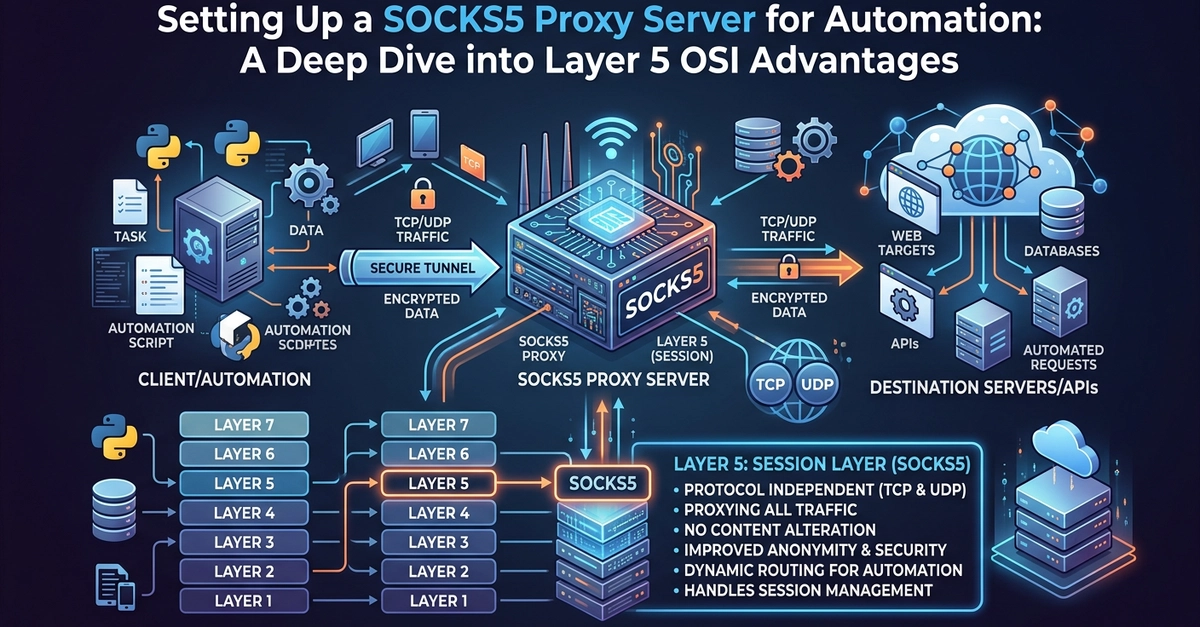
In contrast, SOCKS5 (Socket Secure version 5) operates strictly at Layer 5 (the Session Layer). SOCKS5 acts as an agnostic binary tunnel. It does not parse, inspect, or modify the application-level data flowing through it; it simply establishes a transparent session connection between the client and the destination server.
Whether your automation pipeline is running HTTP, FTP, SMTP, raw WebSockets, or a proprietary VoIP streaming protocol, SOCKS5 handles the underlying transport session uniformly. By stepping out of the application layer, SOCKS5 removes the architectural footprints that modern anti-bot systems rely on to flag and neutralize automated traffic.
Chronology: The Evolution of Web Defense and Proxy Architecture
To understand how we arrived at the current reliance on SOCKS5, it helps to examine the chronological evolution of web security systems and the corresponding adaptation of automation infrastructure.
- Phase 1: The Era of IP Blocking (Early 2000s)
In the early days of web scraping and automated interaction, defenses were primitive. Websites relied almost exclusively on basic rate-limiting based on source IP addresses. A simple pool of rotating HTTP proxies was enough to circumvent blocks. - Phase 2: Header Inspection and Layer 7 Filtering (2010–2018)
As automated tools matured, web defenses evolved. WAFs began analyzing HTTP headers for proxy signatures, datacenter IP ranges, and missing browser-like fields. Developers countered by building complex header-randomization engines, but HTTP proxies still leaked application-layer metadata. - Phase 3: Deep Fingerprinting and Transport-Layer Analysis (Present Day)
Modern anti-bot solutions (such as Cloudflare, Akamai, and PerimeterX) no longer rely solely on HTTP headers. They execute sophisticated TLS fingerprinting (JA3/JA4 analysis), HTTP/2 frame ordering checks, and behavioral analysis. At this stage, traditional Layer 7 proxies introduce too much noise. Modern infrastructure requires Layer 5 and Layer 4 control to manage the raw TCP/UDP handshake and handshake characteristics directly, bringing SOCKS5 to the forefront of enterprise automation design.
Supporting Data: Comparative Analysis of Proxy Layers
To quantify the structural differences between legacy Layer 7 solutions and modern Layer 5 architectures, enterprise engineers evaluate proxies across several key performance and security metrics:
| Performance Metric | HTTP Proxy (Layer 7) | SOCKS5 Proxy (Layer 5) | Operational Impact |
|---|---|---|---|
| Protocol Support | Restricted to HTTP/HTTPS | Universal (TCP, UDP, FTP, SMTP, Custom) | SOCKS5 enables multi-protocol automation without infrastructure redesign. |
| Data Visibility | Inspects, logs, and modifies headers | Pure binary pass-through ("Blind Bridge") | Eliminates header leakage and preserves cryptographic integrity. |
| Latency Profile | Higher due to application-layer parsing | Lower due to direct stream forwarding | SOCKS5 reduces CPU overhead on proxy nodes, improving throughput. |
| Stealth & Footprint | High footprint; easily flagged by WAFs | Low footprint; indistinguishable from direct traffic | Drastically lowers block rates on protected enterprise endpoints. |
| UDP Capabilities | Generally unsupported or limited | Native UDP associate request support | Essential for real-time data, VoIP, and gaming automation. |
Architectural Implications: The "Stealth by Design" Framework
Designing resilient automation requires a shift in mindset: moving away from obsessing exclusively over what data is being sent, and focusing intensely on how the connection is perceived by the remote server.
1. The Transparency Paradox
Unlike Layer 7 proxies that act as active middlemen, a properly configured SOCKS5 server acts as a clean network bridge. It initiates an outbound TCP connection to the target destination on behalf of the client. To the destination server, the TCP handshake originates cleanly from the proxy node’s IP address, but the underlying packet payload and TLS handshake remain completely untouched by the proxy middleware. This lack of intermediate tampering is the cornerstone of modern network stealth.
2. The UDP Frontier
A critical limitation of legacy proxy setups is their strict adherence to TCP. However, modern high-performance web applications increasingly leverage UDP-based protocols (such as HTTP/3 and QUIC) to accelerate content delivery. SOCKS5 is uniquely positioned as the standard proxy protocol that natively supports UDP associate requests. For advanced automation workflows involving real-time data feeds, media streaming, or UDP-dependent APIs, SOCKS5 is not merely an alternative—it is a strict technical requirement.
3. Secure Session Authentication
SOCKS5 provides robust, standardized authentication mechanisms—including GSS-API and secure username/password validation—that occur strictly during the initial session negotiation phase. This completely eliminates the "leaky bucket" syndrome common in poorly configured HTTP proxies, where sensitive proxy authentication credentials can accidentally leak into application-level headers destined for the target server.
Official Recommendations: Building a Production-Ready SOCKS5 Infrastructure
Moving from theoretical architecture to a high-concurrency production environment requires rigorous server hardening. Deploying a SOCKS5 instance on a Linux-based virtual private server (VPS) demands tuning well beyond default operating system configurations.
The Hardened Session Checklist for Engineers
- Kernel Optimization: Adjust TCP window scaling, increase file descriptor limits (
nofile), and tunesomaxconnto handle high connection concurrency without dropping handshakes. - Minimalist OS Footprint: Deploy on a lightweight base distribution (such as Alpine Linux or a minimal Debian build) to minimize the attack surface and eliminate background resource latency.
- Granular Access Control: Restrict proxy binding to authorized automation client IP ranges rather than exposing open ports to the public internet.
Practical Implementation: Configuring Dante SOCKS Server
For production-grade stability, Dante is widely regarded by systems administrators as one of the most robust, secure, and granular SOCKS server implementations available. Below is an architectural blueprint for a hardened sockd.conf configuration file:
# Example configuration for a hardened production sockd.conf
internal: eth0 port = 1080
external: eth0

# Use robust authentication methods for production environments
socksmethod: username

# Client access control: Whitelist your specific automation cluster IP range
client pass
    from: 192.0.2.0/24 to: 0.0.0.0/0
    log: error  # Limit logging verbosity to preserve high disk I/O performance


# Protocol routing rules: Permit both TCP and UDP streams securely
socks pass
    from: 0.0.0.0/0 to: 0.0.0.0/0
    protocol: tcp udp
Implementing a Strict "Kill-Switch"
In high-scale automation, an unproxied request is a catastrophic failure that can instantly burn an enterprise account or expose internal infrastructure. Client-side codebases (whether written in Python, Go, or Node.js) must implement strict SOCKS5 connectors configured to throw a hard, unrecoverable exception if the proxy session drops, rather than silently falling back to a direct, unproxied connection.
Conclusion: The Future of Stateful Session Control
We have entered a digital era where web identity is no longer defined solely by persistent cookies, but by the microscopic behavioral characteristics of the network connection itself. Legacy Layer 7 proxies are increasingly noisy, easily flagged by advanced TLS fingerprinting tools like JA3/JA4, and vulnerable to deep protocol inspection.
By migrating your automation architecture to a Layer 5 SOCKS5 framework, you reclaim absolute control over the underlying transport medium. You cease to be a simple script runner blindly pushing requests through a URL redirector; you become a rigorous session manager capable of orchestrating network traffic that remains indistinguishable from organic human activity.
The ultimate engineering question remains: Where is the next structural bottleneck in your infrastructure stack? Is it merely the reputation of your IP addresses, or is it fundamentally rooted in how your network sessions are negotiated? For elite systems architects, the answer almost always lies deeper in the socket layer.







