Bridging the Gap: AWS Lambda MicroVMs Usher in a New Era for Secure, Stateful Serverless Computing
In a move that promises to redefine the landscape of serverless architecture, Amazon Web Services (AWS) has unveiled AWS Lambda MicroVMs, a transformative compute primitive designed specifically for the rising tide of multi-tenant, user-centric applications. By offering virtual machine-level isolation combined with the operational simplicity of serverless, AWS is addressing a critical "middle ground" in cloud infrastructure: the need to run untrusted, stateful code for individual end-users without the heavy lifting of managing traditional VM fleets or the security risks inherent in shared-kernel container environments.
The Paradigm Shift: Why Lambda MicroVMs Matter
For years, developers building modern, interactive applications—such as AI coding assistants, collaborative data analytics platforms, and browser-based game servers—have faced an "impossible triad." To run code supplied by end-users, they needed strong security, near-instant performance, and the ability to maintain state across long-lived sessions.
Historically, this required choosing between suboptimal compromises:
- Virtual Machines (VMs): While they offer robust isolation, they are notoriously slow to boot, often taking minutes to reach a ready state—an eternity in the context of a modern web experience.
- Containers: These launch rapidly but rely on shared-kernel architectures, necessitating extensive, complex security hardening to prevent "escape" scenarios when executing untrusted code.
- Functions-as-a-Service (FaaS): Traditional Lambda functions are optimized for ephemeral, event-driven tasks. They struggle with long-running, stateful interactive sessions where memory and disk state must persist between user inputs.
AWS Lambda MicroVMs are purpose-built to solve this. By leveraging Firecracker, the high-performance, open-source virtualization technology that has powered over 15 trillion monthly Lambda invocations, AWS has created a primitive that grants each user a dedicated, isolated sandbox that acts like a VM but behaves with the agility of a serverless function.

A Technical Chronology: From Firecracker to MicroVMs
The journey to this announcement began with the open-sourcing of Firecracker in 2018. Designed to enable "serverless computing at scale," Firecracker allowed AWS to move away from heavy, monolithic virtual machine monitors (VMMs) to a lightweight, minimalist approach.
The evolution followed a clear trajectory:
- 2018: Introduction of Firecracker as the backbone of Lambda and AWS Fargate, enabling secure, fast-start isolation.
- 2020–2024: The rise of AI coding assistants and interactive notebooks created a surge in demand for persistent execution environments. Developers began building custom "sidecar" infrastructure to manage these sessions, often resulting in "infrastructure sprawl."
- June 2026: AWS introduces Lambda MicroVMs, codifying the lessons learned from years of Firecracker-based operations into a standalone, developer-facing service.
This release marks the transition from "internal AWS infrastructure technology" to "customer-accessible compute primitive," allowing developers to tap into the same security and performance engineering that AWS uses for its own flagship services.
How It Works: The "Snapshot-and-Resume" Engine
The core innovation behind Lambda MicroVMs is the "image-then-launch" workflow. Developers package their code—complete with dependencies and application logic—using a standard Dockerfile. Once uploaded to Amazon S3, the system builds the environment and takes a comprehensive Firecracker snapshot of the running disk and memory state.

When an end-user triggers a session, the system does not "boot" from scratch; instead, it resumes from the pre-initialized snapshot. This results in:
- Near-Instant Startup: Because the application is already initialized in memory, the user experiences virtually no latency.
- Persistent State: Unlike standard functions that reset after every execution, MicroVMs retain local variables, open file handles, and memory-resident data for the duration of the session.
- Intelligent Lifecycle Management: Through configurable "idle policies," these environments can be suspended when the user is inactive, allowing for cost-optimization without losing the user’s work.
Supporting Data and Technical Specifications
Lambda MicroVMs are not a one-size-fits-all tool; they are highly scalable, catering to resource-intensive applications. Key specifications at launch include:
- Compute: Up to 16 vCPUs per MicroVM.
- Memory: Up to 32 GB of RAM.
- Storage: Up to 32 GB of dedicated disk space.
- Architecture: Native ARM64 support.
- Availability: Initially launched in US East (N. Virginia, Ohio), US West (Oregon), Europe (Ireland), and Asia Pacific (Tokyo).
These specifications allow developers to deploy full-stack applications, data science environments (such as Jupyter kernels), or even localized model inference engines directly into the user’s session space.
Implications for Developers and Security Teams
The implications for the developer community are profound. By offloading the complexity of isolation to AWS, teams can redirect engineering resources toward building product features rather than maintaining virtualization infrastructure.

Security Posture
In a multi-tenant environment, the risk of cross-tenant data leakage or malicious code execution is the primary concern. By utilizing Firecracker’s hardware-level virtualization, Lambda MicroVMs ensure that each user’s session exists in a silo. Because there is no shared kernel, the security boundary is significantly more robust than traditional container-based multi-tenancy.
The "Stateful" Serverless Future
The most significant shift is the legitimization of stateful serverless. Until now, serverless was synonymous with "stateless." By allowing memory and disk to persist, AWS has unlocked a new category of "stateful serverless" applications. This is particularly critical for AI, where loading a Large Language Model (LLM) into memory takes time. With MicroVMs, the model stays "warm" in the snapshot, ready to respond the instant the user hits "Enter."
Official Perspective and Strategic Direction
In the company’s internal briefing, AWS spokespeople emphasized that Lambda MicroVMs are intended to complement, not replace, traditional Lambda Functions. "Lambda Functions remain the industry standard for event-driven, request-response microservices," the company noted. "MicroVMs are a specialized tool for the specific challenge of interactive, user-generated code execution. They are two sides of the same coin."
This strategic distinction suggests that AWS is moving toward a modular compute future, where developers select the "execution primitive" that best fits their specific workload—be it a short-lived function or a long-running, stateful MicroVM—all within the same unified AWS ecosystem.
Looking Ahead: Building the Next Generation of Apps
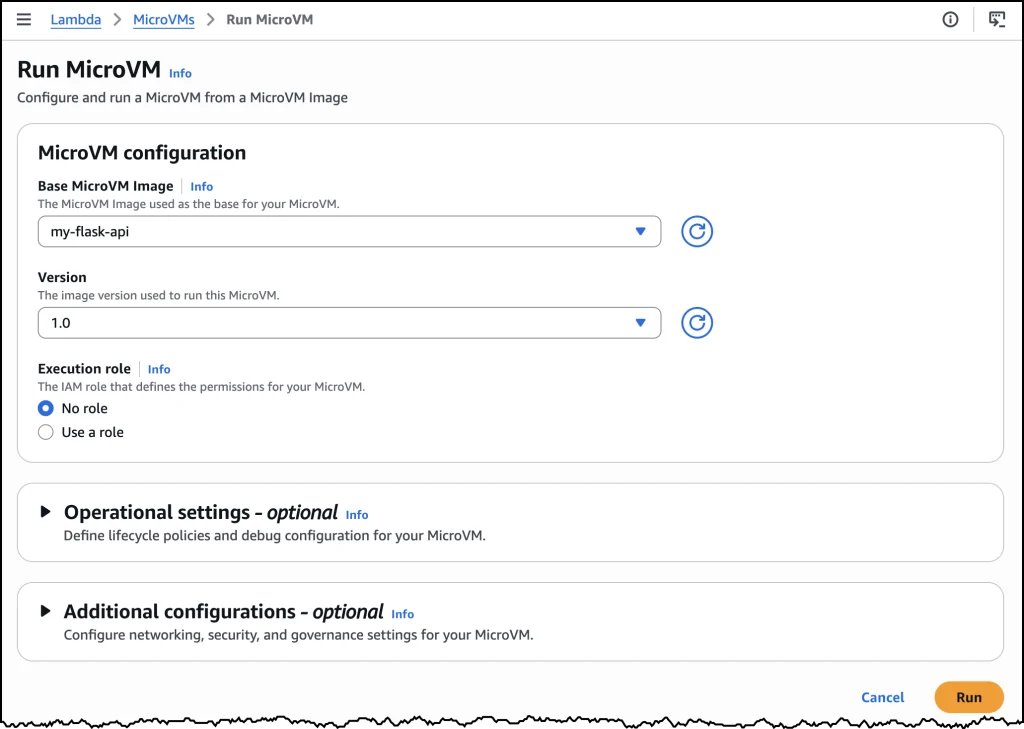
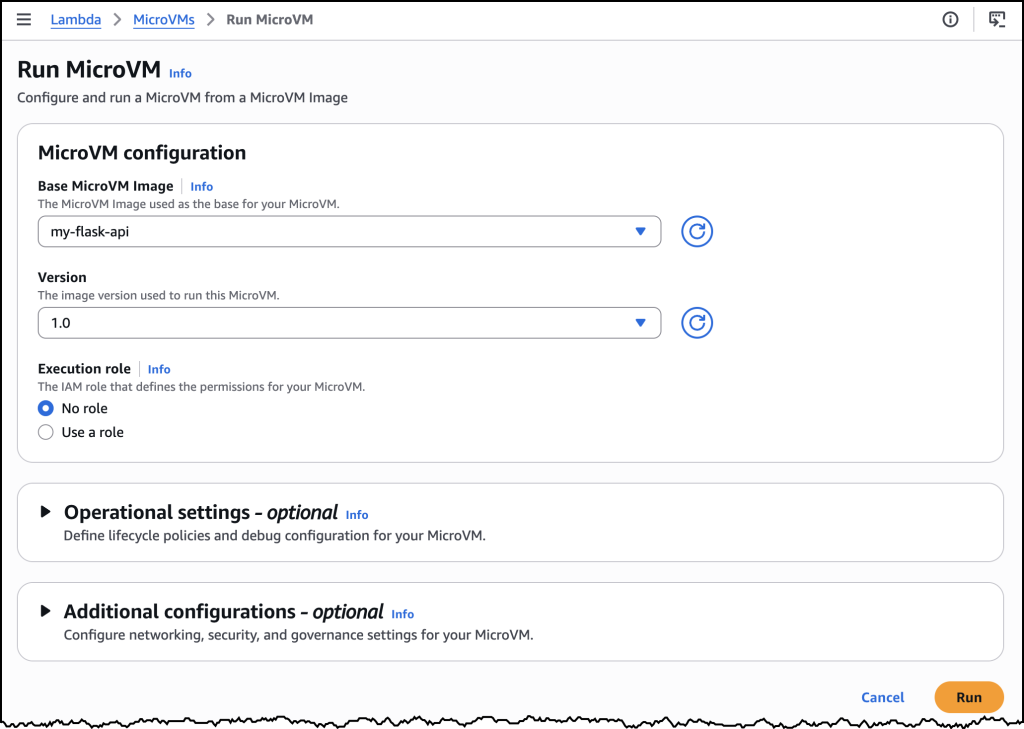
To begin using Lambda MicroVMs, developers can navigate to the Lambda console, where a new section for "MicroVMs" has been added. The integration is seamless, allowing users to create image versions via the AWS CLI or the management console.
For organizations currently struggling to scale interactive coding environments or data platforms, the transition to MicroVMs offers a clear path toward reducing "infrastructure debt." By embracing this new primitive, developers can provide their users with the performance of a dedicated VM and the agility of the cloud, effectively removing the barriers that have historically held back the most innovative, user-interactive software products.
As we move further into the second half of the decade, the rise of Lambda MicroVMs signals a shift toward a more granular, efficient, and secure cloud. It is a reminder that in the world of cloud computing, the most powerful innovations are often those that hide the complexity of the machine, leaving the developer to focus entirely on the application.