Bridging the Knowledge Gap: AWS Launches Web Search for Amazon Bedrock AgentCore
In a significant expansion of its generative AI portfolio, Amazon Web Services (AWS) has announced the general availability of "Web Search" for Amazon Bedrock AgentCore. This new capability marks a pivotal shift in how enterprise-grade AI agents interact with the outside world. By enabling agents to ground their responses in real-time, verified web information—without compromising data privacy or security—AWS is addressing one of the most persistent challenges in the deployment of large language models (LLMs): the "knowledge cutoff" and the tendency for models to hallucinate when faced with current events.
The Core Innovation: Secure, Grounded Intelligence
For many organizations, the promise of generative AI has been tempered by the reality of static data. LLMs are trained on massive datasets, but those datasets are fixed in time. When an AI agent is asked about today’s market trends, a recent scientific discovery, or a breaking regulatory change, it often struggles to provide an accurate, fact-based answer.
Web Search on Amazon Bedrock AgentCore solves this by acting as a bridge between the agent and the live internet. Unlike traditional search integrations that might require complex middleware or expose sensitive internal data to external third-party search APIs, the new Web Search tool is fully managed and operates entirely within the customer’s secure AWS environment.
Zero Egress, Maximum Compliance
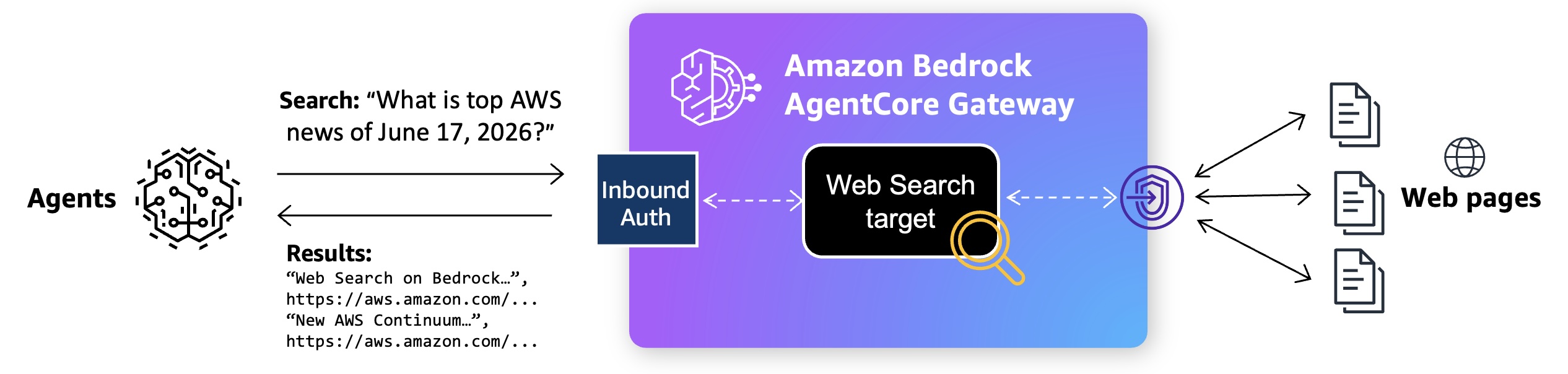
The standout feature of this release is the architecture. Utilizing the Model Context Protocol (MCP), Web Search acts as a built-in connector target on the Bedrock AgentCore Gateway. When an agent receives a query, it generates a natural-language search request. This request is processed within the AWS ecosystem, and the results—including snippets, source URLs, and publication dates—are returned directly to the agent. Because no data leaves the customer’s secured AWS perimeter during this process, organizations can maintain strict adherence to enterprise governance and data residency policies, a critical requirement for industries like finance, healthcare, and government.

Chronology of Development: From Alexa to Enterprise AI
The technology underpinning this launch is not entirely new; it is the culmination of years of internal R&D at Amazon. The search infrastructure powering Web Search on AgentCore draws from the same engine that has scaled and refined search experiences across Amazon’s most high-traffic products, including Alexa+, Amazon Quick, and the Kiro platform.
- Foundational Years: Amazon spent nearly a decade perfecting agentic search, focusing on how to combine massive web indexes with structured data.
- The Shift to Knowledge Graphs: Recognizing that web search alone can be noisy, the team integrated the Amazon Knowledge Graph. This adds a layer of "verified facts" to the search results, ensuring that when an agent retrieves information, it isn’t just getting the most popular result, but the most accurate one.
- The Introduction of MCP: The adoption of the Model Context Protocol (MCP) served as the final piece of the puzzle, allowing for a standardized, plug-and-play interface that developers could use to connect agents to external tools without rebuilding their underlying infrastructure.
- General Availability (June 2026): After a successful beta period with select enterprise partners, AWS officially opened the tool to all users in the US East (N. Virginia) region, signaling its readiness for large-scale production workloads.
Supporting Data and Technical Implementation
The power of Web Search lies in its multi-source grounding approach. By combining traditional web indexing with structured knowledge graph data, the system provides a dual-layer of validation.
Developer Workflow
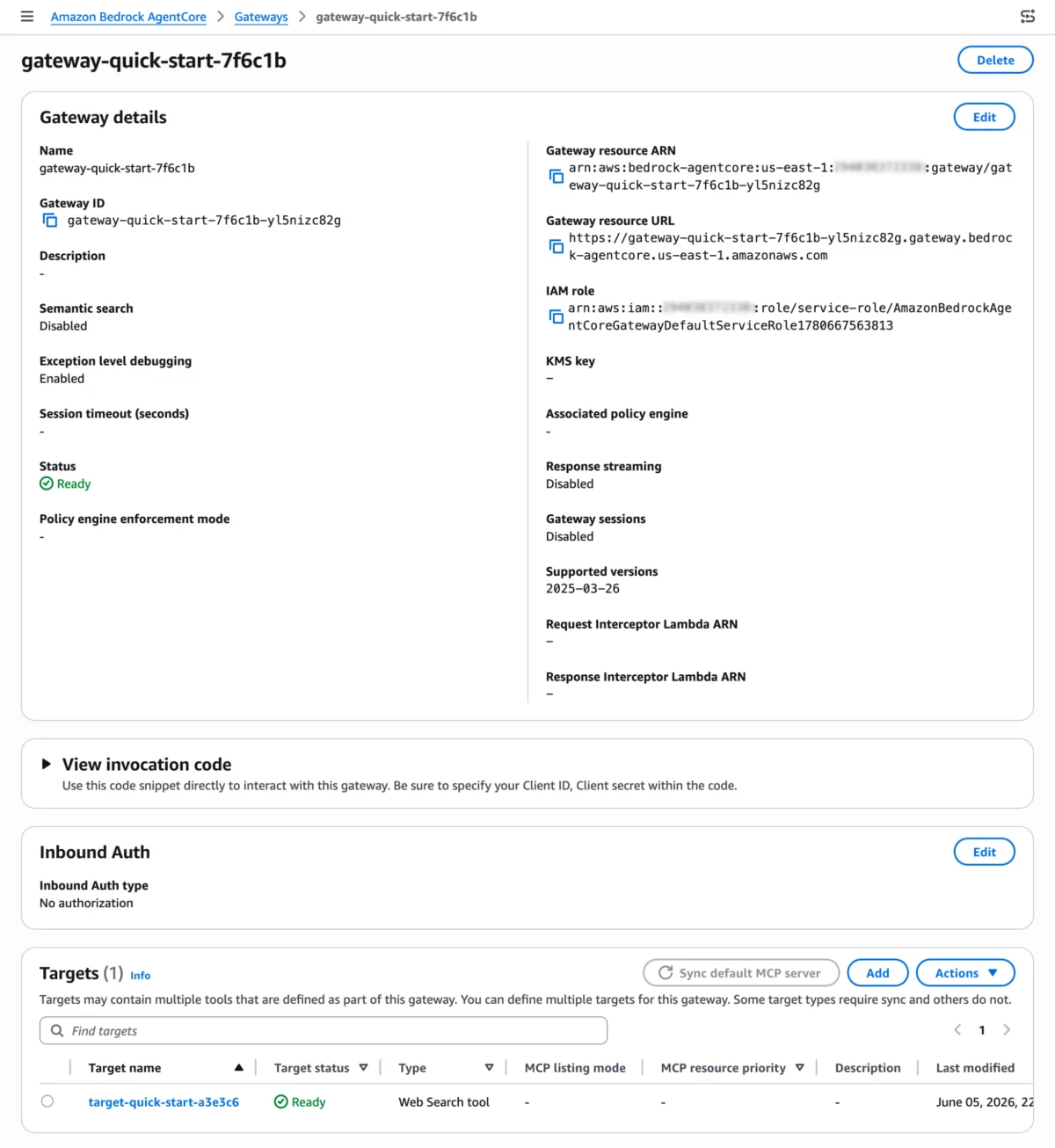
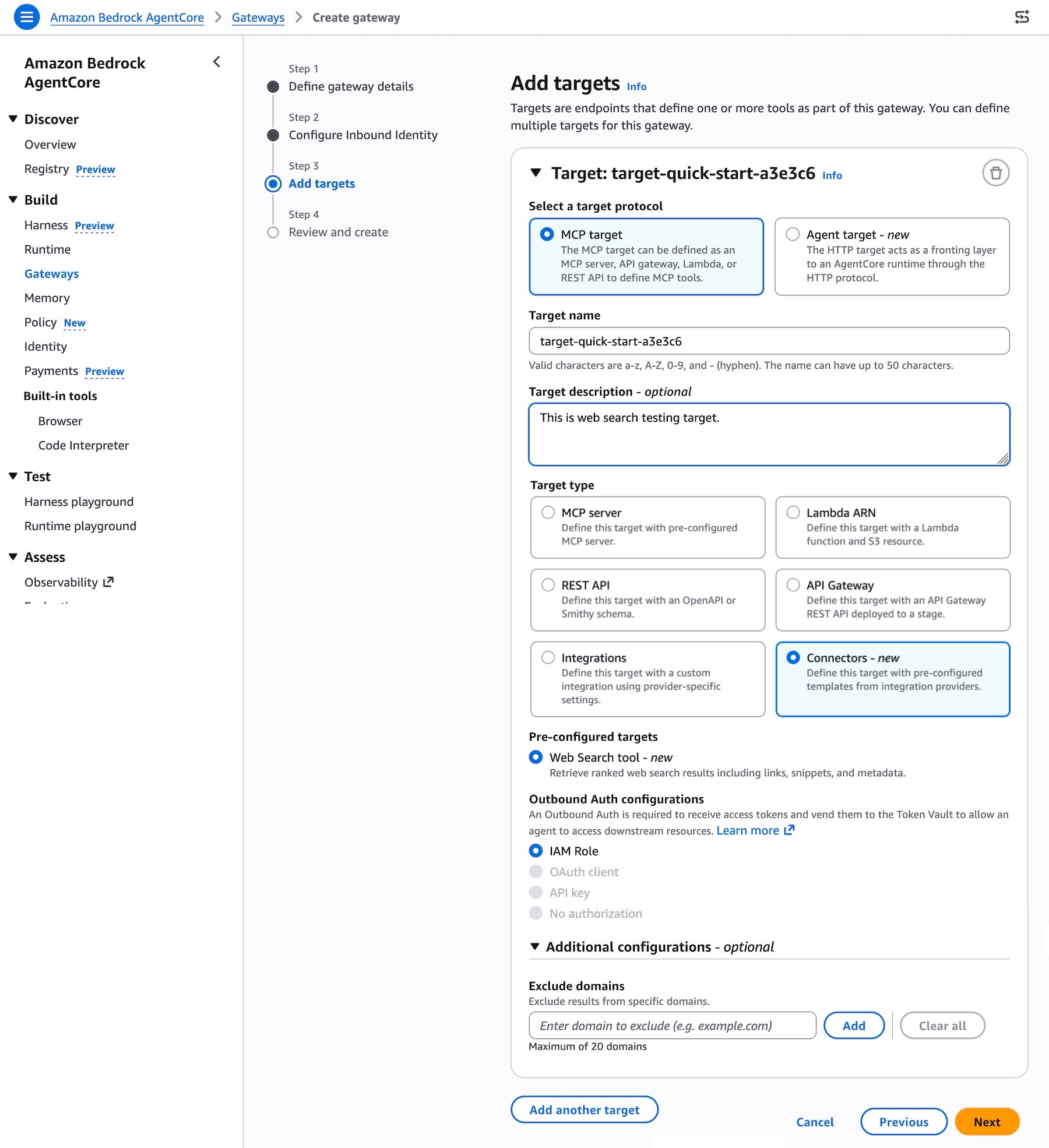
For developers looking to integrate this into their existing workflows, the process is streamlined through the Bedrock AgentCore console:
- Gateway Configuration: Developers create a Bedrock AgentCore Gateway and select "MCP target" as the protocol.
- Connector Assignment: The "Web Search" tool is selected as a preconfigured target.
- Deployment: Once the Gateway URL is established, developers can interact with the tool using standard API calls, the AWS CLI, or the MCP Inspector for real-time debugging.
This modular approach allows teams to "plug in" search capabilities to existing agents without needing to modify the core LLM architecture. Whether a developer is using Python, the MCP SDK, or Strands MCP Client, the invocation remains consistent and predictable.

Cost Structure
AWS has opted for a transparent, usage-based pricing model, a departure from some of the complex tiering seen in other AI services. Priced at $7 per 1,000 queries, the service is designed to scale with the business. Additionally, the inclusion of the tool in the broader AWS Free Tier (up to $200 in credits for new customers) lowers the barrier to entry for startups and individual developers looking to experiment with agentic search.
Industry Perspectives: Early Adopters and Real-World Use Cases
The true value of this update is best illustrated by its early adopters, who have used the tool to solve specific, high-stakes problems.
Benchling: Accelerating Scientific R&D
For Benchling, a platform dedicated to scientific research and development, the ability to synthesize internal data with external literature is transformative. Nicholas Larus-Stone, Head of AI Agents at Benchling, notes that scientists can now query a research target and receive a response grounded in both their proprietary institutional data and the latest published literature. This isn’t just about speed; it’s about accuracy. By providing a secure, governed environment to ingest published data, Benchling ensures that hypothesis generation is grounded in facts, not just probabilistic text generation.
Gen Digital: Cyber Safety and Reputation
Gen Digital has utilized the tool within its "Norton Revamp" service. According to Iskander Sanchez-Rola, Senior Director of AI & Innovation, the goal was to provide professionals with current, actionable content ideas for building their online reputations. "What we value most," Sanchez-Rola explained, "is that AWS uses its own search index and keeps queries within our trusted AWS environment." For a company whose brand is built on security and privacy, this "walled garden" approach to AI search is a non-negotiable feature.
Implications for the Future of AI Agents
The launch of Web Search on Amazon Bedrock AgentCore signals a maturing phase in the AI industry. We are moving away from the era of "chatbots" that only know what they were trained on, and toward an era of "intelligent agents" that act as active participants in the modern information landscape.
1. The Death of the Knowledge Cutoff
With this tool, the concept of a "knowledge cutoff" becomes a relic of the past for businesses. Agents can now provide real-time updates on news, technical documentation, and market data, effectively extending the utility of any LLM integrated into the Bedrock platform.
2. Standardized Agentic Workflows
By adopting the Model Context Protocol, AWS is helping to standardize how agents interact with tools. This is a massive win for interoperability. As more developers build on the MCP standard, the ecosystem for agents will grow, allowing developers to swap out search tools or add new ones without needing to rewrite their entire codebase.
3. Trust and Governance as a Product Feature
Perhaps the most profound implication is the shift in how enterprises view AI search. For years, the security risk of sending queries to public search engines prevented many firms from adopting advanced AI features. By keeping the search index and the query processing within the AWS environment, Amazon is effectively selling "trust" alongside "intelligence."
4. A Competitive Horizon
As AWS rolls this out, competitors will undoubtedly feel the pressure to offer similar "in-house" grounding capabilities. However, the combination of Amazon’s massive search index, the maturity of their knowledge graph, and the existing scale of the AWS cloud provides a significant competitive moat.
Conclusion
The general availability of Web Search on Amazon Bedrock AgentCore is a foundational step forward. It transforms the AI agent from a static repository of historical data into a dynamic, real-time research assistant. For businesses, this means the ability to automate complex, knowledge-intensive tasks with a higher degree of confidence and security than ever before. As AWS continues to iterate on this service, including future regional expansions and potential enhancements to the search engine’s retrieval capabilities, the role of AI agents in the enterprise is set to become both more sophisticated and more indispensable.
For those looking to build the next generation of AI-driven applications, the path is now clear: the integration of real-time, grounded, and secure search is no longer an optional add-on—it is the baseline.