Comprehensive Guide to Database Testing: Ensuring Security, Integrity, and Performance in Modern Applications
As mobile applications, cloud ecosystems, and enterprise software scale in complexity, the importance of robust backend architecture has never been greater. Modern digital products—spanning industries from mobile health applications to high-frequency financial trading platforms—rely heavily on robust backend systems. Consequently, ensuring the security, quality, and reliability of these systems through comprehensive database (DB) testing has become a critical discipline in software engineering.
1. Main Facts: The Growing Criticality of Database Testing
Database testing is the systematic process of validating backend data repositories to ensure accuracy, security, and performance. Unlike front-end user interface (UI) validation, database testing operates behind the scenes, verifying data integrity, schema definitions, stored procedures, triggers, and transaction protocols.

- Ubiquity of Databases: Databases are fundamental components across web, desktop, mobile, client-server, and enterprise peer-to-peer applications.
- Industry-Agnostic Demand: From healthcare and retail to space exploration and banking, every industry sector depends on reliable data persistence.
- The Big Data Challenge: Traditional databases often struggle with modern, large-scale, and highly complex unstructured or semi-structured data.
- Diverse Tooling Ecosystem: Organizations utilize various database management tools—such as MS SQL Server, Oracle, MySQL, PostgreSQL, DB2, and Toad—each offering distinct features, cost models, and security matrices.
2. Chronology: The Evolution of Backend Validation
The methodology of verifying data storage systems has transformed dramatically alongside software development practices. Understanding this timeline highlights why modern testing goes far beyond simple table checks.
- Phase I: Early Client-Server Systems (Pre-2000s)
Database validation primarily involved manual verification of flat files and basic relational tables. Testing was largely decoupled from agile development loops, focusing strictly on basic CRUD (Create, Retrieve, Update, Delete) execution via direct SQL commands. - Phase II: The Web and Enterprise Expansion (2000–2010)
As three-tier architectures (Presentation, Business Logic, Database) became standard, databases absorbed more complex responsibilities, including stored procedures, relational constraints, and database-level triggers. Testing expanded to include integration checks between the UI and the backend. - Phase III: Mobile, Cloud, and Big Data Era (2010–Present)
The explosion of mobile applications, high-frequency transactions, and distributed cloud databases introduced unprecedented scale. Testing methodologies evolved to rigorously evaluate distributed ACID compliance, real-time data synchronization, and automated verification scripting.
3. Supporting Data: Core Focus Areas in Database Testing
Executing a thorough database test strategy requires focusing on four foundational pillars: Data Mapping, ACID Properties, Data Integrity, and Business Rule Conformity.

Data Mapping
In any software application, data flows bidirectionally between the user interface and the backend repository. Testers must verify that every field displayed on a front-end screen accurately maps to its corresponding database column. This includes validating that actions like saving or modifying records from the GUI correctly update the respective database tables without truncation, loss of precision, or formatting errors.
ACID Properties Validation
Transactions executed within a database must strictly adhere to ACID properties to maintain system stability:

- Atomicity: Ensures that a transaction is all-or-nothing. If any step within a transaction fails, the entire transaction is aborted, and no partial data is committed.
- Consistency: Guarantees that the database transitions from one valid state to another, strictly respecting all predefined rules, constraints, and cascades.
- Isolation: Ensures concurrent execution of transactions leaves the database in the same state that would have been obtained if the transactions were executed sequentially.
- Durability: Confirms that once a transaction has been successfully committed, its changes survive system crashes, power outages, and software errors.
Data Integrity Across CRUD Operations
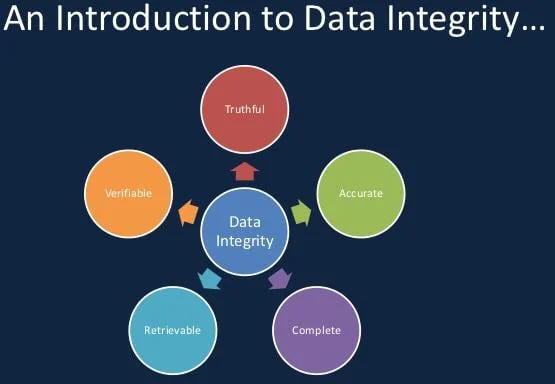
End users interact with databases primarily through four operations: Create, Retrieve, Update, and Delete. Data integrity testing ensures that once a piece of shared data is modified on one screen or module, the updated and most recent value is instantly and consistently reflected across all other views and forms within the application.
Business Rule Conformity
Modern relational databases are powerful engines capable of executing complex business logic via foreign key constraints, triggers, and stored procedures. Testers must formulate advanced SQL queries and test scripts to validate that these server-side scripts execute accurately under varied operational conditions.

4. Official Guidelines: The Step-by-Step Database Testing Checklist
Implementing an effective database testing protocol requires a structured, repeatable sequence of activities. Below is the industry-standard workflow and checklist utilized by professional software quality assurance engineers.
[Prepare Environment]
       │
       ▼
[Execute Test Query/Action]
       │
       ▼
[Check Test Output]
       │
       ▼
[Validate Against Expected Results]
       │
       ▼
[Report Findings to Stakeholders]
Essential Database Testing Checklist
- Transactions & Rollbacks: Utilize statements like
BEGIN TRANSACTION,COMMIT, andROLLBACKto verify that error conditions safely revert database states. - Schema Validation: Inspect table structures, column data types, field lengths, and indexes to ensure they align with formal architectural specifications (SRS/BRS).
- Triggers: Test automated database routines (triggers) both via UI integration and by directly loading source data to confirm that dependent tables update correctly.
- Stored Procedures: Execute stored procedures using call or execute statements, validating input parameters and examining resulting datasets for accuracy.
- Field Constraints: Validate default values, unique constraints, and foreign key relationships by deliberately attempting to inject violating data loads through both the UI and backend interfaces.
5. Implications: Technical Proficiency, Security, and Future Outlook
The growing complexity of backend infrastructures carries significant implications for software development teams and organizations worldwide.

The Rise of Technical QA Professionals
Gone are the days when software testers could rely solely on black-box UI evaluations. Because databases now house core business logic, modern QA engineers must possess strong technical competencies, including advanced SQL querying skills, knowledge of Data Manipulation Language (DML), and familiarity with database automation tools.
Overcoming Cost and Bottleneck Misconceptions
Some development budgets historically treated comprehensive database testing as an unnecessary expenditure or an operational bottleneck. However, industry data consistently demonstrates that catching data corruption, mapping errors, or security vulnerabilities at the database layer is exponentially cheaper than resolving production failures caused by compromised data integrity.

Security and Compliance Implications
With regulations like GDPR, HIPAA, and CCPA imposing strict penalties for data breaches, database security testing has emerged as a specialized domain. Ensuring proper Data Control Language (DCL) implementation—specifically managing GRANT and REVOKE privileges—is vital to protecting sensitive user information from unauthorized access.
Ultimately, prioritizing database testing safeguards enterprise applications against system failures, protects sensitive user data, and ensures reliable performance in an increasingly data-driven digital economy.