Demystifying Retrieval-Augmented Generation (RAG): The Architectural Backbone of Modern Enterprise AI
As enterprises and developers race to adopt Generative Artificial Intelligence, they quickly encounter a specialized vocabulary: Large Language Models (LLMs), Embeddings, Vector Search, and Retrieval-Augmented Generation (RAG). To the uninitiated, these terms can appear intimidating, evoking complex mathematical models and dense engineering pipelines.
However, the core concept behind RAG is remarkably intuitive. At its heart, RAG is a framework designed to bridge the gap between static, pre-trained AI models and the dynamic, proprietary information that organizations rely on every day. By understanding how RAG works, organizations can unlock the transformative power of generative AI without exposing sensitive data or dealing with the prohibitive costs of continuously retraining foundational models.
The Enterprise Knowledge Dilemma
Imagine an enterprise environment housing over 10,000 internal documents, ranging from human resources guidelines and IT security handbooks to product manuals and detailed corporate travel policies.
Now, consider a common employee query:
"How much can I claim for a hotel during business travel?"
If you submit this question to a standard, off-the-shelf Large Language Model—such as GPT-4 or Claude—would you expect it to know your company’s unique corporate reimbursement limits?
Almost certainly not. While foundational models possess vast general knowledge gathered from public internet data, they are completely blind to proprietary internal documentation. The specific answer resides securely inside your company’s private files.
This exact challenge is where Retrieval-Augmented Generation (RAG) becomes indispensable.
Defining RAG: What Is Retrieval-Augmented Generation?
Coined by researchers at Meta AI in 2020, RAG stands for Retrieval-Augmented Generation.
Think of RAG as an open-book exam for an AI. Instead of forcing the model to memorize every piece of corporate policy—which is impossible for rapidly changing data—the system follows a simple two-step philosophy: Find the right information first, then ask the AI to formulate an answer using strictly that information.
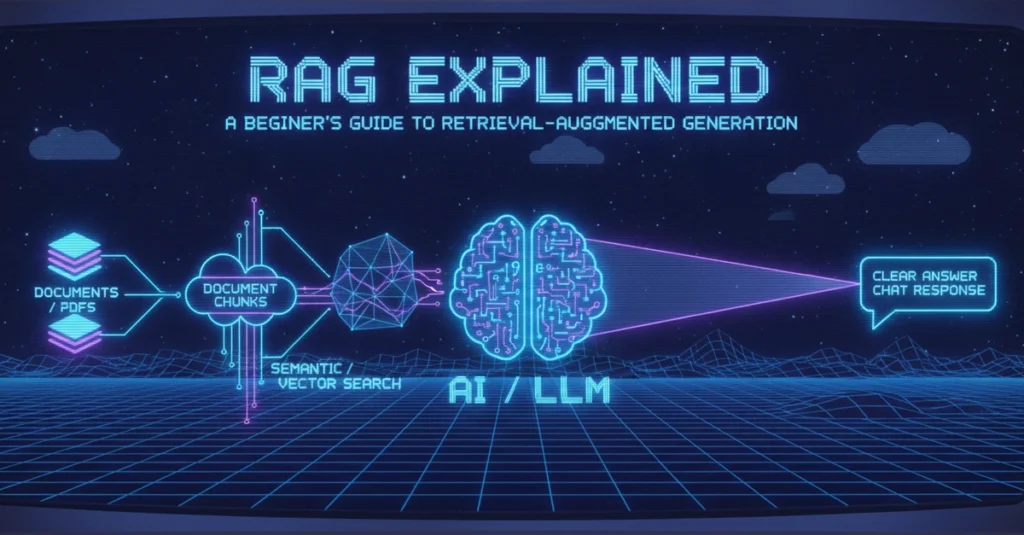
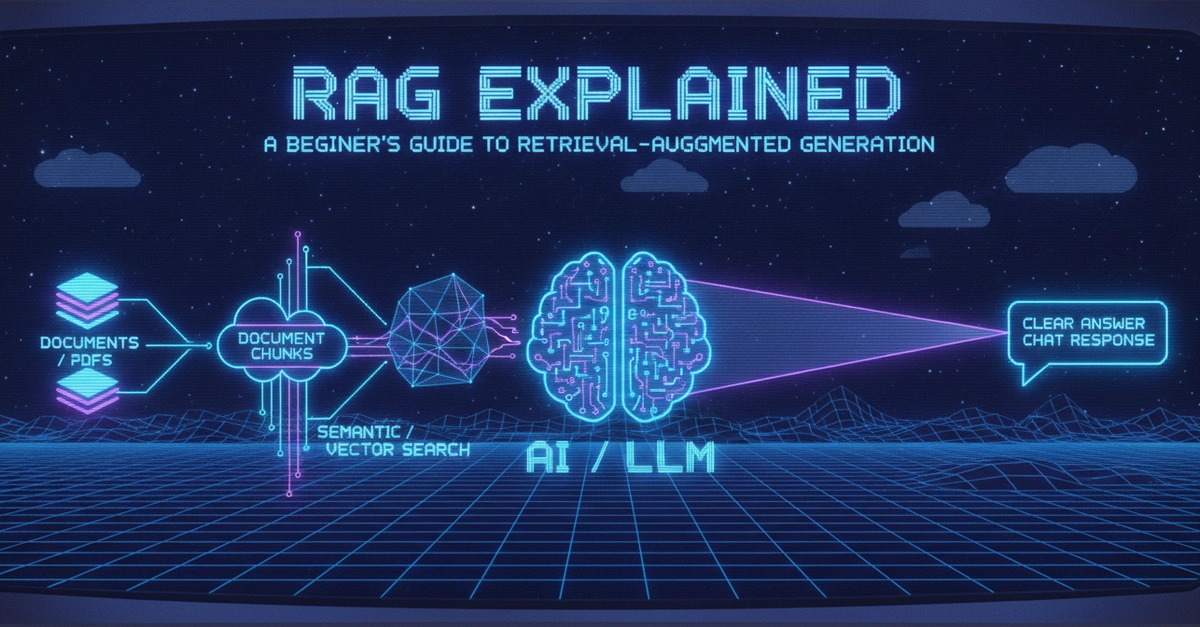
The simplified execution flow operates as follows:
- A user submits a natural language question.
- The system searches an internal knowledge base to find relevant document excerpts.
- The system feeds those specific excerpts, alongside the original question, to the AI model as context.
- The AI generates a precise, context-aware answer based on the provided material.
To illustrate, if your company’s travel policy explicitly states that employees can claim hotel expenses up to $150 per night, a RAG-enabled application retrieves this exact clause from your PDF handbook. The AI then responds: "According to the company travel policy, employees can claim hotel expenses up to $150 per night."
Crucially, the AI did not magically "know" the policy beforehand; the application simply retrieved the correct text block and handed it to the model to synthesize.
Chronology of a Query: How RAG Works Under the Hood
To appreciate how RAG systems operate efficiently at scale, we must break down the architecture into two distinct operational stages: Stage 1: Preparing the Knowledge, and Stage 2: Answering the User’s Question.
Stage 1: Preparing the Knowledge
Before a user can ever type a question, developers must ingest, parse, and structure the organization’s documents so that relevant facts can be retrieved in milliseconds.
Step 1: Document Ingestion
Enterprise knowledge is rarely stored in a single, neat text file. It spans multiple formats and repositories:
- HR policies (PDFs)
- Technical architecture wikis (Confluence, Notion)
- Customer support logs (SQL databases, markdown files)
- Product manuals and developer documentation
These documents form the foundational knowledge source for the AI application.
Step 2: Document Chunking
Imagine attempting to pass a 100-page corporate travel policy to an AI model every time an employee asks a simple question. Doing so would not only consume massive amounts of computational tokens, but it would also dilute the model’s focus, increasing the likelihood of missed details.
Instead, engineers divide large documents into smaller, digestible segments known as "chunks"—typically paragraphs or small sections of text. When a user asks a question, the system retrieves only the specific chunk related to that inquiry (e.g., Chunk 27: Hotel Reimbursement Limits), mirroring how a human researcher flips directly to the relevant page of a textbook rather than reading it cover-to-cover.
Step 3: Generating Embeddings
This brings us to one of the most vital concepts in modern AI: Embeddings.
An embedding is a numerical representation of text (expressed as a vector of floating-point numbers) generated by a specialized machine learning model. Embeddings allow systems to capture the semantic meaning of words rather than relying solely on rigid keyword matching.
For example, if a user asks, "How much can I claim for a hotel?" and the document states, "Hotel accommodation expenses are capped at $150 per night," traditional search engines might struggle if they look only for identical keywords like "claim." Embeddings, however, map both phrases into a multi-dimensional vector space where semantic closeness is measured mathematically. The system recognizes that "claim" and "capped at," while lexically different, share a deeply related meaning.
Step 4: Vector Storage and Indexing
Once chunks and their corresponding embeddings are generated, they must be stored in a specialized database optimized for high-speed mathematical searches—a Vector Database (such as Pinecone, Qdrant, Milvus, or Azure AI Search).
Along with the vector, these databases store critical metadata, such as:
- Document Name (
TravelPolicy.pdf) - Department (
Finance) - Effective Date (
2026) - Document Type (
Policy)
This metadata allows developers to filter search results programmatically (e.g., restricting searches strictly to documents published by the Finance department).
Stage 2: Answering the User’s Question
Once the knowledge base is fully indexed, the live query lifecycle begins.
Step 5: Semantic Retrieval
When an employee asks, "What is the hotel reimbursement limit?", the application converts the query into a query embedding and executes a vector search across the vector database. The system calculates the mathematical distance between the query vector and all stored document vectors, returning the top matches—for instance, pulling the exact clause on hotel limits while filtering out irrelevant details about international flight approvals or expense submission deadlines.
Step 6: Contextual Prompting and Generation
With the relevant context isolated, the application constructs a prompt for the Large Language Model:
System Prompt: You are an enterprise HR assistant. Answer the user’s question using only the provided context.
Retrieved Context: "Employees can claim hotel expenses up to $150 per night."
User Question: "What is the hotel reimbursement limit?"
The LLM processes this synthesized prompt and outputs a clear, authoritative response: "Employees can claim hotel expenses up to $150 per night." This workflow epitomizes the Generation phase of Retrieval-Augmented Generation.
Supporting Data: RAG vs. Fine-Tuning
A frequent dilemma faced by technical architects entering the generative AI space is choosing between RAG and Fine-Tuning. While both methods customize AI behavior, they serve fundamentally different architectural purposes.
| Dimension | Retrieval-Augmented Generation (RAG) | Model Fine-Tuning |
|---|---|---|
| Mechanism | Retrieves external information dynamically at query time. | Further trains the underlying neural network weights. |
| Data Volatility | Ideal for information that changes frequently (e.g., daily policies, prices). | Best for static linguistic styles, formats, or specialized coding languages. |
| Maintenance | Documents can be updated, added, or deleted independently. | Requires re-running computationally expensive training cycles. |
| Primary Use Case | Knowledge retrieval, enterprise chat assistants, Q&A systems. | Adapting model tone, behavior, or domain-specific reasoning skills. |
As a general rule of thumb: Use RAG when you want the AI to know things (facts, documents, data). Use fine-tuning when you want the AI to act in a specific way (tone, format, style). If an HR policy changes tomorrow, updating a RAG knowledge base takes seconds; fine-tuning a model to reflect that same change is slow and cost-prohibitive.
Real-World Enterprise Implications and Use Cases
Far from being a mere academic exercise, RAG has become the standard design pattern for enterprise AI deployment across multiple verticals:
- Developer Assistants: Engineers can query internal software architecture repositories to ask, "How does our legacy authentication microservice handle OAuth tokens?" instead of digging through undocumented codebases.
- Human Resources Portals: Employees instantly check complex benefits structures, parental leave rules, or remote work stipulations without tying up HR personnel.
- Customer Support: Support agents leverage RAG-backed knowledge bases to pull exact troubleshooting steps for complex hardware or software products in real time.
- Enterprise Compliance & Legal: Legal teams can scan thousands of contract amendments and compliance filings to surface liabilities and historical precedents instantly.
Implementation Architecture: .NET and Azure
For enterprise developers building scalable cloud applications, modern ecosystems offer robust toolchains for implementing RAG. For instance, a standard .NET enterprise architecture leverages Microsoft Azure services:
- User Interface / API: A .NET Web API handles incoming HTTP requests from the end-user.
- Retrieval Layer: Azure AI Search manages the vector index, chunking metadata, and high-speed semantic similarity searches.
- Orchestration: The .NET backend coordinates the embedding generation and structures the prompt context.
- Generation Layer: Azure OpenAI Service (hosting models like GPT-4o) receives the prompt-plus-context payload and returns the final generated response.
This decoupled, modular design ensures high availability, enterprise-grade data security, and compliance with corporate data governance standards.
Official Responses and Limitations: Is RAG 100% Accurate?
Despite its immense power, industry experts and AI researchers issue a consistent warning: RAG does not make an AI 100% accurate.
Production RAG systems can still fail or produce hallucinations under specific conditions:
- Bad Retrieval: If the vector search engine fails to retrieve the correct document chunk, the LLM has no accurate context to work with and may hallucinate a plausible-sounding falsehood.
- Context Window Confusion: If too many conflicting or noisy chunks are fed into the prompt, the LLM may lose track of crucial details.
- Ambiguous Queries: Poorly phrased user questions can lead vector search engines astray, returning irrelevant contextual data.
Consequently, robust enterprise RAG deployments require careful monitoring, rigorous evaluation frameworks (such as RAGAS—Retrieval-Augmented Generation Assessment), and continuous refinement of chunking and embedding strategies. RAG is not a magical cure-all; rather, it is a disciplined architectural pattern designed to firmly ground AI applications in verified, external knowledge sources.
The 5 Core Concepts to Remember
For professionals beginning their journey into Generative AI architecture, mastering these five foundational pillars is essential:
- Documents: The raw enterprise knowledge base (PDFs, wikis, databases).
- Chunks: Smaller, digestible sections of text derived from large documents.
- Embeddings: Numerical representations that capture semantic meaning to enable intelligent searching.
- Vector Search: The high-speed search mechanism that matches queries to relevant text chunks based on meaning rather than keywords.
- LLM Generation: The final synthesis step where the model translates the retrieved context into a natural, human-readable answer.
When chained together seamlessly—Documents ➔ Chunks ➔ Embeddings ➔ Vector Search ➔ Retrieved Context ➔ LLM ➔ Final Answer—these components form the bedrock of modern enterprise AI engineering.