Empowering the Intelligent Data Lake: Amazon S3 Introduces Powerful New "Annotations" Metadata Capability
In a major leap forward for cloud-native data management, Amazon Web Services (AWS) has unveiled "Annotations," a groundbreaking metadata capability for Amazon Simple Storage Service (S3). Designed to meet the demands of the burgeoning artificial intelligence (AI) and autonomous agent landscape, this new feature allows users to attach vast, rich, and mutable context directly to S3 objects. By moving beyond the limitations of traditional object tags and headers, S3 Annotations provide a scalable, queryable, and highly flexible framework for organizations to organize their data at petabyte scale.
The Evolution of Metadata: From Tags to Annotations
For nearly two decades, Amazon S3 has been the bedrock of the global data lake. As data volumes have exploded, the necessity for robust metadata—information that describes other data—has become critical. Historically, S3 users relied on a tiered approach to metadata: system-defined properties (such as file size and storage class), user-defined metadata (limited to 2 KB), and object tags (limited to 10 keys for lifecycle and access control).
While these tools have served operational tasks effectively, they were never designed for the complexity of the modern AI era. Modern workflows often require attaching massive amounts of context to a single object, such as AI-generated summaries, high-fidelity technical specs, or multi-language content classifications. Previously, this required the construction of "sidecar" databases or external metadata systems—a process that is expensive, difficult to synchronize, and prone to latency.
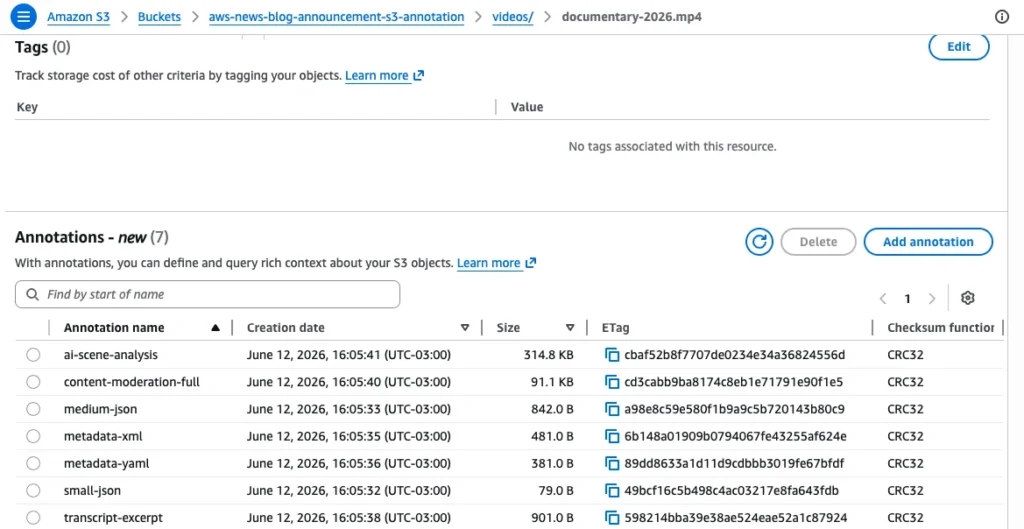
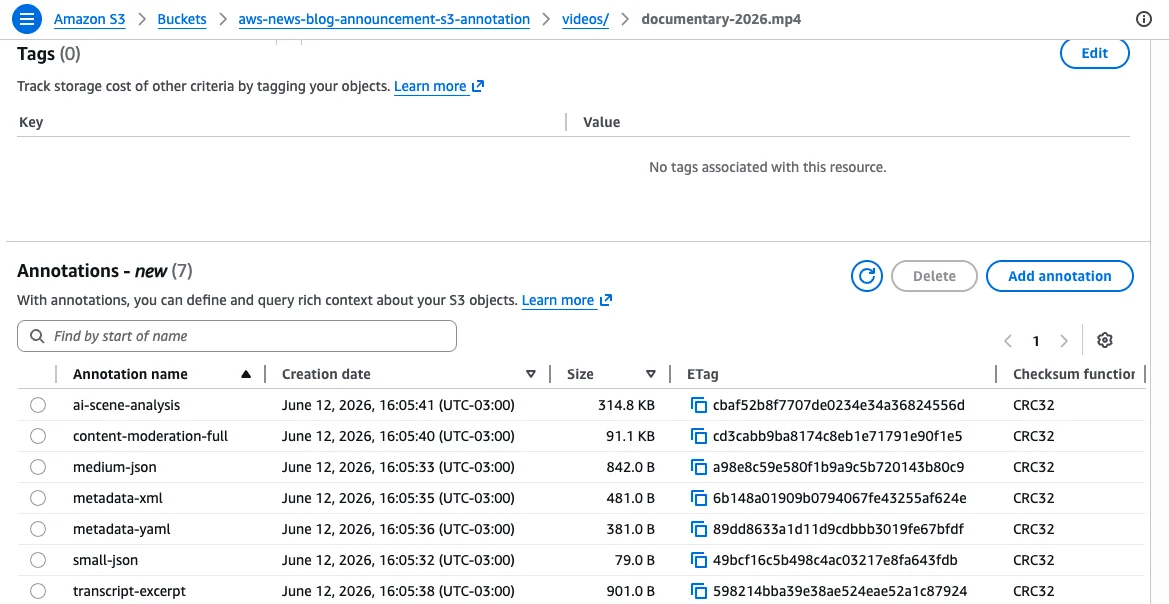
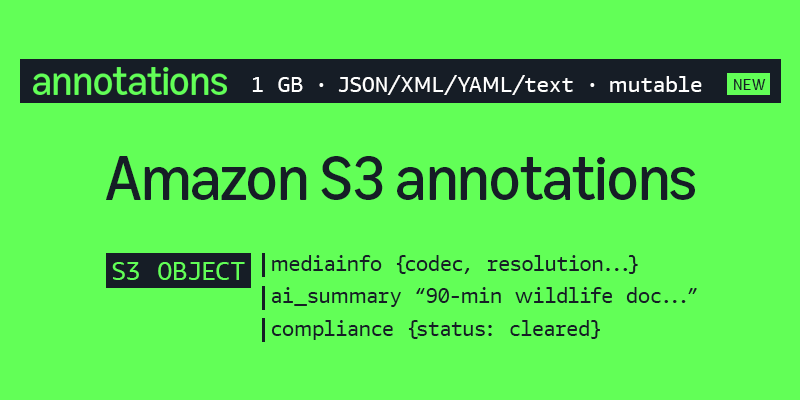
With the introduction of S3 Annotations, AWS is effectively collapsing these silos. Users can now attach up to 1,000 named annotations per object, with each annotation supporting up to 1 MB of data. This allows for a total of 1 GB of metadata per object—a massive increase in capacity that enables developers to store complex JSON, XML, YAML, or plain text files directly alongside their data.
Chronology of the Development
The shift toward this new architecture represents years of internal development aimed at "agentic" computing. The path to this announcement followed a distinct trajectory:
- The Rise of AI Agents: AWS observed a growing trend where customers were building autonomous workflows. These agents needed to "understand" data without human intervention.
- The Metadata Bottleneck: Customers consistently reported that the inability to attach evolving, large-scale metadata to objects was the primary barrier to efficient AI model training and data retrieval.
- Integration with S3 Tables: The development team integrated Annotations into the broader S3 Metadata framework, utilizing the performance of Apache Iceberg tables to ensure that this new metadata would be instantly queryable.
- The 2026 Rollout: Today, following extensive internal testing and pilot programs, AWS has enabled the feature globally across all regions, including AWS China.
Supporting Data: The Capability Matrix
The following table illustrates why S3 Annotations represent a paradigm shift in how developers handle object-level context compared to legacy methods.
| Capability | Max Size | Mutable? | Best Use Case |
|---|---|---|---|
| System Metadata | Fixed | No | Basic properties (size, class) |
| User Metadata | 2 KB | No | Small key-value pairs |
| Object Tags | 10 tags | Yes | Access control, lifecycle rules |
| Annotations | 1 GB | Yes | Rich AI/Business context |
Official Perspective: The "Agentic" Future
In the official announcement, AWS highlights that the primary driver for this release is the support for agentic workflows. As AI agents become more prevalent, they require a "standardized interface" to discover and interact with data. By utilizing the S3 Tables MCP (Model Context Protocol) server, these agents can now perform natural language queries against an organization’s entire data lake without needing to move, copy, or "rehydrate" archived data.
"Organizations are building AI agents that need to find, understand, and act on data without human intervention," said Daniel Abib, the lead on the project. "To support these workflows, you need metadata that evolves alongside the data, scales to petabytes, and remains queryable without expensive retrieval."
Implications for Industry and Enterprise
The implications of S3 Annotations are far-reaching, particularly for data-intensive industries such as media, finance, and genomics.
Media and Entertainment
A media company managing a massive archive of video assets can now attach technical specifications (resolution, codecs, audio track information) and AI-generated transcripts as distinct, mutable annotations. Because these annotations move with the object during replication or cross-region transfers, the data remains self-describing throughout its lifecycle.

Compliance and Finance
In highly regulated sectors, the ability to append compliance labels, legal hold statuses, or audit trails directly to an object provides a seamless way to satisfy regulatory requirements. If a policy changes, the organization can update the annotation for millions of objects without ever needing to touch the underlying data, avoiding the cost and risk of re-writing large blobs of storage.
The Power of Queryability: Amazon Athena Integration
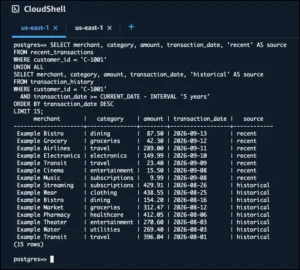
Perhaps the most potent feature of S3 Annotations is the automatic flow of metadata into fully managed Apache Iceberg tables. Once enabled, the annotations are indexed by S3 and become immediately queryable via Amazon Athena. This allows data engineers to write complex SQL queries to filter objects based on their content rather than their name.
For example, a data scientist can identify all video files that contain a specific scene or metadata tag without scanning the entire object store. By running a simple SQL query, they can extract the audio_tracks or language fields directly from the JSON-formatted annotation. This reduces the need for expensive, high-latency index scans and brings data discovery speeds down to seconds.
Implementation: Getting Started
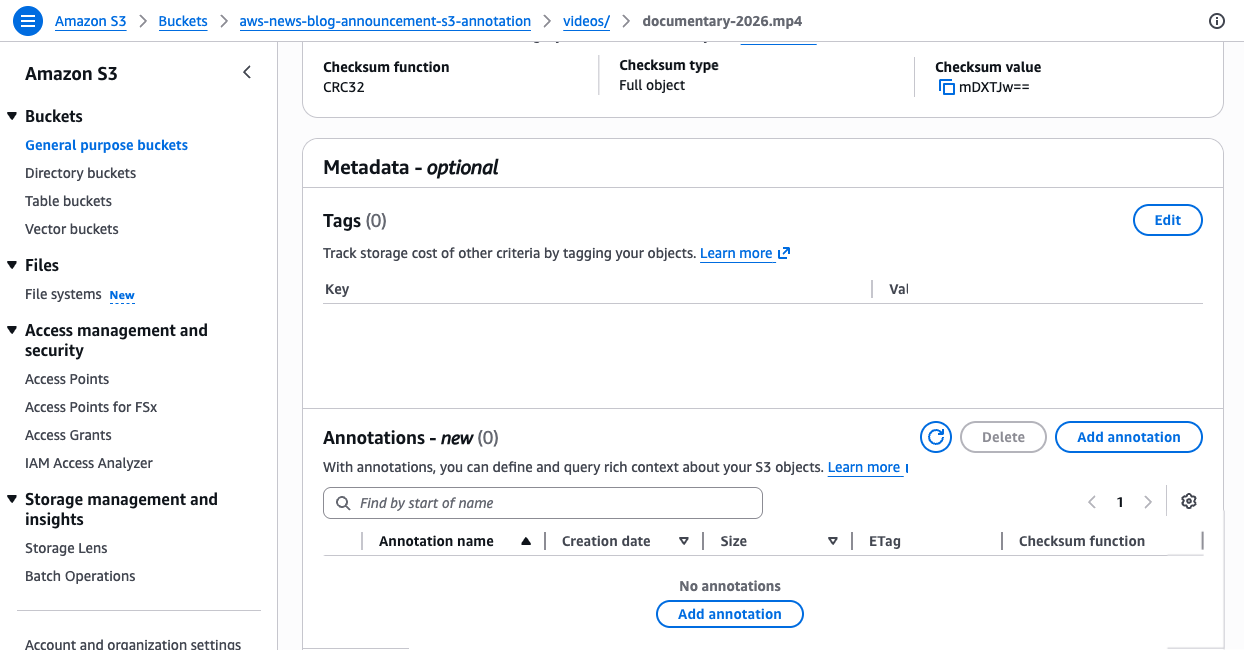
The implementation process has been designed for developer familiarity. Using the AWS CLI, adding an annotation is as simple as:
aws s3api put-object-annotation
  --bucket my-media-bucket
  --key videos/documentary-2026.mp4
  --annotation-name ai_summary
  --annotation-payload ./ai_summary.txt
This command structure preserves the "developer-first" philosophy of AWS. By allowing developers to use standard API calls for Put, Get, List, and Delete operations, AWS ensures that existing automation scripts can be easily upgraded to support the new capability.
Future-Proofing the Data Lake
As we look toward the future, the ability to attach "living" metadata to "static" storage is expected to become a standard requirement for all enterprise-grade storage systems. By enabling the automatic backfilling of existing objects and providing seamless integration with SageMaker and other AI tools, AWS has provided a path for legacy data lakes to become "AI-ready" overnight.
Furthermore, the cost structure is transparent. Annotation storage is billed at standard S3 rates, regardless of the storage class of the parent object. This provides predictability for enterprise budgets, ensuring that as metadata grows, storage costs remain manageable.
Conclusion
Amazon S3 Annotations are more than just a new feature; they represent a fundamental change in the relationship between data and its context. By allowing businesses to store rich, mutable, and queryable metadata directly on their objects, AWS is providing the infrastructure necessary for the next generation of autonomous, AI-driven enterprises. Whether it is a film studio tracking metadata for a global release or a bank managing sensitive compliance logs, S3 Annotations provide the scale, speed, and flexibility required to turn massive, dark data lakes into bright, actionable intelligence.
For organizations looking to deploy these capabilities, the path is clear: enable the S3 Metadata configuration, define your annotation schemas, and begin the transition toward a more intelligent, agent-accessible data architecture. The age of the static data lake is officially over; the era of the annotated, AI-native data reservoir has begun.