Mastering the Globe: KORE and Kaleido Team Up to Redefine Enterprise Connectivity Beyond SGP.32
As enterprise Internet of Things (IoT) deployments continue their rapid expansion across countries, oceans, and continents, organizations are discovering that physical geographic borders are matched only by the complex regulatory, technical, and operational boundaries of global digital infrastructure. Ensuring reliable, secure, and fully compliant connectivity has swiftly escalated from a routine IT task into one of the most critical, high-stakes challenges modern businesses face.
Scaling an operation from a few localized endpoints to supporting thousands—or even millions—of globally distributed connected devices demands far more than merely selecting the latest wireless standard or plugging in off-the-shelf hardware. It requires an architectural philosophy built from the ground up for true global resilience.
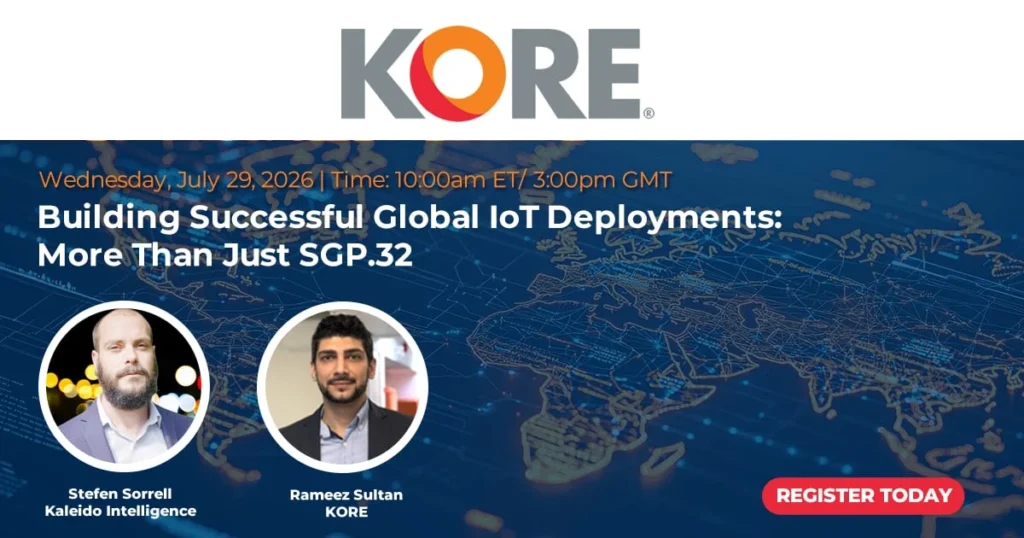
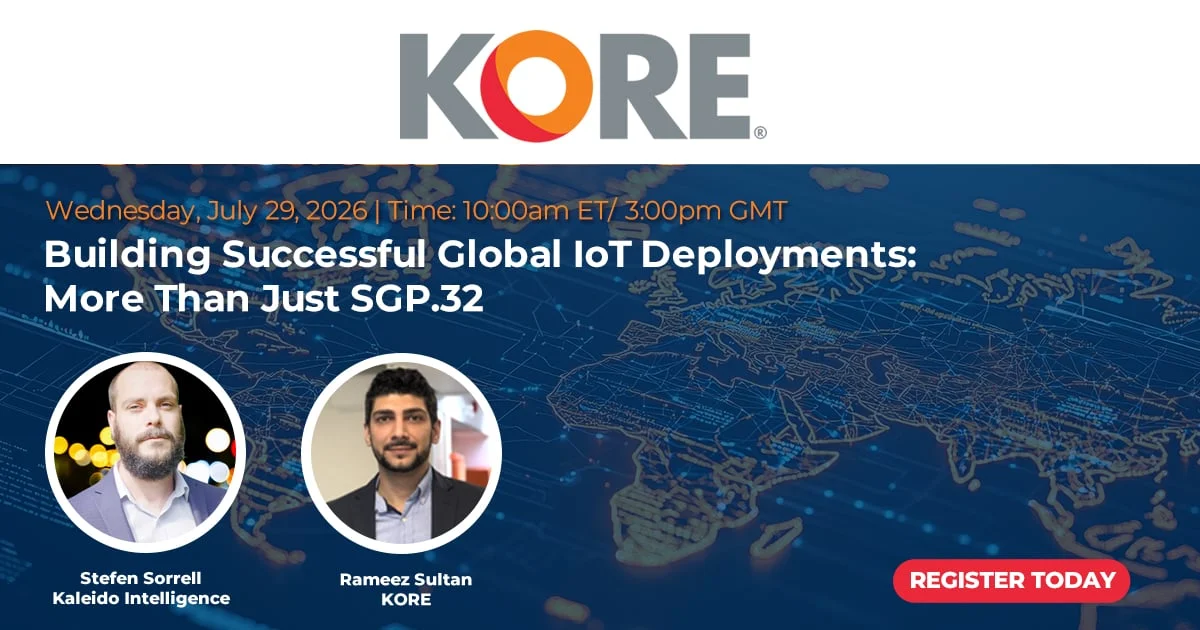
To help enterprises untangle this web of complexity, industry leaders KORE and Kaleido Intelligence are joining forces to host a definitive, high-level educational webinar titled "Building Successful Global IoT Deployments: More Than Just SGP.32." Scheduled for Wednesday, July 29, 2026, at 10:00 a.m. ET / 3:00 p.m. GMT, the virtual event aims to equip decision-makers with the strategic insight required to navigate the next generation of connected ecosystems. Whether an organization is meticulously planning its maiden international IoT rollout or attempting to optimize an already sprawling, multi-region deployment, this session promises indispensable guidance on keeping devices connected, compliant, and operationally viable no matter where business takes them.
Main Facts: Decoding the 2026 Global IoT Landscape
At the core of the upcoming KORE and Kaleido webinar is a timely and pragmatic reality check for the enterprise technology sector: while hardware and connectivity standards are evolving at a breakneck pace, technology alone cannot solve the multifaceted puzzle of global deployments.
The primary takeaways framing this digital event include:
- The Event: Building Successful Global IoT Deployments: More Than Just SGP.32
- Hosts: KORE, a pioneer in IoT solutions and global connectivity services, and Kaleido Intelligence, a prominent connectivity market research and consulting firm.
- Date & Time: Wednesday, July 29, 2026, at 10:00 a.m. ET / 3:00 p.m. GMT.
- The Core Thesis: While the emerging SGP.32 standard for remote SIM provisioning represents a monumental leap forward for device management, treating it as a silver bullet is a critical strategic error. True global success demands a holistic framework encompassing carrier relationships, regional compliance, lifecycle security, and proactive logistical planning.
- Target Audience: IoT architects, enterprise network directors, chief technology officers, supply chain managers, product developers, and operations executives navigating international expansion.
Chronology: The Evolution of Global IoT and the Rise of SGP.32
To understand why the KORE and Kaleido webinar arrives at such a pivotal historical juncture, it is vital to trace the chronological evolution of cellular IoT and remote SIM provisioning over the past decade.
Phase 1: The Fragmented Early Years (Pre-2018)
In the early days of large-scale commercial IoT, deploying devices across multiple countries meant wrestling with physical SIM cards tied to individual mobile network operators (MNOs). If a fleet of smart logistics containers traveled from North America to Western Europe, organizations faced exorbitant international roaming fees or were forced to physically open hardware housings to swap out local SIM cards. Connectivity was siloed, expensive, and notoriously difficult to manage at scale.
Phase 2: The Advent of eSIM and SGP.02/SGP.22 (2018–2024)
The introduction of embedded SIM (eSIM) technology and GSMA specifications (such as SGP.02 for Machine-to-Machine/M2M and SGP.22 for Consumer devices) revolutionized the industry. For the first time, profiles could be downloaded and managed remotely over the air (OTA). However, these early architectures were largely designed with either tightly locked industrial use cases or consumer smartphones in mind. They often lacked the seamless multi-profile flexibility, low-power optimization, and headless device management capabilities required by massive, un-attended enterprise IoT fleets.
Phase 3: The SGP.32 Paradigm Shift (2024–2026)
Recognizing the limitations of legacy specifications for modern IoT, the GSMA developed SGP.32—a standard specifically engineered for IoT remote SIM provisioning. SGP.32 introduced an architecture tailored for devices that lack user interfaces (headless devices), optimizing profile switching, reducing power consumption, and granting enterprises greater autonomy over their carrier profiles without relying heavily on local MNO intervention.
Phase 4: The Strategic Awakening (Present Day, 2026)
As SGP.32 adoption gathers momentum across the enterprise ecosystem, industry analysts and service providers have noticed a dangerous trend: organizations pinning all their operational hopes on the standard itself, assuming that implementing SGP.32 automatically guarantees a frictionless global deployment. The upcoming July 2026 webinar directly targets this phase, urging enterprises to look beyond the acronym and build robust, end-to-end operational strategies.
Supporting Data: Why Connectivity Strategy Matters More Than Ever
The necessity for a holistic approach is underscored by the sheer scale and friction points of modern enterprise IoT. Market intelligence from firms like Kaleido consistently highlights that while connectivity hardware and software standards are becoming more sophisticated, operational deployment hurdles remain the primary cause of project delays and budget overruns.
Consider the compounding variables that modern enterprises must navigate:
- Regulatory Fragmentation: Telecommunications regulations vary wildly from jurisdiction to jurisdiction. Data sovereignty laws, permanent roaming restrictions enforced by national regulators, and local compliance mandates mean that a connectivity profile that is legal and functional in Germany may violate compliance frameworks in India or Brazil.
- Carrier Diversity and Coverage Gaps: No single Mobile Network Operator possesses absolute global dominance. Even the largest Tier-1 operators rely on roaming agreements that can introduce latency, dropped packets, or unexpected cost spikes. Achieving true global resilience requires multi-network orchestration rather than a single-source dependency.
- The Total Cost of Ownership (TCO) Lifecycle: A connected device deployed today may remain in the field for five, ten, or even fifteen years. Throughout that lifecycle, cellular technologies will evolve (e.g., the eventual sunset of older generations), network partners will change, and security certificates will expire. Connectivity strategies must account for long-term remote management, firmware-over-the-air (FOTA) updates, and security patching without requiring physical intervention.
- Security Vulnerabilities: With millions of endpoints acting as potential entry points into corporate infrastructure, securing the data pipe from the device to the cloud is paramount. Encryption, private APNs, secure tunnel establishment, and threat detection must be woven directly into the connectivity fabric.
Official Responses and Expert Insights
Industry leaders from both KORE and Kaleido Intelligence have emphasized that the July webinar will cut through industry marketing hype to deliver hard-earned, practical wisdom.
While SGP.32 provides the underlying technical conduit for managing profiles on remote, headless IoT devices, experts stress that the technology is merely an instrument—not the entire orchestra.
"Implementing SGP.32 is a monumental step forward for remote SIM provisioning, offering unprecedented flexibility and simplified device management," industry analysts note ahead of the session. "However, viewing SGP.32 as a standalone cure-all ignores the vast operational, regulatory, and logistical realities of running a mission-critical IoT deployment across international borders."
By pairing KORE’s decades of frontline experience in managing global IoT deployments with Kaleido Intelligence’s rigorous market data and analytical foresight, the webinar aims to demystify how enterprises can harmonize technology standards with real-world execution. The sessions will break down how SGP.32 acts as a powerful complement—rather than a complete replacement—to an enterprise’s broader connectivity roadmap.

Practical Takeaways: What Attendees Will Learn
Designed with pragmatism in mind, the one-hour session is structured to ensure participants leave with actionable frameworks they can immediately apply to their organizational strategies.
Key learning objectives include:
- Navigating the SGP.32 Landscape: A clear, technical yet accessible breakdown of what SGP.32 actually achieves, where its boundaries lie, and how it integrates with existing enterprise platforms.
- Balancing Carrier Flexibility and Global Reach: Best practices for designing multi-network strategies that prevent vendor lock-in while ensuring seamless coverage across disparate geographic zones.
- Overcoming Regulatory Hurdles: Proven tactics for staying compliant with localized data residency laws, permanent roaming restrictions, and changing international telecom frameworks.
- Lifecycle Management Mastery: Strategies for managing connected assets from initial factory provisioning through years of field operation, maintenance, and eventual decommissioning.
- Future-Proofing Infrastructure: Insights into how leading organizations are preparing their IoT ecosystems for future technological shifts, ensuring scalability without sacrificing security or operational efficiency.
Implications: Preparing for the Future of Connected Enterprise
The implications of the themes explored in the KORE and Kaleido webinar extend far beyond a single afternoon of education. As businesses increasingly rely on IoT to drive digital transformation, supply chain visibility, smart infrastructure, and remote industrial automation, the margin for error in connectivity strategy shrinks daily.
A poorly planned global IoT rollout can result in orphaned devices—endpoints that drop off the network permanently due to a roaming dispute, a regulatory shift, or an expired profile—costing organizations millions in truck rolls, hardware replacements, and reputational damage. Conversely, enterprises that master the art of holistic connectivity planning gain a distinct competitive advantage, characterized by agile deployments, optimized operational expenditures, and unwavering reliability.
Who Should Attend?
This high-level webinar is specifically tailored for professionals charged with steering organizational connectivity and IoT strategy, including:
- Chief Technology Officers (CTOs) and Chief Information Officers (CIOs)
- IoT Solution Architects and Enterprise Network Directors
- Supply Chain, Logistics, and Operations Executives
- Product Managers developing connected hardware and software solutions
- Compliance and Regulatory Officers navigating international telecommunications laws
Secure Your Spot
As the complexity and scale of global IoT deployments continue to accelerate, organizations must look beyond the allure of the newest technical standards and invest in resilient, long-term operational strategies.
Join the experts from KORE and Kaleido on Wednesday, July 29, 2026, at 10:00 a.m. ET / 3:00 p.m. GMT to discover how industry leaders are successfully navigating the future of connected device management.
Click here to register for the webinar today and gain the practical insights needed to simplify your global deployments, enhance operational efficiency, and keep your business connected wherever it goes.