Recipe Lanes: Charting a Course Through Culinary Complexity with AI
A common frustration for home cooks and seasoned chefs alike is the impenetrable "wall of text" that often constitutes a recipe. In the heat of the moment, amidst sizzling pans and bubbling pots, locating a crucial measurement or the next step in a dense block of instructions can transform a joyful culinary endeavor into a stressful scramble. Enter Recipe Lanes, an innovative open-source project by developer [bohemian-miser], which leverages the power of Large Language Models (LLMs) to transform traditional, linear recipe texts into intuitive, easy-to-follow flowcharts. This pioneering tool promises to revolutionize how we interact with recipes, making the cooking process more streamlined, less daunting, and ultimately, more enjoyable.
The Culinary Conundrum: Navigating Text-Heavy Recipes
For generations, recipes have been primarily communicated through written instructions. From ancient clay tablets detailing brewing techniques to elaborate medieval cookbooks and modern digital archives, the format has largely remained consistent: a list of ingredients followed by a sequence of textual steps. While effective for those with ample time and focus, this traditional presentation poses significant challenges in the dynamic environment of a kitchen.
The Modern Kitchen’s Dilemma
The modern kitchen is a multi-sensory, often fast-paced workspace. Cooks frequently juggle multiple tasks: chopping vegetables, monitoring cooking temperatures, and managing timings. In such an environment, pausing to decipher a lengthy paragraph of text, especially when sticky fingers or a timer’s insistent beep demand immediate attention, introduces a significant cognitive load. This can lead to errors, forgotten steps, or simply a diminished cooking experience. The problem is exacerbated by the sheer volume of recipes available online, many of which prioritize SEO over user-friendliness, resulting in verbose introductions and convoluted instructions.
Users often find themselves endlessly scrolling to locate a specific detail – "Was it 2 tablespoons or 2 teaspoons of salt?" "Did I add the onions before or after the garlic?" This constant search-and-read cycle breaks concentration and disrupts the flow of cooking, turning what should be an enjoyable creative process into a test of memory and navigation. The inherent linearity of text, while fundamental to language, often clashes with the non-linear, often parallel nature of culinary execution.
The Birth of a Solution: Recipe Lanes
Recognizing this pervasive challenge, [bohemian-miser] conceptualized Recipe Lanes. The project’s core mission is to abstract away the textual complexity of recipes, presenting them in a visually digestible format that mirrors the logical progression of cooking tasks. By employing an LLM, Recipe Lanes seeks to understand the semantic intent of recipe instructions and translate them into a graphical representation – a flowchart – that highlights dependencies, parallel tasks, and decision points. This fundamental shift from text to visual logic is not merely a cosmetic change but a profound re-engineering of the user interface for culinary information.
From Text to Flow: The Mechanics of Recipe Lanes
The ingenuity of Recipe Lanes lies in its application of advanced artificial intelligence to a seemingly simple, yet deeply impactful, problem. By harnessing the capabilities of Large Language Models, the tool bridges the gap between unstructured textual data and structured visual representation, offering a fresh perspective on recipe interpretation.
Leveraging Large Language Models for Clarity
At the heart of Recipe Lanes is an LLM, an AI model trained on vast amounts of text data, enabling it to understand, interpret, and generate human-like language. In the context of recipes, the LLM’s role is multifaceted. It parses the input recipe text, identifying key entities such as ingredients, quantities, cooking methods, timings, and sequential steps. Crucially, it must also infer the logical relationships between these elements. For example, it understands that "sauté onions until translucent" precedes "add garlic and cook for one minute."
The LLM is tasked with breaking down complex sentences, extracting discrete actions, and recognizing implicit instructions. This allows it to create a structured dataset from the free-form text, which is then used to generate the flowchart. The power of the LLM lies in its ability to handle the variability and nuance of natural language – different recipes might phrase similar instructions in myriad ways, but the LLM can identify the underlying culinary command. This intelligent interpretation is what elevates Recipe Lanes beyond a simple text parser, enabling it to produce genuinely useful and coherent visual guides.
A Visual Revolution in Culinary Instruction
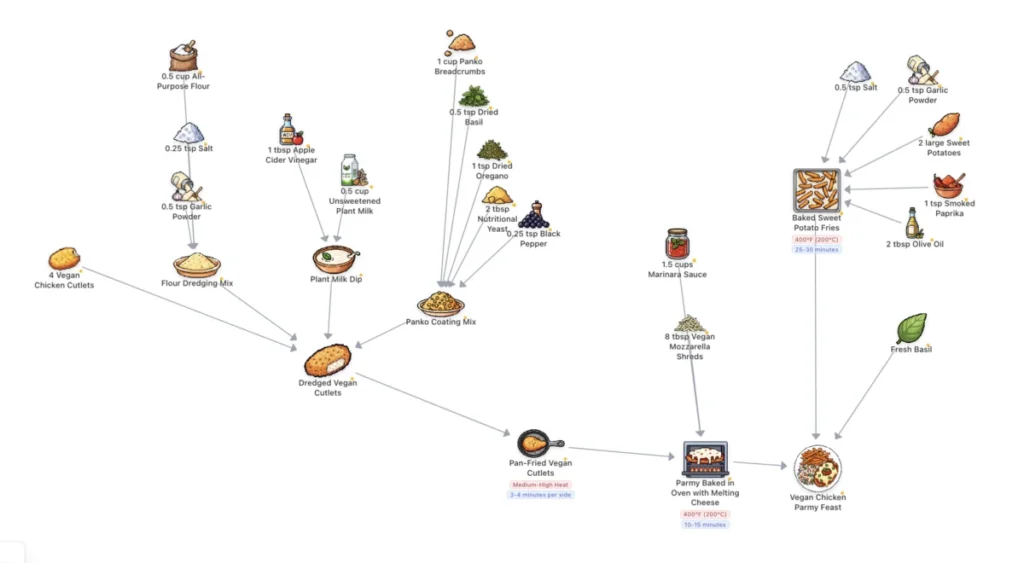
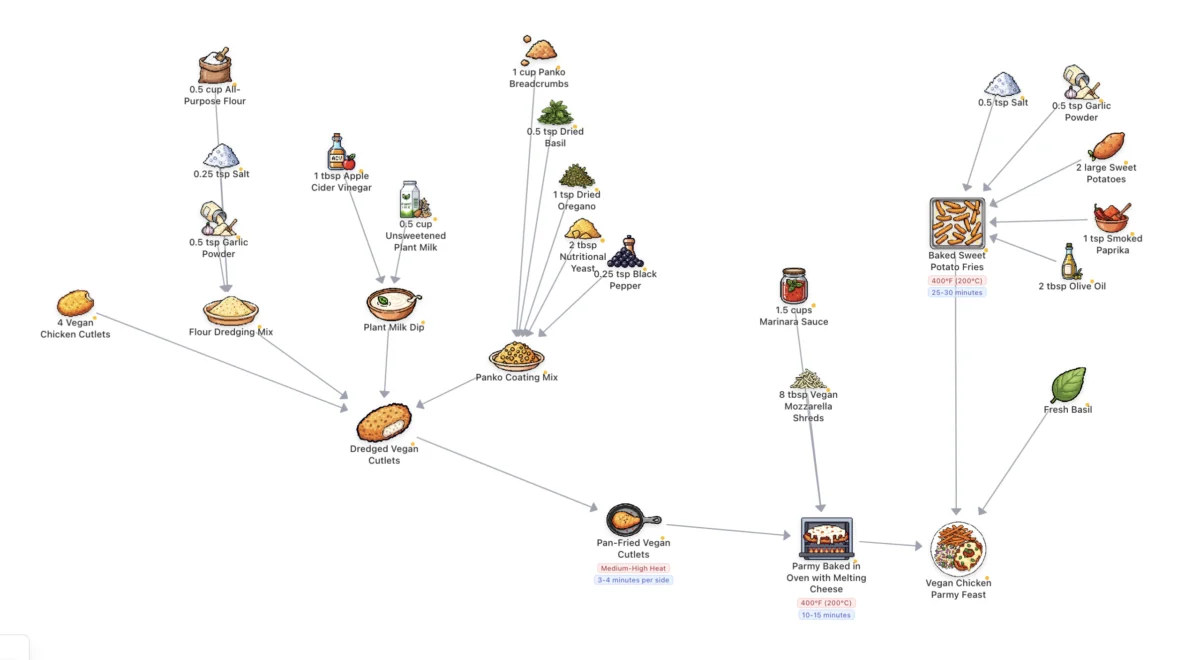
The output of Recipe Lanes is a dynamic flowchart, a visual representation that maps out the cooking process. Each step, ingredient, or decision point is encapsulated within a distinct node, connected by arrows indicating the flow of progression. This visual paradigm offers several advantages:
- Instant Overview: Users can grasp the entire cooking process at a glance, understanding the major phases and their dependencies without having to read through every word.
- Quick Reference: During cooking, a swift glance at the flowchart can confirm the next step or an ingredient quantity, eliminating the need for frantic text scanning.
- Error Reduction: The clear visual separation of steps minimizes the chance of skipping an instruction or misinterpreting a sequence.
- Parallel Task Identification: Flowcharts can effectively illustrate when multiple tasks can be performed concurrently (e.g., "while pasta boils, prepare sauce"), a feature often obscured in linear text.
Furthermore, Recipe Lanes generates distinctive icons for each ingredient, adding another layer of visual distinction and quick identification. This graphical shorthand reduces cognitive load, allowing cooks to quickly associate visual cues with ingredients rather than needing to re-read their names.
The User Experience: Bridging the Human-AI Gap
As noted by early users, interacting with an LLM effectively often requires a specific "language." Initial attempts with Recipe Lanes, much like with other LLM interfaces, might yield less-than-perfect results if the input prompts are too vague or deviate significantly from the LLM’s expected structure. However, the project’s gallery of examples serves as an invaluable guide, demonstrating the optimal phrasing and level of detail the LLM anticipates. Once users acclimate to this "language," the generation of detailed flowcharts and ingredient icons becomes a seamless process.
A crucial design choice within Recipe Lanes is the interactive nature of its output. While the LLM intelligently organizes the initial flowchart, the tool allows users to independently move and rearrange elements across the canvas. This feature addresses potential quirks in AI-generated layouts, where elements might overlap or appear in a less-than-optimal sequence. This manual override empowers the user to refine the flowchart to their exact preference, ensuring maximum clarity and usability – a vital component for a tool still in its developmental stages. This blend of AI automation and human customization exemplifies a user-centric design philosophy.
A Journey of Innovation: The Genesis and Evolution of Recipe Lanes
The development of Recipe Lanes is not merely a technical exercise but a response to a long-standing need within the culinary world. Its trajectory, though nascent, reflects broader trends in technology and community-driven development.
Tracing the Problem: A Historical Perspective on Recipe Presentation
The format of recipes has evolved alongside information technology. From oral traditions, where knowledge was passed down through demonstration and spoken word, to handwritten manuscripts and printed cookbooks, the emphasis was on concise, often abbreviated instructions. The advent of the internet brought an explosion of recipe content, democratizing culinary knowledge but often sacrificing clarity for quantity. Blogs, forums, and vast databases became the new repositories, yet the fundamental presentation remained text-based.
While some platforms introduced features like step-by-step photos or video tutorials, these often supplement, rather than fundamentally alter, the core textual instructions. The "wall of text" persisted, challenging cooks to mentally parse and visualize the process. Recipe Lanes stands out by fundamentally re-imagining this core interaction, acknowledging that visual processing can often be more efficient than textual interpretation, particularly for sequential, procedural tasks.
The Vision of [bohemian-miser]: Open Source for Culinary Advancement
While [bohemian-miser]’s specific motivations are not detailed in the original text, the decision to make Recipe Lanes an open-source project speaks volumes. It suggests a vision that extends beyond a proprietary product, aiming instead for collaborative innovation and broad accessibility. An open-source model implies a belief in the power of community contribution to refine, expand, and perfect the tool.
The developer likely envisioned a project that could grow organically, benefiting from diverse perspectives and coding skills. This approach aligns with the spirit of innovation seen in the broader "kitchen hacks" community, where creative solutions to everyday problems are often shared freely and improved upon collectively. By releasing Recipe Lanes as open source, [bohemian-miser] invites fellow developers, culinary enthusiasts, and UI/UX designers to contribute to its evolution, ensuring it remains relevant and responsive to user needs.
Community-Driven Development: The Power of Open Source
The "infancy" of Recipe Lanes, coupled with its open-source nature, highlights a critical pathway for its future. Open-source projects thrive on community engagement. This means that bug fixes, feature enhancements, and even entirely new functionalities can be contributed by a global network of volunteers. For a tool like Recipe Lanes, this is particularly beneficial:
- Diverse Perspectives: Different users and developers will have varied cooking styles and preferences, leading to a more robust and adaptable tool.
- Rapid Iteration: The collective effort of a community can accelerate development cycles, introducing new features and improvements more quickly than a small, closed team.
- Transparency and Trust: Open source fosters transparency, allowing users to understand how the tool works and ensuring there are no hidden agendas.
- Long-Term Sustainability: Projects supported by an active community are often more sustainable in the long run, even if the original developer moves on.
This collaborative model is particularly exciting for Recipe Lanes, as it suggests a future where the tool could adapt to different cuisines, incorporate advanced AI features, or integrate with other smart kitchen technologies, all driven by the collective passion of its users and contributors.
Beyond the Flowchart: Design, Aesthetics, and Engagement
While the core functionality of Recipe Lanes is its AI-powered flowchart generation, the project also demonstrates a keen awareness of user experience through its aesthetic choices and interactive design.
The Charm of 8-bit Aesthetics
The article specifically mentions the "8-bit icon style and button text" as contributing a "fun bit of flair." This seemingly nostalgic design choice is more than just a stylistic preference; it plays a crucial role in the overall user experience. The 8-bit aesthetic evokes a sense of playfulness and simplicity, making the advanced AI technology feel approachable and less intimidating. In an era where many tech interfaces strive for sleek minimalism, the deliberate retro charm of Recipe Lanes sets it apart, creating a memorable and engaging brand identity.
This choice can also contribute to clarity. The chunky, distinct nature of 8-bit graphics often means icons are immediately recognizable, even if stylized. This aligns perfectly with the goal of visual communication, ensuring that ingredient icons and step markers are easily distinguishable at a glance, further reducing the cognitive effort required during cooking. It’s a testament to thoughtful design that considers not just functionality, but also the emotional connection and ease of use for the end-user.
Intuitive Interaction: A User-Centric Approach
Beyond the visual style, the interactive elements of Recipe Lanes reinforce its user-centric design. The ability to "independently move across the canvas" each generated element addresses a common limitation of AI-generated content: the occasional imperfection. Rather than forcing users to accept a rigid, AI-determined layout, Recipe Lanes provides the flexibility to fine-tune the organization. This empowers the user, giving them agency over the final presentation and ensuring that the flowchart truly meets their individual needs and preferences.
This level of customizability is crucial for a tool that aims to simplify a personal and often idiosyncratic activity like cooking. What might be a "sensible order" for one cook might not be for another, and allowing for this personal adjustment elevates Recipe Lanes from a mere AI utility to a truly adaptive culinary assistant.
Implications for the Future of Cooking and Culinary Technology
Recipe Lanes, despite its current "infancy," represents a significant step forward in the application of AI to everyday problems. Its implications extend beyond individual home cooks, potentially influencing recipe creation, culinary education, and the broader landscape of kitchen technology.
Empowering the Home Chef
For the average home cook, Recipe Lanes offers a tangible reduction in stress and an increase in confidence. By simplifying complex instructions, it encourages experimentation with new recipes that might otherwise seem daunting. Imagine tackling a multi-step international dish, previously avoided due to its lengthy instructions, now presented as a clear, manageable flowchart. This empowerment can foster a greater love for cooking, reduce reliance on convenience foods, and ultimately lead to healthier, more diverse diets. It democratizes access to culinary knowledge, making intricate techniques accessible to novices and seasoned cooks alike.
Redefining Recipe Publishing
The success of Recipe Lanes could establish a new standard for recipe presentation. Food bloggers, cookbook authors, and culinary websites might increasingly adopt visual flowchart formats alongside traditional text, or even as the primary method of instruction. This could lead to a paradigm shift in how recipes are designed and consumed, with an emphasis on clarity, visual guidance, and interactive elements. Publishers might even integrate Recipe Lanes-like functionality directly into their platforms, offering dynamic, personalized recipe flowcharts to their audience.
AI as a Practical Kitchen Ally
Recipe Lanes is a compelling example of AI moving beyond abstract computations and into practical, user-facing applications that genuinely solve everyday problems. It demonstrates that LLMs are not just for generating creative text or answering complex queries, but can also be powerful tools for transforming unstructured information into actionable, structured insights. This project validates the potential for AI to act as an intuitive assistant, making routine tasks simpler and more efficient in the most common of domestic spaces: the kitchen.
The Broader Landscape of Kitchen Innovation
Recipe Lanes fits neatly into the growing ecosystem of smart kitchen technology. In a world of IoT-enabled appliances, smart ovens, and connected devices, a tool that provides visually clear, step-by-step instructions could seamlessly integrate. Imagine a future where your smart display automatically shows a Recipe Lanes flowchart for the dish you’re preparing, or where a voice assistant can guide you through the flowchart’s next step. The project’s open-source nature makes such integrations more plausible, fostering a collaborative environment for future kitchen innovations. Other "kitchen hacks" like ramen in edible packaging, rotary phone kitchen timers, or automated Arduino splash guards, while distinct, share a common thread of seeking inventive solutions to culinary challenges, a spirit that Recipe Lanes embodies with its AI-driven approach.
The Road Ahead: An Open-Source Future
As Recipe Lanes is "still in its infancy," its open-source status is its greatest asset. The path forward involves continuous refinement, expansion of its LLM capabilities, and community contributions. The project will likely evolve to handle more complex recipes, support a wider array of input formats, and potentially integrate with other kitchen technologies.
The implicit "official response" from the project’s very existence is an invitation: an invitation to contribute, to experiment, and to help shape the future of culinary instruction. It’s a call to action for developers who understand the frustrations of cooking from text-heavy recipes and who possess the skills to enhance an AI-driven solution. The vision is clear: to create a universally accessible, adaptable, and intuitive tool that makes cooking a more enjoyable and less stressful experience for everyone.
Conclusion: A Step Towards a Smarter Kitchen
Recipe Lanes by [bohemian-miser] is more than just a novel application of AI; it’s a thoughtful response to a pervasive culinary pain point. By transforming dense recipe texts into interactive, visually appealing flowcharts, it promises to streamline the cooking process, reduce cognitive load, and empower home chefs to explore new culinary horizons with greater confidence. Its 8-bit charm, user-centric design, and open-source foundation position it as a significant, albeit nascent, player in the evolving landscape of kitchen technology. As this innovative project matures, driven by community collaboration, it holds the potential to redefine how we interact with recipes, making the journey from ingredients to a finished dish clearer, simpler, and ultimately, more satisfying for cooks everywhere.