Securing the Digital Frontier: A Comprehensive Evaluation of Acunetix Web Vulnerability Scanner (WVS)
In an era where web applications and digital platforms form the very backbone of global commerce, the frequency and sophistication of cyberattacks have reached unprecedented heights. As organizations increasingly migrate critical business operations to the cloud, threat actors have found lucrative avenues in exploiting vulnerabilities at the web application layer.

SQL Injection, Cross-Site Scripting (XSS), and flaws outlined in the OWASP Top 10 represent existential threats to enterprise security. Consequently, integrating automated web vulnerability scanning into the Software Testing Life Cycle (STLC) is no longer a luxury—it is an operational necessity.

This deep-dive review explores the capabilities, architecture, and practical application of Acunetix Web Vulnerability Scanner (WVS), a premier automated security auditing tool designed to uncover, analyze, and help remediate vulnerabilities before malicious actors can exploit them.

Main Facts: What is Acunetix Web Vulnerability Scanner?
Acunetix WVS is an automated web application security testing solution engineered to combat the rapid surge of attacks targeting the application layer. Operating fundamentally as a black-box scanner, Acunetix audits a target website or web application by launching a simulated barrage of attacks—mirroring the exact methodology of a real-world malicious hacker.

Key attributes of the platform include:

- Comprehensive Vulnerability Coverage: Exceptional capabilities in detecting SQL Injection, XSS, and complex OWASP Top 10 vulnerabilities.
- Technology Agnosticism: Operates effectively over HTTP and HTTPS, capable of scanning platforms built on PHP, ASP.NET, Ruby on Rails, Java frameworks, and Content Management Systems (CMS) like WordPress.
- Intelligent Automation: Features specialized engines like DeepScan for handling AJAX and JavaScript-heavy modern web apps, and AcuSensor for Interactive Application Security Testing (IAST).
- Actionable Reporting: Generates high-level executive summaries, developer-centric debugging reports, and industry compliance documentation (PCI-DSS, HIPAA, OWASP Top 10).
Chronology: The Hands-On Testing Workflow
To understand how security analysts and developers interact with Acunetix WVS in real-world scenarios, a hands-on audit of a test environment (utilizing Acunetix’s dedicated PHP test beds such as http://testphp.vulnweb.com) reveals a streamlined, wizard-driven workflow.

1. Initiating the Scan Wizard
The scanning process begins via the intuitive Scan Wizard, accessible directly from the main toolbar. Users specify the target URL, laying the groundwork for the automated reconnaissance phase.

2. Customizing Scanning Profiles
Acunetix WVS offers predefined scanning profiles that group specific tests logically. While the Default profile executes every available test, users can configure granular parameters to target only high-risk alerts. Advanced settings allow network configuration via HTTP proxies and custom headers.

3. Navigating Password-Protected Areas
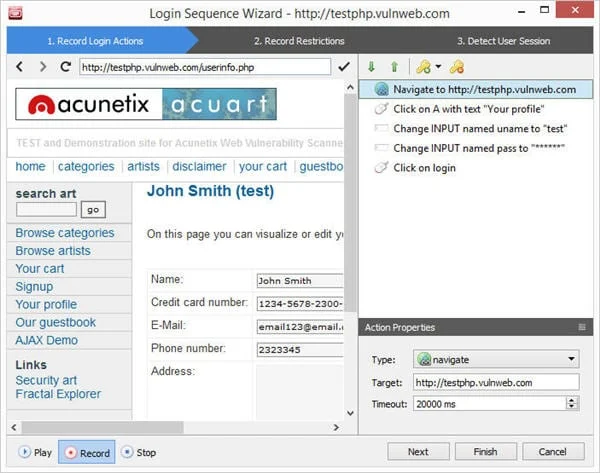
Scanning authenticated sections of a website historically presented bottlenecks for automated tools. Acunetix solves this through its Login Sequence Recorder:

- Recording: The user performs a standard login on the target site; the recorder captures every action.
- Replay & Restriction: Users can verify the script via the playback feature and restrict sensitive links (such as "Logout" buttons or nonces) to prevent the scanner from inadvertently terminating its own session.
- Session Patterns: The scanner automatically detects unique markers to differentiate between logged-in and logged-out states.
4. Scan Optimization and Fingerprinting
Rather than wasting processing cycles running irrelevant checks, Acunetix fingerprints the web application’s technology stack. For instance, if a site is identified as running PHP, the scanner bypasses tests specific to ASP.NET environments, drastically reducing audit times.

Supporting Data: Advanced Engines and Deep Analysis
Beyond traditional black-box crawling, Acunetix incorporates cutting-edge technology stacks that elevate scanning accuracy and minimize false positives.

The DeepScan Engine for Modern Web Apps
Modern web applications rely heavily on single-page frameworks, AJAX, and complex JavaScript. Standard crawlers often fail to parse these environments. Acunetix integrates a DeepScan Engine—a fully functional headless browser working in tandem with the crawler. This allows the scanner to:

- Execute and interact with dynamic JavaScript and HTML5 elements.
- Uncover DOM-based XSS vulnerabilities with high precision.
- Generate a comprehensive DOM stack trace, illustrating exactly how an XSS payload flows through the browser.
AcuSensor: Bridging Black-Box and Source Code Analysis
While black-box scanners cannot observe backend code execution during runtime, static code analyzers lack runtime context. Acunetix bridges this gap via AcuSensor, an optional server-side component for PHP and .NET applications enabling Interactive Application Security Testing (IAST).

AcuSensor communicates directly with the scanner, providing visibility into backend behavior. It can uncover vulnerabilities in hard-to-reach areas—such as INSERT statement SQL injections—and pinpoint the exact file and line of vulnerable code, vastly accelerating remediation timelines.

AcuMonitor for Second-Order Vulnerabilities
Certain vulnerabilities do not yield immediate responses during initial testing. Known as second-order vulnerabilities, these include Blind/Delayed XSS, XML External Entity Injection (XXE), Server-Side Request Forgery (SSRF), and Out-of-Band SQL Injection.

Acunetix addresses this through AcuMonitor, a background intermediary service. By routing out-of-band requests through AcuMonitor, the scanner effortlessly captures and reports these hidden threats without user intervention.

Official Responses and Remediation Framework
Discovering a vulnerability is only half the battle; remediation dictates the true value of a security audit. Acunetix WVS excels by providing structured, context-aware reporting and verification mechanisms.

- Detailed Alert Breakdown: Selecting a detected vulnerability (such as an SQL Injection) exposes the vulnerable input parameter, attack variations, technical summaries, potential business impacts, and external reference URLs.
- The Retest Feature: Instead of running a full scan from scratch to verify if a patch was successful, analysts can utilize the Retest feature. By right-clicking an alert and selecting Retest alert(s), the software re-runs specific tests. Successfully resolved vulnerabilities are clearly marked in a grey, strike-through font.
- Robust Reporting Suite: Acunetix generates multiple report formats (PDF, HTML) tailored to diverse stakeholders:
- Executive Summaries: High-level overviews for management.
- Compliance Reports: Pre-formatted documentation mapped to regulatory standards like OWASP Top 10, PCI-DSS, and HIPAA, updated regularly to match evolving compliance mandates.
- Developer Reports: Granular technical documentation containing debugging information and remediation guidelines.
Implications for Modern Software Development
The integration of tools like Acunetix WVS into the enterprise ecosystem carries profound implications for software development lifecycles (SDLC):

- Shift-Left Security: By embedding automated vulnerability scans and utilizing developer-friendly reports early in the development pipeline, organizations can remediate security flaws during the coding phase rather than post-deployment, significantly lowering remediation costs.
- Bridging the DevSecOps Gap: The inclusion of intuitive login recorders, IAST capabilities via AcuSensor, and comprehensive re-testing mechanisms bridges the historic divide between development teams and security auditors.
- Regulatory Compliance Readiness: With automated mapping to frameworks like PCI-DSS and HIPAA, companies can streamline audit preparations, ensuring that customer data and digital infrastructure remain resilient against evolving cyber threats.
Conclusion
Acunetix Web Vulnerability Scanner remains a robust, comprehensive solution for organizations striving to secure their web footprints. By combining intelligent black-box reconnaissance, headless browser execution via DeepScan, and IAST precision through AcuSensor, it equips security professionals and software engineers alike with the tools necessary to defend the digital frontier.