Securing the Digital Perimeter: A Comprehensive Review of Acunetix Web Vulnerability Scanner
In an era where web applications serve as the primary gateway for global commerce, data management, and communication, the security of the application layer has never been more critical. As businesses increasingly migrate operations to the cloud, the "attack surface"—the total sum of vulnerabilities that an attacker can exploit—has expanded exponentially. Consequently, the integration of automated security auditing into the software development life cycle (SDLC) has transitioned from a best practice to an absolute necessity.

Among the various tools designed to combat these evolving threats, the Acunetix Web Vulnerability Scanner (WVS) stands out as a industry-standard solution. This article provides an in-depth examination of Acunetix WVS, exploring its technical capabilities, its role in modern cybersecurity, and the impact it has on the professional testing landscape.

Main Facts: What is Acunetix WVS?
Acunetix WVS is a sophisticated, automated security testing tool engineered to identify vulnerabilities at the web application layer. Founded on the principle that the most effective defense is a proactive, simulated attack, the software audits websites by launching a controlled series of exploit attempts against them.

The core strength of the tool lies in its ability to detect the "OWASP Top 10" vulnerabilities—a list of the most critical security risks to web applications, including SQL Injection, Cross-Site Scripting (XSS), and Broken Authentication. Unlike simple scanners that merely crawl a site, Acunetix employs a multi-layered approach to identify, verify, and suggest remediation strategies for security flaws.

Key Capabilities:
- Black-Box Testing: The scanner operates without prior knowledge of the target’s backend infrastructure, effectively mimicking the perspective of an external malicious actor.
- DeepScan Engine: Utilizing a headless browser, this engine parses JavaScript and AJAX-heavy applications, allowing it to interact with complex, modern web frameworks that traditional scanners often fail to interpret.
- AcuSensor Technology: An optional, server-side IAST (Interactive Application Security Testing) component that provides deep visibility into code execution, mapping vulnerabilities directly to specific lines of source code.
- AcuMonitor: An out-of-band detection service that identifies "second-order" vulnerabilities, such as Blind XSS and Server-Side Request Forgery (SSRF), which do not produce immediate, visible responses.
Chronology of the Testing Workflow
To understand the efficacy of Acunetix WVS, it is essential to observe its operational flow. The tool is designed to be user-centric, beginning with a "Scan Wizard" that streamlines the complex process of security configuration.

1. Preparation and Configuration
The initial phase involves defining the target. Users input the target URL and utilize the Scan Wizard to select a "Scanning Profile." These profiles are essentially curated sets of tests; while the "Default" profile runs an exhaustive battery of checks, advanced users can create custom profiles to focus on specific high-risk areas, significantly reducing scan times for large-scale enterprise applications.

2. Crawling and Fingerprinting
Before testing begins, the scanner performs an intelligent crawl. It fingerprints the technology stack—identifying whether the server runs PHP, ASP.NET, Java, or Ruby on Rails. This is a critical efficiency step; for instance, if the scanner detects a PHP environment, it will automatically exclude tests specific to ASP.NET, thereby streamlining the process and reducing the probability of false positives.

3. Authentication and Session Management
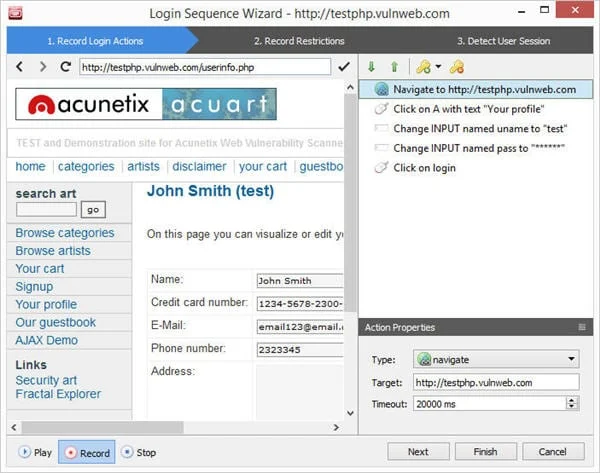
Modern applications are rarely static; most require authenticated access. Acunetix features a robust "Login Sequence Recorder." By navigating the site as a user would, the tool records the necessary interaction steps, including form submissions and multi-step logins. It then monitors "Session Patterns" to ensure the scanner remains logged in throughout the testing phase, preventing premature session termination.

4. Analysis and Reporting
Once the crawl and attack simulation are complete, the tool generates a detailed report. These reports range from high-level "Executive Summaries" for management to granular "Developer Reports" that provide exact payloads, affected parameters, and specific code-level remediation steps.

Supporting Data: Why Automated Scanning Matters
The reliance on manual penetration testing alone is no longer sustainable. According to recent cybersecurity industry data, the average time to identify a breach in a web application can stretch into months if automated, continuous monitoring is not in place.

Acunetix provides a measurable return on investment by:

- Reducing "Time-to-Remediate": By pinpointing the exact line of vulnerable code via AcuSensor, development teams can slash the time spent debugging security flaws by upwards of 60%.
- Ensuring Compliance: For organizations subject to PCI-DSS, HIPAA, or ISO 27001, the tool provides automated, up-to-date compliance reporting. This ensures that security postures remain aligned with evolving regulatory requirements without the need for manual audit preparation.
- Continuous Integration: The ability to integrate scanning into CI/CD pipelines ensures that security is not a final hurdle before deployment, but a constant, automated check throughout the development lifecycle.
Official Responses and Industry Reception
The security community has long regarded Acunetix as a reliable, albeit powerful, instrument. Its longevity in the market—spanning over a decade of rapid web evolution—speaks to the vendor’s ability to pivot alongside the technology landscape.

Security professionals often highlight the "Retest" feature as a significant differentiator. When a vulnerability is patched, the tester does not need to re-run the entire scan. Instead, they can right-click the specific vulnerability, select "Retest," and the tool validates the fix in isolation. This functionality has been praised in technical forums for its focus on developer efficiency and project velocity.

However, industry experts also note that no tool is a "silver bullet." The consensus among security auditors is that while Acunetix handles the heavy lifting of known vulnerability patterns, it should be part of a "Defense in Depth" strategy that includes human-led penetration testing, secure code reviews, and threat modeling.

Implications: The Future of Web Vulnerability Management
The shift toward "DevSecOps"—the integration of security into the DevOps culture—has profound implications for tools like Acunetix. As applications become more decentralized and reliant on APIs and microservices, the demand for scanners that can operate at the speed of deployment is surging.

1. The Death of the "Scan and Forget" Mentality
The traditional approach of performing an annual security scan is effectively obsolete. The rapid deployment cycles of modern web applications require continuous, incremental scanning. Acunetix’s ability to handle complex, headless, and JavaScript-heavy interfaces positions it well for this reality.

2. The Rise of IAST
The integration of IAST, through components like AcuSensor, represents the next frontier in application security. By moving beyond black-box analysis and into the realm of instrumentation, scanners can provide the context necessary to reduce "security alert fatigue"—a condition where developers ignore reports due to the overwhelming volume of false positives.

3. Compliance as a Constant
As governments and industries implement stricter data protection laws (such as GDPR or CCPA), the burden of proof for security falls on the business. Automated, report-generating tools like Acunetix are becoming essential for legal and compliance departments, providing an audit trail that proves "due diligence" has been performed.

Conclusion
Acunetix Web Vulnerability Scanner remains a formidable force in the cybersecurity arsenal. By balancing the ease of use—represented by its intuitive Wizards and Recorder tools—with the raw power of deep analysis engines, it addresses the dual needs of software developers and security auditors.

For businesses looking to secure their web presence against an increasingly hostile digital landscape, the implementation of a professional-grade scanner is an essential step. While the technical sophistication of the tool is impressive, its true value lies in its ability to translate complex security threats into actionable intelligence, allowing organizations to move from a reactive posture to a proactive, resilient state of defense.

As we look toward the future of web development, the integration of such tools will only grow in importance. Security is no longer an optional layer added at the end; it is the foundation upon which trust, functionality, and business continuity are built.

Have you integrated automated vulnerability scanning into your development pipeline? Do you find that tools like Acunetix effectively bridge the gap between security and development teams? Share your experiences and feedback in the comments section below.