Securing the Digital Perimeter: A Comprehensive Review of Acunetix Web Vulnerability Scanner
In an era where web applications serve as the primary gateway for global commerce, data management, and communication, the threat landscape has grown exponentially more sophisticated. As businesses digitize their operations, the attack surface for malicious actors has expanded, making web application security not just a technical necessity, but a critical pillar of business continuity. Among the suite of tools designed to fortify these digital assets, the Acunetix Web Vulnerability Scanner (WVS) stands out as a foundational instrument for security auditing.

This article provides an in-depth examination of the Acunetix WVS, exploring its capabilities, its methodology for identifying high-risk vulnerabilities such as SQL Injection and Cross-site Scripting (XSS), and its role in modern DevSecOps lifecycles.

Main Facts: What is Acunetix WVS?
Acunetix WVS is an automated web application security testing solution engineered to combat the prevalence of vulnerabilities within the application layer. At its core, the software functions as an intelligent, automated auditor that mimics the behavior of a malicious actor to uncover security gaps before they can be exploited.

The tool is designed to address the "OWASP Top 10"—a standard awareness document for developers and web application security—covering risks like broken access control, cryptographic failures, and injection attacks. By launching a series of controlled, simulated attacks, Acunetix provides security teams with actionable intelligence, including concise reporting and remediation guidance, effectively bridging the gap between detection and resolution.

Chronology of the Scanning Process
To understand the efficacy of the Acunetix WVS, it is essential to look at the lifecycle of a typical scan. The process is designed to be both user-friendly for beginners and granular enough for seasoned penetration testers.

1. Initiation and Configuration
The process begins with the Scan Wizard. Users define the target URL and select a Scanning Profile. These profiles are logical groupings of tests that allow for customization. For instance, a user might choose a "High-Risk Only" profile to expedite testing, or a "Full Audit" profile to ensure complete coverage.

2. Crawling and Fingerprinting
Once the scan begins, Acunetix performs intelligent fingerprinting. It analyzes the web application to identify the underlying technology stack—be it PHP, .NET, Java, or a specific Content Management System (CMS) like WordPress. By identifying the stack early, the scanner optimizes its operations, ignoring irrelevant test vectors and significantly reducing total scan time.

3. Authentication and Session Management
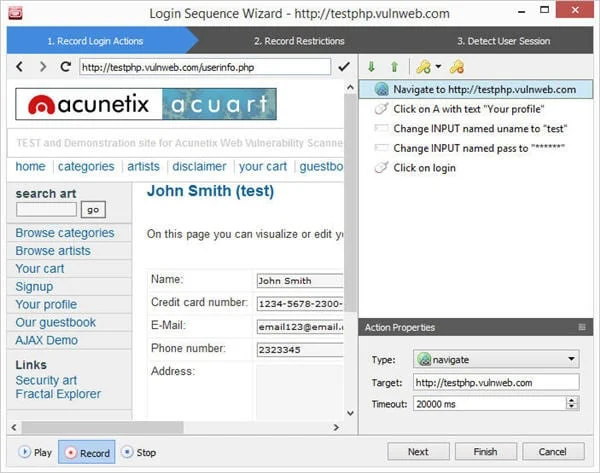
Modern web applications often hide their most sensitive data behind login forms. Acunetix features a robust Login Sequence Recorder. Instead of requiring complex manual configuration, users simply perform the login actions in a browser-like window. The tool records these steps, allowing the scanner to navigate authenticated areas while maintaining session persistence. It also identifies "Session Patterns," ensuring the scanner knows exactly when it has been logged out so it can re-authenticate automatically.

4. DeepScan and Dynamic Analysis
Using its proprietary DeepScan engine, the tool handles complex AJAX and JavaScript-heavy interfaces. By utilizing a headless browser, Acunetix can interact with the page as a user would, enabling it to detect DOM-based XSS with remarkable accuracy—a feat many legacy scanners fail to achieve.

Supporting Data: Technology Coverage and Advanced Features
The power of Acunetix lies in its multi-layered approach to security. While it operates primarily as a "black-box" scanner—testing without prior knowledge of the internal code—it offers optional, high-fidelity components that provide deeper insight.

The Role of AcuSensor (IAST)
The AcuSensor component represents the next evolution in security testing: Interactive Application Security Testing (IAST). By deploying a small sensor on the server-side (for PHP or .NET), the tool gains visibility into the execution environment. While a standard scanner might guess that an input is vulnerable, AcuSensor can point to the exact file and line of code responsible for the vulnerability. This drastically reduces the "Mean Time to Repair" (MTTR) for development teams.

The Power of AcuMonitor
Many modern attacks are "blind" or "second-order," meaning they do not return an immediate, visible response to the attacker. Vulnerabilities like Blind Out-of-Band SQL Injection or Server-Side Request Forgery (SSRF) require a third-party intermediary to report the activity. AcuMonitor serves as this "set-it-and-forget-it" technology, waiting in the background for callback signals from the target, effectively capturing vulnerabilities that would otherwise remain hidden from traditional scanners.

Official Perspectives: The Value of Automated Auditing
Security professionals often debate the merits of automated versus manual testing. However, the industry consensus—reflected in the design philosophy of Acunetix—is that automation is the only way to scale security.

In discussions with security auditors, the consensus is that Acunetix provides a "force multiplier" effect. By automating the identification of common vulnerabilities, security teams are freed to perform high-level manual penetration testing and complex business logic assessments. The tool does not replace the human expert; it provides the expert with a comprehensive roadmap of the low-hanging fruit, allowing them to focus on the sophisticated, high-value vulnerabilities that automated tools might miss.

Implications for Modern Business
The integration of a tool like Acunetix WVS has profound implications for the software development lifecycle (SDLC).

1. Compliance and Governance
For organizations operating in regulated industries, maintaining compliance with standards such as PCI-DSS, HIPAA, and the GDPR is non-negotiable. Acunetix provides dedicated reporting modules that map scan results directly to these compliance frameworks. This ensures that security reports are not just technical documents, but governance tools that can be presented to auditors and stakeholders.

2. Developer Empowerment
One of the most significant barriers to secure development is the "friction" between security teams and developers. By providing detailed, context-rich alerts—complete with remediation steps and links to further documentation—Acunetix turns the security report into a developer-friendly bug report. This fosters a culture of "shifting left," where security is integrated into the earliest stages of development rather than being a final, painful hurdle before deployment.

3. Continuous Security
The "Retest" feature in Acunetix is a testament to the need for iterative development. Rather than re-running an entire scan, developers can fix a specific issue and trigger a targeted retest. If the vulnerability is confirmed as resolved, the system updates the status automatically. This loop is essential for Agile and DevOps teams who deploy updates frequently and need immediate feedback on the security of their latest code changes.

Conclusion: A Proactive Stance on Security
In the current digital landscape, the cost of a data breach—both in financial terms and brand reputation—is astronomical. Relying on periodic manual audits is no longer sufficient. As this review has demonstrated, the Acunetix Web Vulnerability Scanner provides a robust, intelligent, and highly automated platform for maintaining a secure web presence.

Whether through its advanced DeepScan engine, the precision of AcuSensor, or the second-order detection capabilities of AcuMonitor, the tool addresses the multifaceted nature of modern web attacks. For any organization serious about its security posture, adopting a tool like Acunetix is a decisive step toward safeguarding its digital future.

As we continue to build more complex and interconnected applications, the tools that secure them must evolve with equal velocity. Acunetix remains a key player in this ongoing battle, providing the visibility, accuracy, and efficiency required to stay one step ahead of those who would do us harm.