The Evolution of the Hacker’s Toolkit: An In-Depth Look at Flipper One
In the ever-evolving landscape of cybersecurity and hardware hacking, few names have garnered as much cult-like devotion as the Flipper Zero. Originally conceived as a portable multi-tool for pentesting and hardware experimentation, the device became a global phenomenon, bridging the gap between academic theory and practical, "in-the-field" application. However, the community has long clamored for more: more power, more connectivity, and, most importantly, more Linux.
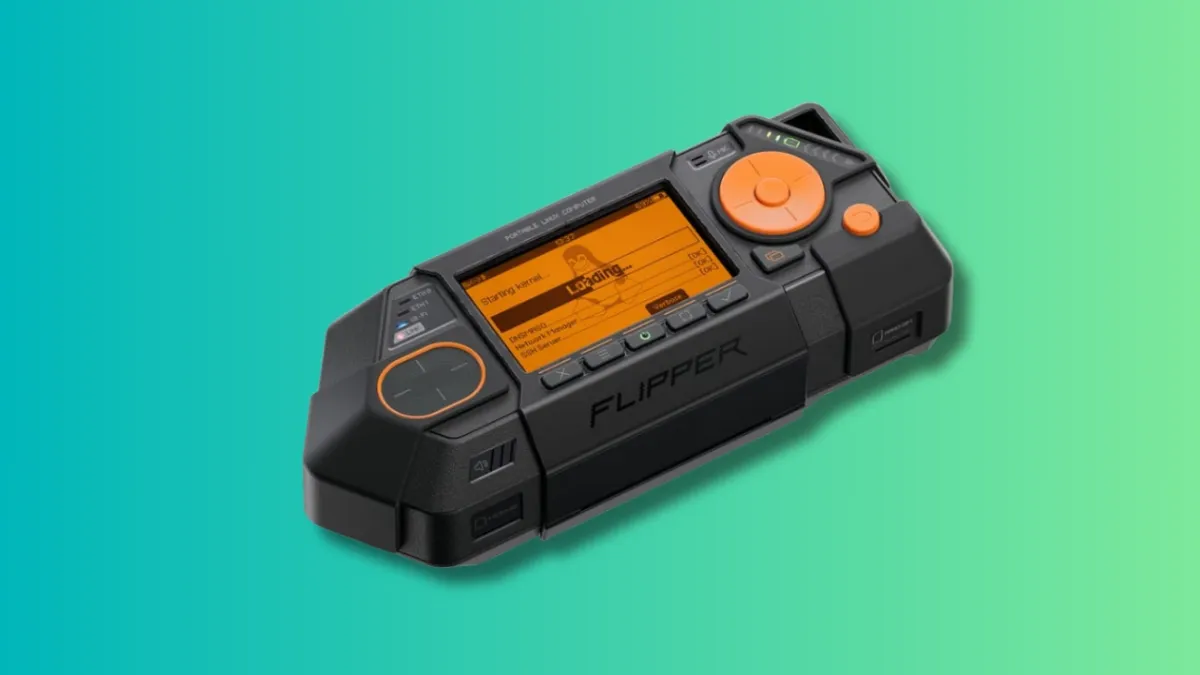
Enter the Flipper One. While the Flipper Zero mastered the offline world of NFC, RFID, and infrared, the Flipper One is poised to redefine the "cyberdeck" paradigm. It is not merely an iterative upgrade; it is a fundamental shift toward a fully networked, mainline Linux-based portable computer designed for the modern security researcher.
Main Facts: A New Breed of Cyberdeck
At its core, the Flipper One is designed to be the "Swiss Army knife" for IP networks across all OSI layers. Unlike its predecessor, which operated primarily on an MCU-based architecture, the Flipper One integrates a full-fledged Linux environment. This allows it to function as a bridge for multi-hotspot networks, an inline Ethernet sniffer, a secure VPN gateway, or even a sophisticated USB-based network adapter for other machines.
The device represents a radical departure from the "black box" philosophy prevalent in consumer electronics. By committing to a design free of proprietary binary blobs, the Flipper team is setting a new standard for transparency. The device is built to be an open-source sandbox where the only limit is the user’s expertise and imagination.
Chronology: From Concept to Community-Driven Development
The journey of the Flipper One began in the wake of the Flipper Zero’s massive success. Recognizing that the community needed a device capable of handling the complexity of modern networking, the Flipper team began the arduous task of designing a system that balances extreme portability with desktop-class functionality.
- Initial Design Phase (2024-2025): The team focused on the hardware architecture, ensuring that the integration of both an ARM-based CPU and an MCU could coexist efficiently. This dual-architecture design was essential to achieving the "always-on" capability of the MCU while reserving the CPU for heavy lifting.
- The "Open Everything" Mandate (Early 2026): The decision was made to eschew proprietary blobs entirely. This required a monumental effort to source and write open-source drivers for every hardware component.
- The Developer Portal Launch (Mid-2026): Moving away from closed-door development, the team launched a public Developer Portal, inviting the global community to participate in documentation, software optimization, and hardware design refinement.
- Current State: The device remains in active development, with a roadmap that prioritizes kernel stability and the refinement of the FlipperCTL interface.
Technical Foundations and Hardware Specifications
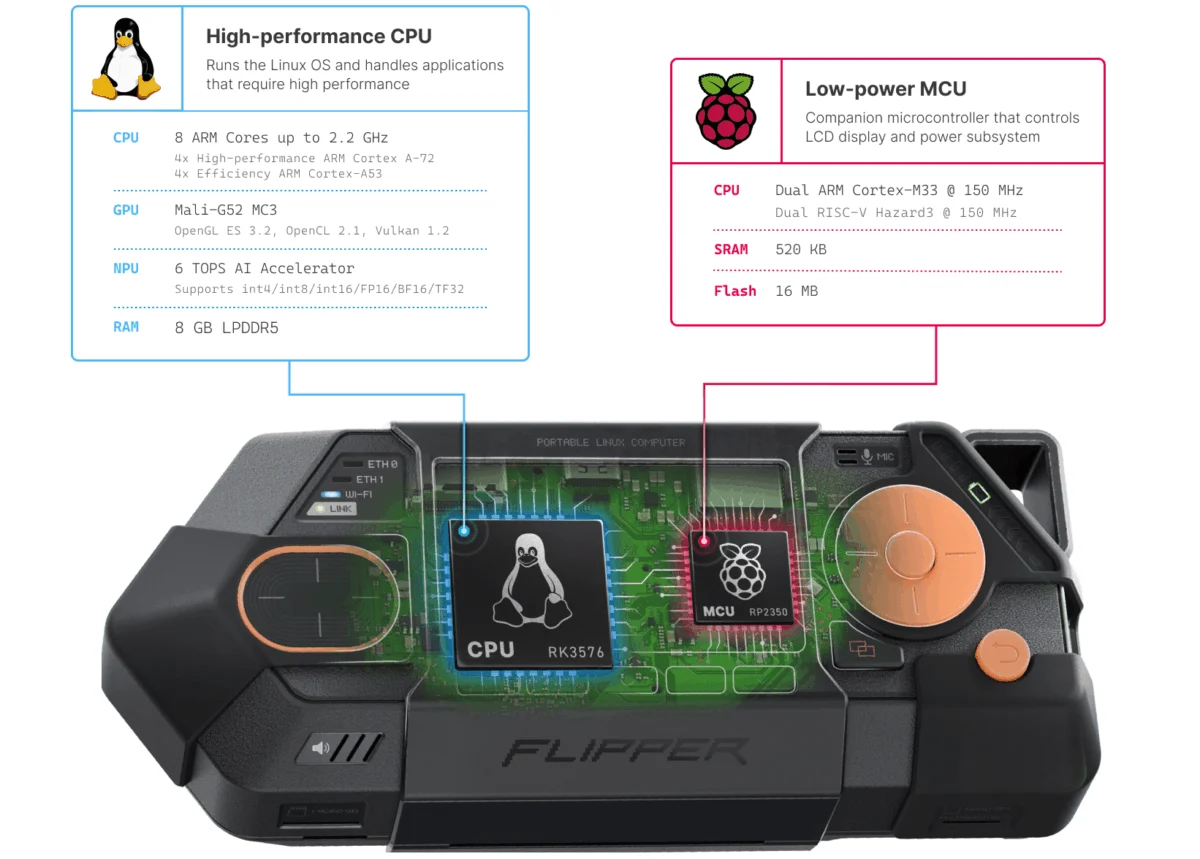
The hardware architecture of the Flipper One is a marvel of miniaturization. It is built around a custom board that accommodates both a high-performance ARM processor—comparable in raw throughput to a Raspberry Pi 5—and a secondary Microcontroller Unit (MCU).
The Dual-Processor Advantage
The presence of both a CPU and an MCU is a deliberate design choice. When the user is not actively engaged in intensive Linux-based tasks, the main CPU can be powered down to preserve battery life. The MCU remains active, handling low-power background operations, monitoring the buttons, and driving the monochrome 256x144px display. This ensures that the Flipper One can function as a basic utility tool for extended periods without requiring a charge.
Interface and Connectivity
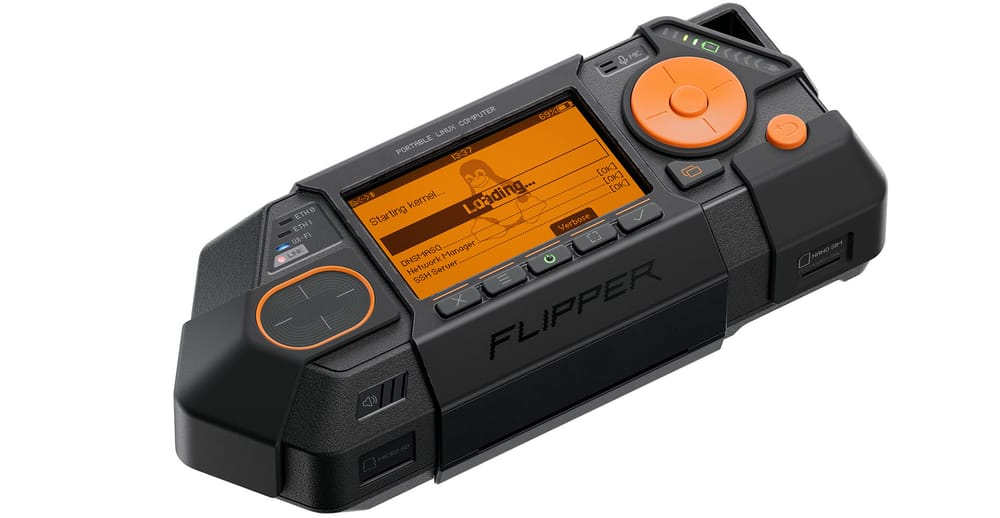
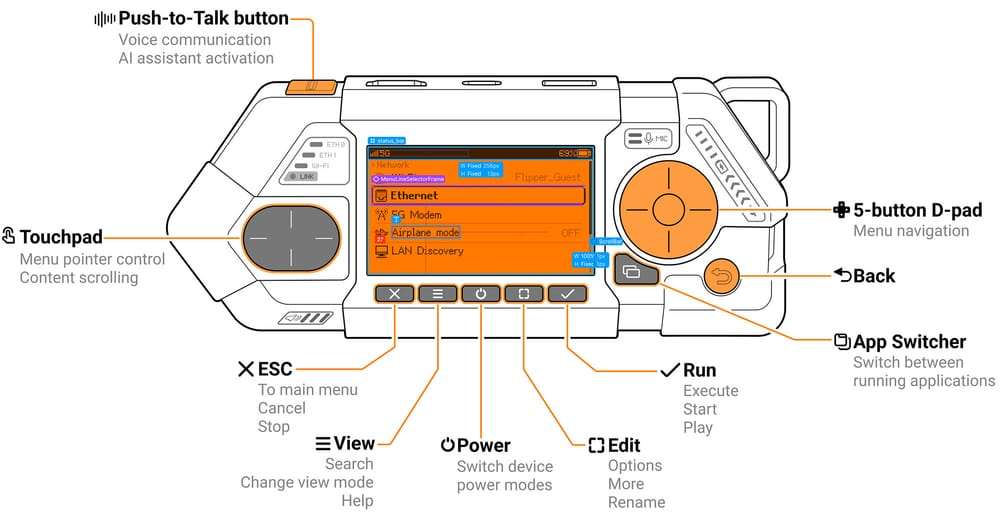
The device eschews a traditional touchscreen, favoring a more rugged, tactical input method. This includes:

- Tactile Controls: A 5-button D-pad, a dedicated back button, an app-switcher, and five function buttons (Power, Edit, Run, Escape, and View).
- Communication: A dedicated push-to-talk button triggers an integrated, pre-installed offline AI assistant, providing a hands-free way to query command-line syntax or troubleshoot network configurations on the fly.
- I/O Ports: The device is expected to house a comprehensive array of physical ports, including USB-C (for data, power, and video output), a dedicated Ethernet jack, and an expansion header for modular hardware add-ons.
Software Ecosystem: FlipperOS and FlipperCTL
The software stack is arguably the most ambitious component of the project. The team is developing FlipperOS, a custom distribution built upon the foundation of Debian. The goal is to provide a user-space environment that is both familiar to Linux power users and optimized for the unique constraints of the device.
To address the inherent difficulty of running desktop-grade Linux on a small-format display, the developers created FlipperCTL. This UI layer acts as an abstraction, wrapping complex command-line utilities—like nmap, ping, and traceroute—into an interface designed specifically for the D-pad and function buttons. It removes the need for a keyboard and mouse, allowing for rapid execution of common pentesting tasks in the field.
Furthermore, the developers have expressed interest in supporting full-featured desktop environments like KDE Plasma. When connected to an external monitor via the USB-C port, the Flipper One transforms into a portable workstation, effectively turning any HDMI-equipped display into a fully functional "hacker’s hub."
Supporting Data and Potential Use Cases
The versatility of the Flipper One allows for a wide range of use cases that go beyond traditional pentesting:
- Survival Desktop: A mobile, hardened environment that can be used for secure communication or sensitive document storage.
- Thin Client: By connecting to a remote server, the device acts as a gateway to cloud-based computing resources.
- Media Platform: By running software like Kodi, the device can act as a personal media server or "hacker’s TV box," making it an ideal travel companion for hotel stays where access to secure, private content is a priority.
- Network Forensics: The ability to act as an inline Ethernet sniffer makes it an invaluable tool for network administrators diagnosing complex traffic issues in real-time.
Official Responses and the "Open" Philosophy
The Flipper team has been remarkably candid about the challenges they face. In official communications via their developer portal, they have admitted that the transition to a fully open-source hardware and software stack is a "humongous task." By opening their internal documentation, task tracking, and even their debates to the public, they are fostering a level of trust rarely seen in the hardware industry.
They have explicitly stated that they are looking for more than just code. They are seeking industrial designers, 3D modelers to create custom enclosures, technical writers to document the complex APIs, and testers to put the hardware through its paces in diverse real-world environments.
Implications: The Future of User-Led Innovation
The Flipper One is more than just a gadget; it is a signal of a larger shift in the tech industry. For years, users have been forced to accept increasingly locked-down, "polished" corporate hardware that prioritizes vendor control over user autonomy. The Flipper One rejects this trend entirely.
By providing a device that is meant to be disassembled, customized, and re-engineered, Flipper is effectively democratizing the power of high-level networking. If successful, this project will likely inspire a new wave of modular, open-source devices that encourage rather than discourage user modification. It stands as a beacon of hope for the "tinkerer" demographic, proving that even in a world of proprietary ecosystems, there is still room for community-driven, radical innovation.
Conclusion: Joining the Movement
The development of the Flipper One is not a spectator sport; it is a collaborative effort. Whether you are a seasoned kernel developer, a UI/UX designer, or someone who simply enjoys the idea of a truly "free" computer, there is a place for you in this project.
The Flipper Developer Portal serves as the nerve center for this initiative. As the project matures, it will undoubtedly face hurdles regarding power management, thermal throttling, and software stability. However, the passion demonstrated by the Flipper team—and the enthusiasm of the community rallying behind them—suggests that these challenges will be met with the same ingenuity that defined their previous work.
For those interested in the cutting edge of portable computing, the Flipper One is not just a tool to wait for; it is a project to contribute to. By participating today, you are helping to shape a device that will likely define the next decade of mobile security research. The era of the open, pocket-sized cyberdeck has arrived, and it is in the hands of the community to ensure it reaches its full, disruptive potential.