The Ghost in the Circuit: How ‘InjectEave’ Reimagines the TEMPEST Threat
For decades, the field of information security has operated under the assumption that if a device is "air-gapped"—physically disconnected from the internet and external networks—it is essentially impervious to remote exploitation. This belief relies on the physical impossibility of data traversal across an open-air void. However, a groundbreaking new research paper has shattered this sense of security, demonstrating that the very laws of physics that govern electronic signals can be weaponized against modern devices.
The technique, dubbed InjectEave, represents a sophisticated evolution of TEMPEST (Telecommunications Electronics Material Protected from Emanating Spurious Transmissions) attacks. By turning everyday electronics into unwitting radio transmitters, researchers have proven that your smart home devices, VoIP phones, and audio equipment may be leaking sensitive data even when they appear perfectly secure.
The Core Mechanism: Exploiting Unintentional Antennas
To understand InjectEave, one must first understand the concept of the "unintentional antenna." Every electronic device contains conductive pathways—traces on a PCB, internal wiring, or even the leads of a component—that act as antennas. In most modern devices, these pathways are too small or poorly tuned to radiate a meaningful signal at the frequencies used by the device’s internal components. Consequently, modern electronics are generally "quiet," making them far less vulnerable to the classic TEMPEST eavesdropping methods used in the era of high-voltage, high-emission CRT monitors.
InjectEave changes the game by using a process called nonlinear mixing. Instead of waiting for a device to leak a signal, the attackers induce it.
How the Attack Works
The researchers utilize a targeted radio frequency (RF) signal to irradiate the target device. This frequency is specifically tuned to resonate with the device’s internal, unintentional antenna structures. When this external signal hits the device’s circuitry, it interacts with nonlinear components—such as amplifiers, power converters, and switching MOSFETs.
When the internal signal (the data being processed) and the injected external RF signal meet within these nonlinear components, they "mix." This interaction generates RF sidebands—modulated signals that carry the information of the internal data, but now at a frequency that is capable of radiating away from the device. This "new" signal is then broadcast into the surrounding environment, where it can be captured by a receiver and demodulated to recover the original audio or data stream.
A Chronology of Electronic Espionage
The history of TEMPEST is a cat-and-mouse game between intelligence agencies and hardware engineers.
- 1960s–1980s (The CRT Era): The Cold War era saw the birth of TEMPEST. Security agencies realized that the high-voltage flyback transformers in CRT displays generated massive amounts of electromagnetic interference. By monitoring these emissions from a distance, observers could reconstruct the text appearing on a screen.
- 1990s–2010s (The Shielding Era): As computing moved toward low-power, high-frequency components, manufacturers began implementing more rigorous electromagnetic compatibility (EMC) shielding. Attacks became significantly more difficult, requiring expensive, laboratory-grade equipment and proximity to the target.
- 2015–2023 (The Modern Renaissance): Researchers began demonstrating that even "quiet" devices leak data through unconventional side channels, such as power consumption fluctuations (power analysis) or acoustic noise (coil whine).
- 2026 (The InjectEave Breakthrough): The publication of the InjectEave research marks a paradigm shift. It moves the field from passive eavesdropping (listening for leaks) to active interrogation (forcing a device to speak).
Supporting Data and Experimental Results
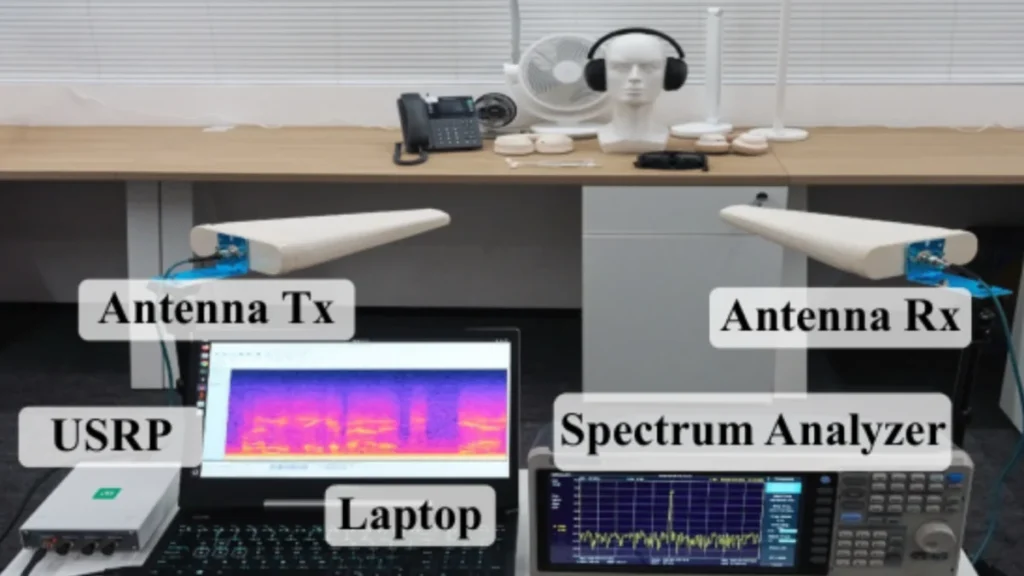
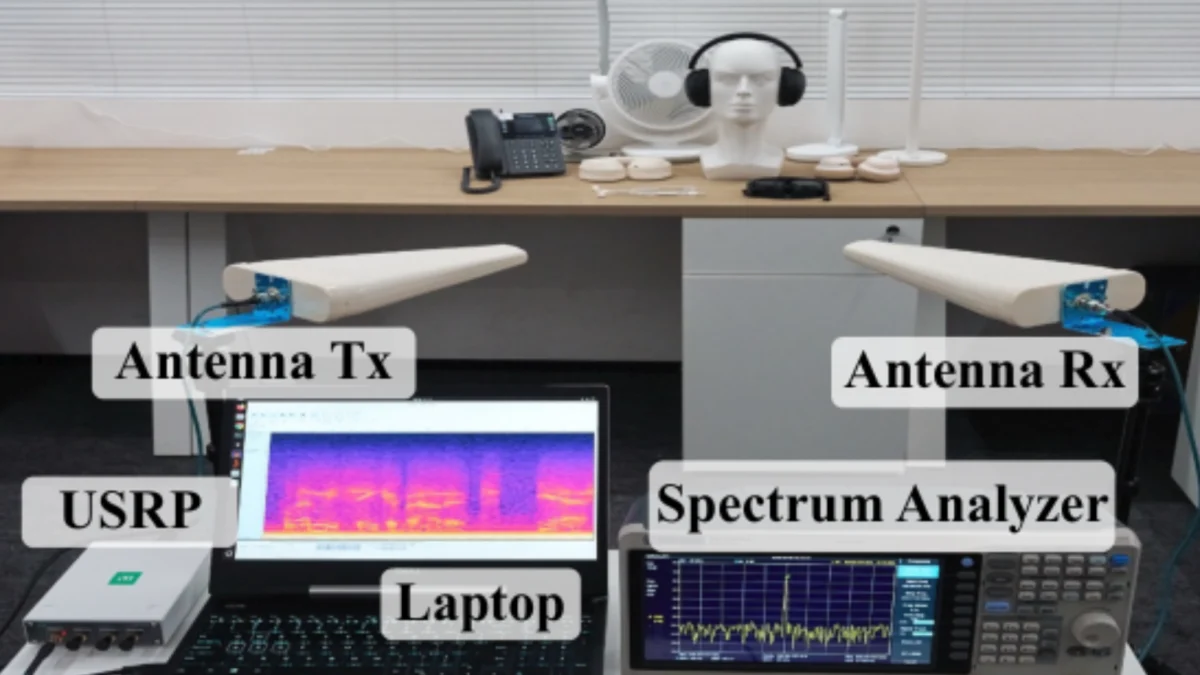
The research team behind InjectEave, utilizing a USRP B210 software-defined radio (SDR) and a spectrum analyzer, tested the efficacy of the technique across a variety of consumer electronics. The results were remarkably consistent, proving that the phenomenon is a fundamental characteristic of semiconductor physics rather than a flaw in a specific manufacturer’s design.
Success Across Hardware Types
The researchers successfully recovered data from:
- Wired and Wireless Headphones: Audio streams were intercepted with high fidelity.
- Wireless Landlines: Conversations were extracted by focusing the injection signal on the phone’s base station.
- Smart Home Appliances: The researchers were able to determine the operational state (on/off) of smart lamps and fans by monitoring the modulation of the injected RF signal.
- VoIP Telephony: The most concerning demonstration involved a VoIP phone. Not only could the researchers listen to the call, but by injecting a malicious signal, they were able to perform a "man-in-the-middle" attack, synthesizing voice data and injecting it back into the call in real-time.
Range and Precision
While the attack requires physical proximity, the researchers demonstrated that it could function through walls, effectively neutralizing standard physical barriers. Using a high-gain power amplifier, they achieved stable signal recovery from a distance of up to 30 meters. Perhaps most significantly, the researchers noted that the injection frequency is highly selective. By tuning the source to the specific resonant frequency of a device’s internal components, they could isolate one target in a room filled with multiple electronic devices, effectively "tuning in" to a specific target like a radio station.
Implications for Modern Security
The implications of the InjectEave findings are profound and necessitate a rethink of how we define "secure" hardware.
The End of Air-Gap Security
Historically, organizations handling sensitive state or corporate secrets have relied on air-gapping to protect against remote network intrusions. InjectEave demonstrates that the physical isolation of a system does not prevent it from being a target for remote interception. If an attacker can get a signal into a room, they can, in theory, turn any semiconductor-based device into a microphone or a data transmitter.
The Vulnerability of the Smart Home
For the average consumer, this technology represents a new frontier of privacy invasion. The proliferation of "smart" devices—which are often manufactured with minimal attention to electromagnetic security—creates a massive attack surface. A smart speaker, a connected thermostat, or a modern LED light bulb could theoretically be used to monitor the acoustics of a private residence.
Real-Time Manipulation
The ability to inject speech into a VoIP call is particularly chilling. This elevates the threat from simple surveillance to active manipulation. In a corporate or government context, the potential for social engineering via real-time voice synthesis and injection could lead to massive financial fraud or the exfiltration of sensitive authorization codes.
The Path Forward: Mitigation and Response
As of the date of this report, there is no simple "patch" for InjectEave. Because the vulnerability is rooted in the nonlinear physical properties of semiconductors and the inescapable nature of unintentional antennas, software updates cannot resolve the issue.
Potential Defensive Strategies
- Electromagnetic Shielding: While expensive, high-sensitivity environments (SCIFs—Sensitive Compartmented Information Facilities) may need to upgrade their RF-shielding (Faraday cages) to include a wider spectrum of attenuation.
- Hardware Redesign: Manufacturers could begin designing circuits with better filtering to prevent the mixing of external RF signals, though this would likely increase the cost and size of consumer electronics.
- Detection Systems: The research suggests that nonlinear junction detectors—often used to find hidden electronic bugs—could be adapted to detect the specific signatures of an InjectEave attack in progress.
Expert Commentary and Industry Response
While no formal policy response has been issued by major regulatory bodies like the FCC or the cybersecurity arms of national governments, the research has sent a shockwave through the information security community. Security researchers are already speculating that an open-source implementation of the InjectEave protocol is inevitable. Just as we have seen with previous TEMPEST-based attacks, once the "proof of concept" is public, the barrier to entry for malicious actors drops significantly.
The consensus among experts is that this research serves as a final wake-up call. We are living in an era where the hardware we trust is fundamentally "leaky." As we move forward, security must be considered at the silicon level, rather than just the software layer.
In conclusion, the InjectEave technique serves as a stark reminder that the digital world does not exist in a vacuum; it is anchored in the physical world. As long as our devices rely on electricity, they will follow the laws of electromagnetism—and as long as they follow those laws, they will remain susceptible to the silent, invisible prying of those who know how to listen.