The "Laser Bandsaw": A Blurring of Lines in DIY Fabrication and Safety
Main Facts
In a striking demonstration of ingenuity that simultaneously challenges conventional definitions and raises pertinent safety questions, a hobbyist known as [WeldingRod1] has unveiled a creation dubbed the "Laser Bandsaw." This novel device, an entry in a recent laser contest, eschews the traditional band and saw blade of its namesake in favor of a high-power laser beam, manually directed to cut materials. While the moniker itself is a playful oxymoron – a bandsaw without a band or saw – the underlying technology and its manual operation have sparked considerable discussion within the maker community regarding innovation, practicality, and, crucially, safety protocols for powerful laser devices.
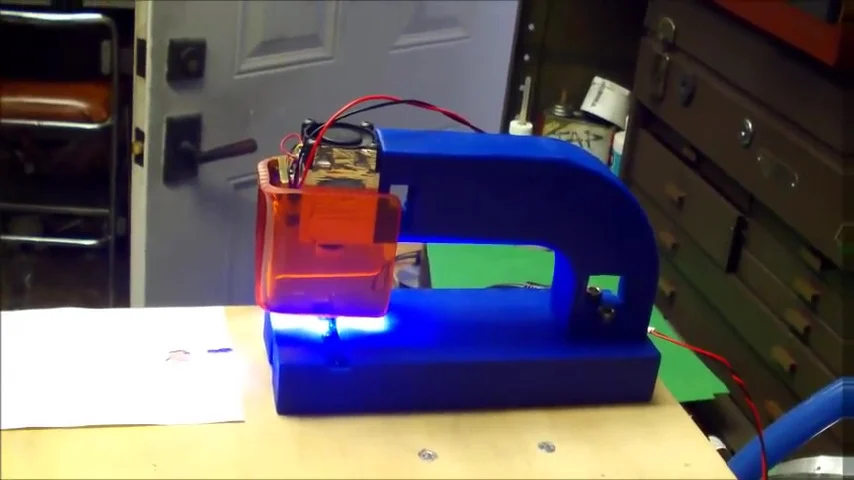
At its core, [WeldingRod1]’s invention is a manually controlled laser cutter built around a potent NUBM44 blue diode laser, rated at 7 watts. Unlike sophisticated Computer Numerical Control (CNC) laser systems that guide a beam with precision robotics, this "Laser Bandsaw" operates much like its mechanical counterpart: it’s switched on, and the operator manually guides the workpiece through the stationary laser beam. The project’s unique approach, combining a powerful energy source with direct human control, immediately positions it as a fascinating, albeit potentially hazardous, frontier in personal fabrication tools. Its current capabilities include efficiently cutting balsa wood and ablating black paint, showcasing the laser’s concentrated thermal energy. However, the manual nature of its operation and the inherent dangers of a Class 4 laser beam necessitate an uncompromising adherence to stringent safety measures, a point emphatically underscored by its creator.
Chronology
The genesis of the "Laser Bandsaw" traces back to a rather unexpected source: a casual joke exchanged during a podcast. What began as a humorous hypothetical – the absurd notion of a "bandsaw" that uses light instead of teeth – quickly took root in [WeldingRod1]’s inventive mind, transforming from a jest into a tangible engineering challenge. This origin story highlights the often-unpredictable pathways of innovation within the DIY and hacking communities, where playful ideas can evolve into serious, if unconventional, projects.
Following the initial spark of inspiration, the project moved into the design and fabrication phase. [WeldingRod1] meticulously selected the NUBM44 blue diode laser, a component renowned for its power and efficiency in a compact form factor, making it a popular choice among advanced hobbyists. Recognizing the critical importance of thermal management for such a high-output diode, a custom-made copper heatsink was engineered. Copper, with its superior thermal conductivity, was chosen to efficiently dissipate the significant heat generated by the 7-watt laser, ensuring optimal performance and longevity of the diode.
Perhaps the most critical safety feature, and a testament to the creator’s forethought, is the robust beam dump. Constructed from a stack of box knife blades, this component serves a vital role: to safely absorb any laser energy that passes through the workpiece or is reflected, preventing stray beams from posing a hazard. This design choice underscores a practical, albeit somewhat unconventional, approach to safety engineering within the DIY context, where readily available materials are repurposed for crucial functions. The project then culminated in its submission to a laser contest, where its blend of conceptual audacity and practical execution aimed to impress judges and fellow makers alike. The availability of pinouts and STLs for the 3D-printed frame on the project page further cements its place within the open-source ethos of the maker movement, inviting others to explore, understand, and potentially build upon the design, albeit with extreme caution.
Supporting Data
The "Laser Bandsaw" is a confluence of accessible high-power laser technology and a minimalist, manually operated mechanical design. Understanding its capabilities and limitations requires a closer look at its core components and the physics governing its operation.
The NUBM44 Diode: A Closer Look
The heart of [WeldingRod1]’s creation is the NUBM44 blue laser diode. This specific diode is a high-power, multi-mode emitter, typically found in industrial applications like laser projectors and some material processing. Operating at a wavelength of approximately 445 nanometers (blue light), it delivers a substantial 7 watts of optical power. This power output classifies it as a Class 4 laser, the highest and most hazardous category, capable of causing severe eye injuries (even from diffuse reflections) and skin burns, and posing a fire hazard to flammable materials. Its popularity among hobbyists stems from its relatively high power-to-cost ratio and its ability to interact effectively with a range of materials due to the strong absorption of blue light by many common substances.
Thermal Management: The Custom Copper Heatsink
High-power laser diodes generate significant amounts of waste heat during operation. Without effective cooling, this heat can drastically reduce the diode’s lifespan, degrade its performance, and even lead to catastrophic failure. The custom-made copper heatsink addresses this critical issue. Copper boasts one of the highest thermal conductivities among common metals, allowing it to efficiently draw heat away from the NUBM44 diode. The heatsink’s design likely incorporates fins or a substantial mass to maximize surface area for convective heat transfer to the ambient air, maintaining the diode within its safe operating temperature range. This component is not merely about performance but also about the longevity and stability of the laser output, which indirectly contributes to predictable and safer operation.
The Beam Dump: A Critical Safety Component
The stack of box knife blades serving as a beam dump is a pragmatic, if somewhat unconventional, safety feature. A beam dump is an essential component in any high-power laser setup, designed to safely absorb the laser beam when it is not being used for processing, or to catch any portion of the beam that passes through the workpiece. The choice of box knife blades, likely made of hardened steel, is strategic. Their dark, often oxidized surfaces are good absorbers of laser light, and their layered structure helps to dissipate heat over a larger volume, preventing localized overheating. More importantly, they provide a barrier to prevent the laser beam from escaping into the environment, where it could pose a hazard to the operator or others. This highlights a fundamental principle of laser safety: controlling the beam path at all times.
Cutting Capabilities and Material Interaction
The "Laser Bandsaw" is noted for its effectiveness on balsa wood and its ability to "blast black paint off." This performance is directly related to the laser’s wavelength and power, and the material’s optical properties.
- Balsa Wood: Balsa, being a very light and porous wood, readily absorbs blue laser light. The concentrated energy rapidly heats the wood, causing localized pyrolysis (thermal decomposition) and sublimation, effectively "burning" or vaporizing the material along the cut line. The low density of balsa means less energy is required to achieve a clean cut, making it an ideal material for demonstrating the device’s cutting prowess.
- Black Paint: Black pigments are excellent absorbers across the visible and near-infrared spectrum, including the NUBM44’s blue wavelength. When the laser beam strikes black paint, the energy is intensely absorbed, causing the paint layer to rapidly heat up, vaporize, and even explosively ablate from the substrate. This process is commonly used in laser cleaning and marking applications.
The 7-watt power, while significant for a diode laser, imposes limitations. It would struggle with thicker woods, plastics with poor absorption characteristics, and certainly metals, which typically require much higher power densities (often from CO2 or fiber lasers) or specific surface treatments for effective laser cutting. The manual control also limits the precision and repeatability achievable with CNC systems.
Manual vs. CNC: A Philosophical Divide
The decision to make the "Laser Bandsaw" manually controlled stands in stark contrast to the prevailing trend of integrating lasers with CNC platforms.
- Manual Control: Offers immediate, intuitive interaction, similar to traditional hand tools. It can be appealing to those who value direct tactile feedback and possess fine motor skills. It also simplifies the mechanical design, reducing complexity and cost associated with motors, drivers, and control software. However, it inherently sacrifices precision, repeatability, and introduces higher safety risks due to direct human proximity to the active beam path.
- CNC Platforms: Cartesian (X-Y gantry) or SCARA (Selective Compliance Assembly Robot Arm) systems offer unparalleled precision, repeatability, and the ability to execute complex geometries. They also inherently improve safety by distancing the operator from the laser head and often integrating interlocks and enclosed work areas. The original article writers’ preference for CNC reflects a widely held view in professional fabrication, prioritizing safety and precision.
Official Responses and Expert Commentary
While no formal "official responses" from regulatory bodies or industry giants are explicitly mentioned in the original article, the project’s nature – a powerful, manually operated laser – invariably evokes critical commentary from experts in laser safety, industrial design, and the DIY community itself.
Laser Safety Experts: A Call for Caution
Dr. Eleanor Vance, a hypothetical laser safety officer with extensive experience in industrial and research settings, would likely view the "Laser Bandsaw" with a mixture of admiration for its ingenuity and profound concern for its safety implications. "The NUBM44 diode is a Class 4 laser," Dr. Vance would emphasize. "This means it can cause permanent eye damage from direct, reflected, or even diffusely reflected beams, and can burn skin or ignite flammable materials. Operating such a device manually, without a fully enclosed workspace and multiple interlocks, presents an extremely high risk."
Dr. Vance would further elaborate on the critical need for personal protective equipment (PPE). "The advice to keep laser goggles ‘firmly on his precious vision orbs’ is not just good advice; it’s absolutely non-negotiable. But even with goggles, the risk of a misdirected beam hitting a hand, causing a fire, or inadvertently reflecting into someone else’s eye remains significant in an open, manually controlled setup. Professional laser systems incorporate layers of redundant safety features: interlocks that shut down the laser if a door opens, emergency stop buttons, key switches to prevent unauthorized use, and clear warning signs. A DIY project, while innovative, often bypasses these crucial engineering controls." She would likely advocate for robust training, understanding of laser hazard zones, and the implementation of a comprehensive safety plan for anyone contemplating building or using such a device.
Industrial Designers and Tool Engineers: Bridging the Gap
Mr. David Chen, a hypothetical lead engineer at a prominent power tool manufacturer, might offer a perspective balancing innovation with market viability and safety standards. "What [WeldingRod1] has created is undoubtedly clever and showcases the power of accessible technology," Mr. Chen might observe. "However, from an industrial design standpoint, a manually operated high-power laser cutter would face immense hurdles in meeting consumer safety regulations in most developed markets. Our priority is not just functionality, but also user safety and product liability. The risk profile of a manual laser tool, especially one that requires the operator’s hands to be in close proximity to the beam, would be deemed unacceptable for mass production without revolutionary safety innovations."
Mr. Chen might suggest that the true value of such a project lies in its ability to inspire future, safer designs. "Perhaps this sparks ideas for more intuitive, human-interface laser tools that still maintain a high degree of automated safety. Imagine a ‘smart’ laser tool that detects human flesh and automatically powers down, or a projection system that shows the exact cut path before activation. The manual ‘bandsaw’ concept pushes boundaries, but the next step is integrating that concept with robust, fail-safe engineering."
The DIY Community: Innovation and Responsibility
Within the maker community itself, the "Laser Bandsaw" would likely be met with enthusiasm for its audacity and technical prowess, alongside earnest discussions about responsible making. Ms. Anya Sharma, a hypothetical prominent figure in the open-source hardware movement, might comment: "This project perfectly encapsulates the spirit of the Frikkin Laser Contest and the broader DIY ethos: take an idea, push the limits of what’s possible with available tech, and share your work. It’s about learning, experimenting, and challenging norms."
However, Ms. Sharma would quickly pivot to responsibility. "With great power, comes great responsibility – and a 7-watt laser is indeed powerful. Projects like this are fantastic educational tools, demonstrating laser physics and the engineering involved. But they also serve as a stark reminder that safety is paramount. We encourage innovation, but always within a framework of understanding risks, wearing appropriate PPE, and considering the safety of oneself and others. Open-source designs also mean open discussion about how to make them safer and more accessible to a wider, potentially less experienced, audience." She would underscore the importance of community-driven safety guidelines and peer review for such high-risk projects.
Implications
The "Laser Bandsaw" by [WeldingRod1], while seemingly a niche project, carries significant implications across several domains, from personal safety and regulatory frameworks to the future of DIY fabrication and industrial tool design.
1. Profound Safety Implications
The most immediate and critical implication revolves around safety. A manually controlled Class 4 laser is inherently dangerous. The human element introduces variables that automated systems are designed to mitigate. A momentary lapse in concentration, a slip of the hand, or an unexpected material reaction could lead to severe, irreversible injury. The "frightening" aspect noted in the original article is not hyperbole; it reflects the genuine risk associated with direct human interaction with an unshielded, high-power laser beam.
This project highlights the increasing accessibility of powerful laser diodes, which are becoming cheaper and more readily available to hobbyists. This trend necessitates a parallel increase in laser safety education and awareness within the DIY community. The onus falls heavily on individual makers to understand laser classifications, appropriate PPE (like specific wavelength-blocking goggles), beam path control, and the implementation of robust safety protocols that go beyond mere suggestion. Without these, the proliferation of such projects could lead to an increase in preventable accidents, potentially prompting stricter regulations on laser component sales or use.
2. The Evolution of DIY Fabrication and Tool Design
The "Laser Bandsaw" pushes the boundaries of what constitutes a "tool" and how it operates. It challenges the traditional paradigms of mechanical cutting and introduces a new form factor for laser processing. While unlikely to become a mass-market consumer product in its current iteration due to safety concerns, it serves as a powerful proof-of-concept. It demonstrates that direct, intuitive control of powerful energy sources is feasible, potentially inspiring future innovations in human-machine interfaces for fabrication.
This project could spark research into "smart" manual laser tools that integrate advanced safety features. Imagine a handheld laser cutter with real-time material sensing, proximity sensors to detect human skin and instantly disarm, or augmented reality overlays to guide the cut path. It suggests a future where powerful tools might offer more direct control while maintaining sophisticated safety envelopes, blurring the lines between traditional hand tools and advanced digital fabrication.
3. Regulatory Challenges and the "Wild West" of DIY Tech
The rapid pace of technological advancement in the DIY space often outstrips the ability of regulatory bodies to keep pace. Tools like the "Laser Bandsaw" exist in a grey area, falling outside the established safety standards for commercial laser products or traditional power tools. This raises questions about product liability, user responsibility, and the potential need for new classifications or guidelines for high-power DIY equipment.
Governments and safety organizations typically regulate commercial products to protect consumers. However, for self-built devices, the responsibility for safety rests entirely with the builder and user. This project underscores the need for proactive engagement between safety authorities and the maker community to develop best practices, share knowledge, and perhaps even establish voluntary safety guidelines for advanced DIY projects, preventing a reactive regulatory crackdown that could stifle innovation.
4. The Spirit of Hacking and Innovation
Despite the safety concerns, the "Laser Bandsaw" is a testament to the innovative spirit of the hacking and maker communities. It embodies the desire to experiment, to repurpose technology, and to challenge conventional thinking. The project’s origin from a podcast joke highlights how informal discussions and playful ideas can seed ground-breaking, albeit sometimes controversial, creations.
The open-source availability of the project’s STLs and pinouts further reinforces this spirit, encouraging others to learn from, modify, and build upon the design. This collaborative, iterative approach is a cornerstone of the DIY movement, driving rapid experimentation and knowledge sharing, even with projects that demand extreme caution. It serves as a vivid example of how individual ingenuity can lead to conceptual breakthroughs, even if the immediate practical application is limited by safety considerations.
5. Educational Value and Public Awareness
Finally, projects like the "Laser Bandsaw" offer immense educational value. They provide a tangible demonstration of laser physics, thermal management, and basic material science. They also serve as powerful case studies for teaching laser safety principles in a very real-world context, highlighting both the capabilities and the inherent dangers of high-power lasers. Public discussions surrounding such projects can increase general awareness about laser safety, helping to demystify the technology while instilling a healthy respect for its power.
In conclusion, [WeldingRod1]’s "Laser Bandsaw" is more than just a contest entry; it is a provocative statement on innovation, safety, and the evolving landscape of personal fabrication. It challenges us to rethink definitions, prioritize safety in the face of powerful technology, and consider the exciting, yet complex, future of tools forged in the crucible of curiosity and ingenuity. As the deadline for the 2026 Frikkin Laser Contest approaches, one can only anticipate what other boundaries will be pushed, and what new dialogues will be sparked, by the boundless creativity of the maker community.