Ubuntu’s AI Evolution: Inside "Myna," the New Localized Speech-to-Text Engine

The landscape of the modern desktop is undergoing a fundamental transformation. As artificial intelligence moves from the experimental fringes into the core of operating system design, Canonical—the force behind Ubuntu—is taking a measured, privacy-first approach. Following a strategic roadmap unveiled earlier this spring, the company has officially introduced Myna, an innovative speech-to-text (STT) engine destined to debut in Ubuntu 26.10 this October.
This development represents a significant milestone in Ubuntu’s integration of "implicit AI," marking the first tangible step in a broader effort to bake machine intelligence into the GNOME desktop environment without compromising user sovereignty.
The Genesis of Myna: A Strategic Roadmap
In April, Jon Seager of Canonical outlined a two-pronged philosophy for AI integration within Ubuntu. The framework distinguishes between "implicit AI," which operates quietly in the background to refine existing workflows, and "explicit AI," which involves active user interaction.
Myna falls squarely into the former category. By embedding dictation capabilities directly into the operating system, Canonical aims to bring Ubuntu’s accessibility standards in line with modern platforms like macOS and Windows, where native voice-to-text has long been a staple for productivity and inclusivity.
The project, which has been in internal development for several months, recently broke cover on the official Ubuntu Discourse forums. While the current GitHub repository for Myna is skeletal—containing little more than architectural documentation and licensing—the speed at which it has moved from a concept in April to a planned release for Ubuntu 26.10 suggests a well-resourced and prioritized effort by Canonical’s desktop team.
Architecture and Technical Implementation
The engineering challenge behind building a system-wide dictation tool is substantial. To ensure a seamless user experience, Canonical has designed Myna as a modular, sandboxed architecture that prioritizes performance and privacy in equal measure.

The Three-Layered Approach
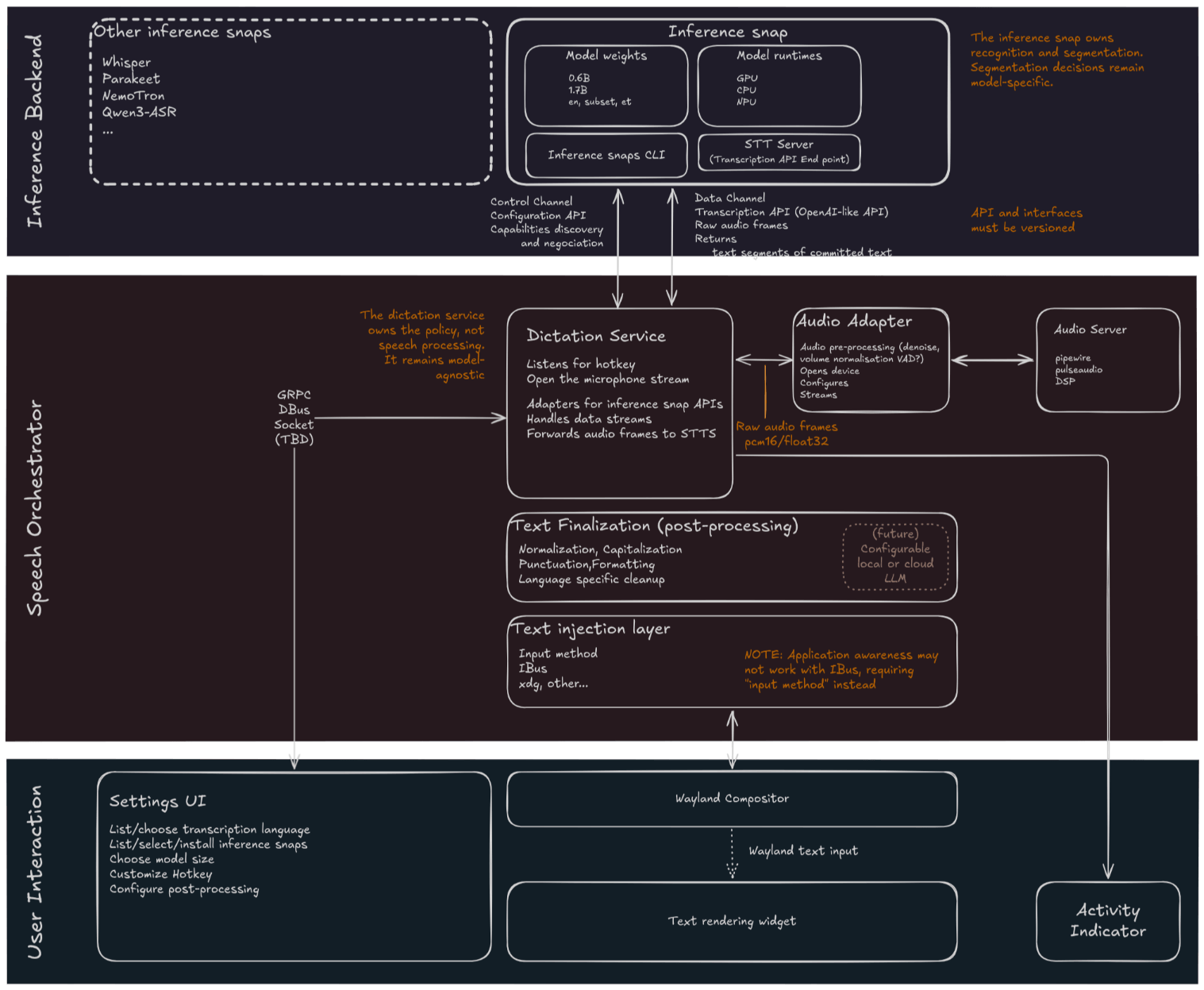
According to technical specifications released by Canonical, the Myna architecture relies on three primary components working in harmony:
- The Audio Adapter: This component serves as the gateway for raw input. It handles microphone interfacing, noise suppression, and "chunking"—the process of breaking audio streams into manageable data packets before they are processed by the inference engine.
- The Speech Orchestrator: Acting as the brain of the operation, this service manages the session lifecycle. It monitors the user’s "push-to-talk" trigger, coordinates between the audio input and the inference snap, and ensures the transcribed text is routed correctly to the active cursor position.
- The Canonical Inference Snap: This is the core of the system. By utilizing the Snap package format, Canonical provides a sandboxed environment for the machine learning models. This component is designed to be hardware-agnostic, supporting a range of compute targets from standard CPUs to dedicated NPUs (Neural Processing Units) and NVIDIA GPUs.
Hardware Flexibility and Model Scaling
One of Myna’s most compelling features is its scalability. Canonical intends to offer speech models in three distinct sizes: lightweight, default, and quality. This tiered approach allows users to tailor the AI’s performance based on their hardware. A user on a low-power laptop can opt for the lightweight model to conserve battery and system memory, while a workstation user can leverage the quality model for maximum transcription accuracy.
Privacy by Design: The Local-Only Mandate
In an era where "AI" is often synonymous with "cloud-based data harvesting," Canonical’s commitment to privacy is perhaps the most significant aspect of Myna. The project is strictly "local-only."
When a user initiates a dictation session, the audio never leaves the machine. There is no remote API call, no cloud-based processing, and no data telemetry associated with the voice recordings. Once the appropriate model is installed, the system functions entirely offline.
Furthermore, the design includes strict data-handling protocols. The audio buffer is kept in volatile, in-memory storage only for the duration of the active session. Once the transcription is finalized and delivered to the text field, the audio data is immediately discarded. There is no persistent storage of voice data, and the system is designed to prevent "flickering" or partial-word hallucinations by waiting until the inference is finalized before committing text to the user’s interface.
Limitations and Current Scope
Canonical has been transparent about the limitations of Myna’s initial release. To ensure a stable and focused debut, the team has intentionally scoped out several "fancier" AI features.

For the initial launch in Ubuntu 26.10, the following features will not be included:
- Voice Assistants: There is no "chat" component or conversational agent.
- Wake Words: The system requires a manual push-to-talk trigger, preventing the "always-listening" privacy concerns common in commercial smart speakers.
- Continuous Listening: The service is strictly for dictated input, not passive monitoring.
- Voice Commands: Users cannot control the OS (e.g., "Open Settings" or "Close Window") through Myna at this stage.
- Language Detection: The system will likely require the user to pre-select their primary language rather than auto-detecting it on the fly.
- Speaker Identification: The system is designed to transcribe, not to verify or track the speaker.
By stripping away these complex, often intrusive features, Canonical is prioritizing a reliable, high-performance tool that solves one specific problem well: turning speech into text.
Implications for the Linux Ecosystem
The arrival of Myna in Ubuntu 26.10 is more than just a new feature for a single distribution; it is a signal to the broader Linux community.
Bridging the Accessibility Gap
For users with motor impairments or those who simply prefer voice input for long-form content creation, the lack of a reliable, native, and privacy-respecting dictation tool has long been a barrier to adopting Linux as a daily driver. By integrating this at the desktop level, Canonical is significantly lowering the barrier to entry for a wide demographic of users who have historically felt underserved by the open-source desktop experience.
Standardizing AI Integration
Canonical’s use of the Snap format for the Inference engine is also a strategic move. By packaging the inference runtime as a Snap, they ensure that the necessary libraries and dependencies—which can be notoriously difficult to manage in pure, distro-agnostic Linux environments—are pre-configured and sandboxed. This creates a blueprint for how other Linux distributions might implement AI features in the future, potentially leading to a more standardized approach to local AI deployment.
A Community-Driven Development Cycle
Jean-Baptiste Lallement, Canonical’s Director of Engineering for Ubuntu Desktop, has emphasized that this project is still in its formative stages. The release of the architecture diagrams and the open invitation for feedback from the accessibility community suggests that Canonical is seeking a collaborative refinement process.
The company is particularly interested in hearing from developers and power users who are already experimenting with tools like VOSK or Whisper on Linux. By soliciting this feedback before the architecture is finalized, Canonical is attempting to avoid the "walled garden" pitfalls that have plagued proprietary operating systems, ensuring that Myna remains a tool that feels like a native part of the Ubuntu ecosystem.
Looking Ahead: The October Launch
As the October release of Ubuntu 26.10 approaches, the eyes of the Linux world will be on the daily builds. The introduction of Myna serves as the "canary in the coal mine" for Canonical’s broader AI strategy. If successful, Myna could pave the way for more sophisticated implicit AI features, such as automated system optimization, predictive performance management, and deeper integration with GNOME’s existing accessibility stack.
For now, the focus remains on execution. The transition from a concept document to a production-ready system component is never easy, but the architectural foundation laid by Canonical suggests a mature, thoughtful, and—most importantly—private approach to one of the most requested features in the history of the Ubuntu desktop.
As we await the first glimpses of Myna in the daily builds, it is clear that Ubuntu is not just jumping on the AI bandwagon; it is building its own vehicle, designed to respect the principles of open source and user privacy while delivering the cutting-edge functionality that the modern desktop demands.