Update: Access Restricted to Claude Fable 5 and Mythos 5 on Amazon Bedrock
Date: June 12, 2026
Subject: Compliance-Driven Access Revocation for Anthropic’s Latest Models
Executive Summary: A Sudden Shift in AI Availability
In a significant development for the generative AI landscape, Anthropic has instructed Amazon Web Services (AWS) to immediately revoke access to its flagship models, Claude Fable 5 and Claude Mythos 5, for all users on the Amazon Bedrock platform. This decision, effective as of June 12, 2026, is a direct response to new US Government export control directives concerning high-performance artificial intelligence systems.
While the restriction applies to these two specific, high-capability models, AWS and Anthropic have confirmed that other models in the Claude family—most notably Opus 4.8—remain fully operational and unaffected by this policy shift. Users currently utilizing these models for enterprise or research applications are encouraged to review the official Anthropic statement to understand the scope of these regulatory adjustments.
Chronology of Events: From Launch to Regulatory Pivot
The lifecycle of the Fable 5 and Mythos 5 models has been characterized by rapid deployment and high demand, followed by abrupt regulatory intervention.
- June 8, 2026: Anthropic announces the availability of Claude Fable 5 on Amazon Bedrock and the Claude Platform on AWS. The announcement positions the model as a "step-change" in AI capability, boasting state-of-the-art performance in complex reasoning, software engineering, and multi-modal vision tasks.
- June 9–10, 2026: AWS provides technical documentation updates, including refined scripts for data retention settings and configuration guidance for the
bedrock-mantleandbedrock-runtimeengines. - June 12, 2026: In compliance with evolving US Government export control mandates, Anthropic and AWS announce the suspension of access to both Fable 5 and Mythos 5.
Understanding the Models: Fable 5 vs. Mythos 5
Prior to the restriction, Claude Fable 5 was marketed as an enterprise-grade powerhouse. It was designed specifically for "ambitious, long-running work," offering superior architectural stability and reasoning capabilities compared to its predecessors.
The Role of Safety Safeguards
A key differentiator for Claude Fable 5 was the implementation of strict "fallback" mechanisms. Anthropic engineered the model with safeguards that monitor for high-risk prompts—specifically those involving cybersecurity, advanced biology, chemistry, or public health. When such queries were detected, the system would automatically pivot to the Opus 4.8 model to generate a response, ensuring that the raw, unrestricted power of Fable 5 was gated by rigorous safety filters.
Conversely, Claude Mythos 5 was built without these specific performance-limiting safeguards. It was originally intended to be a restricted release, available only to a highly vetted group of enterprise and research partners who met specific security and compliance criteria. Under the new directive, both the "safe" version (Fable) and the "unrestricted" version (Mythos) have been pulled from the public-facing Bedrock environment.
Technical Implications: Configuring for Bedrock
For organizations that were in the process of integrating Fable 5 into their workflows, the technical requirements—specifically the data retention policies—were particularly stringent.

The Mandatory Data Retention API
To access the advanced features of these models, users were required to opt into a specific data-sharing configuration. This was not a standard setting; it required interacting with the Data Retention API to enable provider_data_share.
Anthropic’s requirement for this mode was non-negotiable:
- 30-Day Retention: All input and output data must be retained for 30 days.
- Human Review: The architecture mandated that data be subject to potential human review to facilitate abuse detection.
For developers, this meant implementing specific CLI or SDK commands to authorize the retention of inference logs. For instance, using the AWS CLI, the configuration required:
aws bedrock put-account-data-retention --mode provider_data_shareThis level of transparency was designed to align with the safety-first deployment strategy of the Fable series.
The Broader AI Ecosystem: Why Export Controls Matter
The suspension of these models highlights the increasing intersection of artificial intelligence development and national security policy. As AI models reach higher tiers of reasoning and technical proficiency, governments are becoming more focused on preventing the proliferation of these tools to regions or entities that may misuse them for cyberattacks or bio-threat generation.
Implications for Enterprise Strategy
For businesses relying on Amazon Bedrock, this incident serves as a critical reminder of the volatility of "bleeding-edge" AI access.
- Operational Resilience: Organizations are advised to maintain fallback strategies. Because Opus 4.8 remains unaffected, companies can migrate their workloads back to this proven model with minimal downtime.
- Regulatory Monitoring: Compliance teams must now treat model availability as a variable rather than a constant. The rapid nature of the June 12th announcement underscores the importance of having a robust legal and technical infrastructure that can adapt to sudden changes in government oversight.
Official Responses and Next Steps
Anthropic has framed this move as a commitment to responsible AI deployment. By prioritizing compliance, the company aims to maintain the trust of regulators while continuing to advance the state-of-the-art.
Guidance for AWS Users
For those who were using the Claude Fable 5 model via the bedrock-mantle or bedrock-runtime endpoints, the following steps are recommended:

- Check Model IDs: Ensure that application code points to currently available models like Opus 4.8.
- Consult Documentation: Review the Amazon Bedrock User Guide for the most current list of supported models.
- Community Engagement: Participate in the AWS re:Post for Amazon Bedrock to share feedback or seek technical assistance regarding the transition.
Supporting Data: Infrastructure Requirements
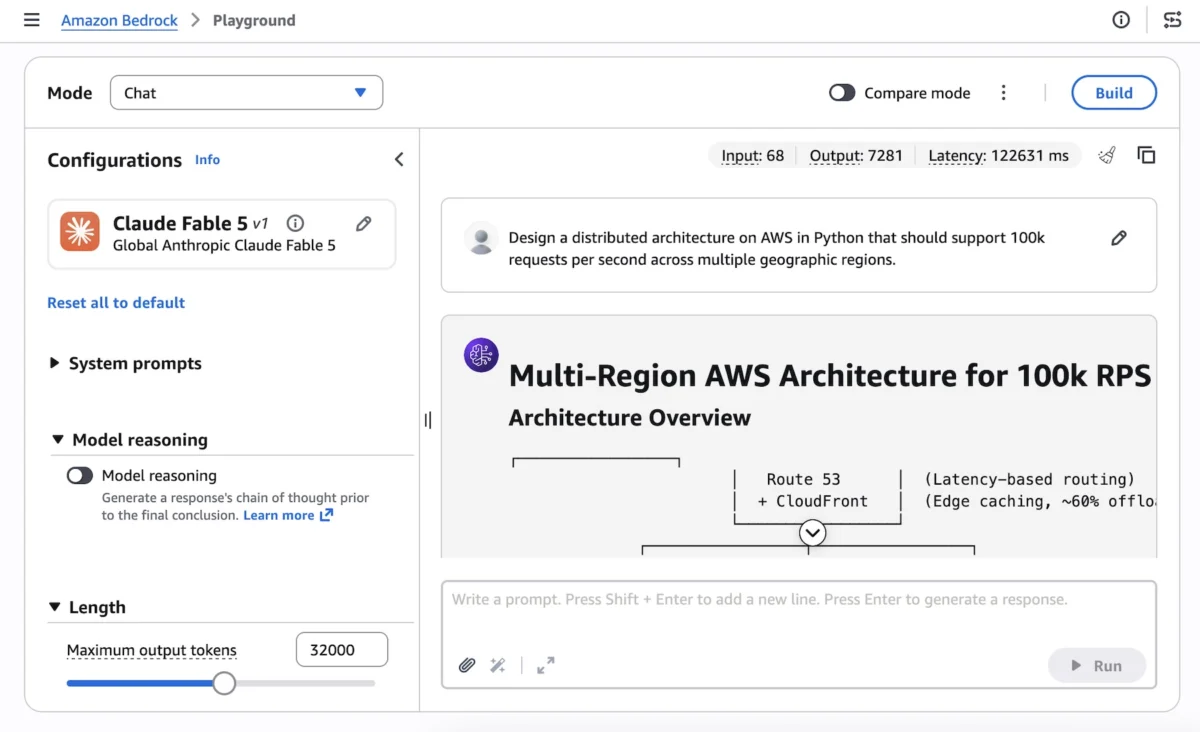
The technical architecture of the Claude Fable 5 environment on AWS was built to be highly scalable, supporting up to 100k requests per second across multiple geographic regions. Developers were utilizing the Anthropic SDK for Python to interface with the bedrock-mantle endpoint.
Example of the now-deprecated initialization:
import anthropic

client = anthropic.Anthropic(
    base_url="https://bedrock-mantle.us-east-1.api.aws/anthropic",
    api_key="<your-bedrock-api-key>"
)
The simplicity of this integration made the adoption of Fable 5 rapid, but the complexity of the underlying compliance (the mandatory data retention and SigV4 authentication) meant that only sophisticated users had successfully integrated the model into production environments prior to the shutdown.
Conclusion: Looking Ahead
The suspension of Claude Fable 5 and Mythos 5 is not necessarily the end of these models, but rather a pause while the industry adjusts to the regulatory climate. As Anthropic works with government agencies to satisfy export control requirements, it is likely that future iterations will be developed with these constraints "baked-in" from the start.
For the developer community, this episode emphasizes the importance of a modular AI strategy. By utilizing platforms like Amazon Bedrock that offer a wide catalog of models, developers can pivot between different versions of Claude and other foundational models, ensuring that business-critical applications remain online even when individual models are pulled for compliance review.
Stay tuned to the AWS and Anthropic news feeds for further updates regarding the potential reinstatement or modification of these models in the coming months.