Beyond the Model Layer: Why PostgreSQL is the Bedrock of Enterprise AI Governance
In the rapidly evolving landscape of enterprise artificial intelligence, a dangerous architectural fallacy has taken root. Organizations are obsessively refining their Large Language Models (LLMs), implementing sophisticated guardrails, and hiring legions of prompt engineers. Yet, they are frequently ignoring the most critical component of a production-grade AI system: the data foundation.
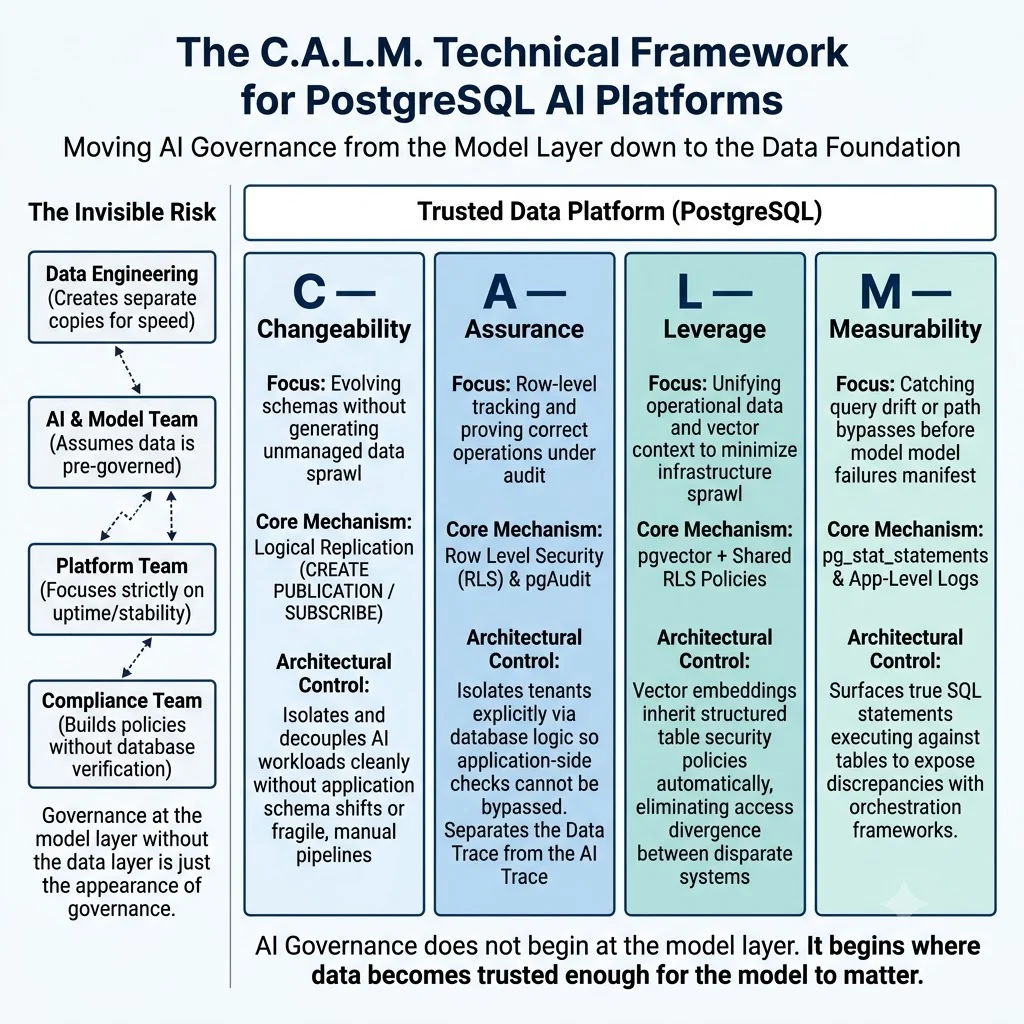
Recent analysis suggests that when AI governance is restricted to the model layer, it is merely "governance theater"—an illusion of control that evaporates the moment it encounters the complexities of real-world data infrastructure. To bridge this gap, industry experts are increasingly turning to the C.A.L.M. Framework, a technical blueprint that anchors AI governance directly within the PostgreSQL database.
The Invisible Risk: The Four-Silo Dilemma
The breakdown of AI governance rarely stems from malice or incompetence; it arises from a fragmented organizational structure. In a typical large-scale financial services environment, four distinct teams operate in isolation, each convinced they are fulfilling their mandate:
- Data Engineering: Tasked with speed and agility, they frequently extract customer data into siloed environments to feed AI models, inadvertently creating unmanaged data sprawl.
- AI & Model Teams: They build sophisticated agents, operating under the assumption that the data they receive has been pre-governed, scrubbed, and validated upstream.
- Platform Teams: Focused on database stability and infrastructure uptime, they often treat AI-specific data governance as a concern for the application layer.
- Compliance & Governance: They draft robust, high-level policies—access controls and audit trails—that look perfect on paper but lack technical enforcement at the database level.
The result is a fragile ecosystem where "governance" exists only as a series of disparate, often conflicting, assumptions. When a regulator asks, "Who accessed this data and why?" the organization finds itself unable to provide a unified answer, as the data has been fragmented, copied, and transformed across multiple, disconnected environments.
The C.A.L.M. Framework: A New Paradigm
The C.A.L.M. framework shifts the focus from the volatile model layer to the immutable data layer. By leveraging the native capabilities of PostgreSQL, organizations can move from reactive, fragmented governance to a proactive, integrated architecture. The acronym stands for Changeability, Assurance, Leverage, and Measurability.
1. C — Changeability: Managing Evolution Without Sprawl
AI requirements are inherently volatile. As business logic shifts and new retrieval patterns emerge, the pressure to create "just one more copy" of the database becomes overwhelming. Traditional architectures succumb to this, resulting in a chaotic landscape of shadow data.
The C.A.L.M. framework utilizes PostgreSQL’s Logical Replication (CREATE PUBLICATION / SUBSCRIBE) to resolve this. By creating governed, independently evolvable replicas, teams can decouple AI workloads from core operational systems. This allows for rapid experimentation without modifying the source application schema, ensuring that the AI platform grows alongside the business without creating unmanaged, undocumented silos.
2. A — Assurance: Proving the Truth
Assurance is the most common point of failure in modern AI stacks. If an organization cannot prove that its data is being accessed only by authorized entities, the entire governance structure is moot.
PostgreSQL’s Row-Level Security (RLS) is the primary mechanism for enforcement here. Unlike application-side checks that can be bypassed by faulty code or unauthorized queries, RLS operates at the database level. By embedding security policies directly into the data layer, the database becomes the final arbiter of access. Complementing this, pgAudit provides granular session and object-level logging, ensuring that every interaction—from the initial query to the final output—is traceable, providing a verifiable audit trail that satisfies even the most stringent regulatory scrutiny.
3. L — Leverage: Reducing Complexity, Not Relocating It
"AI sprawl" occurs when organizations treat vector databases, relational databases, and metadata stores as separate, disconnected systems. This multiplication of infrastructure leads to an exponential increase in attack surfaces and governance gaps.
The C.A.L.M. framework advocates for Leverage by unifying structured data and vector context within a single PostgreSQL instance. Using pgvector alongside existing RLS policies allows vector embeddings to inherit the same security posture as the underlying relational records. When a customer record is restricted, the corresponding embedding is automatically restricted as well. This eliminates the need for complex synchronization between disparate systems, drastically reducing the complexity of the security architecture.
4. M — Measurability: Proactive Detection
In the C.A.L.M. model, measurability is the "early warning system." It is insufficient to monitor model performance after a failure has already occurred. Instead, the focus must be on the SQL layer.
By utilizing pg_stat_statements and custom application-level logs, organizations can gain deep visibility into the queries being executed by their AI agents. This allows for the identification of "query drift" or unauthorized access patterns before they manifest as customer-facing incidents. It transforms the database from a passive storage bin into an active participant in the governance process.
Chronology of an AI Governance Crisis
To understand why this shift is necessary, one must look at the historical progression of typical enterprise AI projects:
- Phase 1: Pilot Programs. Teams build proof-of-concepts using "clean" local data. Governance is overlooked in the name of speed.
- Phase 2: Data Proliferation. As the pilot moves to production, data engineering creates specialized copies for model training. The first governance gaps appear.
- Phase 3: Security & Audit. Compliance teams demand audit trails. They realize the data lineage is broken because the AI team bypassed core database controls.
- Phase 4: The Crisis. A regulatory audit or a security incident forces the organization to realize that their "model-layer" governance is ineffective because the data layer was never secured at the source.
- Phase 5: Refactoring. The organization begins the painful, expensive process of retrofitting security and governance into a fragmented, multi-copy data estate.
The C.A.L.M. framework is designed to prevent Phase 4 and 5 by ensuring that governance is baked into the foundation during Phase 1.
Implications for Enterprise Architecture
The adoption of the C.A.L.M. framework has significant implications for how CIOs and CTOs approach their technology stack.
Shift in Responsibility: Governance is no longer an "overlay" managed by a compliance team; it is an infrastructure requirement managed by database architects and platform engineers. This requires a cultural shift, where data governance is treated as a first-class technical task alongside performance optimization.
Architectural Minimalism: The framework challenges the trend of "maximalist" data architectures. By leveraging the versatility of PostgreSQL, organizations can simplify their tech stacks, reducing the number of moving parts. A simpler architecture is, by definition, more governable and easier to secure.
The "Data-First" Mandate: Perhaps most importantly, C.A.L.M. reinforces the principle that an AI model is only as intelligent as the data it consumes. If the data is poorly governed, the model will inevitably produce unreliable, potentially risky, or non-compliant results.
Expert Perspective: The Role of Accountability
Industry observers note that while PostgreSQL provides the capabilities for C.A.L.M., it does not provide the intent.
"The tools—RLS, pgAudit, logical replication—are already there in the box," notes an industry consultant familiar with the framework. "The failure isn’t technical; it’s operational. The C.A.L.M. framework forces an organization to assign accountability. It asks: who is responsible for the RLS policy? Who is monitoring the replication lag? Who is reviewing the pg_stat_statements? Once you have a name attached to these technical tasks, you have real governance."
Moving Forward: The Four-Question Diagnostic
For any organization looking to stress-test their AI platform, the C.A.L.M. diagnostic provides a straightforward, binary evaluation:
- Changeability: Can you add a new retrieval pattern without creating a new unmanaged copy of your data?
- Assurance: Can you trace an AI decision back to the exact source record using a SQL query, rather than a weeks-long forensic project?
- Leverage: Is your platform reducing the total number of systems and pipelines in your stack, or adding to them?
- Measurability: Can you detect if an AI agent is accessing stale or unauthorized data before a human notices?
If the answer to any of these is "no," the organization is operating with an unaddressed risk.
Conclusion
The future of enterprise AI will not be defined solely by the most advanced neural networks, but by the robustness of the data foundations upon which they sit. By adopting the C.A.L.M. framework, organizations can stop chasing the ghost of "model-layer governance" and begin building a secure, scalable, and genuinely governed AI architecture.
In the world of high-stakes enterprise technology, true governance does not begin when the model is deployed; it begins in the database, where the data is born, where it is governed, and where it is ultimately trusted. By centering AI strategy on the reliability of the PostgreSQL data layer, enterprises can ensure that their AI initiatives are not just innovative, but built to last.