Bridging Art and Engineering: Joshua Bird Unlocks the Potential of Ceramic 3D Printing
Introduction: Bridging Art and Engineering with Additive Ceramics
In the dynamic and ever-evolving landscape of additive manufacturing, the creation of three-dimensional objects from ceramic materials has long stood as a frontier fraught with significant technical challenges. Unlike their plastic-extruding counterparts, ceramic 3D printers remain a rarity, a testament to the complex interplay of material science, mechanical engineering, and an often-unforgiving fabrication process. Yet, in a remarkable display of ingenuity and persistence, independent maker Joshua Bird has not only navigated these intricate hurdles but has successfully constructed a ceramic 3D printer capable of producing intricate, even "impossible," objects. His project not only pushes the boundaries of desktop additive manufacturing but also opens new avenues for artistic expression and specialized industrial applications.
The Elusive World of Ceramic 3D Printing
Standard Fused Deposition Modeling (FDM) 3D printers have democratized rapid prototyping and custom fabrication for thermoplastics, making them ubiquitous in workshops and homes worldwide. Their fundamental mechanism – extruding a molten material layer by layer – seems deceptively simple. However, translating this principle to ceramics introduces a cascade of complexities that elevate the difficulty by orders of magnitude. The inherent properties of clay and other ceramic slurries – their rheological behavior, abrasive nature, and the dramatic material shrinkage that occurs during drying and high-temperature firing – present formidable obstacles that have historically confined ceramic additive manufacturing to specialized research labs and high-end industrial settings.
The journey from a digital design to a finished ceramic piece is a multi-stage marathon, far removed from the relatively straightforward print-and-go model of plastic FDM. It involves meticulous material preparation, precise extrusion, careful drying, and often multiple firing cycles, each step carrying the risk of catastrophic failure. It is precisely this intricate dance between material science and mechanical precision that makes Bird’s achievement so significant.
Joshua Bird’s Breakthrough: Crafting the Impossible
Joshua Bird’s latest endeavor builds upon a foundation of previous innovative 3D printer designs, showcasing a consistent drive to explore unconventional printing methods. His ceramic printer stands as a testament to this spirit, demonstrating how dedicated experimentation can overcome what many consider insurmountable barriers. The project, meticulously documented and shared, reveals a deep understanding of the challenges involved, from the design of a robust extrusion system to the nuanced handling of clay’s unpredictable behavior.
The term "impossible objects," often associated with his work, refers to designs that are either exceedingly difficult or simply unfeasible to produce through traditional ceramic hand-building or molding techniques. Bird’s ability to print double-walled cups, intricately detailed climbing-themed mugs, and even a delicate chain-mail mesh from clay highlights the transformative potential of his system. These creations are not merely functional items; they are sculptural proofs-of-concept, demonstrating a level of geometric freedom previously unattainable for many ceramicists and engineers. His work effectively bridges the gap between the digital realm of design and the tactile world of fired ceramics, offering a new toolkit for innovation.
The Genesis of Innovation: A Deep Dive into Development
Bird’s ceramic 3D printer is not merely an adaptation of an existing FDM machine; it is a bespoke creation, engineered from the ground up to address the unique demands of clay extrusion. His journey reflects a classic engineering challenge: identifying problems, iterating on solutions, and relentlessly testing until a viable system emerges.
A Personal Quest: From Concept to Reality
Joshua Bird’s foray into ceramic 3D printing appears to be driven by a genuine curiosity and a desire to push the boundaries of what’s possible with additive manufacturing. While the exact motivations behind embarking on such a challenging project aren’t explicitly detailed, his previous work on unique 3D printer designs suggests a passion for exploring novel kinematics and material applications. This project wasn’t just about building a machine; it was about understanding and taming a notoriously temperamental material.
The development process was undoubtedly iterative and arduous, a common characteristic of pioneering engineering projects. Bird’s experience with severe material shrinkage, collapsing bridges, and the surprising abrasiveness of clay speaks to the countless hours spent troubleshooting, redesigning, and recalibrating. This hands-on, problem-solving approach is central to the project’s success, illustrating that innovation often stems from a willingness to confront and learn from repeated failures. Each collapsed bridge or abraded auger represented a crucial data point, guiding subsequent design decisions and refining the overall system.
Engineering the Heart of the Printer: The Clay Extruder
The centerpiece of any FDM-style printer is its extruder, and for ceramic printing, this component is paramount. Bird’s design for the clay extruder is a sophisticated solution tailored to the specific challenges of dense, viscous clay. It deviates significantly from the typical filament-feeding mechanisms of plastic printers.
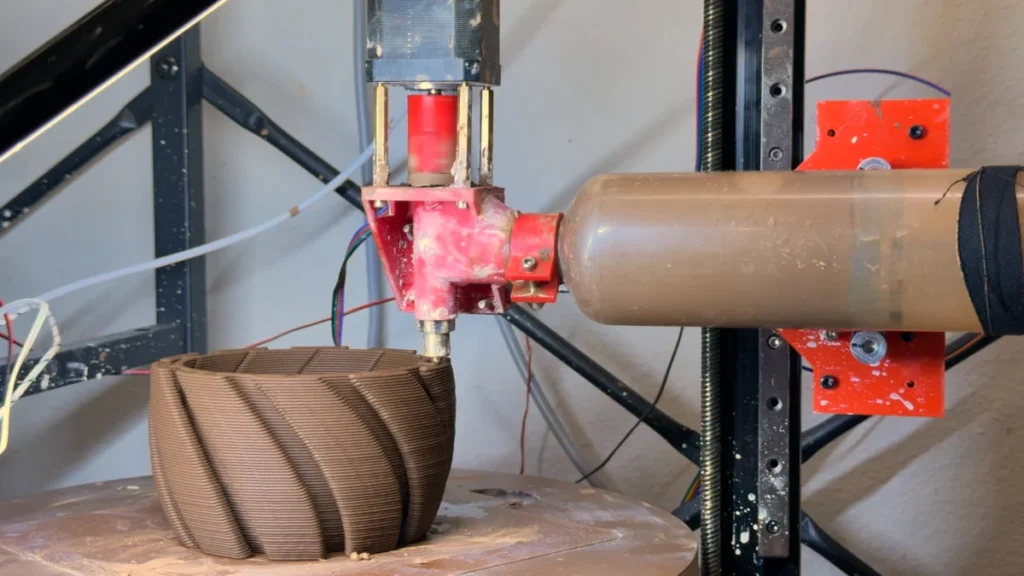
At its core, the system utilizes an air compressor to pressurize a sealed tube filled with clay. This pneumatic force acts as a constant, uniform pressure on the material, ensuring a steady supply to the extruder head. Within the extruder, an auger — a helical screw mechanism — takes over, positively displacing the clay and forcing it through the nozzle. This auger-based extrusion is critical because it provides a precise, controllable flow rate that would be difficult to achieve with simple pneumatic pressure alone, especially when dealing with the variable viscosity of clay. The auger acts as a metered pump, pushing a consistent volume of material with each rotation.
A crucial design element is the small gap strategically placed at the top of the extruder. This gap serves a vital function: allowing trapped air to escape. Air bubbles within the clay mixture are a significant concern in ceramic printing. They can lead to voids in the printed object, causing structural weaknesses, surface imperfections, and even explosive failures during the high-temperature firing process as the trapped air expands. By providing an escape route, Bird mitigated a common source of print defects and structural integrity issues. The combination of pneumatic pressure for bulk material feeding and an auger for fine-tuned extrusion represents a robust and well-thought-out engineering solution.
Navigating the Nuances of Rheology: The Clay’s Temperament
One of the most profound challenges in ceramic 3D printing, as highlighted by Bird, is the rheology of clay. Rheology is the study of the flow of matter, primarily in a liquid state but also as "soft solids" or gels. For clay, its rheological properties dictate how easily it flows under pressure (extrudability) and how well it holds its shape once deposited (green strength). These two requirements often stand in direct opposition:
- Extrudability: The clay needs to be soft enough, with a sufficiently low yield stress and viscosity, to flow smoothly through the extruder’s nozzle without excessive force, preventing blockages or inconsistent extrusion.
- Green Strength: Once extruded, the clay must be stiff enough to support the weight of subsequent layers and to bridge gaps without collapsing or deforming under gravity. This property, known as "green strength," is critical for building complex geometries.
Bird’s breakthrough in managing this rheological tightrope involved a strategic approach: pressurizing the clay as much as possible. By applying high pneumatic pressure to the clay reservoir, he was able to effectively "force" stiffer clay mixtures through the auger and nozzle. Stiffer clay mixtures inherently possess higher green strength, making them more stable for building intricate structures and supporting overhangs. This counter-intuitive solution—using more force to enable the use of stronger, less flowable material—was a critical enabler for the successful printing of complex geometries and bridges that would otherwise collapse. This demonstrates a deep understanding of material behavior under dynamic conditions.
The Battle Against Abrasion: Durability Triumphs
The abrasive nature of clay presented another significant hurdle to the longevity and reliability of the extruder. Clay, being composed of fine mineral particles (silicates, aluminosilicates), acts as an abrasive slurry when forced through a mechanism. Joshua Bird initially experimented with 3D-printed plastic augers, a common and cost-effective prototyping method. However, the results were stark: the clay rapidly abraded these plastic components, often rendering them unusable in less than an hour of operation. This rapid wear would lead to inconsistent extrusion, loss of control, and ultimately, print failures.
The solution, though more complex to fabricate, was elegant: a 3D-printed stainless steel extruder. Stainless steel, a much harder and more durable material than typical plastics, proved highly resistant to the abrasive effects of the clay. This material upgrade transformed the extruder from a fragile, short-lived component into a robust, reliable workhorse. This shift underscores a fundamental principle in engineering: selecting the right material for the application is often as critical as the design itself, especially when dealing with challenging material interactions. The use of 3D-printed metal also highlights the increasing accessibility and utility of advanced additive manufacturing techniques for creating custom, high-performance parts.
The Motion System: A Twist on Traditional Printing
Beyond the extruder, the motion system of a 3D printer dictates its build volume and geometric capabilities. Bird’s ceramic printer utilizes a polar design, a less common configuration compared to Cartesian (XYZ) or Delta systems. A polar system typically involves a rotating build platform (theta axis) and a print head that moves radially (R axis) from the center. This design is an adaptation of his earlier work on a non-planar 3D printer, which suggests a deliberate choice to explore alternative kinematics.
Polar systems offer distinct advantages for certain types of geometries and can simplify the mechanical design in some respects. For circular objects, a polar system can be highly efficient, as the continuous rotation of the build plate allows for smooth, uninterrupted printing paths. The reference to its potential for making it "easier to print overhangs" hints at the synergy with his previous non-planar slicing experiments. Non-planar printing involves extruding layers that are not perfectly flat, but rather follow the contours of the object, which can significantly improve the quality of overhangs and curved surfaces by reducing the need for support structures. Combining a polar motion system with non-planar capabilities could unlock even greater geometric freedom for ceramic objects, allowing for complex forms that defy traditional layer-by-layer constraints.
The Intricate Dance of Ceramic Fabrication
The act of "printing" in ceramic is merely one step in a multi-stage, labor-intensive process. Unlike plastic prints that are often ready to use off the print bed, ceramic objects require a series of post-processing steps that are critical to their structural integrity, aesthetic appeal, and functional properties. Joshua Bird’s description of his workflow underscores this complexity.
Beyond the Print: The Multi-Stage Ceramic Process
For each part he creates, Bird undertakes a rigorous, multi-stage process:
- Clay Mixing: The starting point is the careful preparation of the clay mixture. This involves not only combining raw clay powders with water but also achieving the precise consistency and rheological properties required for extrusion. Any inconsistencies at this stage can lead to print failures.
- Loading the Tube: The prepared clay slurry must be carefully loaded into the printer’s reservoir tube, ensuring no air bubbles are introduced, which, as mentioned, can compromise the print.
- Cleaning the Extruder: Given the sticky and abrasive nature of clay, thorough cleaning of the extruder after each use is essential to prevent blockages and maintain optimal performance. This is a recurring maintenance task unique to clay printing.
- Actual Printing: This is the additive manufacturing phase, where the digital model is translated into a physical clay object layer by layer.
- Drying: Once printed, the "greenware" (unfired clay object) must undergo a slow and controlled drying process. This stage is crucial for removing all moisture evenly. Rapid or uneven drying can lead to warping, cracking, or complete destruction of the object due to differential shrinkage.
- Firing (Bisque Firing): The dried object is then placed in a kiln and fired at a relatively lower temperature (bisque firing). This process vitrifies the clay to some extent, making it harder and less fragile, but still porous. It’s an irreversible chemical and physical transformation.
- Applying Glaze: After bisque firing, the object is typically glazed. Glaze is a glass-forming substance that, when fired, creates a durable, often decorative, non-porous surface. This step requires skill and precision to ensure even application.
- Firing Again (Glaze Firing): Finally, the glazed object undergoes a second, usually higher-temperature firing (glaze firing). This melts the glaze into a glassy layer and fully vitrifies the clay body, transforming it into its final, hard, non-porous ceramic state.
This multi-step process illustrates that ceramic 3D printing is not just about the printer itself, but about mastering the entire traditional ceramic workflow, with the additive manufacturing step integrated into it.
Confronting Shrinkage: A Maker’s Nemesis
One of the most persistent and destructive challenges in ceramic fabrication, particularly for 3D printing, is material shrinkage. Clay shrinks at two primary stages:
- Drying Shrinkage: As water evaporates from the clay body, the clay particles draw closer together, causing the object to reduce in size. This can be significant, often 5-10%. Uneven drying leads to differential shrinkage, creating internal stresses that manifest as cracks or warping.
- Firing Shrinkage: During the high-temperature firing process, further shrinkage occurs as organic matter burns out, and the clay particles undergo vitrification, fusing together into a denser material. This can add another 5-15% shrinkage, sometimes more for specific clay bodies.
The cumulative effect of these two shrinkage phases means that a printed object might end up 10-25% smaller than its initial "green" size. For Bird, this was a constant battle, destroying "many prints." Complex geometries, especially those with varying wall thicknesses or intricate internal structures, are highly susceptible to these stresses. Successful ceramic printing requires not only anticipating this shrinkage but also designing parts with appropriate tolerances and controlling drying and firing rates meticulously to minimize stress. Bird’s success in producing complex forms despite this inherent material behavior speaks volumes about his iterative refinement of both his printing parameters and post-processing techniques.
Unveiling the Creations: Form and Function
Despite the numerous challenges, Joshua Bird’s perseverance yielded impressive results, showcasing the unique capabilities of his ceramic 3D printer:
- Double-Walled Cup: This is a particularly challenging object for traditional methods. Creating two concentric walls with a void between them, often connected only at the rim, is a hallmark of additive manufacturing’s ability to produce complex internal geometries. Such designs can offer improved insulation properties.
- Decorative Climbing-Themed Cup: This demonstrates the printer’s capacity for intricate surface details and personalized designs, allowing for artistic expression that would be difficult or impossible with hand-building or slip casting.
- Chain-Mail Mesh: Perhaps the most striking example of "impossible objects," a chain-mail mesh made of ceramic is a testament to the printer’s precision and ability to create interconnected, articulated structures. Traditional ceramic techniques would find it almost impossible to create individual, interlocked ceramic rings that are then fired without fusing. This showcases the power of additive manufacturing to create complex assemblies as a single, contiguous print.
These successful prints not only validate Bird’s design but also highlight the immense potential of ceramic 3D printing for both artistic endeavors and specialized functional applications where intricate forms and material properties of ceramics are desired.
Broader Context and Industry Resonance
Joshua Bird’s project resonates within the broader landscape of additive manufacturing, touching upon specialized niches, community-driven innovation, and ongoing research into advanced extrusion techniques.
The Specialized Niche of Ceramic Additive Manufacturing
While plastic 3D printers are ubiquitous, ceramic additive manufacturing occupies a specialized niche. The inherent challenges make it less accessible, but the unique properties of ceramics – high temperature resistance, chemical inertness, hardness, and biocompatibility – make them invaluable for specific applications. Industries such as aerospace (thermal protection systems, engine components), biomedical (implants, prosthetics), automotive (catalytic converters, sensors), and energy (fuel cells, heat exchangers) are keenly interested in ceramic 3D printing for its ability to create custom, complex, and high-performance parts. Bird’s project, though on a smaller scale, contributes to the overall understanding and development of the fundamental techniques required for such industrial applications. It shows that dedicated effort can bring sophisticated capabilities to more accessible platforms.
Lessons from the Open-Source Community
The context of Hackaday, where this project was featured, is crucial. Hackaday is a hub for open-source hardware development and DIY engineering, fostering a community where individuals like Joshua Bird share their innovations and inspire others. Bird’s detailed documentation and sharing of his build contribute to this ecosystem, providing valuable insights and potential blueprints for other makers interested in exploring ceramic 3D printing. This collaborative spirit accelerates innovation and makes advanced technologies more accessible beyond corporate R&D labs. His work serves as a prime example of how individual ingenuity, when shared, can significantly impact a specialized field.
Contrasting Approaches: Auger vs. Piston Extrusion
The article notes that Bird’s auger-based clay extruder is reminiscent of other similar designs and even direct-granule FDM printing. This highlights a key differentiation in ceramic and paste extrusion systems:
- Auger-Based Extrusion: As seen in Bird’s design, an auger screw actively pushes the material. This provides excellent control over flow rate, allows for good retraction capabilities, and can handle a wider range of paste viscosities. It’s particularly effective for materials that are somewhat stiff and prone to clogging. The "direct-granule FDM" comparison is apt because both methods involve actively moving a granular or paste-like material through a screw mechanism.
- Piston-Based Extrusion: Many other clay or paste extruders use a piston to directly push material from a syringe or cartridge. While simpler mechanically, piston extruders can struggle with precise flow control, especially for retractions, and may not handle very stiff pastes as effectively. They are also prone to issues with air bubbles if not loaded carefully.
Bird’s choice of an auger system, combined with pneumatic pressurization, suggests a deliberate selection of a more robust and controllable method for handling the challenging rheology of clay, optimizing for precision and consistency over simplicity.
Implications and the Road Ahead
Joshua Bird’s ceramic 3D printer is more than just a hobbyist project; it represents a significant step forward in making advanced ceramic fabrication more accessible and versatile. Its implications span various fields, from artistic creation to industrial innovation.
Democratizing Ceramic Art and Design
The most immediate impact of such a printer is on the world of ceramic art and design. Traditional ceramic methods, while rich in history and technique, often impose limitations on geometric complexity. Bird’s printer empowers artists to:
- Create Unprecedented Forms: Artists can now design and produce intricate, organic, or structurally complex pieces that would be impossible to hand-build or cast. This opens up new avenues for sculptural expression.
- Rapid Prototyping for Ceramicists: Designers can quickly iterate on ceramic forms, testing different shapes and structures before committing to more labor-intensive traditional production methods.
- Personalization and Customization: The ability to print one-off, highly customized ceramic items could revolutionize personalized pottery, bespoke decorative objects, and architectural elements.
- Educational Tool: Such a printer could serve as an invaluable educational tool in art schools and design programs, teaching students about material science, digital fabrication, and the intricacies of ceramic processing.
By lowering the barrier to entry for complex ceramic forms, Bird’s work contributes to a broader democratization of advanced ceramic fabrication, moving it from specialized industrial labs into the hands of creative individuals.
Paving the Way for Industrial Applications
While Bird’s printer is currently a desktop-scale prototype, the principles and solutions he developed have direct relevance to industrial ceramic additive manufacturing. The challenges he faced – rheology, abrasion, shrinkage – are universal to the field. His successful mitigation strategies could inform the design of larger, more robust industrial systems. Potential industrial applications include:
- Specialized Components: Manufacturing ceramic parts with complex internal geometries for high-performance applications (e.g., lightweight aerospace components, intricate catalytic converters, durable tooling).
- Medical Implants: Biocompatible ceramics can be 3D printed into custom bone scaffolds or dental implants with patient-specific geometries.
- Custom Molds and Tooling: Creating complex ceramic molds for casting other materials, leveraging ceramics’ heat resistance.
- Research and Development: Providing a flexible platform for material scientists to experiment with new ceramic slurries and composite materials for additive manufacturing.
The ability to consistently print stiff clay mixtures with a durable extruder, as demonstrated by Bird, is a crucial step towards making ceramic additive manufacturing a more reliable and widespread industrial process.
Future Frontiers: Scaling, Speed, and Material Diversity
Joshua Bird’s project, while groundbreaking, also points to the next frontiers in ceramic 3D printing. Future developments might focus on:
- Scaling Up: Developing larger build volumes and higher throughput to enable the production of bigger objects or more parts in a shorter time.
- Increased Speed: Optimizing print speeds without compromising quality, potentially through multi-nozzle systems or faster motion platforms.
- Wider Material Compatibility: Expanding the range of printable ceramic materials beyond typical clays to include advanced technical ceramics like alumina, zirconia, or silicon carbide, which require even more specialized processing.
- Real-time Monitoring and Feedback: Integrating sensors to monitor material flow, layer adhesion, and shrinkage in real-time to further reduce print failures.
- Automation of Post-Processing: Streamlining or automating the drying, firing, and glazing stages to reduce manual labor and improve consistency.
The Enduring Spirit of Innovation
Joshua Bird’s ceramic 3D printer is a powerful illustration of the enduring spirit of innovation that characterizes the maker community. By tackling a notoriously difficult challenge with persistence, ingenuity, and a willingness to learn from failure, he has not only created a remarkable machine but has also contributed valuable knowledge to the broader field of additive manufacturing. His "impossible objects" stand as tangible proof that with enough dedication, the boundaries of what’s achievable continue to expand, inspiring a new generation of engineers, artists, and innovators to bridge the gap between imagination and physical reality.