AWS Revolutionizes Infrastructure-as-Code: Introducing CloudFormation Express Mode
In a move set to drastically alter the velocity of cloud-native development, Amazon Web Services (AWS) has officially launched CloudFormation Express mode. This new deployment architecture is designed to strip away the latency inherent in traditional infrastructure provisioning, specifically targeting the iterative cycles that developers, DevOps engineers, and AI-driven automation tools face daily. By fundamentally changing how AWS signals the completion of a stack deployment, the company claims it can achieve speed improvements of up to four times over standard deployment protocols.
For years, the "stabilization check"—the phase where CloudFormation verifies that every resource is fully functional before marking a stack as "CREATE_COMPLETE"—has been a double-edged sword. While it provides a safety net for production-grade stability, it has long been a bottleneck for developers iterating on code or testing new architectural patterns. With Express mode, AWS is providing a mechanism to bypass this wait, turning minutes of anticipation into seconds of execution.
The Core Innovation: Redefining Deployment Completion
To understand the magnitude of this update, one must first understand the traditional CloudFormation workflow. Historically, when a user initiated a stack update, CloudFormation would not only provision the requested resources but would also perform exhaustive health checks to ensure each component was ready to receive traffic. While essential for production stability, this process created a rigid feedback loop that slowed down experimental development.
How Express Mode Changes the Game
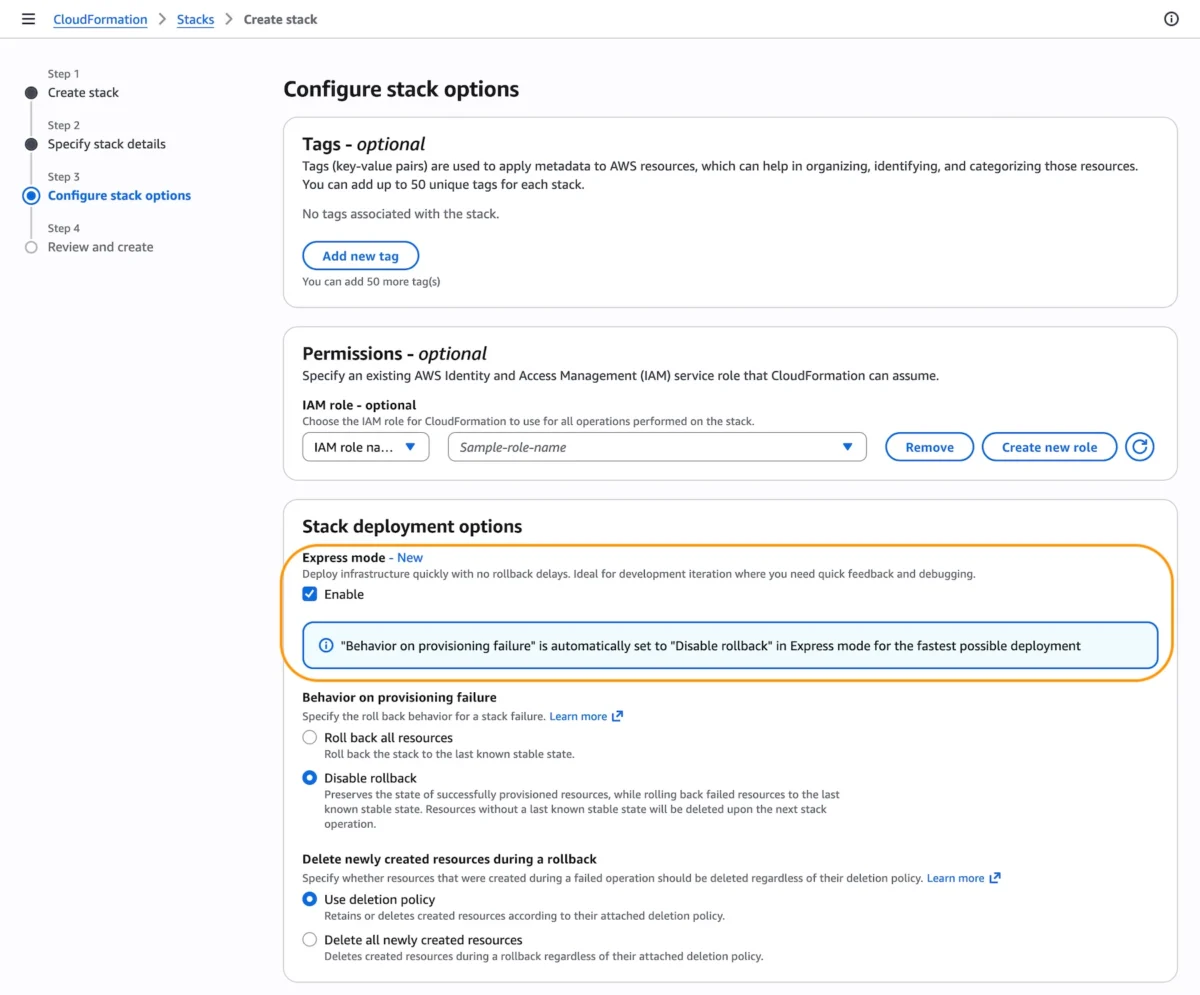
Express mode redefines the "completion" signal. Instead of waiting for every resource to pass its internal stabilization checks, the service now signals completion as soon as the configuration intent is successfully applied to the underlying AWS APIs. The resources continue to stabilize in the background, but the developer—or the automated CI/CD pipeline—is freed immediately to move to the next task.
The architectural genius behind this shift is the implementation of built-in, automated resilience. If a resource encounters a transient failure during its background stabilization phase, CloudFormation now handles retries automatically without requiring intervention from the user. This effectively offloads the management of timing jitter and dependency synchronization from the developer to the AWS control plane.
Chronology: From Legacy Wait-Times to Instant Iteration
The evolution toward Express mode follows a long-standing demand from the AWS developer community for faster feedback loops.
- The Era of Stabilization (2011–2025): Since the inception of AWS CloudFormation, the "stabilization check" was a non-negotiable requirement. It ensured that systems did not "break" because they were not ready for traffic. However, as microservices architectures grew, the time required for these checks scaled linearly, often resulting in 10-to-30-minute waits for even minor configuration changes.
- The Rise of AI and Rapid Prototyping (2023–2025): The proliferation of AI-assisted infrastructure development (using tools like Kiro or Amazon Q) highlighted the limitations of the existing stack deployment model. When an AI agent is iterating on infrastructure, a 10-minute wait for a simple SQS queue creation creates a significant friction point in the development cycle.
- The Announcement (June 2026): AWS officially unveiled Express mode to address this friction, focusing on high-frequency development environments and production scenarios where developers are prepared to manage eventual stabilization independently.
Supporting Data: Benchmarking the Efficiency Gains
The performance improvements offered by Express mode are not merely incremental; they represent a paradigm shift in how IaC (Infrastructure as Code) interacts with the cloud environment.
Comparative Performance Metrics
According to internal AWS benchmarking tests, the delta between Standard and Express modes is profound:
- Amazon SQS Queue Provisioning: In standard deployments, creating a queue with a Dead Letter Queue (DLQ) configuration takes approximately 64 seconds. In Express mode, that same operation completes in under 10 seconds.
- AWS Lambda Function Deletion: This is perhaps the most striking example. Deleting a Lambda function that has an associated network interface (ENI) typically triggers a long cleanup process, often taking between 20 and 30 minutes. Express mode reduces this wait to roughly 10 seconds, allowing for rapid teardown and reconstruction of serverless environments.
These metrics underscore the potential for teams to save hundreds of hours annually in "idle wait time," allowing developers to maintain their flow state and significantly shortening the duration of automated test suites.
Implementation: Integrating Express Mode into Workflows
AWS has ensured that the barrier to entry for Express mode is minimal. Because it is a deployment-time configuration rather than a template-level requirement, teams can adopt it without rewriting their existing YAML or JSON files.
The CLI Approach
For developers working within the terminal, the implementation is straightforward. By appending the --deployment-config flag to standard CLI commands, users can toggle between standard and express behaviors:
aws cloudformation create-stack
   --stack-name my-app
   --template-body file://template.yaml
   --deployment-config '"mode": "EXPRESS", "disableRollback": true'
Leveraging CDK and AI Tools
For those using the AWS Cloud Development Kit (CDK), the process is even more streamlined. The introduction of the cdk deploy --express command allows for high-speed deployment directly from the development environment. Furthermore, AWS has integrated support for AI tools, enabling agents to leverage the EXPRESS flag automatically when generating and applying infrastructure changes.
Critical Considerations: The Role of Rollback
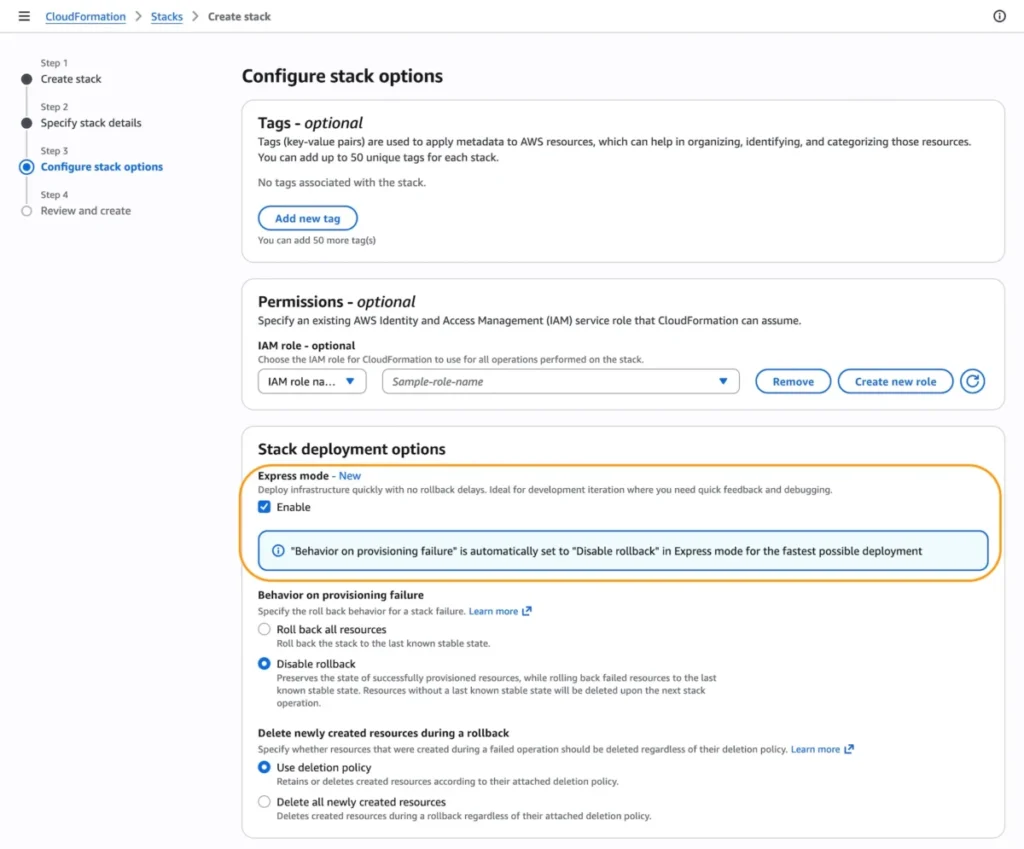
It is important to note that Express mode disables rollback by default. This is an intentional design choice to prioritize speed. For developers using this for rapid iteration, this is a benefit. However, for production environments, AWS recommends setting disableRollback to false or implementing external monitoring and cleanup mechanisms to ensure that, in the rare event of a failed configuration, the environment does not remain in an inconsistent state.
Implications for the Future of Cloud Engineering
The launch of Express mode is not just a feature update; it is an acknowledgment that the "infrastructure-as-code" industry is moving toward a more fluid, high-velocity model.

1. The Rise of "Just-in-Time" Infrastructure
By lowering the cost of deployment time, AWS is enabling a new class of workflows where infrastructure is treated as truly ephemeral. Teams that were previously hesitant to tear down and rebuild environments due to the time cost will now be able to automate the lifecycle of dev-environments more aggressively.
2. AI-Driven Infrastructure Evolution
We are witnessing the infancy of autonomous cloud management. AI tools that write code often need to test that code against real cloud resources. With Express mode, the feedback loop for these AI models is compressed to the sub-minute range. This will likely lead to more sophisticated, self-healing infrastructure patterns where AI agents can iterate on complex topologies in real-time.
3. Shift in Operational Responsibilities
While Express mode increases speed, it places more responsibility on the operator. By bypassing the default stabilization checks, teams are essentially taking on the responsibility of "eventual consistency" management. Organizations will need to ensure that their application-level monitoring is robust enough to handle resources that are still in the process of becoming operational.
Official Perspective and Availability
AWS has confirmed that CloudFormation Express mode is available immediately in all commercial AWS Regions. The company views this as a foundational step toward a more responsive and intelligent cloud experience.
"Our goal was to eliminate the artificial waiting periods that hindered innovation," noted a spokesperson for the AWS CloudFormation team. "By allowing developers to define their own threshold for stabilization, we are putting the power of speed back into their hands."
Getting Started
For those looking to adopt this feature, the documentation is comprehensive. AWS recommends starting by testing non-critical dev environments with the EXPRESS flag to observe the behavior of resource provisioning. The company also encourages developers to share feedback through the AWS re:Post community or via their dedicated support channels.
As the cloud continues to evolve, tools like CloudFormation Express mode demonstrate that the next frontier of innovation is not just about what you can build, but how fast you can build it. With this update, AWS has effectively removed a major speed limit on the highway of cloud-native development, inviting engineers to experiment, fail fast, and iterate faster than ever before.