Scaling the Spectrum: TensorFlow Introduces Native Distributed Fast Fourier Transform Support
In the realm of high-performance computing and machine learning, the Fast Fourier Transform (FFT) stands as a foundational pillar. From signal processing and image enhancement to the regularization of complex neural network models, the ability to convert data from the spatial or temporal domain into the frequency domain is indispensable. However, as the scale of modern datasets—particularly in fields like climate modeling, medical imaging, and high-resolution computer vision—explodes, single-accelerator architectures are increasingly hitting a "memory wall."
Addressing this critical bottleneck, Google has officially integrated native support for Distributed Fast Fourier Transform (Distributed FFT) into TensorFlow v2. By leveraging the power of DTensor, TensorFlow’s robust distributed computing API, developers can now scale FFT operations across massive, multi-accelerator clusters, effectively bypassing the memory constraints that have historically limited large-scale spectral analysis.
The Evolution of Distributed Spectral Analysis
The journey toward native distributed support in TensorFlow is a result of years of refinement in high-performance computing. Historically, implementing distributed FFTs required bespoke, often cumbersome, library integrations.
A Chronology of Progress
- The Early Days of Distributed FFT: Previously, large-scale FFT implementations were largely academic or project-specific. The foundational research, notably Tianjian Lu’s paper, Large-Scale Discrete Fourier Transform on TPUs, provided the architectural blueprint for handling massive datasets across distributed systems.
- TensorFlow v1 Limitations: In the era of TensorFlow v1, researchers were forced to rely on external, library-based implementations to bridge the gap between local processing and distributed hardware. This created fragmentation in workflows and complicated the maintenance of large-scale models.
- The DTensor Paradigm Shift: With the emergence of TensorFlow v2, the focus shifted toward "Single Program, Multiple Data" (SPMD) programming. DTensor was introduced to provide a uniform API that handles the complexity of distributing tensors and computations automatically.
- The September Update: The recent rollout of native FFT support marks the culmination of these efforts, bringing the high-performance capabilities of specialized research directly into the hands of standard TensorFlow users.
Understanding the DTensor Architecture
At the heart of this innovation is DTensor, an extension designed to simplify synchronous distributed computing. Unlike traditional approaches that require manual sharding and intricate orchestration, DTensor abstracts the complexity of data and model parallelism.
By employing the SPMD extension, DTensor allows developers to write code as if they were running on a single device, while the underlying framework manages the distribution of tensors across a "mesh" of available hardware. This means that when a user calls a standard function like tf.signal.fft2d on a DTensor, the system automatically understands how to slice, distribute, and compute the result across a multi-accelerator system.

Performance Analysis: The Trade-offs of Scale
While the capability to process massive tensors is a major breakthrough, it is essential to understand the architectural trade-offs. Scaling data across multiple devices inherently introduces communication overhead.
The Shuffle-and-Compute Model
The current implementation of Distributed FFT in TensorFlow utilizes a "shuffle+local FFT" method—a standard approach used by industry-leading libraries like FFTW and PFFT. In this model, the input data is sharded across the cluster. To perform the Fourier Transform, the data must undergo a transposition or "shuffle" across the interconnects to ensure each device has the necessary data segments to perform local FFT operations.
Data Insights from the 10K x 10K Experiment
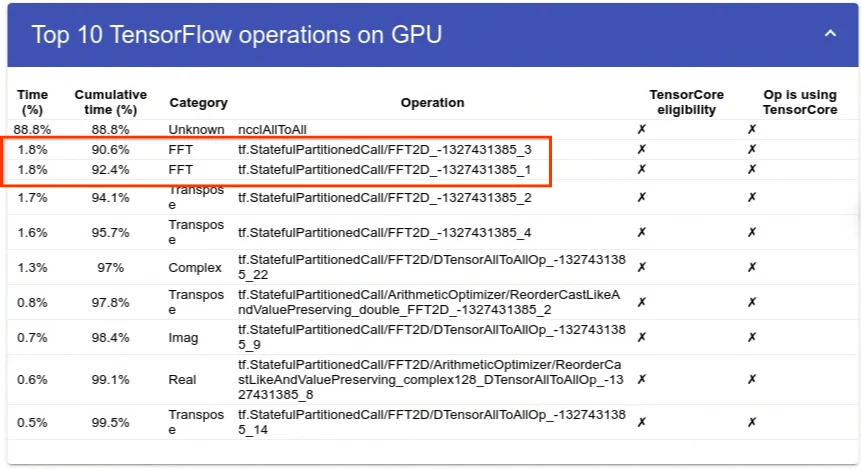
Benchmarking on an 8xV100 GPU system reveals a fascinating performance profile. In a 10K x 10K distributed FFT experiment, the actual local computation—the "math" itself—accounted for only 3.6% of the total execution time (approximately 15ms).
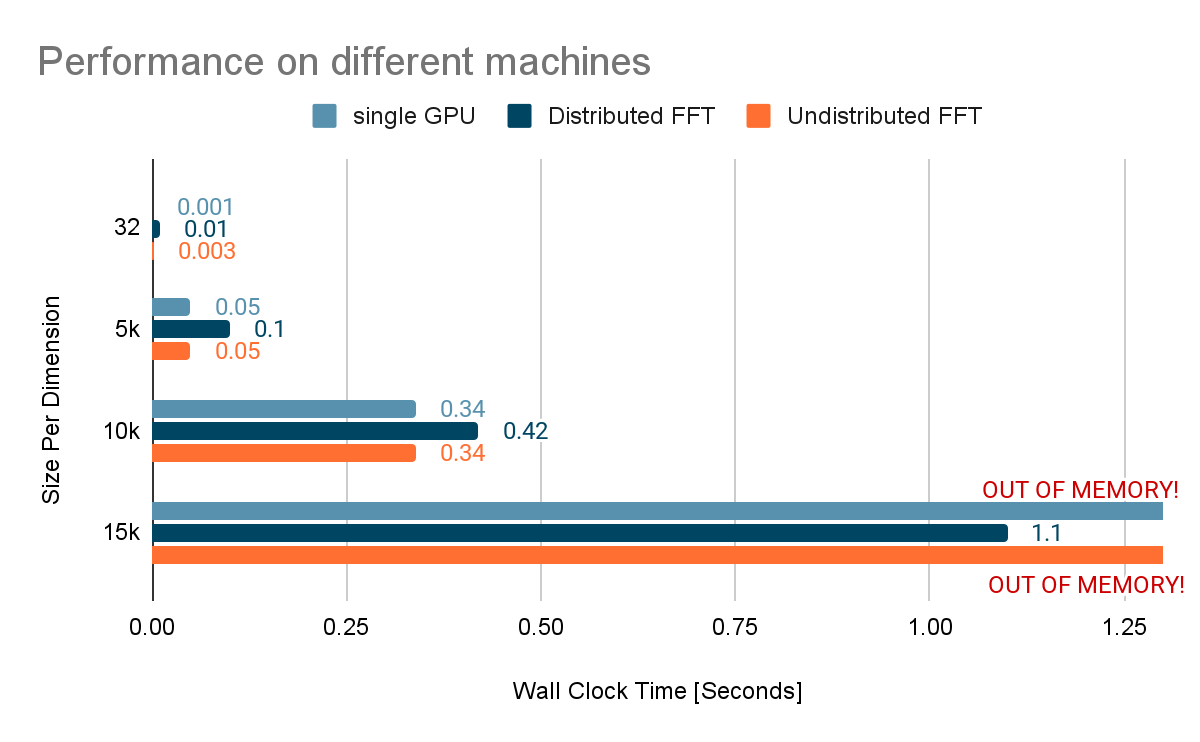
This underscores a vital reality of modern distributed computing: the primary bottleneck is no longer the raw floating-point performance of the GPUs, but the inter-device communication. The vast majority of the runtime is consumed by the ncclAllToAll operation, which facilitates the necessary data shuffles across the network. Despite this overhead, the ability to process datasets that would otherwise trigger an "Out of Memory" (OOM) error on a single device makes this a net gain for large-scale research.
Implications for Modern Machine Learning
The integration of native Distributed FFT into TensorFlow is not merely a technical upgrade; it is an enabler for a new generation of data-intensive AI research.

Solving the Memory Wall
For researchers working with 3D volumes or high-resolution atmospheric data, fitting a single tensor into the memory of a single GPU is often impossible. Distributed FFT allows these researchers to scale their input sizes linearly with the number of available accelerators, effectively allowing the "memory footprint" of the model to grow alongside the infrastructure.
Simplification of the Research Pipeline
By making distributed FFT an "out-of-the-box" experience, Google is lowering the barrier to entry for complex spectral modeling. Developers no longer need to write custom MPI-style code or rely on fragile third-party wrappers. If a model works on a single CPU, it can now be adapted to a massive distributed TPU/GPU cluster with minimal code modifications—often just by changing the Layout of the input tensor.
Impact on Model Regularization and Feature Extraction
Spectral methods are gaining renewed interest in deep learning as a means to regularize models against adversarial attacks and to extract frequency-based features that standard convolutions might miss. With native distributed support, these techniques can now be applied to massive-scale models that were previously restricted to spatial-domain operations.
Official Guidance and Future Trajectories
While the current implementation provides a robust baseline, the engineering team at Google is already looking toward optimization. The "simplest algorithm" approach was chosen for its reliability and ease of adoption, but future iterations aim to address the communication overhead identified in the performance profiling.
Optimization Strategies Under Consideration:
- Communication Overlap: Implementing techniques to overlap communication with computation, potentially hiding the latency of the
ncclAllToAllshuffle. - Adaptive Mesh Reconfiguration: Developing smarter heuristics for DTensor to choose the most efficient data layout based on the specific topology of the cluster.
- Kernel Fusing: Combining the shuffle and local FFT operations into singular, fused kernels to reduce the overhead of launching operations across the Python-C++ boundary.
A Call for Community Engagement
The TensorFlow team has explicitly requested feedback from the developer community via the TensorFlow Forum. Because Distributed FFT is a specialized tool, the real-world use cases—ranging from computational fluid dynamics to large-scale seismic analysis—will play a critical role in shaping the next generation of performance tuning.
Conclusion
The introduction of native Distributed FFT support in TensorFlow v2 represents a maturation of the framework’s distributed capabilities. By treating spectral transforms as a first-class citizen in the DTensor ecosystem, Google has provided a scalable, unified, and accessible pathway for researchers to tackle the next frontier of data-intensive AI.
While the "shuffle-heavy" nature of distributed FFT remains a challenge, the path forward is clear. By moving the complexity of distribution from the user to the framework, TensorFlow is ensuring that as datasets continue to grow in complexity and size, the tools available to process them can keep pace. As the community begins to stress-test this feature on larger and more diverse clusters, we can expect the performance profiles to sharpen, further solidifying the role of spectral analysis in the future of deep learning.